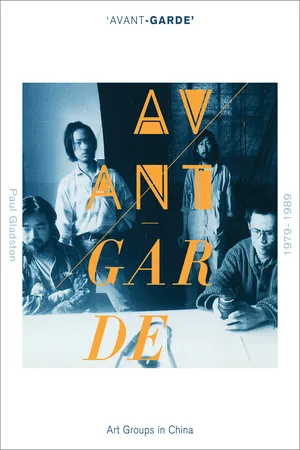
'Avant-garde' Art Groups in China gives a critical account of four of the most significant avant-garde Chinese art groups and associations of the late 1970s and '80s. It is made up largely of conversations conducted by the author with members of these organizations that provide insight into the circumstances of artistic production during the decade leading up to the Tiananmen Square Massacre of 1989. The conversations are supported by an extended introduction and other comprehensive notes that give a detailed overview of the historical circumstances under which the groups and associations developed.
The Stars group was formed as a result of the actions of two mature students at the Beijing Workers’ Cultural Centre (Beijing gongren wehhua
), Ma Desheng
and Huang Rui
. They, encouraged by views solicited from fellow students and teachers at the centre, including the artist and teacher He Baoshen
, approached government officials requesting permission to stage an exhibition of experimental art alongside China’s ‘Fifth National Art Exhibition’ (Di wu jie quanguo meizhan
) at the National Art Museum in Beijing during September 1979.
Ma and Huang’s request was turned down on the grounds that there would be no space available within the museum to house such an exhibition—a predictable outcome given the then established government policy that those exhibiting art publicly within the PRC should first gain officially approved political status and give proof of long-standing conformity to nationally codified aesthetic principles, neither of which could be claimed by Ma and Huang. Undaunted, Ma and Huang requested access to an alternative exhibition space. This request was also turned down.
In response, Ma and Huang set about organizing an unofficial exhibition of the work of 23 largely self-taught artists, including Zhong Ahcheng
, Bo Yun
, Qu Leilei
, Yan Li
, Li Shuang
, Wang Keping
, Gan Shaocheng
, Yang Yiping
, Mao Lizi
, Ai Weiwei
and Chen Yansheng
, which was staged outdoors in public space to the east of the National Museum in Beijing on 27 and 28 September 1979 with the title ‘Exhibition of the Stars’ (Xingxing meizhan
).1 Works exhibited in the exhibition, many of which were hung on street-side railings adjacent to the National Museum, included paintings, prints and wooden sculptures often produced in a distinctly amateurish manner at odds with the academic conventions of Soviet-influenced socialist-realism within the PRC. As the critic Li Xianting
writing in a contemporaneous article makes clear, works included in the Stars’ exhibition can be divided into two categories: ‘those that delved into life, and those that explored form’ (Li 2010: 11). This division of interests is also suggested by the preface to the Stars’ exhibition written by Huang Rui which states that while works by the Stars speak to the group’s ‘individual ideals,’ the group also wished to give their artistic ‘harvest back to the land, and to the people’ (Huang Rui 2010: 7–8) (Plate 1).
Berghuis suggests indirectly that the Stars’ decision to mount an unofficial outdoor exhibition may have been influenced by performance installations titled Plastic Bag Happenings in China (Zhongguo jiaodai ke binlin
), staged by the Hong Kong artist Kwok Mang-ho
, outdoors in Beijing and surrounding areas in the autumn of 1979, which, he claims, were witnessed by Huang Rui. However, the chronological relationship of the Stars’ unofficial outdoor exhibition to the staging of Kwok’s performance installations is unclear. A more likely precedent for the Stars’ unofficial exhibition is the staging of outdoor exhibitions by semi-official art groups within the PRC in the months preceding that of the Stars. These include an exhibition of the work of the Oil Painting Research Association (Youhua yanjiu hui
), which was held in Zhongshan Park (Zhongshan gongyuan
) in Beijing in February 1979, some seven months before the Stars’ first exhibition, and the Painting Exhibition of the Twelve (Shi’er ren huazhan
), which was held outdoors in Shanghai in 1978 (Köppel-Yang 2003: 59).
The unofficial outdoor exhibition of the work of the Stars attracted considerable public attention and was closed down on the orders of the Dongcheng Public Security Bureau (Dongcheng gonganju
) after only two days, on the morning of 29 September.2 According to an account by Xu Wenli
, Liu Qing
and others, titled ‘A Letter to the People’
,which was posted publicly in Beijing in October 1979, the Dongcheng Public Security Bureau mobilized ‘nearly one hundred policemen’ who ‘seized all of the exhibited works [by the Stars] left in the care of the National Gallery.’ The letter also claims that, in addition to the police, there was a ‘group of unidentified people who gathered together in an organized way to cause a commotion and to harass and abuse the exhibition’s personnel’ and that this unidentified group ‘made trouble with foreign reporters for no reason’ (Xu and Liu 2010: 8).
Immediately following the closure of the Stars’ outdoor exhibition, Ma and Huang were taken to a local police station where government officials explained the reasons for their decision: first, that, as organizers of the Stars’ exhibition, Ma and Huang had not received legally required permission from municipal and national artists associations, the Public Security Bureau and the Cultural Branch of the Beijing Municipal Government; second, that the event broke newly issued restrictions on unofficial public display known as the ‘Six Announcements’; and third, that growing interest in the exhibition posed a serious threat to public order (a significant concern to the authorities in Beijing at the time because of continuing public unrest associated with the PRC’s burgeoning Democracy Movement).
On the same day, Huang turned to his friends Bei Dao
and Mang Ke
, founding editors of the literary magazine Jintian
(Today), for advice on what action might be taken in protest against the closure of the Stars’ outdoor exhibition. As a result of Huang’s discussions with Bei and Mang, the Stars became a focus of interest for Liu Qing and Xu Wenli, founders of the underground political magazine April 5th Forum (Siwu luntan
)—the title of which refers to public protests in Beijing following the death of China’s long-serving Premier Zhou Enlai
(1898–1976) on 5 April 1976—who viewed the decision of the Dongcheng Security Bureau to close down the group’s exhibition as unconstitutional and were concerned that jurisdiction over public exhibitions of art might begin to shift dangerously awayfrom recognized government bodies to the police. In light of these concerns, Liu and Xu encouraged the Stars to demand a public apology from the Dongcheng Public Security Bureau with a deadline of 9.00am on 1 August.
In response, Ma and Huang posted two copies of a letter of public protest, one at the Democracy Wall at Xidan Street in Beijing and another at the site of the Stars’ outdoor exhibition next to the National Museum. According to Xu and Qing’s ‘A Letter to the People,’ Ma and Huang’s letter of public protest called on the Beijing Municipal Government (Beijing shi zhengfu
) to ‘redress’ the Dongcheng Bureau’s ‘mistaken behaviour’ (Xu and Liu 2010: 8–9). Ma and Huang’s letter was also taken by hand to the Confidential Communications Office (Jiyao tongxun shi
) of the Beijing Municipal Committee. During the following day, police reacted by posting their own public notices at the site of the exhibition stating that it had been taken down solely in order to safeguard public order.
Soon after the closure of their outdoor exhibition, members of the Stars were also invited to attend a meeting at the National Museum in Beijing by Liu Xun, Head of the Beijing Municipal Artists Association (Beijing shi meishujia xiehui
). Liu, who had been imprisoned for ten years as a result of his denunciation as a ‘rightist’ in 1957 and who may well have sympathized with the stand taken by the Stars, announced to the group that their exhibition would be restaged officially in mid-October 1979 at the Huafang Studio (Huafang zhai
) in Beihai Park (Beihai gongyuan
), just north of the Forbidden City in Beijing. Consequently, some members of the Stars moved their work from the National Gallery, where it had been kept under protection on the instructions of Liu Xun, to the Huafang Studio in preparation for their forthcoming exhibition there.
Despite Liu Xun’s conciliatory offer and with no response to Ma and Huang’s open letter having been received from the Beijing Municipal Committee, eight of the Stars3 then took part in a public protest against the closure of their exhibition. The protest, which had been jointly organized by Huang Rui, Bei Dao, Mang Ke, Liu Qing and Xu Wenli, began at 9.15am on 1 October with speeches at the Democracy Wall in Xidan recounting the aims of the Stars and their grievances against the Dongcheng Bureau. These speeches were then followed by a rain-sodden march through the streets of Beijing to the offices of the Beijing Municipal Committee (Plate 2).
During the march, which attracted the attention of foreign journalists gathered to report on the PRC’s National Day celebrations in Beijing on the same day, somewhere between 700 and 1000 participants took to the streets of Beijing preceded by red banners emblazoned with the slogans ‘March to Uphold the Constitution’ and ‘Political Democracy – Artistic Freedom!’ (‘Yao yishu ziyou, yao zhengzhi minzhu
).4 At Liubukuo (
), the protesters encountered a police picket-line that prevented them from marching further along Chang’an Avenue (Chang’an Jie
). Published accounts of what happened next differ. According to Zhu Zhu, the appearance of the police caused all but a very few of the protesters to disperse into Beijing’s side streets (Zhu 2007a: 25–26). However, Xu and Liu’s ‘A Letter to the People’ states that the protesters were simply diverted and carried on in an orderly fashion to their destination (Xu and Liu 2010: 10). Both Liu Qing and Xu Wenli were later arrested and imprisoned for three years as a direct consequence of their involvement in the planning of the Stars’ public protest (Berghuis 2008: 45–46). By contrast, none of Stars who took part in the protest were detained or imprisoned by the authorities.
Following their protest, the Stars were allowed to restage their first exhibition at the Huafang Studio in Beihai Park, not as initially promised in mid-October 1979, but instead between 23 November and 2 December of the same year.5 In the summer of 1980, the Stars Painters Association (Xingxing huahui
) was formally recognized by the Chinese authorities (although it could not register officially because of its continued standing as an autonomous group). With the support of another one-time ‘rightist’ ...
Table of contents
Cover Page
Title Page
Copyright
Contents
Acknowledgements
About the Author
Introduction
China’s Post-Maoist ‘Avant-garde’ in Context: Modern and Contemporary Art in China, 1911–2011
The Stars―The Northern Art Group―The Pond Association―Xiamen Dada
The Stars (Xingxing)
The Northern Art Group (Beifang yishu qunti)
The Pond Association (Chi she)
Xiamen Dada (Xiamen Dada)
References
Index
Plates
Back Page
Trusted by 375,005 students
Access to over 1.5 million titles for a fair monthly price.
Study more efficiently using our study tools.
Frequently asked questions
Yes, you can cancel anytime from the Subscription tab in your account settings on the Perlego website. Your subscription will stay active until the end of your current billing period. Learn how to cancel your subscription
No, books cannot be downloaded as external files, such as PDFs, for use outside of Perlego. However, you can download books within the Perlego app for offline reading on mobile or tablet. Learn how to download books offline
Perlego offers two plans: Essential and Complete
Essential is ideal for learners and professionals who enjoy exploring a wide range of subjects. Access the Essential Library with 800,000+ trusted titles and best-sellers across business, personal growth, and the humanities. Includes unlimited reading time and Standard Read Aloud voice.
Complete: Perfect for advanced learners and researchers needing full, unrestricted access. Unlock 1.5M+ books across hundreds of subjects, including academic and specialized titles. The Complete Plan also includes advanced features like Premium Read Aloud and Research Assistant.
Both plans are available with monthly, semester, or annual billing cycles.
We are an online textbook subscription service, where you can get access to an entire online library for less than the price of a single book per month. With over 1.5 million books across 990+ topics, we’ve got you covered! Learn about our mission
Look out for the read-aloud symbol on your next book to see if you can listen to it. The read-aloud tool reads text aloud for you, highlighting the text as it is being read. You can pause it, speed it up and slow it down. Learn more about Read Aloud
Yes! You can use the Perlego app on both iOS and Android devices to read anytime, anywhere — even offline. Perfect for commutes or when you’re on the go. Please note we cannot support devices running on iOS 13 and Android 7 or earlier. Learn more about using the app
Yes, you can access 'Avant-garde' Art Groups in China, 1979-1989 by Paul GLADSTON in PDF and/or ePUB format, as well as other popular books in History & History of Art. We have over 1.5 million books available in our catalogue for you to explore.