An antidote to the culture of fear that dominates modern life
From moral panics about immigration and gun control to anxiety about terrorism and natural disasters, Americans live in a culture of fear. While fear is typically discussed in emotional or poetic terms—as the opposite of courage, or as an obstacle to be overcome—it nevertheless has very real consequences in everyday life. Persistent fear negatively effects individuals' decision-making abilities and causes anxiety, depression, and poor physical health. Further, fear harms communities and society by corroding social trust and civic engagement. Yet politicians often effectively leverage fears to garner votes and companies routinely market unnecessary products that promise protection from imagined or exaggerated harms.
Drawing on five years of data from the Chapman Survey of American Fears—which canvasses a random, national sample of adults about a broad range of fears—Fear Itself offers new insights into what people are afraid of and how fear affects their lives. The authors also draw on participant observation with Doomsday preppers and conspiracy theorists to provide fascinating narratives about subcultures of fear.
Fear Itself is a novel, wide-ranging study of the social consequences of fear, ultimately suggesting that there is good reason to be afraid of fear itself.
eBook - ePub
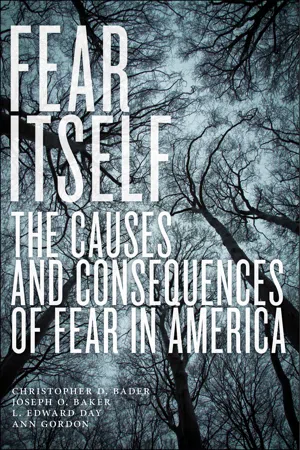
Fear Itself
The Causes and Consequences of Fear in America
- English
- ePUB (mobile friendly)
- Available on iOS & Android
eBook - ePub
Fear Itself
The Causes and Consequences of Fear in America
About this book
Information
Topic
Theology & ReligionSubtopic
Religion1
The Sum of All Fears
In December 2014, someone with the measles visited Disneyland. As reported by the Centers for Disease Control and Prevention (CDC), this infected tourist, likely from overseas, coughed or sneezed while strolling the park and exposed other vacationers and park employees to the virus. Normally, exposure to measles would not be problematic, as the MMR (measles, mumps, and rubella) vaccine is widely available in the United States. But in recent years, fear had developed among certain segments of the population that vaccinations can cause autism, stoked by the very public anti-vaccination campaign of actress Jenny McCarthy. During a 2007 appearance on Oprah Winfrey’s talk show, McCarthy espoused the belief that her son’s autism was caused by the MMR vaccine and peddled her book Louder Than Words: A Mother’s Journey in Healing Autism. Coverage of McCarthy and the claims of other “anti-vaxxers” was successful in creating skepticism about the benefits of vaccines. The CDC estimates as few as 50 percent of those exposed to the Disneyland virus had been vaccinated.
In the second wave of our survey of American fears (2015), we included a series of items designed to gauge Americans’ opinions about vaccination. We asked Americans if vaccines can cause autism, if “drug companies aren’t being honest about the risks from vaccinations,” and if, these days, American children “get too many vaccinations,” all common claims of the anti-vaccination movement.1 Distrust of what drug companies are saying about vaccinations was quite high, with more than half (52 percent) of Americans believing that drug makers are not completely disclosing vaccination risks. Nearly one-fifth of Americans (19 percent) believe there is a connection between vaccines and autism.
Curiously, public discussion about the anti-vaccination movement only served to spread myths about its adherents. In 2017, LiveScience reported that the “vast majority” of people commenting, sharing, and liking anti-vaccination information on Facebook were women.2 The state of California allows personal belief exemptions from vaccination. The Los Angeles Times found that these exemptions were used most often in “wealthy coastal and mountain communities,”3 and particularly in private schools, leading the paper to conclude that “rich, educated and stupid parents are driving the vaccination crisis.”4 The reader could be forgiven from drawing the conclusion from such coverage that the typical anti-vaxxer is a highly educated, higher income woman. But such a conclusion would be problematic at best. We can tell little about the actual demographics of anti-vaccination beliefs from Facebook postings. Online usage does not represent a random sample of Americans. Besides, women are more likely than men to use Facebook.5 Likewise, the fact that private schools see more claimed exemptions from vaccinations does not necessarily mean that higher-income individuals are more likely to hold anti-vaccination beliefs. The income relationship could be a simple function of the nature of private schools; after all, they tend to be expensive and may have characteristics (such as a religious orientation) that are associated with skepticism about vaccinations.
If we want to combat unnecessary fears based on false information, we cannot begin that quest with false information. With this purpose, we started the Chapman University Survey of American Fears (CSAF): to document what Americans fear and to understand both the characteristics of those who fear and the consequences of those fears for people’s lives. Every year we survey a new, random sample of Americans. These samples are representative of the general population, meaning that, unlike the online convenience polls we hear so much about, we can confidently make assertions that our findings represent the current state of beliefs and fears among Americans. Our findings can show us who really believes that vaccines are dangerous.
To determine patterns of anti-vaccination, we created a scale that added responses to the six questions we asked respondents about vaccinations.6 Possible scores ranged from 0 to 18. A person who received a zero on our Anti-Vaxx scale has rejected entirely the claims of the movement, strongly disagreeing that there is a link between vaccines and autism, that parents should be allowed to choose vaccinations, and so on. An individual who scored an 18 on the Anti-Vaxx scale is in complete alignment with Jenny McCarthy and other hardline vaccine skeptics, believing that children receive too many vaccinations, which provide little benefit and may cause autism.
The idea that the anti-vaccination movement was largely composed of elites makes good copy but simply does not match reality. It is a common mistake to assume that the most visible faces of a moral crusade are representative of its membership. Sociologists have long known that the leaders of movements that produce exaggerated claims about the dangers of a product or group of people are “dominated by those in the upper levels of the social structure” and not typically reflective of those who become convinced by their claims.7 After all, societal elites have greater access to the resources that will allow them to promote their claims publicly.
We performed a multivariate analysis that allows us to determine how a host of personal characteristics are associated with anti-vaccination beliefs while controlling for other related factors. We examined gender, education, income, race/ethnicity, region of the country, whether or not the respondent lives in a metro area, employment status, political conservatism and political party, and multiple indicators of religiosity.8 The average American exhibits some skepticism about vaccines, scoring a 7 on our Anti-Vaxx scale. But such beliefs precipitously decline with education. On average, a person with no formal education scores an 11 (out of 18) on our scale of anti-vaccination beliefs. Those who have achieved a bachelor’s degree are far less conspiratorial about vaccines, scoring a 6 on our scale, and those with a PhD score only 5. Income is also significantly and negatively related to anti-vaccination beliefs, with those earning less than $7,500 a year having the highest Anti-Vaxx scores and those earning $175,000 a year or more the lowest. Controlling for all these factors, gender had no effect on anti-vaccination beliefs. Men were just as likely to be skeptical about vaccines as women.
All told, the person most likely to hold anti-vaccination beliefs is a younger, politically conservative, nonwhite person of either gender who has a lower level of income and education. The problem of anti-vaccination is not an issue of too much education but, rather, too little. To combat such beliefs, policy makers will need to invest more heavily in public education, particularly science-based public education.
Ultimately, 145 people in the United States and dozens more in Canada and Mexico contracted measles from “patient x’s” visit to Disneyland in 2014.9 It could have been much worse. By April, no new cases had been reported, and no one had died from their exposure. Yet the incident highlights the key role fears play in American society. We often find ourselves in crises of our own making, situations simultaneously created and exacerbated by our fears. The first step in addressing some of the social problems caused by fear is a clear understanding of who fears what and why based on high-quality data.
Fear Factors
Our surveys asked Americans about dozens of specific fears, ranging from fear of sharks to nuclear attacks and running out of money. Exploring the demographic patterns behind each of these fears individually would be unnecessarily tedious; however, many of these specific fears are about similar underlying concepts. For instance, we asked respondents how much they fear the pollution of drinking water, the pollution of oceans and lakes, the extinction of plants and animals, oil spills, and global warming. Although it is certainly possible that some individuals, because of where they live or life circumstances, might fear the pollution of their drinking water but have little concern about the other items, for most respondents, views on these issues are likely to be closely related. Someone fearful about oil spills probably worries about ocean pollution too. We used factor analysis to look for such patterns in our data.10 If respondents answered in a similar way to a selection of items, factor analysis will group them together. Our analysis determined that the myriad of fears could be collapsed into 11 major “fear factors” (see Table 1.1), ranging from the fear of crime and victimization to the fear of technology, as well as fears about sharks, clowns, ghosts, and other animals/entities.
Divided by Fear
Fears often reflect social and political...
Table of contents
- Cover
- Title Page
- Copyright
- Dedication
- Contents
- Foreword
- Introduction
- 1. The Sum of All Fears
- 2. Things Are Not What They Seem
- 3. Apocalypse How? Fear of Natural, Environmental, and Human-Made Disasters
- 4. Beyond Contagion: Terrorism, the Media, and Public Fear
- 5. Visions of Crime: How the Media, Satan, and Social Factors Shape Fears of Crime
- 6. Consequences of Fear
- Conclusion: Where Do We Go from Fear?
- Acknowledgments
- Notes
- References
- Index
- About the Authors
Trusted by 375,005 students
Access to over 1.5 million titles for a fair monthly price.
Study more efficiently using our study tools.
Frequently asked questions
Yes, you can cancel anytime from the Subscription tab in your account settings on the Perlego website. Your subscription will stay active until the end of your current billing period. Learn how to cancel your subscription
No, books cannot be downloaded as external files, such as PDFs, for use outside of Perlego. However, you can download books within the Perlego app for offline reading on mobile or tablet. Learn how to download books offline
We are an online textbook subscription service, where you can get access to an entire online library for less than the price of a single book per month. With over 1.5 million books across 990+ topics, we’ve got you covered! Learn about our mission
Look out for the read-aloud symbol on your next book to see if you can listen to it. The read-aloud tool reads text aloud for you, highlighting the text as it is being read. You can pause it, speed it up and slow it down. Learn more about Read Aloud
Yes! You can use the Perlego app on both iOS and Android devices to read anytime, anywhere — even offline. Perfect for commutes or when you’re on the go.
Please note we cannot support devices running on iOS 13 and Android 7 or earlier. Learn more about using the app
Please note we cannot support devices running on iOS 13 and Android 7 or earlier. Learn more about using the app
Yes, you can access Fear Itself by Christopher D. Bader,Joseph O. Baker,L. Edward Day,Ann Gordon in PDF and/or ePUB format, as well as other popular books in Theology & Religion & Religion. We have over 1.5 million books available in our catalogue for you to explore.