- English
- ePUB (mobile friendly)
- Available on iOS & Android
eBook - ePub
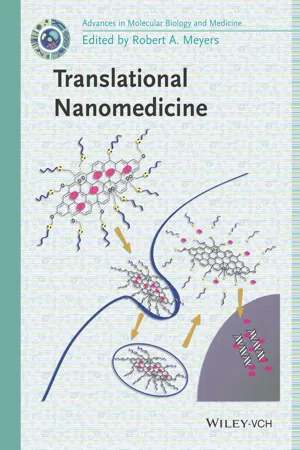
Translational Nanomedicine
About this book
The largest high-level encyclopedia on molecular medicine is now publishing a topical volume on Nanomedicine. The long awaited volume gives a comprehensive overview on nanomaterials in drug delivery, imaging and as therapeutics.
Information
Part I
Laboratory Techniques Translational
1
Microfluidics in Nanomedicine
YongTae Kim1 and Robert Langer2
1Georgia Institute of Technology, George W. Woodruff School of Mechanical Engineering, Wallace H. Coulter Department of Biomedical Engineering, Institute for Electronics and Nanotechnology, Parker H. Petit Institute for Bioengineering and Bioscience, 345 Ferst Drive, Atlanta, GA 30318, USA
2Massachusetts Institute of Technology, Department of Chemical Engineering, Harvard-MIT Division of Health Sciences and Technology, David H. Koch Institute for Integrative Cancer Research, 500 Main Street, Cambridge,MA 02139, USA
- 1 Introduction
- 1.1 Nanomedicine Development
- 1.2 Microfluidics Technology
- 2 Microfluidic Assembly of Nanomedicines
- 3 Microfluidic Characterization of Nanomedicines
- 4 Microfluidic Evaluation of Nanomedicines
- 4.1 Mimicking Physiological Environments
- 4.2 Endothelial Cell Systems
- 4.3 “Organ‐On‐A‐Chip”
- 4.4 Renal Toxicity and Hepatotoxicity
- 4.5 Live Tissue Explants
- 4.6 Intact Organisms
- 5 Challenges and Opportunities
- 6 Concluding Remarks
- Acknowledgments
- References
Keywords
Microfluidics
The science and technology that involves the manipulation of nanoscale amounts of fluids in microscale fluidic channels for applications that include chemical synthesis, and biological analysis and engineering.
Nanotechnology
The manipulation of matter on atomic and molecular scales.
Nanomedicine
The medical application of nanotechnology for the advanced diagnosis, treatment and prevention of a number of diseases.
Biomimetic microsystem
A microscale device that mimics biological systems and is used to probe complex human problems.
Clinical translation
Clinical translation involves the application of discoveries made in the laboratory to diagnostic tools, medicines, procedures, policies and education, in order to improve the health of individuals and the community.
Nanomedicine is the medical application of nanotechnology for the treatment and prevention of major ailments, including cancer and cardiovascular diseases. Despite the progress and potential of nanomedicines, many such materials fail to reach clinical trials due to critical challenges that include poor reproducibility in high‐volume production that have led to failure in animal studies and clinical trials. Recent approaches using microfluidic technology have provided emerging platforms with great potential to accelerate the clinical translation of nanomedicine. Microfluidic technologies for nanomedicine development are reviewed in this chapter, together with a detailed discussion of microfluidic assembly, characterization and evaluation of nanomedicine, and a description of current challenges and future prospects.
1
Introduction
Nanomedicine4 is the medical application of nanotechnology that uses engineered nanomaterials for the robust delivery of therapeutic and diagnostic agents in the advanced treatment of many diseases, including cancer [1–3], atherosclerosis [4–6], diabetes [7–9], pulmonary diseases [10 11] and disorders of the central nervous system [12 13]. One key advantage of nanomedicine is the ability to deliver poorly water‐soluble drugs [14–16] or plasma‐sensitive nucleic acids (e.g., small interfering (si)RNA [17 18]) into the circulation with enhanced stability. Nanomedicine is also capable of providing contrast agents for different imaging modalities and the targeting of specific sites for the delivery of drugs and/or genes [19–23]. Engineered nanomaterials, developed as particulates that are widely referred to as nanoparticles (NPs), have been formulated using a variety of materials that includes lipids, polymers, inorganic nanocrystals, carbon nanotubes, proteins, and DNA origami [24–36]. The ultimate goal of nanomedicine is to achieve a robust, targeted delivery of complex assemblies that contain sufficient amounts of multiple therapeutic and diagnostic agents for highly localized drug release, but with no adverse side effects [37 38], and a reliable detection of any site‐specific therapeutic response [39 40].
1.1
Nanomedicine Development
Typical nanomedicine development processes for the clinical translation include benchtop syntheses, characterizations, in‐vitro evaluations, in‐vivo evaluations with animal models, and scaled‐up production in readiness for clinical trials. Although, previously, several NPs have been reported as superior platforms, many are still far from their first stages of patient clinical trials due to several critical challenges [41 42]. Such challenges mainly result from batch‐to‐batch variations of NPs produced in the benchtop synthesis process, and from insignificant outcomes in the in‐vitro evaluation process under physiologically irrelevant conditions. These limitations ultimately lead to highly variable results in the in‐vivo evaluation, or to failure in clinical trials. In order to address these challenges, the following methodologies need to be established in the nanomedicine development process:
- Nanomedicine needs to be continuously produced in a high‐throughput fashion. The large‐scale, continuous production of nanomedicines will allow a robust supply of highly reproducible materials for the in‐vitro and in‐vivo evaluation stages and clinical trials, ultimately increasing the success rate in clinical trials.
- Nanomedicines synthesized using large‐scale, continuous production methods also need to be characterized in a high‐throughput manner. Rapid characterization will create an efficient production cycle for an optimized nanomedicine via feedback loops between the synthesis and characterization stages.
- The in‐vitro evaluation of nanomedicine must be conducted in more physiologically relevant environments. Highly repeatable results obtained from these biomimetic conditions will allow the obviation of a number of simple screening experiments in animal studies, not only saving costly animal models but also accelerating the clinical translation.
1.2
Microfluidics Technology
Microfluidics technology provides highly comp...
Table of contents
- Cover
- Table of Contents
- Preface
- Part I: Laboratory TechniquesTranslational
- Part II: Devices
- Part III: Pharmaceutical Delivery
- Part IV: Cancer
- Part V: Tissue Engineering and Regeneration
- Index
- End User License Agreement
Trusted by 375,005 students
Access to over 1.5 million titles for a fair monthly price.
Study more efficiently using our study tools.
Frequently asked questions
Yes, you can cancel anytime from the Subscription tab in your account settings on the Perlego website. Your subscription will stay active until the end of your current billing period. Learn how to cancel your subscription
No, books cannot be downloaded as external files, such as PDFs, for use outside of Perlego. However, you can download books within the Perlego app for offline reading on mobile or tablet. Learn how to download books offline
Perlego offers two plans: Essential and Complete
- Essential is ideal for learners and professionals who enjoy exploring a wide range of subjects. Access the Essential Library with 800,000+ trusted titles and best-sellers across business, personal growth, and the humanities. Includes unlimited reading time and Standard Read Aloud voice.
- Complete: Perfect for advanced learners and researchers needing full, unrestricted access. Unlock 1.5M+ books across hundreds of subjects, including academic and specialized titles. The Complete Plan also includes advanced features like Premium Read Aloud and Research Assistant.
We are an online textbook subscription service, where you can get access to an entire online library for less than the price of a single book per month. With over 1.5 million books across 990+ topics, we’ve got you covered! Learn about our mission
Look out for the read-aloud symbol on your next book to see if you can listen to it. The read-aloud tool reads text aloud for you, highlighting the text as it is being read. You can pause it, speed it up and slow it down. Learn more about Read Aloud
Yes! You can use the Perlego app on both iOS and Android devices to read anytime, anywhere — even offline. Perfect for commutes or when you’re on the go.
Please note we cannot support devices running on iOS 13 and Android 7 or earlier. Learn more about using the app
Please note we cannot support devices running on iOS 13 and Android 7 or earlier. Learn more about using the app
Yes, you can access Translational Nanomedicine by Robert A. Meyers in PDF and/or ePUB format, as well as other popular books in Physical Sciences & Nanoscience. We have over 1.5 million books available in our catalogue for you to explore.