Human Drug Metabolism
eBook - ePub

Human Drug Metabolism

  1. English
  2. ePUB (mobile friendly)
  3. Available on iOS & Android
eBook - ePub

Human Drug Metabolism

About this book

Provides a timely update to a key textbook on human drug metabolism

The third edition of this comprehensive book covers basic concepts of teaching drug metabolism, starting from extreme clinical consequences to systems and mechanisms and toxicity. It provides an invaluable introduction to the core areas of pharmacology and examines recent progress and advances in this fast moving field and its clinical impact.

Human Drug Metabolism, 3rd Edition begins by covering basic concepts such as clearance and bioavailability, and looks at the evolution of biotransformation, and how drugs fit into this carefully managed biological environment. More information on how cytochrome P450s function and how they are modulated at the sub-cellular level is offered in this new edition. The book also introduces helpful concepts for those struggling with the relationship of pharmacology to physiology, as well as the inhibition of biotransformational activity. Recent advances in knowledge of a number of other metabolizing systems are covered, including glucuronidation and sulphation, along with the main drug transporters. Also, themes from the last edition are developed in an attempt to chart the progress of personalized medicine from concepts towards practical inclusion in routine therapeutics. The last chapter focuses on our understanding of how and why drugs injure us, both in predictable and unpredictable ways. Appendix A highlights some practical approaches employed in both drug metabolism research and drug discovery, whilst Appendix B outlines the metabolism of some drugs of abuse. Appendix C advises on formal examination preparation and Appendix D lists some substrates, inducers and inhibitors of the major human cytochrome P450s.

  • Fully updated to reflect advances in the scientific field of drug metabolism and its clinical impact
  • Reflects refinements in the author's teaching method, particularly with respect to helping students understand biological systems and how they operate
  • Illustrates the growing relationship between drug metabolism and personalized medicine
  • Includes recent developments in drug discovery, genomics, and stem cell technologies

Human Drug Metabolism, 3rd Edition is an excellent book for advanced undergraduate and graduate students in molecular biology, biochemistry, pharmacology, pharmacy, and toxicology. It will also appeal to professionals interested in an introduction to this field, or who want to learn more about these bench-to-bedside topics to apply it to their practice.
Frequently asked questions

Yes, you can cancel anytime from the Subscription tab in your account settings on the Perlego website. Your subscription will stay active until the end of your current billing period. Learn how to cancel your subscription.
No, books cannot be downloaded as external files, such as PDFs, for use outside of Perlego. However, you can download books within the Perlego app for offline reading on mobile or tablet. Learn more here.
Perlego offers two plans: Essential and Complete
  • Essential is ideal for learners and professionals who enjoy exploring a wide range of subjects. Access the Essential Library with 800,000+ trusted titles and best-sellers across business, personal growth, and the humanities. Includes unlimited reading time and Standard Read Aloud voice.
  • Complete: Perfect for advanced learners and researchers needing full, unrestricted access. Unlock 1.4M+ books across hundreds of subjects, including academic and specialized titles. The Complete Plan also includes advanced features like Premium Read Aloud and Research Assistant.
Both plans are available with monthly, semester, or annual billing cycles.
We are an online textbook subscription service, where you can get access to an entire online library for less than the price of a single book per month. With over 1 million books across 1000+ topics, we’ve got you covered! Learn more here.
Look out for the read-aloud symbol on your next book to see if you can listen to it. The read-aloud tool reads text aloud for you, highlighting the text as it is being read. You can pause it, speed it up and slow it down. Learn more here.
Yes! You can use the Perlego app on both iOS or Android devices to read anytime, anywhere — even offline. Perfect for commutes or when you’re on the go.
Please note we cannot support devices running on iOS 13 and Android 7 or earlier. Learn more about using the app.
Yes, you can access Human Drug Metabolism by Michael D. Coleman in PDF and/or ePUB format, as well as other popular books in Biological Sciences & Molecular Biology. We have over one million books available in our catalogue for you to explore.

Information

1
Introduction

1.1 Therapeutic window

1.1.1 Introduction

It has been said that if a drug has no side effects, then it is unlikely to work. Drug therapy labours under the fundamental problem that usually every single cell in the body has to be treated just to exert a beneficial effect on a small group of cells, perhaps in one tissue. Although drug‐targeting technology is improving rapidly, most of us who take an oral dose are still faced with the problem that the vast majority of our cells are being unnecessarily exposed to an agent that at best will have no effect, but at worst will exert many unwanted effects. Essentially, all drug treatment is really a compromise between positive and negative effects in the patient. The process of drug development weeds out agents that have seriously negative actions and usually releases onto the market drugs that may have a profile of side effects, but these are relatively minor within a set concentration range where the drug’s pharmacological action is most effective. This range, or therapeutic window, is rather variable, but it will give some indication of the most ‘efficient’ drug concentration. This effectively means the most beneficial pharmacodynamic effects for the minimum side effects.
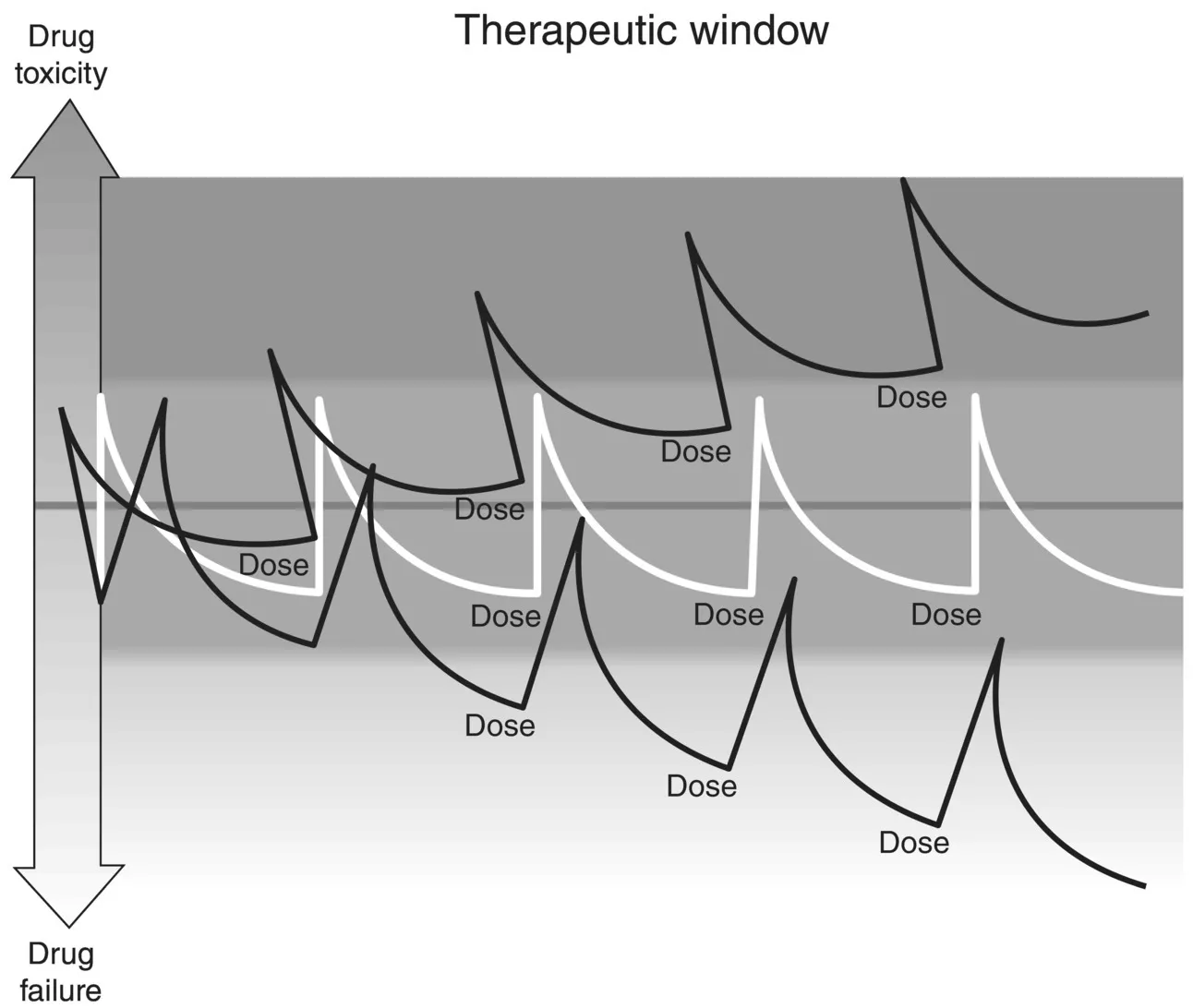
The therapeutic window (Figure 1.1) may or may not correspond exactly to active tissue concentrations, but it is a useful guideline as to whether drug levels are within the appropriate range. Sometimes, a drug is given once only and it is necessary for drug levels to be within the therapeutic window for a relatively brief period, perhaps when paracetamol (acetaminophen) is taken as a mild analgesic. However, the majority of drugs require repeated dosing in time periods that range from a few days for a course of antibiotics, to many years for anti‐hypertensives and antithyroid drugs. During repeated intermediate and long‐term dosing, drug levels may move below or above the therapeutic window due to events such as patient illness, changes in diet, or co‐administration of other drugs. Below the lowest concentration of the window, it is likely that the drug will fail to work, as the pharmacodynamic effect will be too slight to be beneficial. If the drug concentration climbs above the therapeutic window, an intensification of the drug’s intended and unintended (off‐target) pharmacodynamic actions will occur. If drug levels continue to rise, significant adverse effects may ensue which can lead to distress, incapacitation or even death. To some extent, every patient has a unique therapeutic window for each drug they take, as there is such huge variation in our pharmacodynamic drug sensitivities. This book is concerned with what systems influence how long a drug stays in our bodies.
Therapeutic window displaying three sawtooth waveforms (ascending, horizontal, and descending) with a vertical two-headed arrow at the left with arrowheads for drug toxicity (top) and drug failure (bottom).
Figure 1.1 The therapeutic window, where drug concentrations should be maintained for adequate therapeutic effect, without either accumulation (drug toxicity) or disappearance (drug failure). Such is human variation that our personal therapeutic windows are effectively unique for every drug we take
Whether drug concentrations stay in the therapeutic window is obviously related to how quickly the agent enters the blood and tissues prior to its removal. When a drug is given intravenously, there is no barrier to entry, so drug input may be easily and quickly adjusted to correspond with the rate of removal within the therapeutic window. This is known as steady state, which is the main objective of therapeutics. The majority of drug use is by other routes such as oral or intramuscular rather than intravenous, so there will be a considerable time lag as the drug is absorbed from either the gastrointestinal tract (GIT) or the muscle, so achieving drug levels within the therapeutic window is a slower, more ‘hit and miss’ process. The result from repeated oral dosing is a rather crude peak/trough pulsing, or ‘sawtooth’ effect, which you can see in Figure 1.1. This should be adequate, provided that the peaks and troughs remain within the confines of the therapeutic window.

1.1.2 Therapeutic index

Drugs vary enormously in their toxicity and indeed, the word toxicity has a number of potential meanings. Broadly, it is usually accepted that toxicity equates with harm to the individual. However, ‘harm’ could describe a range of impacts to the individual from mild to severe, or reversible to irreversible, in any given time frame. There is a detailed discussion on what constitutes toxicity in Chapter 8 (sections 2 and 3), but for the meantime, the broad process of harm might begin with supra‐therapeutic ‘pharmacological’ reversible effects, progressing through to irreversible, damaging toxic effects with ascending dosage. Indeed, the concentrations at which one drug might cause potentially harmful or even lethal effects might be 10 to 1000 times lower than a much less toxic drug. A convenient measure for this is the therapeutic index (TI). This has been defined as the ratio between the lethal or toxic dose and the effective dose that shows the normal range of pharmacological effect.
In practice, a drug like lithium, for example, is listed as having a narrow TI if there is twofold or less difference between the lethal and effective doses, or a twofold difference in the minimum toxic and minimum effective concentrations. Back in the 1960s, many drugs in common use had narrow TIs, such as barbiturates, that could be toxic at relatively low levels. Since the 1970s, the drug industry has aimed to replace this type of drug with agents with much wider TIs. This is particularly noticeable in drugs used for depression. The risk of suicide is likely to be high in a condition that takes some time (often several weeks) to respond to therapy. Indeed, when tricyclic antidepressants (TCAs) were the main treatment option, these relatively narrow TI drugs could be used by the patient to end their lives. Fortunately, more modern drugs such as the SSRIs (selective serotonin reuptake inhibitors) have much wider TIs, so the risk of the patient using the drugs for a suicide attempt is greatly diminished. However, many drugs (including the TCAs to a limited extent) remain in use that have narrow or relatively narrow TIs (e.g. phenytoin, carbamazepine, valproate, warfarin). Therefore, the consequences of accumulation of these drugs are much worse and happen more quickly than drugs with wide TIs.

1.1.3 Changes in dosage

If the dosage exceeds the rate of the drug’s removal, then clearly drug levels will accumulate and depart from the therapeutic window towards potential harm to the patient. If the drug dosage is too low, levels will fall below the lowest threshold of the window and the drug will fail to work. If a patient continues to respond well at the same oral dose, then this is effectively the oral version of steady state. So, theoretically, the drug should remain in its therapeutic window at this ‘correct’ dosage for as long as therapy is necessary unless other factors change this situation.

1.1.4 Changes in rate of removal

The patient may continue to take the drug at the correct dosage, but at some point drug levels may drop out of, or alternatively exceed, the therapeutic window. This could be linked with redistribution of the drug between bodily areas such as plasma and a particular organ, or protein binding might fluctuate; however, provided dosage is unchanged, significant fluctuation in drug levels within the therapeutic window will be due to change in the rate of removal and/or inactivation of the drug by active bodily processes.

1.2 Consequences of drug concentration changes

If there are large changes in the rate of removal of a drug, then this can lead in extremis to severe problems in the outcome of the patient’s treatment: the first is drug failure, whilst the second is the drug causing harm (Figure 1.2). These extremes and indeed all drug effects are directly related to the bloo...

Table of contents

  1. Cover
  2. Table of Contents
  3. Preface
  4. 1 Introduction
  5. 2 Drug Biotransformational Systems – Origins and Aims
  6. 3 How Oxidative Systems Metabolise Substrates
  7. 4 Induction of Cytochrome P450 Systems
  8. 5 Cytochrome P450 Inhibition
  9. 6 Conjugation and Transport Processes
  10. 7 Factors Affecting Drug Metabolism
  11. 8 Role of Metabolism in Drug Toxicity
  12. Appendix A: Appendix ADrug Metabolism in Drug DiscoveryDrug Metabolism in Drug Discovery
  13. Appendix B: Appendix BMetabolism of Major Illicit DrugsMetabolism of Major Illicit Drugs
  14. Appendix C: Appendix CExamination TechniquesExamination Techniques
  15. Appendix D: Appendix DSummary of Major CYP Isoforms and Their Substrates, Inhibitors, and InducersSummary of Major CYP Isoforms and Their Substrates, Inhibitors, and Inducers
  16. Index
  17. End User License Agreement