Mindset Mathematics: Visualizing and Investigating Big Ideas, Grade 8
eBook - ePub

Mindset Mathematics: Visualizing and Investigating Big Ideas, Grade 8

  1. English
  2. ePUB (mobile friendly)
  3. Available on iOS & Android
eBook - ePub

Mindset Mathematics: Visualizing and Investigating Big Ideas, Grade 8

About this book

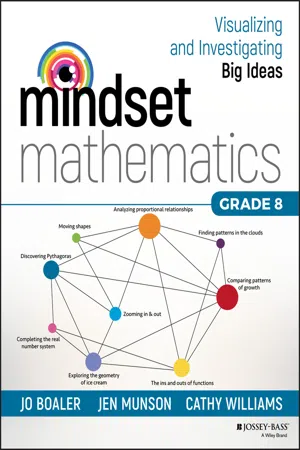
Engage students in mathematics using growth mindset techniques

The most challenging parts of teaching mathematics are engaging students and helping them understand the connections between mathematics concepts. In this volume, you'll find a collection of low floor, high ceiling tasks that will help you do just that, by looking at the big ideas at the eighth-grade level through visualization, play, and investigation.

During their work with tens of thousands of teachers, authors Jo Boaler, Jen Munson, and Cathy Williams heard the same message—that they want to incorporate more brain science into their math instruction, but they need guidance in the techniques that work best to get across the concepts they needed to teach. So the authors designed Mindset Mathematics around the principle of active student engagement, with tasks that reflect the latest brain science on learning. Open, creative, and visual math tasks have been shown to improve student test scores, and more importantly change their relationship with mathematics and start believing in their own potential. The tasks in Mindset Mathematics reflect the lessons from brain science that:

  • There is no such thing as a math person - anyone can learn mathematics to high levels.
  • Mistakes, struggle and challenge are the most important times for brain growth.
  • Speed is unimportant in mathematics.
  • Mathematics is a visual and beautiful subject, and our brains want to think visually about mathematics.

With engaging questions, open-ended tasks, and four-color visuals that will help kids get excited about mathematics, Mindset Mathematics is organized around nine big ideas which emphasize the connections within the Common Core State Standards (CCSS) and can be used with any current curriculum.

Frequently asked questions

Yes, you can cancel anytime from the Subscription tab in your account settings on the Perlego website. Your subscription will stay active until the end of your current billing period. Learn how to cancel your subscription.
No, books cannot be downloaded as external files, such as PDFs, for use outside of Perlego. However, you can download books within the Perlego app for offline reading on mobile or tablet. Learn more here.
Perlego offers two plans: Essential and Complete
  • Essential is ideal for learners and professionals who enjoy exploring a wide range of subjects. Access the Essential Library with 800,000+ trusted titles and best-sellers across business, personal growth, and the humanities. Includes unlimited reading time and Standard Read Aloud voice.
  • Complete: Perfect for advanced learners and researchers needing full, unrestricted access. Unlock 1.4M+ books across hundreds of subjects, including academic and specialized titles. The Complete Plan also includes advanced features like Premium Read Aloud and Research Assistant.
Both plans are available with monthly, semester, or annual billing cycles.
We are an online textbook subscription service, where you can get access to an entire online library for less than the price of a single book per month. With over 1 million books across 1000+ topics, we’ve got you covered! Learn more here.
Look out for the read-aloud symbol on your next book to see if you can listen to it. The read-aloud tool reads text aloud for you, highlighting the text as it is being read. You can pause it, speed it up and slow it down. Learn more here.
Yes! You can use the Perlego app on both iOS or Android devices to read anytime, anywhere — even offline. Perfect for commutes or when you’re on the go.
Please note we cannot support devices running on iOS 13 and Android 7 or earlier. Learn more about using the app.
Yes, you can access Mindset Mathematics: Visualizing and Investigating Big Ideas, Grade 8 by Jo Boaler,Jen Munson,Cathy Williams in PDF and/or ePUB format, as well as other popular books in Education & Teaching Mathematics. We have over one million books available in our catalogue for you to explore.

Information

Publisher
Jossey-Bass
Year
2019
Print ISBN
9781119358749
eBook ISBN
9781119358848
Edition
1

BIG IDEA 1
Moving Shapes

In this book, we focus on a set of big ideas that extend across the eighth-grade curriculum, bringing in a greater focus on geometrical thinking. Geometry has been a neglected part of the eighth-grade curriculum for some time.
Ginsberg, Cooke, Leinwand, Noell, and Pollock (2005) investigated US students’ geometrical experiences, looking at the international tests TIMSS and PISA, and found that US students spend 50% less time on geometry than students in other countries. Not surprisingly given this lack of attention, students’ achievement in these areas was also significantly lower than students in other countries (Driscoll, DiMatteo, Nikula, & Egan, 2007).
Many teachers and students associate geometry with rules, remembering their high school years reproducing two-column proofs. This is the unfortunate outcome of a misguided approach to mathematics, when important ideas are lost as mathematical thinking is reduced to a set of rules. What is more critical to geometry is reasoning and adaptability. In this big idea, we introduce the ideas of congruence and similarity. Rather than just learning definitions for these, students look at cases and consider deeply the question, How do we know if two shapes are congruent or similar? Definitions play a part, but the most important act is reasoning; students should be encouraged to consider such questions as, What do we know now about this shape? What else do we need to know? Can I move or adapt my shape to give me more information? Can I convince someone else that my shapes are similar or congruent? What would I use to convince them? A great starting discussion for this sequence of lessons would be the question, What does it mean to be the same? Transformational geometry, congruence, and similarity are key ideas. We have chosen to focus our attention on triangles, the building blocks of geometric shapes and the coordinate plane, an important visual space for algebra.
In the Visualize activity, students are asked to consider the question, How do we know when two figures are the same? We ask students to study triangles where their vertices are provided. As students plot the points and connect the vertices with segments, they are asked to determine which triangles are congruent. We have created triangles that are congruent but may not appear so because they have been rotated and flipped. Others combine to make a triangle. Students can hone their detective skills by investigating each set. Students explore the key ideas visually.
In the Play activity, students are asked to transform shapes, rotating and reflecting them. We think that students will enjoy working out how one shape turns into another, developing patterns that explain the transformations. This is the work of computer animation, which has been important to the cartoon filmmaking industry for many years. Students will be given the opportunity to create their own puzzle transformations, which they can share with each other.
The Investigate activity provides students the experience of continuous transformations that are repeated over and over again. Students will be invited to design their own shape and think about what happens when they repeat the same transformation on the shape. In doing so, they will become pattern creators, which we hope they will find exciting. The work will help them understand what happens when transformations happen continuously, and the patterns that can result.
Jo Boaler

References

  1. Driscoll, M. J., DiMatteo, R. W., Nikula, J., & Egan, M. (2007). Fostering geometric thinking: A guide for teachers, grades 5–10. Portsmouth, NH: Heinemann.
  2. Ginsburg, A., Cooke, G., Leinwand, S., Noell, J., & Pollock, E. (2005). Reassessing U.S. international mathematics performance: New findings from the 2003 TIMSS and PISA. Washington, DC: American Institutes for Research and Department of Education.

What Does It Mean to Be the Same?

Snapshot

image
Using a set of coordinate pairs that describ...

Table of contents

  1. Cover
  2. Table of Contents
  3. Introduction
  4. Note on Materials
  5. Activities for Building Norms
  6. BIG IDEA 1: Moving Shapes
  7. BIG IDEA 2: Zooming In and Out
  8. BIG IDEA 3: Analyzing Proportional Relationships
  9. BIG IDEA 4: Comparing Patterns of Growth
  10. BIG IDEA 5: The Ins and Outs of Functions
  11. BIG IDEA 6: Finding Patterns in the Clouds
  12. BIG IDEA 7: Completing the Real Number System
  13. BIG IDEA 8: Discovering Pythagoras
  14. BIG IDEA 9: Exploring the Geometry of Ice Cream
  15. Appendix
  16. About the Authors
  17. Acknowledgments
  18. Index
  19. End User License Agreement