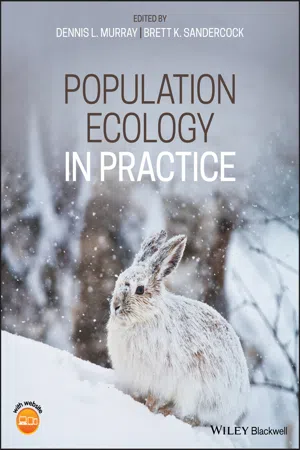
Population Ecology in Practice
- English
- ePUB (mobile friendly)
- Available on iOS & Android
Population Ecology in Practice
About this book
A synthesis of contemporary analytical and modeling approaches in population ecology
The book provides an overview of the key analytical approaches that are currently used in demographic, genetic, and spatial analyses in population ecology. The chapters present current problems, introduce advances in analytical methods and models, and demonstrate the applications of quantitative methods to ecological data. The book covers new tools for designing robust field studies; estimation of abundance and demographic rates; matrix population models and analyses of population dynamics; and current approaches for genetic and spatial analysis. Each chapter is illustrated by empirical examples based on real datasets, with a companion website that offers online exercises and examples of computer code in the R statistical software platform.
- Fills a niche for a book that emphasizes applied aspects of population analysis
- Covers many of the current methods being used to analyse population dynamics and structure
- Illustrates the application of specific analytical methods through worked examples based on real datasets
- Offers readers the opportunity to work through examples or adapt the routines to their own datasets using computer code in the R statistical platform
Population Ecology in Practice is an excellent book for upper-level undergraduate and graduate students taking courses in population ecology or ecological statistics, as well as established researchers needing a desktop reference for contemporary methods used to develop robust population assessments.
Frequently asked questions
- Essential is ideal for learners and professionals who enjoy exploring a wide range of subjects. Access the Essential Library with 800,000+ trusted titles and best-sellers across business, personal growth, and the humanities. Includes unlimited reading time and Standard Read Aloud voice.
- Complete: Perfect for advanced learners and researchers needing full, unrestricted access. Unlock 1.4M+ books across hundreds of subjects, including academic and specialized titles. The Complete Plan also includes advanced features like Premium Read Aloud and Research Assistant.
Please note we cannot support devices running on iOS 13 and Android 7 or earlier. Learn more about using the app.
Information
Part I
Tools for Population Biology
1
How to Ask Meaningful Ecological Questions
Summary
I present and discuss four rules for asking good ecological questions:
- Rule No. 1. Understand the successes and failures from ecological history but do not let this knowledge become a straitjacket.
- Rule No. 2. Develop and define a series of multiple alternative hypotheses and explicitly state what each hypothesis predicts and what it forbids.
- Rule No. 3. Seek generality from your hypotheses and experiments but distrust it.
- Rule No. 4. If your research has policy implications, read the social science literature about how scientific information and policy decisions interface.
Meaningful questions in population ecology address theoretical issues or management questions that demand a solution. The solution should be looked for among a set of multiple working hypotheses. If you have only one hypothesis with no alternatives, there is nothing to do. The classical null hypothesis in a statistical sense is not an alternative hypothesis in which population ecology is interested. Given a question, the possible outcomes of the study should be noted before any field work is carried out, and an interpretation given of what each possible result means in terms of basic theory or applied management. The most useful questions often have multiple dimensions and apply to more than one taxonomic group. Once you have an important question formulated with alternative hypotheses, you must discuss the critical aspects of the experimental design – replication, randomization, treatments, and controls. How many replicates are needed over what landscape units? How long a study is required? How often do you need to sample? Will the confidence limits of any estimates be narrow or wide? If the proposed steps are not followed, it is possible to get lost in the mechanical details of a study without knowing clearly how the outcome will reflect back on the original questions. Serendipity may rescue poorly conceived studies, but the probability of this event may be less than P < 0.01. Management and conservation problems demand both good data and effective policy development. Ecologists need to become more proactive in providing solutions to politicians and business leaders who develop policy options with ecological consequences.
1.1 What Problems Do Population Ecologists Try to Solve?
- Rule No. 1. Understand the successes and failures from ecological history but do not let this knowledge become a straitjacket.
Table of contents
- Cover
- Table of Contents
- Contributors
- Preface
- About the Companion Website
- Part I: Tools for Population Biology
- Part II: Population Demography
- Part III: Population Models
- Part IV: Population Genetics and Spatial Ecology
- Part V: Software Tools
- Index
- End User License Agreement