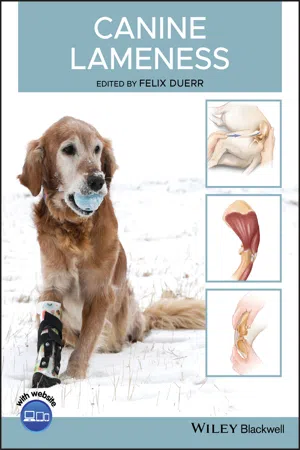
Canine Lameness
eBook - ePub

Canine Lameness

  1. English
  2. ePUB (mobile friendly)
  3. Available on iOS & Android
eBook - ePub

Canine Lameness

About this book

Written by veterinarians across multiple disciplines with expertise in the canine musculoskeletal system, this book offers an easy-to-use guide for diagnosing lameness in dogs. Canine Lameness focuses on evaluation and diagnostic techniques, with descriptions of the most common reasons for lameness. Arranged by anatomical region, this approach complements the clinical assessment of a patient.

Designed for ease of use, the book puts all the information needed to evaluate and diagnose a dog's orthopedic status at the reader's fingertips. Particular emphasis is placed on orthopedic examination, radiographic anatomy, and abnormal radiographic findings.

Features of Canine Lameness:

  • Offers a comprehensive guide to diagnosing musculoskeletal diseases causing lameness in dogs
  • Brings clinical examination, diagnostic imaging, and relevant musculoskeletal anatomy together into a single resource
  • Takes a logical, regions-based approach, outlining diagnostic steps and differential diagnoses for each specific area
  • Focuses on commonly encountered conditions while highlighting critical diagnostic steps to ensure other, less common, differential diagnoses are not missed
  • Includes access to a companion website with video clips demonstrating detailed steps of the examination, techniques, and lameness conditions

Canine Lameness is an excellent resource for veterinarians and staff involved in the diagnosis of lameness in dogs, and will be of great benefit to all animal health professionals working in the area of canine orthopedics.

Frequently asked questions

Yes, you can cancel anytime from the Subscription tab in your account settings on the Perlego website. Your subscription will stay active until the end of your current billing period. Learn how to cancel your subscription.
No, books cannot be downloaded as external files, such as PDFs, for use outside of Perlego. However, you can download books within the Perlego app for offline reading on mobile or tablet. Learn more here.
Perlego offers two plans: Essential and Complete
  • Essential is ideal for learners and professionals who enjoy exploring a wide range of subjects. Access the Essential Library with 800,000+ trusted titles and best-sellers across business, personal growth, and the humanities. Includes unlimited reading time and Standard Read Aloud voice.
  • Complete: Perfect for advanced learners and researchers needing full, unrestricted access. Unlock 1.4M+ books across hundreds of subjects, including academic and specialized titles. The Complete Plan also includes advanced features like Premium Read Aloud and Research Assistant.
Both plans are available with monthly, semester, or annual billing cycles.
We are an online textbook subscription service, where you can get access to an entire online library for less than the price of a single book per month. With over 1 million books across 1000+ topics, we’ve got you covered! Learn more here.
Look out for the read-aloud symbol on your next book to see if you can listen to it. The read-aloud tool reads text aloud for you, highlighting the text as it is being read. You can pause it, speed it up and slow it down. Learn more here.
Yes! You can use the Perlego app on both iOS or Android devices to read anytime, anywhere — even offline. Perfect for commutes or when you’re on the go.
Please note we cannot support devices running on iOS 13 and Android 7 or earlier. Learn more about using the app.
Yes, you can access Canine Lameness by Felix Duerr in PDF and/or ePUB format, as well as other popular books in Medicine & Veterinary Medicine. We have over one million books available in our catalogue for you to explore.

Information

Year
2019
Print ISBN
9781119474029
eBook ISBN
9781119474050
Edition
1

Section 1
Lameness Diagnosis

Part I
Lameness Evaluation

1
Subjective Gait Evaluation

Felix Michael Duerr
Department of Clinical Sciences, College of Veterinary Medicine and Biomedical Sciences, Colorado State University, Fort Collins, CO, USA

1.1 Introduction

Lameness can be due to orthopedic, oncologic, or neurologic conditions that disrupt the tissues responsible for normal locomotion. Subjective gait analysis is one component of the orthopedic and neurologic examination and provides valuable information to assist in determining what limb(s) and structures are affected. Succeeding chapters further discuss the other components that play an important role in any canine lameness evaluation (e.g. history, orthopedic examination, etc.).

1.2 Observation at Rest

Subjective gait evaluation starts by observing the animal at rest, when it stands, or raises from a sitting or lying position. Frequently, this can be accomplished by letting the animal roam freely in the exam room during the history taking. During this time, the observer may also evaluate mental status, behavior, and posture of the patient (which is part of the neurologic exam, see Chapter 4). Many dogs will show obvious off‐loading of the affected limb during standing (Video 1.1), particularly with cranial cruciate ligament disease and neurogenic (i.e. nerve root signature) lameness. Caution should be used when interpreting off‐loading if the animal is not standing square. Anxious animals may be encouraged to stand still by leading them toward an exit door, pausing prior to opening the door. Most dogs will focus on the door being opened and while being distracted, the observer can judge weight‐bearing in a square position.
Video 1.1:
eye
Pelvic limb lameness – unilateral CCLD.
Difficulty in either rising, or sitting, or both suggests a problem in the hind end. For example, animals with cranial cruciate ligament disease will display a classic sitting pattern avoiding flexion of the affected stifle(s). Animals that sit “square” (Chapters 19 and 20; Video 20.2) are unlikely to suffer from cruciate disease. Animals with lumbosacral disease may have difficulty rising, while animals with bilateral cruciate disease will hesitate to sit down. Spontaneous knuckling (i.e. standing on the dorsum of their paw during stance) indicates neurologic disease.

1.3 Observation in Motion

During the subjective gait evaluation, the observer is attempting to localize and specify the type of lameness (e.g. which leg is most severely affected, neurologic versus orthopedic origin, etc.). Certain gait features, such as ataxia or dragging/scuffing of the toes, clearly indicate neurologic disease. Decreased range of motion in a joint and the associated gait changes may point toward an articular source of the lameness. Changes in stride length may indicate a musculoskeletal or neurologic problem. Increased range of motion may indicate a ligament problem (such as carpal hyperextension injury with increased carpal extension or Achilles tendon rupture with increased tarsal flexion).
The use of slow‐motion video analysis for improving the observer's ability to identify a lameness has been reported in dogs and horses; however, no clinical benefit was observed in a recent canine study using dogs (He Lane et al. 2015). Although in that study the degree of lameness was not quantified. Nonetheless, in the author's experience, this technique can be extremely helpful in dogs with a subtle lameness (Video 1.2). Slow‐motion videography is integrated into newer smart phone devices and numerous apps also offer this feature, thus making it easily utilized in daily practice.
Video 1.2:
eye
Thoracic limb lameness – case examples.

1.3.1 Presentation

Ideally, the animal is presented by a dedicated handler/technician. Since most owners are not used to walking their dog without interfering with gait, this approach will allow reducing the time required to complete the lameness evaluation: the handler should allow the animal to move freely (e.g. not pulling on the leash) yet at a constant speed. Pulling on the leash makes observation of a head nod more difficult. Ideally, the animal should look straight ahead during evaluation. This can be accomplished by letting the animal walk toward the owner.
The animal should be observed at the walk and ideally at the trot if the severity of the lameness allows. In general, if animals are unable to trot, their disease should be severe enough that lameness identification can be done at a stance or walk. A flat, even surface with good traction, such as a parking lot or driveway, is ideal to avoid distractions (such as areas to sniff/mark). The gait should be viewed both from the side (to judge stride length, symmetry, and possible changes in sagittal joint range of motion) and the animal moving toward and away from the examiner (to judge head nod, pelvic tilt, and frontal plane abnormalities).
To make a lameness more detectable, the animal can be asked to trot in circles, walk stairs, go up and down hills, or perform the ta...

Table of contents

  1. Cover
  2. Table of Contents
  3. List of Contributors
  4. Preface
  5. Acknowledgments
  6. Editor Biography
  7. About the Companion Website
  8. Section 1: Lameness Diagnosis
  9. Section 2: Regional Diagnosis
  10. Glossary
  11. List of Abbreviations
  12. Index
  13. End User License Agreement