Mobile Robots
eBook - ePub

Mobile Robots

Navigation, Control and Sensing, Surface Robots and AUVs

  1. English
  2. ePUB (mobile friendly)
  3. Available on iOS & Android
eBook - ePub

Mobile Robots

Navigation, Control and Sensing, Surface Robots and AUVs

About this book

Presents the normal kinematic and dynamic equations for robots, including mobile robots, with coordinate transformations and various control strategies

This fully updated edition examines the use of mobile robots for sensing objects of interest, and focus primarily on control, navigation, and remote sensing. It also includes an entirely new section on modeling and control of autonomous underwater vehicles (AUVs), which exhibits unique complex three-dimensional dynamics.

Mobile Robots: Navigation, Control and Sensing, Surface Robots and AUVs, Second Edition starts with a chapter on kinematic models for mobile robots. It then offers a detailed chapter on robot control, examining several different configurations of mobile robots. Following sections look at robot attitude and navigation. The application of Kalman Filtering is covered. Readers are also provided with a section on remote sensing and sensors. Other chapters discuss: target tracking, including multiple targets with multiple sensors; obstacle mapping and its application to robot navigation; operating a robotic manipulator; and remote sensing via UAVs. The last two sections deal with the dynamics modeling of AUVs and control of AUVs. In addition, this text:

  • Includes two new chapters dealing with control of underwater vehicles
  • Covers control schemes including linearization and use of linear control design methods, Lyapunov stability theory, and more
  • Addresses the problem of ground registration of detected objects of interest given their pixel coordinates in the sensor frame
  • Analyzes geo-registration errors as a function of sensor precision and sensor pointing uncertainty

Mobile Robots: Navigation, Control and Sensing, Surface Robots and AUVs is intended for use as a textbook for a graduate course of the same title and can also serve as a reference book for practicing engineers working in related areas.

Frequently asked questions

Yes, you can cancel anytime from the Subscription tab in your account settings on the Perlego website. Your subscription will stay active until the end of your current billing period. Learn how to cancel your subscription.
At the moment all of our mobile-responsive ePub books are available to download via the app. Most of our PDFs are also available to download and we're working on making the final remaining ones downloadable now. Learn more here.
Perlego offers two plans: Essential and Complete
  • Essential is ideal for learners and professionals who enjoy exploring a wide range of subjects. Access the Essential Library with 800,000+ trusted titles and best-sellers across business, personal growth, and the humanities. Includes unlimited reading time and Standard Read Aloud voice.
  • Complete: Perfect for advanced learners and researchers needing full, unrestricted access. Unlock 1.4M+ books across hundreds of subjects, including academic and specialized titles. The Complete Plan also includes advanced features like Premium Read Aloud and Research Assistant.
Both plans are available with monthly, semester, or annual billing cycles.
We are an online textbook subscription service, where you can get access to an entire online library for less than the price of a single book per month. With over 1 million books across 1000+ topics, we’ve got you covered! Learn more here.
Look out for the read-aloud symbol on your next book to see if you can listen to it. The read-aloud tool reads text aloud for you, highlighting the text as it is being read. You can pause it, speed it up and slow it down. Learn more here.
Yes! You can use the Perlego app on both iOS or Android devices to read anytime, anywhere — even offline. Perfect for commutes or when you’re on the go.
Please note we cannot support devices running on iOS 13 and Android 7 or earlier. Learn more about using the app.
Yes, you can access Mobile Robots by Gerald Cook,Feitian Zhang in PDF and/or ePUB format, as well as other popular books in Technology & Engineering & Robotics. We have over one million books available in our catalogue for you to explore.

Information

1
Kinematic Models for Mobile Robots

1.1 Introduction

This chapter is devoted to the development of kinematic models for two types of wheeled robots. The kinematic equations are developed along with the basic geometrical properties of achievable motion. The two configurations considered here do not exhaust the myriad of possible configurations for wheeled robots; however, they serve as an adequate test bed for the development and discussion of the principals involved.

1.2 Vehicles with Front‐Wheel Steering

The first type of mobile robot to be considered is the one with front‐wheel steering. Here the vehicle is usually powered via the rear wheels, and the steering is achieved by way of an actuator for turning the front wheels.
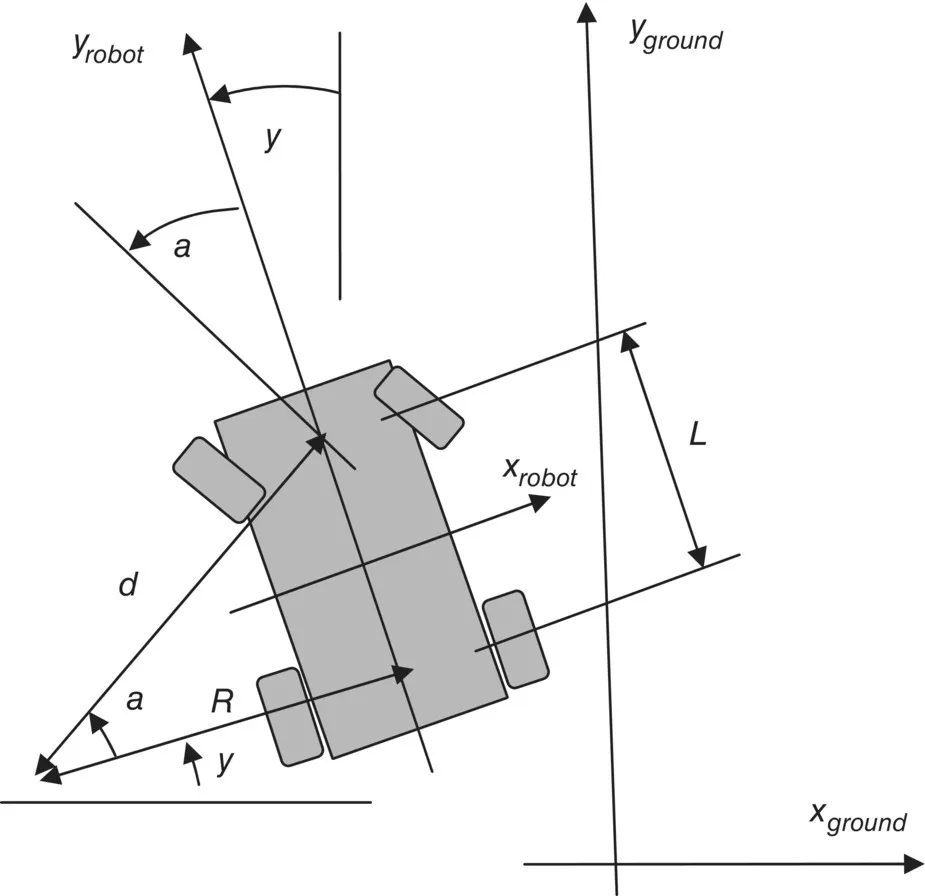
In Figure 1.1, we have a diagram for a four‐wheel front‐wheel‐steered robot. The equations would also apply for the case of a single front wheel. The angle the front wheels make with respect to the longitudinal axis of the robot, yrobot, is defined as α, measured in the counter‐clockwise direction. The angle that the longitudinal axis, yrobot, makes with respect to the yground axis is defined as ψ, also measured in the counter‐clockwise direction. The instantaneous center about which the robot is turning is the point of intersection of the two lines passing through the wheel axes.
From geometry we have
equation
which may be solved to yield the instantaneous radius of curvature for the path of the midpoint of the rear axle of the robot.
Image described by caption and surrounding text.
Figure 1.1 Schematic diagram of the front‐wheel steered robot.
(1.1)
equation
From geometry we also have
equation
or
equation
which can be written as
(1.2)
equation
If one held the steering angle α constant, the trajectory would result in a circle whose radius is dictated by the robot length and the actual steering angle used per equation (1.1).
Now the instantaneous curvature itself is defined as the ratio of change in angle divided by change in distance or change in angle per distance traveled. It is given by
equation
which is the inverse of the instantaneous radius of curvature. Thus, the radius of curvature may be interpreted as
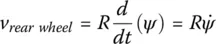
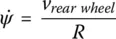
...

Table of contents

  1. Cover
  2. Table of Contents
  3. Preface
  4. About the Authors
  5. Introduction
  6. 1 Kinematic Models for Mobile Robots
  7. 2 Mobile Robot Control
  8. 3 Robot Attitude
  9. 4 Robot Navigation
  10. 5 Application of Kalman Filtering
  11. 6 Remote Sensing
  12. 7 Target Tracking Including Multiple Targets with Multiple Sensors
  13. 8 Obstacle Mapping and Its Application to Robot Navigation
  14. 9 Operating a Robotic Manipulator
  15. 10 Remote Sensing via UAVs
  16. 11 Dynamics Modeling of AUVs
  17. 12 Control of AUVs
  18. Appendix A: Demonstrations of Undergraduate Student Robotic ProjectsDemonstrations of Undergraduate Student Robotic Projects
  19. Index
  20. End User License Agreement