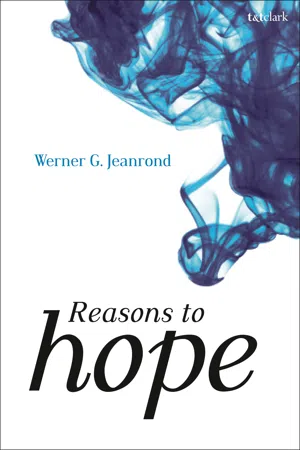
Werner G. Jeanrond approaches hope from the perspective of a theology of love. He distinguishes human hopes from the hope which God has given to humanity. Jeanrond discusses the challenges of a Christian praxis of hope in today's world and invites both a new conversation on a future with God and a reassessment of the potential of hope for Christian discipleship.
Jeanrond argues that memory is important for hope, and that nobody can hope for herself or himself alone. Hope thus invites personal, communal, political and global participation and transformation. Moreover, it gives rise to a powerful constellation of symbolic expressions, including judgement, heaven, hell, and purgatory, that call for ongoing interpretation. Ranging from radical hope and the hope for salvation, to the power of judgment and contemporary fears about the future of nations, humankind and the world, Jeanrond's latest work offers a theological contribution to the multireligious conversation on hope, death and the human future in our universe.
- 240 pages
- English
- ePUB (mobile friendly)
- Available on iOS & Android
eBook - ePub
Reasons to Hope
About this book
Information
1
Hope, hopes and radical hope
‘Hope dies last’
Exclaiming ‘hope dies last’ is one way of stressing the importance of hope in our lives. We human beings cannot live without some form of hope, without some engagement with what is to happen, without some outlook on the future in general and on our personal and communal future in particular. Our experience of the present is shaped both by our personal and collective memories of the past and by our personal and collective expectations of the future.
We humans are relational beings. We are constantly developing relationships – with other people, with nature and the universe, with God and with our own emerging selves. We do so within a horizon of expectation: what ought to come, what might be happening, and what we would wish should happen to our networks of relationships and to our own selves. Thus, ultimately, nobody hopes for themselves alone, even though many of our particular hopes circle around our own person and our individual needs, desires, fears and expectations. To no small extent, we human beings can be characterized by our hopes. Tell me what your hopes are and I begin to understand who you are.
‘Hope dies last’ also refers to the fact of our certain death: life is constantly changing and all life dies. From the beginning, every life carries death and decay within itself. Consciously or unconsciously, all our hopes develop under the shadow of death. On the one hand, hope refers to the future; yet, on the other hand, hope must also reckon with our death. For some people, the denial of death seems to be the beginning of hope. But is such hope realistic; is such hope responsible? Is hope ultimately a delusion – albeit a much cherished one?1 How realistic is our hope? Should we distinguish between realistic and delusory forms of hope and between good and bad hope?
What do I hope for? Do I hope for better weather? For a long and happy life with my loved ones? For a life without much illness and suffering? Do I hope for shelter and for enough food to sustain me and my family? Do I hope for sufficient clothes to survive heat and cold? Do I hope for freedom from imprisonment, exclusion and isolation? Do I nurture hope mostly for myself, or do I hope also with and for others? Have my hopes changed recently? What may have brought about such change? What is the context or horizon of my hopes and dreams for the future? Nobody hopes outside of some context or horizon, and yet the contexts and horizons of our hopes are shifting and changing.
In this post-industrialized age of globalization, growing environmental awareness and concern, digitalization, sophisticated health planning (at least in the wealthy West), artificial intelligence and an ever-increasing cultural and interreligious encounter and suspicion, our hopes are likely to differ from those of previous generations. Of course, like all generations before us, we too face death, limitations, discrimination, crime, suffering, illness, abuse and decay. We too have to learn to accept that our lives are mortal. Death remains a challenge to all life. Yet, how we human beings relate to death has changed considerably over the centuries. At all times, people have looked for ways to escape death: from medical attempts at overcoming death to hope in the power of cryonics – the preservation of our bodies in a deep freezer until the day when science finally will have manufactured the perfect conditions for human immortality.
Whereas previous generations of Christians considered death as the entry point to the really real life with God, in the community of the saints, today many Christians in the West find it difficult to articulate a hope for some sort of life after death. Post-mortal geography – mapping heaven, hell and purgatory – has lost a lot of its former attraction and fascination. The eschatological landscape – that is, what we expect from eternal life with God – is shifting under our feet. Hence, again, the questions: What do we ultimately hope for? How may we approach hope afresh in our time, place, language and imagination? Should Christians today start by reviewing the content of their faith in terms of exploring what beliefs may be available right now about salvation and the afterlife? Is hope, then, merely a consequence of a set of beliefs, of specific beliefs about death and the thereafter to be distilled from our respective list of doctrines? How are hope and faith related? And how does our hope relate to our everyday life here and now?
The relational nature of hope
In this book, I wish to discuss reasons to hope from a Christian perspective, also taking into account other religious and non-religious perspectives. I am conscious of the fact that hope (like love) is neither a Christian invention nor a Christian possession. Rather, like other religious and non-religious traditions, the Christian tradition has always engaged in some praxis of hope. In recent years, Christians have become more aware of other discourses and approaches to hope – other reasons to hope. Thus, in our ever more pluralist and globalizing world, Christians face the hopes of others as well as the otherness of their own hope.2 Is there a platform on hope which Christians can share with other religious and non-religious people? Should Christians engage in what has been named ‘inter-hope-dialogue’ to initiate a much wider discussion of reasons to hope?3 I think so, and I shall argue accordingly.
Christian concepts of hope have emerged in response to particular experiences in the Jesus movement and its rich Hebrew heritage. Although hope as a human phenomenon signifies attention to and expectation of the future of persons, movements, communities, cultures, institutions, societies and the universe at large, Jewish and Christian understandings of hope have concentrated on the emerging human relationship with God, a relationship that originates in God’s gracious, creative, attentive and reconciling gift of presence in this universe. Thus, Jewish and Christian expressions of hope are not limited to any single term or concept, such as hope, Hoffnung, espérance, qavah, elpis, spes and so on. Rather, these terms attempt to express significant experiences of human beings related to God with regard to their future as persons, communities and people in this universe. In Jewish and Christian traditions, hope functions as a relational concept rather than as some sort of principle.4 Hope is grounded in God’s gracious invitation to men, women and children to accept God’s offer of a personal and transformative relationship of love.
Hence, I wish to propose the following thesis: hope is relational by nature. It is neither a principle nor a general expression of the conviction that in the end all will be well. Rather, hope results from the intimate and dynamic connection between God and human beings, or, more concretely, between divine and human love. Hope dies when this love relationship ends. Then hopelessness and despair reign.
My thesis does not imply that other human hopes are not genuine or unrealistic. The Christian praxis of hope, of course, shares many features with other religious and non-religious approaches and expressions of hope. However, it also differs from them. Ultimately, I wish to argue that the Christian praxis of hope is best understood in connection with love. Hence, I agree with Terry Eagleton’s insight into the intimate relationship between hope and love: ‘Authentic hope … needs to be underpinned by reasons. In this, it resembles love, of which theologically speaking it is a specific mode.’5 The three so-called theological virtues of faith, hope and love all contemplate the divine offer of relationship to human beings and thus they overlap to a significant extent. However, they also differ from each other.
In my book A Theology of Love, I attempted to explore love – the greatest among the three theological virtues.6 The Apostle Paul referred to them in 1 Cor. 13:13; and Thomas Aquinas (1225–74) called them theological virtues in order to highlight their character as divine gifts to human beings. The theological virtues are not a set of skills which we might choose to adapt and develop; rather, they are divinely infused in us in order to guide us on our earthly pilgrimage to union with God and one another. Faith is to guide our intellect, hope to guide our will, and love to help and unite the Christian to God. The theological virtues, thus, are to keep us on the path of perfection.7 Christian theology normally discusses these virtues in the order: faith, hope and love, whereas, as I shall argue later, I prefer a different order: love, hope and faith.
Returning to the virtue of hope, I wish to gather some observations on biblical and post-biblical accounts of hope. Central narratives in the Hebrew Bible are inspired by hope. The story of Abraham’s and Sarah’s late vocation, their pilgrimage and their trust in God’s promises illustrate an emerging praxis of hope (Genesis 12ff.). The account of Moses’s conversion experience at the burning bush – that the future of his people and his own personal future are intricately linked to God’s creative plan and salvific promises – offers an example of radical hope (Exodus 3). The narratives of the pilgrimage of the Israelites through the desert and related biblical texts reflect future perspectives and possibilities springing from trust in the living God, who is seen to be intimately involved in this universe and in the lives of his people as creator, liberator, judge, comforter and sustainer. Likewise, the hymnic and doxological texts of the Hebrew Bible, especially the book of Psalms, are permeated with expressions and contemplations of hope and its significance for the life of God’s people.8
Moreover, the emerging Jewish and Christian faith traditions are characterized by messianic expectations, for instance, that salvation, eternal life, peace, justice, restitution and resurrection are all works of God. They come to God’s people (adventus) as gifts. They are not at the disposition of the people either individually or collectively. Jewish and Christian understandings of the future recognize and honour the particular nature of the divine–human relationship into which God has invited women, men and children. Thus, human expectations, trust, desire and hope are oriented towards the future opened by God, and hence, they cannot escape the purifying fire of the burning bush.
Human hopes and the divine gift of hope can clash. Acknowledging God as creator and recognizing afresh that the human future is a gift from God are two sides of the same coin.9 Affirming God’s creation as good (Genesis 1–2) and expecting that the future made possible by God’s gracious action will also be good are deeply connected activities of trust.10
Optimism and hope
It will be obvious that such hope held by Jews and Christians differs from optimism. Anthony Kelly distinguishes optimism from hope in this way:
Optimism is no bad thing in itself. It is a kind of implicit confidence that things are going well in the present situation. Optimism may be simply a feature of temperament expressing itself in a spontaneous logic: we can manage and cope in a world that is reasonably predictable. Opt...
Table of contents
- Cover
- Half-Title
- Dedication
- Title
- Contents
- Preface
- Notes for the reader
- Acknowledgements
- 1 Hope, hopes and radical hope
- 2 Hoping for salvation
- 3 Salvation and reconciliation
- 4 Individual and community: Three eschatological programmes
- 5 Memory and hope
- 6 Death and hope
- 7 Judgement, heaven and hell: The power of symbols
- 8 The Christian praxis of hope and Europe’s future
- 9 Reasons to hope
- Select bibliography
- Index of names
- Index of subjects
- Copyright
Trusted by 375,005 students
Access to over 1.5 million titles for a fair monthly price.
Study more efficiently using our study tools.
Frequently asked questions
Yes, you can cancel anytime from the Subscription tab in your account settings on the Perlego website. Your subscription will stay active until the end of your current billing period. Learn how to cancel your subscription
No, books cannot be downloaded as external files, such as PDFs, for use outside of Perlego. However, you can download books within the Perlego app for offline reading on mobile or tablet. Learn how to download books offline
Perlego offers two plans: Essential and Complete
- Essential is ideal for learners and professionals who enjoy exploring a wide range of subjects. Access the Essential Library with 800,000+ trusted titles and best-sellers across business, personal growth, and the humanities. Includes unlimited reading time and Standard Read Aloud voice.
- Complete: Perfect for advanced learners and researchers needing full, unrestricted access. Unlock 1.5M+ books across hundreds of subjects, including academic and specialized titles. The Complete Plan also includes advanced features like Premium Read Aloud and Research Assistant.
We are an online textbook subscription service, where you can get access to an entire online library for less than the price of a single book per month. With over 1.5 million books across 990+ topics, we’ve got you covered! Learn about our mission
Look out for the read-aloud symbol on your next book to see if you can listen to it. The read-aloud tool reads text aloud for you, highlighting the text as it is being read. You can pause it, speed it up and slow it down. Learn more about Read Aloud
Yes! You can use the Perlego app on both iOS and Android devices to read anytime, anywhere — even offline. Perfect for commutes or when you’re on the go.
Please note we cannot support devices running on iOS 13 and Android 7 or earlier. Learn more about using the app
Please note we cannot support devices running on iOS 13 and Android 7 or earlier. Learn more about using the app
Yes, you can access Reasons to Hope by Werner G. Jeanrond in PDF and/or ePUB format, as well as other popular books in Teologia e religione & Teologia cristiana. We have over 1.5 million books available in our catalogue for you to explore.