The human body lies at the centre of our relationship to fashion and textiles. Crafting Anatomies explores how the body has become a catalyst for archival research, creative dialogues and hybrid fabrications in fashion design. Focusing on how our response to the corporeal has shifted over time, the book looks at how it is currently influencing design and socio-material practices.
With contributions from a multidisciplinary range of scholars and researchers, Crafting Anatomies examines how new technologies have become integrated with traditional fashion and textiles techniques, bringing together art, science and biomedical approaches. Traversing the cutting-edge of design research, the chapters take us from the forgotten lives of historical garments to the potential of biofabrication to cross the boundaries between skin and textile.
Illustrated with 120 images visualising original research, the book reveals how the human body continues to inspire future design, from historical wearables to prosthetic limbs and 3D-printed footwear. In doing so, it provides an inspiring account of how fashion and textile culture now impacts socio-creativity and the formation of contemporary identity.
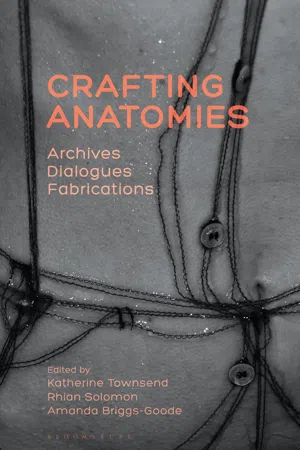
eBook - ePub
Crafting Anatomies
Archives, Dialogues, Fabrications
- 344 pages
- English
- ePUB (mobile friendly)
- Available on iOS & Android
eBook - ePub
Crafting Anatomies
Archives, Dialogues, Fabrications
About this book
Information
1
Introduction
Crafting Anatomies
Katherine Townsend, Rhian Solomon, and Amanda Briggs-Goode
Introduction
Crafting Anatomies places the human body at the centre of a transdisciplinary exploration, revealing how it acts as a catalyst for craft-based collaborative research, using archives, creative dialogues, and technologically advanced fabrications. As the book demonstrates, nothing happens without collaboration in fashion and textiles, which involves intense, creative dialogues at all stages of the process (Anderson 2017). Increasingly, this applies to all contemporary artistic design practice—where the tradition of the “isolated auteur” and mastery of a specific discipline is challenged by the provocative and disruptive nature of information and technology (Mower 2017).
This collection of illustrated narratives seeks to highlight how critical making and conversation around the contemporary body is manifest through a range of material and immaterial responses. The contributors, drawn from a network of creative thinkers and practitioners based in Europe, North America, and Oceania, exploit methodologies that resonate with wider transnational philosophies, “[paying] no attention to the boundaries between fine and applied art, high and low culture, gendered and racial identity, let alone, fashion, textiles and craft”1 (Hemmings 2015: 157). So, through the shared lens of crafting anatomies, researcher/practitioners in materials (textiles) and product (fashion) design are united with artists, writers, scientists, and curators to demonstrate how their/our response to the corporeal is constantly flexing and changing.

Figure 1.1 Ana Rajcevic, “Animal: The Other Side of Evolution” (2012). Photograph by Ana Rajcevic.
Craft
While many of the contributors to this book could be described as “designers,” the term “crafting” is adopted, both literally and metaphorically; revealed through the unique relationships makers have with the fabric of, and for the body. Adamson (2007: 1) asks provocatively “Isn’t craft something mastered by the hands, not the mind? Something consisting of physical actions, rather than abstract ideas?” Skilled making, or craftsmanship, is widely understood as “expertise in technique”; the result of a learned repertoire of refined gestures informed by hand and mind, sustained through supplemental material-based practice (ibid.: 4; Sennett 2008). However, the influence and impact of craft is no longer tied to the Western constructed definition or terrain of “the crafts,” following new insights into the role, value, and “power of making”2 to the creative economy and culture.
The authors within this book demonstrate an inherent understanding of craft’s capacity for collaboration; to communicate across distinct ideologies, domains, and cultures (Niedderer and Townsend 2019; Solomon 2013). The reconceptualization of craft, in parallel with other practices3 has resulted in the melding and dissembling of different genres of making (Ravetz, Kettle, and Felcey 2013). Exchanges between individuals across disciplinary boundaries are shared and through joint endeavor leave one or both sides significantly changed; haptic and reflective dialogues leading to the generation of new and unexpected ideas (Schön 1984). In Crafting Anatomies, therefore, we define craft as a holistic “approach” to the body, realized through the actions and concepts of practitioners who utilize it as a form of “material intelligence” (Adamson 2019).
The body
In Shapeshifters, Francis (2019: 3) discusses our evolving understanding and treatment of the human body from ancient history to the present, observing that “it is in constant flux, with porous physical and psychological borders that are shaped by the environments we inhabit.” Francis also makes connections between the systems of the natural world and humankind’s biological capacity to grow, recover, and adapt based on a continual process of metamorphosis.4 As this study demonstrates, skin,5 the body’s largest organ and regenerative frontier between the inside and outside of the human form, is the source of groundbreaking textile advances. What goes on “beneath the skin,” how our internal organs appear, function, and influence the human condition (Lynch in Alderman et al. 2018) also represents an expanding territory for hybrid practitioners to intervene in.
“The singular, bounded, carbon-based body is being replaced by the proliferation and emergence of technologies and practices which enable the enhancement, alteration and invention of new bodies” (Blackman 2008: 2).
Designer/makers are adapting their existing toolkits and mindsets toward hybrid approaches to the corporeal, drawn from different domains. Consequently, the repair and transformation of the body is no longer restricted to medicine and surgery, with the crafting of its internal and external architectures increasingly located at the intersection of technology and biology (Oxman 2015). The merging of mechanized and natural systems, via hand, augmented and virtual realities are extending the engineering of “the digital body”;6 through the employment of biotechnologies and robotics to enhance its capabilities and ontology.
A plethora of temporary exhibitions and permanent gallery spaces dedicated to the body have also appeared globally (e.g., the Wellcome Collection, Science Gallery, Cité du Corps Humain, and Deutsches Hygiene Museum), stimulating new dialogues and perspectives.
Crafting the body
As Turner (2008: 1) identifies “humans both have bodies and are bodies” the exception being, as Entwistle expands, that “humans are dressed bodies” (Entwistle 2015: 31). Thus, the body, in both its natural and clothed state, has continued to intrigue artists and designers since the beginnings of classical Western culture.7 Cloth and clothing “represent the body as a fundamentally liminal phenomenon by stressing its precarious location on the threshold between the physical and the abstract, the literal and the metaphorical” (Wilson 2003: 273). It is therefore difficult to consider the concept of “crafting anatomies” without contemplating the codes, matrices, and materials of the system in which the body is fashioned (Barthes 2010).
Entwistle (2015: ix) observes “how much the field [of fashion] has massively complexified and breached discipline boundaries” since the beginning of the new millennium. Similarly, the “end of fashion” has been proclaimed and debated by theorists and practitioners alike, acknowledging that its “former paradigms have been exhausted” (Geczy and Karaminas 2019: 1). This is evidenced by changes to the conceptualization, processes, and dissemination of fashion, resulting in a more critical design environment “which has its core in the body and its way of being in the world, of its representations, its masking, its disguises, its measures, and its conflicts with stereotypes and myths” (Calefato 2019: 33). Such change has led to a more focused exploration of the somatic through “corporeal design,” involving subtle and spectacular modifications using decoration and accessories (Zellweger 2011).
One of the most critical issues relating to the crafting of the fashionable body is how fashion and textile products are resourced, designed, and made; the bodies and labor involved (von Busch et al. 2017). Resultantly, a growing number of organizations, including Fashion Revolution8 and the Union of Concerned Researchers9 are attracting international membership and affecting change in the fashion system. Sustainable design is acknowledged by the contributors to this book both implicitly and explicitly; via methodologies that utilize craft as both method and philosophy toward enhancing human expression, health, and well-being, and reducing human impact on the environment.
As the collated examples illustrate, craft-based methodologies often engender slower, co-creative, human-centered models, “aw...
Table of contents
- Cover
- Half-Title Page
- Title Page
- Dedication
- Contents
- List of Illustrations
- Foreword
- Acknowledgments
- 1 Introduction: Crafting Anatomies
- Part 1 The Archived Body
- 2 The Archived Lace Body: Contemporary Artist Designer Responses
- 3 Disarmed: Lasting Impressions
- 4 Pioneering, Nonconforming, and Rematerializing: Crafting Understanding of Older Men’s Experiences of Fashion Through Their Personal Archives
- 5 “The Electric Corset and Other Future Histories”
- Part 2 The Body in Dialogue
- 6 Fashion and Participation in Hands of X
- 7 Tissue Engineered Textiles: Craft’s Place in the Laboratory
- 8 Mind–Body–Garment–Cloth
- 9 Empowerment and Self-Care: Designing for the Female Body
- Part 3 The Fabricated Body
- 10 OurOwnskin: The Development of 3D-Printed Footwear Inspired by Human Skin
- 11 Material Robotics: Shaping the Sensitive Interface
- 12 The Genetics Gym
- 13 The Body as Factory: A Post-Productivist Fashion Practice Through Film
- Discussion
- 14 On Fashioning Anatomy
- Notes on Contributors
- Index
- Copyright
Trusted by 375,005 students
Access to over 1.5 million titles for a fair monthly price.
Study more efficiently using our study tools.
Frequently asked questions
Yes, you can cancel anytime from the Subscription tab in your account settings on the Perlego website. Your subscription will stay active until the end of your current billing period. Learn how to cancel your subscription
No, books cannot be downloaded as external files, such as PDFs, for use outside of Perlego. However, you can download books within the Perlego app for offline reading on mobile or tablet. Learn how to download books offline
Perlego offers two plans: Essential and Complete
- Essential is ideal for learners and professionals who enjoy exploring a wide range of subjects. Access the Essential Library with 800,000+ trusted titles and best-sellers across business, personal growth, and the humanities. Includes unlimited reading time and Standard Read Aloud voice.
- Complete: Perfect for advanced learners and researchers needing full, unrestricted access. Unlock 1.5M+ books across hundreds of subjects, including academic and specialized titles. The Complete Plan also includes advanced features like Premium Read Aloud and Research Assistant.
We are an online textbook subscription service, where you can get access to an entire online library for less than the price of a single book per month. With over 1.5 million books across 990+ topics, we’ve got you covered! Learn about our mission
Look out for the read-aloud symbol on your next book to see if you can listen to it. The read-aloud tool reads text aloud for you, highlighting the text as it is being read. You can pause it, speed it up and slow it down. Learn more about Read Aloud
Yes! You can use the Perlego app on both iOS and Android devices to read anytime, anywhere — even offline. Perfect for commutes or when you’re on the go.
Please note we cannot support devices running on iOS 13 and Android 7 or earlier. Learn more about using the app
Please note we cannot support devices running on iOS 13 and Android 7 or earlier. Learn more about using the app
Yes, you can access Crafting Anatomies by Katherine Townsend, Rhian Solomon, Amanda Briggs-Goode, Katherine Townsend,Rhian Solomon,Amanda Briggs-Goode in PDF and/or ePUB format, as well as other popular books in Conception & Stylisme. We have over 1.5 million books available in our catalogue for you to explore.