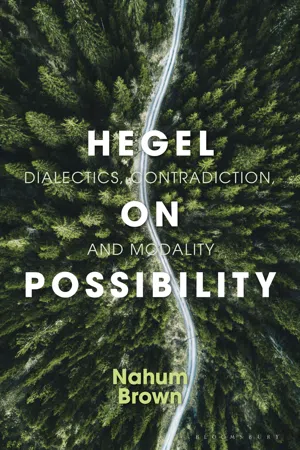
Providing a clear interpretation of Hegel's characterizations of possibility and actuality in the Science of Logic, this book departs from the standard understandings of these concepts to break new ground in Hegelian scholarship.
The book draws out some of the implications of Hegel's view of immanent possibility, especially as it relates to Leibniz's thesis of modal optimism: his view that this world is the best of all possible worlds. Reading Hegel as a philosopher of possibility, against a tradition that has conceived of him primarily as a philosopher of necessity, rationality, and finitude, Nahum Brown demonstrates the historical background and philosophical traditions from which Hegel's concept of possibility emerges.
Systematically outlining Hegel's conceptions of positive and negative freedom, Brown reveals the Hegelian underpinnings of our conception of reality and what it is to be in the world itself. Original and convincing, this book is crucial for philosophers approaching modality from any tradition.
- 248 pages
- English
- ePUB (mobile friendly)
- Available on iOS & Android
eBook - ePub
About this book
Information
Part One
Possibility and Contradiction
1
Hegel on Totality: From Being to Nothing
The aim of this chapter is to articulate Hegel’s implicit conception of contradiction, as it occurs in the Doctrine of Being, through an analysis of his transition from being to nothing in the opening of the Logic. I outline a variety of interpretations of the being-to-nothing transition and I defend what I call the “Dialectical Totality Interpretation” as support for the conclusion that Hegel is committed to a version of totality that, at the same time, embraces genuine alterity. The Dialectical Totality Interpretation leads to a reassessment of totality as a preliminary formulation of what will become, for Hegel, the explicit contradiction of A and not A in the Doctrine of Essence.
Traditional connotations of totality as exclusionary exhaustion, pre-determination, and finitude have often been attributed to Hegel’s thought, especially from critics such as Kierkegaard, Levinas, and more recently from William Desmond. But the Dialectical Totality Interpretation of the transition from being to nothing that I defend prepares the way for an alternative reading of totality in Hegel’s work. In this chapter, I argue that Hegel’s conception of totality should not be defined as the exhaustion of all positive content, but as the coincidence of being and nothing, as the contradiction A is not A, and as the completion of form and content by way of a dialectic with alterity.
The transition from being to nothing exposes a unique kind of totality that is particular to Hegel. To recognize that something is and is not is to exhaust all of the permutations of what that thing can be. The ontological ground for this is established in the being-to-nothing transition. While we normally think of totality in terms of finitude and identity, where to totalize means to exhaust and to comprehensively know, because the opening of the Logic combines being and nothing together, it offers a significantly different conception of totality. Being and nothing form a totality through negation, where the exhaustion and completion of all determinate possibilities is at the same time the result of alterity. At later stages of the Logic, Hegel will develop this alternative conception of totality by privileging contradiction over identity (see my analysis in Chapter 2). Just as there is no position beyond the all-inclusive unity of being that is at the same time nothing, likewise, the formulation of A as not A completely captures the identity and all of the permutations of A. Hegel will eventually refer to this unique kind of totality as the concept (Begriff), which he develops extensively in the third doctrine of the Logic. Dialectical totality is also one of the crucial elements of the relationship between actuality and possibility. By recognizing how Hegel presents this type of totality in terms of the transition from being to nothing, we will be in a position to understand why Hegel claims that possibility is the “totality of form” (SL 479 and 485, WLII 204 and 212) and why absolute contingency turns out to be the same as absolute necessity. This conception of Dialectical Totality prepares the way for Hegel’s further conception of “expanded actuality” and for his one-world system, which includes the totality of every possibility whatsoever.
The transition from being to nothing at the start of Hegel’s Logic marks one of the most controversial but rewarding moments of the book. The transition is controversial because of the abstract nature of the indeterminate concepts being and nothing and because of the sheer immediacy of the conversion. It is rewarding, nonetheless, because it establishes the first movement and the whole trajectory of the book. This transition is, in effect, the second of four arguments that constitute the opening of the Logic. That being transitions to nothing comes directly after the question of how to begin a presuppositionless science at all (first argument), which Hegel addresses in “With What Must the Science Begin?” It also precedes two subsequent arguments: the argument for why being and nothing together transition into becoming (third argument), and why this prepares the way for determinate being (fourth argument). While not everyone will agree that there are four arguments to the opening, nor that each transition can be clearly distinguished from the others, nor even that Hegel’s thinking can be organized as a series of arguments at all, I would like to focus, nevertheless, on the specific question of the motivation for the transition from being to nothing (second argument). I will start by explicating the being, nothing, becoming passages of the opening of the Logic. I will then catalog some of the most prominent commentaries on Hegel’s transition into the various branches of Source and Non-source Interpretations, before defending the Dialectical Totality Interpretation. This chapter concludes with a discussion of how contradiction operates in the Doctrine of Being specifically.
Being, nothing, becoming
While it takes up less than a page of the Logic, the seemingly innocuous little transition from being to nothing has captivated many noteworthy commentators of Hegel. The British Hegel scholar G.R.G. Mure puts it quite well when he says that for readers of the Logic, it must come as a real shock to common sense to see Hegel claim that being is nothing.1 Why does being transition into nothing? What exactly is the motivation for the movement? Let us start by explicating the official passage of the opening:
Being, pure being—without any further determination. It is in its indeterminate immediacy equal only to itself, and yet it is not unequal in contrast to others. It has no inner difference but also no outer difference. If it were able to posit a determination or interior, from which a distinction could be drawn, or through which a distinction could be posited against another, it would not hold fast to its purity. Being is pure indeterminateness and emptiness. There is nothing in it to be intuited, even if one could here speak of intuiting. Or it is simply this pure, empty intuiting itself. There is not anything to be thought in it, or, what is the same, it is empty thinking. Because being is indeterminate immediacy, it is in fact nothing, and not more nor less than nothing. (WL 82–83)
Hegel’s description begins from the fragment “being, pure being.” Being is so simple that it does not even warrant a full sentence, as if the image associated with being were prior to the associations of the syntax of a full sentence (i.e., prior to the format subject-verb-object).2 “Without further determination” suggests that the positing of “being, pure being” is itself the first mark of determinateness. And yet if being is otherwise truly indeterminate, as Hegel describes, then it cannot at the same time be one-sidedly indeterminate, since if it were, it would have determinate being over against it, and this would make indeterminacy determinate. When Hegel writes “[being is] equal only to itself, and yet it is not unequal in contrast to others,” he complicates what we might normally think of as the “indeterminate.” Being is at first indeterminate, but not yet even in the one-sided, exclusionary sense of not being determinate, as if what is determinate were something other than being. Being is, instead, an “indeterminate immediacy” that also has to include determinate being as well. This makes indeterminacy prior and completely inclusive, and makes being all comprehensive and presuppositionless.
Hegel therefore establishes being as comprehensive in the sense that everything and anything has being. If it were equal to itself but not also equal to others, something other than being would stand against being, as its opposite and determination. But since being has no further determination, there is nothing other than being. Since everything has being, being contains everything within it. There is no outside or external reflection for the concept of being. It simply is. Since everything has being, everything simply is, without further qualification and without further need of support.
Hegel arguably overemphasizes the total comprehensiveness of being when he then states that being has no difference within it. If being were really that which has no difference within it, then that which has difference within it would likewise determine indeterminate being. Instead, the point to recognize is that being is prior to the distinction between identity and difference. Being is indifferent in the sense that it indiscriminately fills all things. Each thing simply is, and insofar as each is, there is no difference between one thing and another. Being is the great leveler of difference. But Hegel should have also explained that just as it is not unequal to another, being is also not unequal to differences. Differences themselves are. Otherwise, being would merely be one side of a relation that has difference over against it. Hegel often criticizes this type of one-sided thinking as the folly of “external reflection,” and so we should be careful to qualify in what sense being has no difference within it. If being is truly presuppositionless, positing “being, pure being” would have to precede the question of whether being has difference within it. We might clarify Hegel’s point by explaining that, on the one hand, being contains no difference, since to contain difference would mean to generate determinateness and exclusion. Yet, on the other hand, being cannot be differentiated from that which does contain difference within it, since only through this ambiguity does being obtain the genuine status of indeterminateness.
And yet by visualizing that which is indeterminate in this way, we can only thereby visualize the concept of nothing, because to visualize being as anything at all would be to visualize it as determinate being against another determinate being. This is why in his initial description of being, Hegel describes the concept of nothing by writing: “There is nothing in it to be intuited … it is simply this pure, empty intuiting itself …” (my emphasis). The thought of being is an empty thought, without further determination. That Hegel’s description of being reverts to a description of nothing suggests, on the one hand, that there is nothing that can be grasped from being, that, in other words, being fails to express anything meaningful at all. But this also suggests, on the other hand, that the only determination of being is nothing, in other words, that the positive meaning of being is as nothing. Hegel, again, overemphasizes the point when he describes being as “pure emptiness.” Being is empty but not as something different from absolute fullness. In this sense, we can equally describe being as that which all things indiscriminately are as their most obvious, basic qualification. Being is synonymous with reality itself. But from this total immersion, because it is utter fullness, being is at the same time sheer emptiness. And yet, the only reason why being is an empty concept is because it is so full that nothing at all can exceed it. Since meaning requires distinction and difference, being fails to be meaningful and therefore concedes to the self-same concept of nothing. As interpreters of Hegel’s description of being, we should not assume that when he attributes “empty thinking” to the concept of being, he presupposes that being is without meaning or value. To the contrary, being is so full of meaning, so comprehensive and fundamental, that only a concept of nothing can maintain it.
In the second paragraph of the opening of the Logic, Hegel repeats the parallel structure of “being, pure being”—not even a complete thought, prior to a syntax that would allow for more, just the flashes of indeterminate being, which transition into nothing:
Nothing, pure nothing; it is simple equality with itself, complete emptiness, determination-less and content-less; indistinct in itself. If one can here say anything about intuiting or thinking, one would say that it makes a difference whether something or nothing can be intuited or thought. To intuit or think nothing also has a meaning. Being and nothing are distinct, and so nothing is (exists) in our intuiting or thinking; or, rather, it is empty intuiting or thinking itself, and is therefore empty intuiting or thinking as pure being. Nothing is, therefore, the same determination, or, rather, lack of determination, and is, therefore, the same as being. (WL 83)
Hegel’s descriptions of being and nothing are, at first glance, almost identical. It would seem that the term “nothing” could be substituted for the term “being” without any real change in the meaning of the description. As with his description of being, Hegel begins with a sentence fragment, this time, “nothing, pure nothing.” And yet nothing is also the polar opposite of being. It is non-being rather than being, emptiness rather than fullness, absence rather than presence.
Hegel therefore establishes nothing as the opposite of, but also as the same as, pure being. It is the opposite of being in the sense that being is and nothing is not. However, nothing is also the same as being in the sense that the absolute fullness and total comprehensiveness of being can only be maintained, and can only be conceived of, if being is nothing. In other words, to describe being as indeterminate is to describe being as nothing. The semantic ambiguity of “being has nothing over against it” reveals the double meaning of being’s relation to nothing. The pun expresses that, on the one hand, the concept “nothing” is the opposite, exterior, external contrast of being. But on the other hand, there is literally nothing that stands over against being. That which is the opposite of being is at the same time proof that there is no opposite of being, that even nothing is. In this sense, nothing at all can escape being or be otherwise than being. Either nothing is, in which case, it is not opposite to being, or it is not, but then it has no concrete position against being, and can only produce from this the conclusion that there is nothing other than being, or that this nothing over against being is nothing at all. This makes nothing different from, but at the same time, the same as being.
The concept of nothing is posited, then, as the final test of whether anything at all exceeds being. Nothing demonstrates, as the ultimate proof, that being is the presuppositionless starting point of the Logic. Even nothing, the sheer opposite of being, is contained in being. The conclusion that being is nothing is the only conclusion that secures being as first philosophy. This is a similar test to the one that Socrates uses in conversation with the citizens of Athens who claim to “know” something. This is a similar test as well to the one that Descartes uses in the Meditations when he asks whether anything is beyond all doubt.
To submit being to such a radical test, which Hegel proposes to do when he claims that being is without presupposition, is to significantly alter the concept of being. Being was supposed to be the full comprehension of indubitable reality. But because it can only achieve this status through the proof that being is nothing, the Logic guarantees indubitable being at the cost of conceding that being is, at the same time, the opposite of itself.
The transition from being to nothing is then further explored in Hegel’s concluding description of becoming:
Pure being and pure nothing are therefore the same. What is true is neither being nor nothing, but that being is nothing and that nothing is being—not as passing over, but as having already passed over into each other. What is more, the truth does not lie in their indistinctness, but rather in that they are not the same, that they are absolutely distinct, and yet that they are at the same time unseparated and inseparable, and that they immediately vanish into each other as into their opposites. Their truth is, therefore, this movement in which being and nothing immediately vanish into each other. This movement is becoming, through which both are distinguished, but by a distinction which has immediately dissolved into itself. (WL 83)
Hegel defines “becoming” as the conclusion that being and nothing are the same. Being turns out to be the same as nothing because only insofar as being is nothing is being all comprehensive as everything whatsoever. Hegel’s description of becoming does not really add anything further to his descriptions of being and nothing. Or, the only addition is that with the concept of becoming, Hegel changes the emphasis from the positive concepts “being” and “nothing” to the process of the transition between these two concepts. One might say that if there is an addition at all, it is the recognition that neither being nor nothing as a singular concept is the true starting point—as if the question were, being or nothing?—but only insofar as being is nothing is the Logic able to commence.
We might interpret Hegel here as prioritizing becoming. If the truth of being and nothing lies in their transition, doesn’t becoming turn out to be the real starting point of the Logic? But to agree to this is only half right. Hegel does propose that neither the fixity of the concept of being nor the fixity of the concept of nothing is enough to maintain the presuppositionless starting point. However, this also means that becoming is a compound concept, which cannot be thought apart from its presupposition in being and nothing. Becoming is, therefore, the real starting point, in the sense that it is the truth of being and nothing, but is also derivative, in the sense that it is not more than the summation of being and nothing together.
By defining this transition as becoming, Hegel establishes an unusual type of movement between being and nothing. More than a motion in which one side dissolves, mutates, manifests itself, moves upon, or otherwise passes over into its other, Hegel ...
Table of contents
- Cover
- Halftitle Page
- Title Page
- Contents
- Acknowledgments
- Abbreviations
- Introduction
- Part 1 Possibility and Contradiction
- Part 2 The Thesis from Modal Optimism
- Notes
- Bibliography
- Index
- Imprint
Trusted by 375,005 students
Access to over 1.5 million titles for a fair monthly price.
Study more efficiently using our study tools.
Frequently asked questions
Yes, you can cancel anytime from the Subscription tab in your account settings on the Perlego website. Your subscription will stay active until the end of your current billing period. Learn how to cancel your subscription
No, books cannot be downloaded as external files, such as PDFs, for use outside of Perlego. However, you can download books within the Perlego app for offline reading on mobile or tablet. Learn how to download books offline
Perlego offers two plans: Essential and Complete
- Essential is ideal for learners and professionals who enjoy exploring a wide range of subjects. Access the Essential Library with 800,000+ trusted titles and best-sellers across business, personal growth, and the humanities. Includes unlimited reading time and Standard Read Aloud voice.
- Complete: Perfect for advanced learners and researchers needing full, unrestricted access. Unlock 1.5M+ books across hundreds of subjects, including academic and specialized titles. The Complete Plan also includes advanced features like Premium Read Aloud and Research Assistant.
We are an online textbook subscription service, where you can get access to an entire online library for less than the price of a single book per month. With over 1.5 million books across 990+ topics, we’ve got you covered! Learn about our mission
Look out for the read-aloud symbol on your next book to see if you can listen to it. The read-aloud tool reads text aloud for you, highlighting the text as it is being read. You can pause it, speed it up and slow it down. Learn more about Read Aloud
Yes! You can use the Perlego app on both iOS and Android devices to read anytime, anywhere — even offline. Perfect for commutes or when you’re on the go.
Please note we cannot support devices running on iOS 13 and Android 7 or earlier. Learn more about using the app
Please note we cannot support devices running on iOS 13 and Android 7 or earlier. Learn more about using the app
Yes, you can access Hegel on Possibility by Nahum Brown in PDF and/or ePUB format, as well as other popular books in Philosophy & Logic in Philosophy. We have over 1.5 million books available in our catalogue for you to explore.