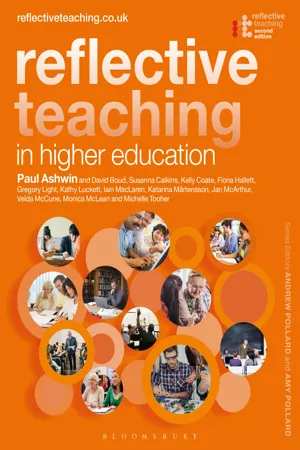
Reflective Teaching in Higher Education
  1. 472 pages
  2. English
  3. ePUB (mobile friendly)
  4. Available on iOS & Android
eBook - ePub

About this book

Reflective Teaching in Higher Education is the definitive textbook for those wanting to excel at teaching in the sector. Informed by the latest research in this area, the book offers extensive support for those at the start of an academic career and career-long professionalism for those teaching in higher education. Written by an international collaborative author team of experts led by Paul Ashwin, Reflective Teaching in Higher Education offers two levels of support:
- practical guidance for day-to-day teaching, covering key issues such as strategies for improving learning, teaching and assessment, curriculum design, relationships, communication, and inclusion
- evidence-informed 'principle's to aid understanding of how theories can effectively inform teaching practices, offering ways to develop a deeper understanding of teaching and learning in higher education In addition to new case studies from a wider variety of countries than ever before, this new edition includes discussion of:
- What is meant by 'agency'
- Gender, ethnicity, disability and university teaching
- Digital learning spaces and social media
- Teaching career development for academics
- Decolonising the curriculum
- Assessment and feedback practices
- Teaching excellence and 'learning gain'
- 2015 UN General Assembly 2030 Agenda for Sustainable Development reflectiveteaching.co.uk provides a treasure trove of additional support. It includes supplementary sector specific material to support for considering questions around society's educational aims, and much more besides.

Frequently asked questions

Yes, you can cancel anytime from the Subscription tab in your account settings on the Perlego website. Your subscription will stay active until the end of your current billing period. Learn how to cancel your subscription.
No, books cannot be downloaded as external files, such as PDFs, for use outside of Perlego. However, you can download books within the Perlego app for offline reading on mobile or tablet. Learn more here.
Perlego offers two plans: Essential and Complete
  • Essential is ideal for learners and professionals who enjoy exploring a wide range of subjects. Access the Essential Library with 800,000+ trusted titles and best-sellers across business, personal growth, and the humanities. Includes unlimited reading time and Standard Read Aloud voice.
  • Complete: Perfect for advanced learners and researchers needing full, unrestricted access. Unlock 1.4M+ books across hundreds of subjects, including academic and specialized titles. The Complete Plan also includes advanced features like Premium Read Aloud and Research Assistant.
Both plans are available with monthly, semester, or annual billing cycles.
We are an online textbook subscription service, where you can get access to an entire online library for less than the price of a single book per month. With over 1 million books across 1000+ topics, we’ve got you covered! Learn more here.
Look out for the read-aloud symbol on your next book to see if you can listen to it. The read-aloud tool reads text aloud for you, highlighting the text as it is being read. You can pause it, speed it up and slow it down. Learn more here.
Yes! You can use the Perlego app on both iOS or Android devices to read anytime, anywhere — even offline. Perfect for commutes or when you’re on the go.
Please note we cannot support devices running on iOS 13 and Android 7 or earlier. Learn more about using the app.
Yes, you can access Reflective Teaching in Higher Education by Paul Ashwin,David Boud,Susanna Calkins,Kelly Coate,Fiona Hallett,Greg Light,Kathy Luckett,Jan McArthur,Iain MacLaren,Monica McLean,Velda McCune,Katarina Mårtensson,Michelle Tooher in PDF and/or ePUB format, as well as other popular books in Education & Higher Education. We have over one million books available in our catalogue for you to explore.

Information

Year
2020
Print ISBN
9781350084667
eBook ISBN
9781350084681
Edition
2

Part one

Becoming reflective

1Identities  Who we are as teachers and who are our students?
2Learning  How do students develop their understanding?
3Reflection  How can we develop the quality of our teaching?
4Principles  What are the foundations of effective teaching and learning?
Part 1 introduces the activity of becoming a reflective teacher in higher education. We start in Chapter 1 with a focus on identities, who we are as teachers and who are our students. Then comes an introduction to ways of understanding students’ ‘learning’ (Chapter 2) – which is the foundation of how we make judgements about our teaching. The chapter on reflective practice (Chapter 3) examines our learning as teachers and discusses how such processes can improve the quality of our teaching. We then review the ten principles of effective teaching, learning and assessment in Chapter 4. These principles underpin the purpose of this book, which is to argue for the methodical use of evidence to inform our judgements as reflective teachers in higher education.

Chapter 1

Identities

Who we are as teachers and who are our students?

Introduction
Knowing ourselves as teachers
What we can do
Where we are going
Who we are going there with
What our values are
How our identities interact with our institutions, academic disciplines and work groups
The role of narrative and autobiography
How we understand and engage with our students
Knowing our students as learners
Students’ views of themselves as learners
Students’ identities and their experiences of university
Our assumptions about our students
Students’ perceptions of their teachers’ identities
Responding to individual students’ identities and their needs
Thinking about identities with our students
Conclusion

INTRODUCTION

Why does it matter who we are as teachers in higher education? Why does it matter that we think about who we are? Why does it matter who our students are, and why does it matter what we think about them? Why does it matter how our students think about themselves as learners?
These questions all concern matters of identity, which lie at the heart of what it means to be a reflective teacher in higher education. This is because the ways in which we see ourselves as human beings, as academics and as teachers, play a vital role in how we teach. Likewise, how our students see themselves as learners is crucial to how well they will be able to engage with the learning experiences we share with them. Understanding matters of identity helps us to navigate our careers and helps us to orientate ourselves towards our students, and to help them to learn.
Our identities can be attributed to us and our students, as white, black, female, LGBT+, working class, middle class, disabled, as members of particular disciplines or fields of study, as ‘home’ or international students or staff. Our identities are constructed through the work we do and the practices that we engage in. They are also a matter of affiliation, in that we may choose to identify with a particular group, but we do not have full control over matters of our identity. What is certain is that an understanding of matters of identity, our own identities and those of our students, enhances our sense of agency, efficacy and ability to influence our teaching and learning in many ways.
Being a teacher and being a student are interrelated processes and so our own identities as scholars and learners can help us to understand our students’ identities. Simply because as teachers we are not learning the same things as our students, it does not mean that we stop learning. On the contrary, our learning should be ever deepening and broadening as we move through our careers as reflective teachers in higher education.
See Chapter 4
TLRP Principles
Two principles are of particular relevance to this chapter on identity:
Principle 2: Effective teaching and learning depends on the scholarship and learning of all those educators who teach and research to support the learning of others. The need for lecturers, teachers and trainers to learn through doing research to improve their knowledge, expertise and skills for teaching should be recognized and supported.
Principle 10: Effective teaching and learning equips learners for life in its broadest sense. Learning should help individuals develop the intellectual, personal and social resources that will enable them to participate as active citizens, contribute to economic, social or community development, and flourish as individuals in a diverse and changing society. This means adopting a broad conception of worthwhile learning outcomes and taking seriously issues of equity and social justice for all.
This chapter discusses the significance of identities for teachers, covering issues such as sense of direction, values, attitude towards students, narrative and biography, shared assumptions, and the role of emotions. In relation to students’ identities, it considers: their perceptions of themselves, their views of each other and their attitudes towards their teachers. The chapter concludes with a restatement of the importance of coming to terms with the role of identity in reflective teaching.
In this chapter, some of the examples we draw upon come from South Africa. South African higher education remains influenced by the vestiges of its apartheid past, and its university teachers often need to grapple with ongoing tensions and opportunities in relation to group and individual identities. Whilst these issues may be more immediately striking in the South African context, they are issues that we all face as reflective teachers. Other examples in this chapter come from research conducted in the UK into how academics understand themselves as teachers and how students from different backgrounds see themselves as learners. Wherever we are located, these cases can help us to think through what ‘identities’ might mean in contexts of diversity and change, which are increasingly present in higher education globally.
To aid this process, Research Briefing 1.1 examines the different meanings of identities and how these relate to agency.
Book
RESEARCH BRIEFING 1.1 Identities and agency
It is quite common when writing about how academics and students see themselves to use the word ‘identities’. This plural form is used to signal that how we understand ourselves is a complex dance over time between: stories we tell about ourselves; stories others tell about us; our values; and our sense of connection with or exclusion from different groups and communities (for recent explorations of academic identities see Evans and Nixon 2015; Brew et al. 2018; McAlpine and Amundsen 2018; Ursin et al. 2018).
It can be helpful to think of our identities as a set of stories about us which are created and recreated over time through social, cultural and historical processes (Sfard and Prusak 2005; McAlpine and Amundsen 2018). The consistent storylines we use over time can give u...

Table of contents

  1. Cover
  2. Half-Title Page
  3. Series Page
  4. Title Page
  5. Dedication
  6. Contents
  7. Introduction
  8. Using this book
  9. A summary of the book
  10. Part one Becoming reflective
  11. 1 Identities Who we are as teachers and who are our students?
  12. 2 Learning How do students develop their understanding?
  13. 3 Reflection How can we develop the quality of our teaching?
  14. 4 Principles What are the foundations of effective teaching and learning?
  15. Part two Creating conditions for learning
  16. 5 Contexts How do they shape us and how do we shape them?
  17. 6 Relationships How are we getting on together?
  18. 7 Engagement How does our engagement with teaching influence student learning?
  19. 8 Spaces How are we creating environments for learning?
  20. Part three Teaching for understanding
  21. 9 Curriculum What is to be taught and learned?
  22. 10 Planning How are we implementing curricula?
  23. 11 Teaching How can we develop strategies focused on student understanding?
  24. 12 Communication How can we support learning through dialogue?
  25. 13 Assessment How does it make a contribution to learning?
  26. Part four Reflecting on consequences
  27. 14 Quality How are we monitoring and enhancing the quality of teaching and learning?
  28. 15 Inclusion How are we enabling opportunities?
  29. Part five Deepening understanding
  30. 16 Expertise How do we develop a career-long engagement with teaching?
  31. 17 Professionalism How does reflective teaching contribute to society?
  32. The Reflective Teaching in Higher Education Team
  33. Bibliography
  34. Index
  35. Copyright