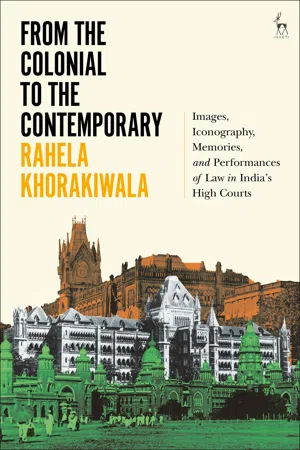
From the Colonial to the Contemporary explores the representation of law, images and justice in the first three colonial high courts of India at Calcutta, Bombay and Madras. It is based upon ethnographic research work and data collected from interviews with judges, lawyers, court staff, press reporters and other persons associated with the courts. Observing the courts through the in vivo, in trial and practice, the book asks questions at different registers, including the impact of the architecture of the courts, the contestation around the renaming of the high courts, the debate over the use of English versus regional languages, forms of addressing the court, the dress worn by different court actors, rules on photography, video recording, live telecasting of court proceedings, use of CCTV cameras and the alternatives to courtroom sketching, and the ceremony and ritual that exists in daily court proceedings. The three colonial high courts studied in this book share a recurring historical tension between the Indian and British notions of justice. This tension is apparent in the semiotics of the legal spaces of these courts and is transmitted through oral history as narrated by those interviewed. The contemporary understandings of these court personnel are therefore seen to have deep historical roots. In this context, the architecture and judicial iconography of the high courts helps to constitute, preserve and reinforce the ambivalent relationship that the court shares with its own contested image.
eBook - ePub
From the Colonial to the Contemporary
Images, Iconography, Memories, and Performances of Law in India's High Courts
- 280 pages
- English
- ePUB (mobile friendly)
- Available on iOS & Android
eBook - ePub
From the Colonial to the Contemporary
Images, Iconography, Memories, and Performances of Law in India's High Courts
About this book
1
Framing the Research
I.Introduction
As a law student in the Bombay High Court, I walked past carvings, statues, portraits, and inscriptions, without pausing to dwell on the images of justice that inhabited the juridical field, alongside the precedents of justice (and injustice) lawyers argued in courtrooms routinely. Yet, I inherited a sense of pride in the history that was conserved in the Bombay High Court through a series of events, performances, documents and archives, such that this sense of historicity was also part of my identity as a lawyer. It was when I encountered a wealth of literature on the iconography of justice, courtroom architecture and prolific images of justice, that I decided to research what law, visuality and culture in former presidency courts tell us about law, history and memory. I borrow eclectically from a range of disciplines and sources – visual studies, legal anthropology, aesthetics, legal theory and history – to frame my research.
I have looked at three High Courts: the Calcutta High Court; the Bombay High Court; and the Madras High Court. I write about the three High Courts in the order in which they were constructed, beginning with Calcutta and ending with Madras. These courts were from the erstwhile presidency towns as designated by the British. It is important to note that the three courts were brought into existence in July 1862 through a Letters Patent issued by the Queen. Through the Letters Patent the several existing courts in these three towns were merged and brought under the ambit of one High Court each. They were the first of the consolidated British judicial institutions, under the direct control of the British Crown, to be thus set up in colonial India. The three High Courts were all sanctioned at the same time and they started their judicial work accordingly. However, the current buildings that these courts inhabit were built subsequently. The Calcutta High Court was completed first in 1872, followed by the Bombay High Court in 1878 and the Madras High Court in 1892. The original buildings from the late 1800s are still the main buildings for these High Courts. Therefore, there is a link between the three courts, having all commenced at the same time, under the same rules and regulations, but each having their own distinct identity. It is for this reason that I have selected these three High Courts for my field research to represent the visual culture of courts in India.
Beginning with ideas of iconography and symbolism I trace the judicial iconography of courts in India and across the world. I follow this through my fieldwork in the former presidency town High Courts where I analyse the intersection of law, history and memory. Observing these courts, I document the prolific images of justice abounding their precincts. Using the intersection of multiple approaches and methods, I compare these High Courts on different registers to describe the visual culture of each court by highlighting the commonalities and distinct features that mark these judicial spaces. I focus on how court buildings memorialise history and how memory attaches itself to specific courtrooms or court artefacts. I am interested in exploring whether court spaces are neutral or if the judicial iconography has a symbolic effect in these spaces. What kind of images of justice do these spaces then purport? When law influences the way history is memorialised, what kind of narratives do the colonial courts of India invert and relate? How may we then define visual justice; or the relation between law and visual culture? This book walks through these High Courts asking these questions, drawing a visual storyboard for court spaces in India.
II.Law, Visuality and Culture
‘Visual justice’ as a concept, or more broadly, ‘law and visual culture’, draws upon different approaches and theories of iconography, semiotics and symbolism to reflect on law as a form of representation. Law is then not merely doctrinal where black-letter law is treated as what the law stands for. Rather than only think of the law through the written text, the emphasis on the relationship between law and the image displaces the written word as the privileged way of defining law. Through this book, I argue that the law may be understood through its ocular representations and different forms of visualisation that manifest in a variety of ways that are constitutive of what we understand by visual justice, or more broadly, the visual culture of law.
By looking at judicial iconography as a starting point, various allegories and images of law and justice come to life and begin to have a new meaning (see chapter two). The symbolic power of law and justice is crucial to law’s legitimacy. Hence, the visual, which encompasses prolific imagery, interplays with the iconographical representation of signs and motifs becoming critical to law. Rather than follow a purely semiotic approach to law, I adopt a socio-legal method to understand the relationship between law and visual culture. This approach allows me to describe how the law, using its various attributes, is able to create an ocular theme that defines its judicial iconography and becomes a symbol of representation for the standard of majesty and dignity that it holds itself to.
In other words, I depart from the model of legal research that largely focuses on the rules of law, interpretation and the analysis of judicial decisions and associated legislative enactments. Rather, I argue that when the same legal system is looked at in terms of its judicial iconography, then a new form of socio-legal research of the visual culture of courts becomes possible. This form of ethnography of the visual culture in courts engages with the judicial space, not only in terms of the law that is promulgated from its orders and judgments, but also through the regulation of the visual in the law, the symbolism of the courtroom as a performative space and the constitution of the court as a theatre where justice is not only done, but must also be seen to be done.
The ethnographic work in this book focuses on the aspects of the architecture of the courts, the dress worn by the various court actors, the debates over the language that the court uses and the official names of the court that it identifies with, along with the symbolism associated with the ceremony and ritual that is part of the daily routine of the court. The avenues of analysis are not restricted only to the outwardly visual, but also to the visual that is controlled in forms of restrictions on photography and video-recording in and of courts that speaks of, to borrow from Robert Cover, the ‘jurispathic’ tendency of the law to violently control competing images that challenge its legitimacy.1
In creating a particular visualisation of court spaces, the law manages to represent itself and create a visual culture of its own. When this visual culture is thus created, the law succeeds in creating a memory of itself that defines not only the present, but even the past and the future. Judicial iconography not only conserves history and memory in specific ways, but also narrates a specific internal history about how law creates and negotiates its symbolic power. Therefore, the visual presentation of law, and in this specific case, the courts of law, creates a history for itself that defines the meaning of judicial iconography for courts and acknowledges the presence of legal symbolism that alters the way the court is perceived, feared and venerated. While research on judicial iconography of courts is prevalent across the world, in India it is a relatively nascent field of research. In this book, I explore the visual culture of courts in India hitherto not considered for socio-legal research. The visual field of the law is thus constituted as a field of research, and the theatre of the court is highlighted. The procedures employed, the daily rituals followed and the traditions of the court are all signifiers of law and its relation to history and memory.
III.The Three Courts: Law, History and Memory
For my research, I travelled to three High Courts of India in Calcutta, Bombay and Madras that represent the colonial structures of law that developed under imperial rule. Each court is linked by a common history, while each has a unique ocular theme. These courts provide a common ground for comparison since each court resources its identity and pride through its architectural and iconic history. Yet, each court has a unique story that represents visual justice in distinct ways. The proliferation of allegories, symbols, icons and ceremonies that were initiated during colonial law, find reinterpretation and layering over after independence. Hence, we do not find that there is only one kind of official judicial iconography that exhausts these courts; rather, the proliferate experimentations with design, ornamentation and even judicial satire complicates our understanding of how legal history inscribes itself on the spaces of the courts today.
India always had its own local and regional judicial systems, and when the British came, they created their own courts of law and imposed the British common law system of the rule of law and natural justice upon its colony, despite these existing judicial systems.2 While several company courts were introduced under the rule of the East India Company, the biggest step in the establishment of a consolidated British judicial system with judges, courts and lawyers in one unified format was introduced by the creation of the three High Courts in the British defined presidency towns of Calcutta, Bombay and Madras. Being the first three courts to be set up in this manner, and to have continued and merged into the Indian legal system post-independence, they define the framework within which I look at the visual representation of law and justice in India.
As Mithi Mukherjee argues, when India gained independence from the British in 1947, it did not mark a break from the colonial past that India had inherited over 200-odd years.3 In fact, the Indian state continued to evolve under, what Mukherjee terms the, ‘shadows of empire’.4 While analysing the three colonial High Courts in the contemporary context it must be remembered that these law courts were established under colonial rule which inherently comprised the principles of ‘domination and subordination’, as noted by Radhika Singha when she debates the despotic nature of colonial law and the way colonial notions defined what law and order meant in India.5 Further, at the time of independence, India carried forward a substantial degree of rules, laws and administrative principles from the colonial period. One of the most important aspects that was carried forward was the judicial system. When the Constitution of India was written, it incorporated most of The Government of India Act, 1935, which was a colonial enactment, along with borrowing principles from the constitutions of various western democracies.6 In the context of this book, the most significant part that followed through after independence, in the form that they were established, were the first three High Courts of 1862 from the erstwhile presidency towns of Calcutta, Bombay and Madras. The laws that were used to create this judicial system were also used to legitimise colonialism and its ideologies.7
The unique colonial influence and the merging of these three High Courts into the Indian legal system as developed with the adoption of The Constitution of India, 1950, places them in a different scope of judicial iconography from other courts that have been analysed in a similar context. The particular colonial history that these courts bring forward was evident through the course of my fieldwork and is an integral part of the understanding of how the study of iconography and semiotics is exclusive to this particular Indian context. Thus, the cultural influence on the visual imagery of the law is influenced by the historical setting of the judicial institution itself. Notably, historians often write about the positive influence of the empire on India8 failing to acknowledge the impact it had on altering the existing traditions under the strong belief that the native Indians needed reform.9
A critical aspect of domination of colonial law was exhibited through colonial architecture, a point that is further elucidated through the course of this book. Elizabeth Kolsky documents that the entire notion of colonialism was linked to a superior-over-inferior relationship and the imperial masters portrayed this principle in several ways, the most prominent being through their buildings, the judicial system and the courts of law.10 Kolsky contends that it was on this very belief of superiority that the preservation of the empire continued and succeeded.11 Ian Baucom notes that in the post-1857 era,12 vast sums of money were spent on building projects as it was believed that, ‘the identity of the empire’s subjects was to a significant degree a product of the objects and structures which they beheld and inhabited’.13 Baucom argues that the belief at that time was that there was an, ‘analogous relationship between architecture and the arts of imperial rule’ and therefore, the British used architecture, not only as a symbol of empire, but also as an, ‘implement of imperial governance’.14 For the British, then, this became a means of disciplining the colony by changing the framework of the colonial space and also by adding the required elements of ‘English morals’ in order to dominate the native Indian.15
In 1878, the understanding for British India was that these Gothic built edifices with their distinct architectural features, which were English in idea and construction, would cause the native Indian to cow down and ‘behold the colonist’.16 The entire notion of creating these buildings was to maintain the British ideals while being constructed at the most important sites of the colony. The courts of law were part of this identity that the empire wanted to create. Colonial law propagated through these colonial structures therefore plays a specific role in the visual histories of the three High Courts under study in this book. The despotic tendencies of colonial law are embedded in the very framework of these courts, creating a specific imperial imagination of iconology, symbolism and signs in an ocular setting. The way the Calcutta, Bombay and Madras High Courts have been structured represent a feature of colonial governance wherein they controlled the colonies through a specific design of imperial polity that has continued in their post-colonial form.
In his germinal work, Bernard Cohn writes that colonialism was a critical factor in the structuring of the metropole and through this it shaped the modern history of all the colonised places.17 While India had its own history, along with an existing Mughal system of administration of law and order, when the East India Company arrived, over the course of the years, they still managed to permeate the native culture thereby making British law the law of India.18 This occurred gradually, and was seen, for example, when Persian was replaced with English in the courts of law, and judges were independent appointees as opposed to the existing panchayat system of ‘judges’ being selected from amidst the locals.19 These important historic occurrences are uniquely tied to the colonial culture of the three High Courts that are the primary focus of this study. It is important therefore to understand these courts, their practices and their rituals within this colonial culture of dominance.
The High Courts of Calcutta, Bombay and Madras are linked to each other through the Letters Patent that established them in 1862 and to the fact that they continue to function with the same perceived authority and through the same judicial structure that was created for their use in the late 1800s. While the common features of these three High Courts link them together, the individual visual culture of these courts creates a distinct identity for them. Reading through the tools of ethnography that I have employed, the specific customs of each court, although different, all speak the same language of justice being represented and identified through different attributes and the contribution of the visual is significant amongst all, along with the various remnants of colonial history that abound their structures.
Today, the erstwhile criminal courtrooms in the three courts have become sites where memory attaches itself to specific courtrooms or legal artefacts. Following the idea that law is, ...
Table of contents
- Cover
- Title Page
- Acknowledgements
- Contents
- List of Abbreviations
- 1. Framing the Research
- 2. The Visual Field of Law
- 3. The Calcutta High Court
- 4. The Bombay High Court
- 5. The Madras High Court
- 6. Attributes of Justice
- 7. Conclusion
- Appendix: Before the Law, Franz Kafka
- Bibliography
- Index
- Copyright Page
Trusted by 375,005 students
Access to over 1.5 million titles for a fair monthly price.
Study more efficiently using our study tools.
Frequently asked questions
Yes, you can cancel anytime from the Subscription tab in your account settings on the Perlego website. Your subscription will stay active until the end of your current billing period. Learn how to cancel your subscription
No, books cannot be downloaded as external files, such as PDFs, for use outside of Perlego. However, you can download books within the Perlego app for offline reading on mobile or tablet. Learn how to download books offline
Perlego offers two plans: Essential and Complete
- Essential is ideal for learners and professionals who enjoy exploring a wide range of subjects. Access the Essential Library with 800,000+ trusted titles and best-sellers across business, personal growth, and the humanities. Includes unlimited reading time and Standard Read Aloud voice.
- Complete: Perfect for advanced learners and researchers needing full, unrestricted access. Unlock 1.5M+ books across hundreds of subjects, including academic and specialized titles. The Complete Plan also includes advanced features like Premium Read Aloud and Research Assistant.
We are an online textbook subscription service, where you can get access to an entire online library for less than the price of a single book per month. With over 1.5 million books across 990+ topics, we’ve got you covered! Learn about our mission
Look out for the read-aloud symbol on your next book to see if you can listen to it. The read-aloud tool reads text aloud for you, highlighting the text as it is being read. You can pause it, speed it up and slow it down. Learn more about Read Aloud
Yes! You can use the Perlego app on both iOS and Android devices to read anytime, anywhere — even offline. Perfect for commutes or when you’re on the go.
Please note we cannot support devices running on iOS 13 and Android 7 or earlier. Learn more about using the app
Please note we cannot support devices running on iOS 13 and Android 7 or earlier. Learn more about using the app
Yes, you can access From the Colonial to the Contemporary by Rahela Khorakiwala in PDF and/or ePUB format, as well as other popular books in Law & Courts. We have over 1.5 million books available in our catalogue for you to explore.