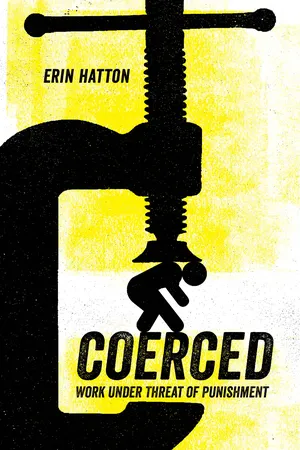
What do prisoner laborers, graduate students, welfare workers, and college athletes have in common? According to sociologist Erin Hatton, they are all part of a growing workforce of coerced laborers.
Coerced explores this world of coerced labor through an unexpected and compelling comparison of these four groups of workers, for whom a different definition of "employment" reigns supreme—one where workplace protections do not apply and employers wield expansive punitive power, far beyond the ability to hire and fire. Because such arrangements are common across the economy, Hatton argues that coercion—as well as precarity—is a defining feature of work in America today.
Theoretically forceful yet vivid and gripping to read, Coerced compels the reader to reevaluate contemporary dynamics of work, pushing beyond concepts like "career" and "gig work." Through this bold analysis, Hatton offers a trenchant window into this world of work from the perspective of those who toil within it—and who are developing the tools needed to push back against it.
- 304 pages
- English
- ePUB (mobile friendly)
- Available on iOS & Android
eBook - ePub
About this book
Information
Publisher
University of California PressYear
2020Print ISBN
9780520305397
Edition
1eBook ISBN
9780520973404
1
“Wicked” and “Blessed”
CULTURAL NARRATIVES OF COERCED LABOR
We’re trying to make them into taxpayers instead of tax burdens. . . . No rest for the wicked.1
—Steve Smith, then director of Colorado Correctional Industries, describing its prison labor program
Exploited? Try blessed. Here’s hoping they spend this weekend counting their blessings while ignoring the members of the chattering class who are trying to convince them to walk away.2
—Seth Davis, senior writer for Sports Illustrated, discussing the possibility of University of Oklahoma men’s basketball players boycotting the 2016 NCAA Final Four
“No rest for the wicked,” then director of Colorado’s prison industry program said of prisoners. Apache agreed, as you will recall. “It’s not supposed to be a camp,” he argued. “We’re in prison. We’re not supposed to come in and kick our feet up.” “If you do bad,” Apache said, “you get bad.” Meanwhile, Sports Illustrated writer Seth Davis described college athletes as “blessed,” not “exploited.” Haley, one of the athletes I interviewed, agreed. Having played for one of the best women’s college basketball teams in the country, she described herself as “100% blessed.” “I still don’t know how it all happened,” she told me, “but I’m forever grateful for that opportunity.”
These tropes of immorality and privilege—being “wicked” and “blessed”—dominate American cultural narratives of incarcerated and college athlete labor, respectively. Prisoners, by virtue of their incarceration, are deemed to be fundamentally immoral, and their labor is construed as punishment, reparation, or rehabilitation for their “wickedness.”3 Athletes, by contrast, are not seen as performing labor at all. Instead, they are viewed as privileged—“blessed”—to play their sport and are therefore expected to be “grateful” for their good fortune.
On some level, these portrayals make sense and not only because we—as writer and reader—are of the culture in which such tropes prevail. In point of fact, prisoners have been convicted of crimes, sometimes heinous ones, and Division I athletes are an elite set, sometimes achieving fame and access to future fortune at a young age. Therefore, although neither group is perceived to be entirely “wicked” or “blessed,” these characterizations likely ring true for many Americans.
Yet these tropes of immorality and privilege are not unique to these groups, for they are also used to characterize the other workers in this study. Like prisoners, workfare workers are culturally construed as immoral, while PhD students, like athletes, are seen as privileged. In fact, these tropes extend well beyond these four groups, dating from (at least) the 18th and 19th centuries when they were applied to enslaved and indigenous people, as well as white housewives in the United States. Thus, the repeated use of these narratives over time and across groups suggests that rather than apt descriptors of such groups, they are cultural artifacts themselves worthy of study.
In this chapter, I unpack these cultural artifacts. I begin with a brief examination of how narratives of immorality and privilege were deployed during the American Industrial Revolution. In highlighting this narrow slice of what is in fact a much broader cultural history, I seek to expose the artificiality of these narratives. Indeed, from today’s perspective the claim that—for example—the violently brutal system of slavery would benefit the enslaved by remedying their inherent laziness is not only a racist and farcical anachronism. It is also an unambiguous strategy to exploit their labor by justifying their exclusion from rights-bearing “work” and legitimizing their bosses’ power over them. In short, claims of enslaved people’s immorality—their laziness as well as their ignorance and criminality—served as the cultural scaffolding for their violent exploitation, subjugation, and coercion.
Having highlighted the social engineering behind such narratives, I then jump from the distant past to the contemporary era to analyze how narratives of immorality and privilege are used to govern the workers at the center of this book. I do so in two analytical steps. First, through a rereading of secondary literature, I show how recent institutional changes in the U.S. criminal justice, welfare, and higher education systems have made it more likely for such narratives to be culturally affixed to their respective populations. Second, through analysis of hundreds of cultural documents—newspaper and magazine articles, government and institutional publications, court rulings, and online discussion boards—I explore how these narratives of immorality and privilege are applied to incarcerated, workfare, college athlete, and graduate student workers.
Despite important differences in how these narratives exploit logics of race, class, and gender, I find that they use similar methods to produce similar results. By portraying their targets as subordinate, dependent, childlike figures who require extensive direction, control, and (often) punishment, narratives of immorality and privilege cast them as something other than “workers” doing something other than rights-bearing “work.” As a result, these narratives not only justify workers’ exclusion from the rights and privileges of “employment.” They also justify workers’ status coercion: their bosses’ legal, culturally accepted, and institutionally expected power over their positions in those institutions and in society. Thus, I argue that narratives of “wickedness” and “blessedness” are two sides of a single ideological apparatus used to delegitimize and discipline workers in America.
IMMORALITY AND PRIVILEGE IN THE INDUSTRIAL REVOLUTION
The Industrial Revolution of the 18th and 19th centuries not only produced modern forms of work; it also produced modern ideas about work. For it was through industrialization that work in America came to be narrowly defined as “wage labor,” a newly constructed category that was deeply entwined with emerging notions of economic independence, morality, and citizenship.4 The fulcrum of this new definition of work was white masculinity, and so, in a looping cycle of exclusion and stigmatization, women and nonwhite workers were excluded from wage labor and associated with economic dependence, immorality, and noncitizenship, or at least a lesser citizenship. As a result, by the end of industrialization a broad range of workers, from enslaved people to housewives, were—despite their labor—neither culturally nor legally deemed to be productive, rights-bearing “workers.”
It is thus illustrative to examine the cultural tropes of nonwork during that time, when such tropes were relatively new and raw, rather than naturalized and normalized as are today’s versions. To do so, I draw on Nancy Fraser and Linda Gordon’s analysis of what they call the three “icons of dependency” in 19th-century America: the “pauper,” the “slave and colonial native,” and the white middle-class “housewife.” 5 My reinterpretation of their findings, as well as my own analysis of primary documents and secondary literature, reveals that tropes of “immorality” and “privilege” were central to discursively framing all of these groups as economically dependent noncitizen nonworkers.
In the case of paupers, for example, narratives of immorality were the sine qua non of their 19th-century cultural construction. As Fraser and Gordon write, “Paupers were not simply poor but degraded, their character corrupted and their will sapped through reliance on charity.”6 More than just vaguely immoral, paupers were associated with several particular brands of immorality: indolence, “feeblemindedness,” criminality, and (for women) sexual promiscuity.7 As the latter suggests, such allegations were not only classed but also gendered and raced, and they were disproportionately levied at those deemed deficient in fulfilling gender roles as well as racialized others, including those with “tainted whiteness” (such as immigrants of Irish, Italian, and Jewish descent).8
To redress their purported immorality, 19th-century paupers (along with people with physical and mental disabilities) were often confined in workhouses, also known as “poorhouses” or “almshouses,” the conditions of which were deliberately abhorrent in an effort to deter claims for relief.9 In such institutions, all remotely able-bodied occupants were compelled to work, for it was broadly believed that labor was the antidote to paupers’ immorality and that because of their inherent laziness, compulsion was required. If they did not adequately perform such labor, or if they broke any of the workhouses’ many moral codes, they would be punished. In one New York poorhouse, for example, such punishment entailed solitary confinement with only bread and water as sustenance.10 As its 1831 “Rules & Regulations” stated,
If any persons shall neglect to repair to their proper place to work, or being there shall refuse to work, or shall loiter, be idle or shall not well perform the task of work wet them, or shall waste or spoil any of the materials or tools, or shall deface the walls, or break the windows, or shall disturb the house by clamorous quarrelling, fighting or abusive language, or shall bring any strong liquors into the house without leave, or shall behave disrespectfully to any, or shall be guilty of lying, or in any other respect act immorally, they shall be punished by withholding their regular means, not exceeding one days [sic] allowance, or by being confined in a cell, or some solitary place and supported on bread and water, at the discretion of the keeper, not exceeding seventy two hours: unless the board of superintendents order a longer confinement, or proceed against them before a justice of the peace, there to be dealt with according to law.11
As this passage suggests, labor was not only the cornerstone of American poorhouses; it was the cornerstone of American morality. Work was explicitly equated with morality—and idleness with immorality—despite unequal access to culturally defined “work.” For paupers, then, compulsory labor was both punishment and remedy for their perceived moral failings.
Immorality was also the central tenet of 19th-century cultural constructions of enslaved and indigenous people. In fact, the only significant difference was the role of race: while paupers were an implicitly racialized emblem of immorality, slaves and Native Americans were explicitly racialized as such. Simply by virtue of their race, they were presumed to be immoral. Yet they were charged with the very same brands of immorality as were paupers: indolence, moral depravity, promiscuity, and feeblemindedness.12 Just as these allegations were used to justify paupers’ confinement and compulsory labor, they were used to justify Black enslavement in the American South. “Since blacks were inferior,” historian Eugene Genovese writes, “they had to be enslaved and taught to work, but, being inferior, they could hardly be expected to work up to Anglo-Saxon expectations.”13 In fact, proponents of slavery argued that this sadistic system of forced labor would morally “elevate” this “degraded race.” For instance, as South Carolina politician William Harper proclaimed in his 1853 Pro-Slavery Argument,
Slavery . . . has done more to elevate a degraded race in the scale of humanity; to tame the savage; to civilize the barbarous; to soften the ferocious; to enlighten the ignorant, and to spread the blessings of Christianity among the heathen, than all t...
Table of contents
- Title
- Copyright
- Dedication
- Epigraph
- Contents
- List of Tables
- Acknowledgments
- Foreword
- Introduction
- 1. “Wicked” and “Blessed”: Cultural Narratives of Coerced Labor
- 2. “Either You Do It or You’re Going to the Box”: Coercion and Compliance
- 3. “They Talk to You in Any Kind of Way”: Subjugation, Vulnerability, and the Body
- 4. “Stay Out They Way”: Agency and Resistance
- 5. “I’m Getting Ethiopia Pay for My Work”: Hegemony and Counter-Hegemony
- Conclusion
- Appendix A. The Story of This Book
- Appendix B. People qua Data
- Notes
- Selected Bibliography
- Index
Trusted by 375,005 students
Access to over 1.5 million titles for a fair monthly price.
Study more efficiently using our study tools.
Frequently asked questions
Yes, you can cancel anytime from the Subscription tab in your account settings on the Perlego website. Your subscription will stay active until the end of your current billing period. Learn how to cancel your subscription
No, books cannot be downloaded as external files, such as PDFs, for use outside of Perlego. However, you can download books within the Perlego app for offline reading on mobile or tablet. Learn how to download books offline
We are an online textbook subscription service, where you can get access to an entire online library for less than the price of a single book per month. With over 1.5 million books across 990+ topics, we’ve got you covered! Learn about our mission
Look out for the read-aloud symbol on your next book to see if you can listen to it. The read-aloud tool reads text aloud for you, highlighting the text as it is being read. You can pause it, speed it up and slow it down. Learn more about Read Aloud
Yes! You can use the Perlego app on both iOS and Android devices to read anytime, anywhere — even offline. Perfect for commutes or when you’re on the go.
Please note we cannot support devices running on iOS 13 and Android 7 or earlier. Learn more about using the app
Please note we cannot support devices running on iOS 13 and Android 7 or earlier. Learn more about using the app
Yes, you can access Coerced by Erin Hatton in PDF and/or ePUB format, as well as other popular books in Social Sciences & Criminology. We have over 1.5 million books available in our catalogue for you to explore.