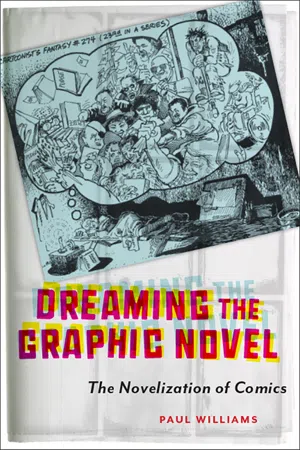
The term "graphic novel" was first coined in 1964, but it wouldn't be broadly used until the 1980s, when graphic novels such as Watchmen and Maus achieved commercial success and critical acclaim. What happened in the intervening years, after the graphic novel was conceptualized yet before it was widely recognized? Dreaming the Graphic Novel examines how notions of the graphic novel began to coalesce in the 1970s, a time of great change for American comics, with declining sales of mainstream periodicals, the arrival of specialty comics stores, and (at least initially) a thriving underground comix scene. Surveying the eclectic array of long comics narratives that emerged from this fertile period, Paul Williams investigates many texts that have fallen out of graphic novel history. As he demonstrates, the question of what makes a text a 'graphic novel' was the subject of fierce debate among fans, creators, and publishers, inspiring arguments about the literariness of comics that are still taking place among scholars today.Unearthing a treasure trove of fanzines, adverts, and unpublished letters, Dreaming the Graphic Novel gives readers an exciting inside look at a pivotal moment in the art form's development.
- English
- ePUB (mobile friendly)
- Available on iOS & Android
eBook - ePub
About this book
Information
Publisher
Rutgers University PressYear
2020Print ISBN
9781978805064
9781978805071
eBook ISBN
9781978805088
1
The Death of the Comic Book
To understand the hunger for novelization, we need to see how desperate the mainstream U.S. comic book industry looked (and to some extent was) during the period. The Cassandras increased in number such that at the end of the 1970s, foreseeing the death of comics had been repeated to the point of cliché. The ambient background for novel talk was this murmur of decline, with book formats and glossy magazines peppering the conversation as a way out of the malaise.
Many iconic superheroes were invented in the 1960s: the Fantastic Four, Spider-Man, the Hulk, Iron Man, Thor, and so on. Marvel’s conflicted characters, hazy-but-progressive politics, and extended, interlocking narratives attracted an apparently new demographic group of readers: college students. They represented a tiny proportion of the market, but the college audience garnered national attention in the press and was a key component of Marvel’s self-promotion as a publisher with adult appeal. In 1967, Marvel’s titles were outselling those of their main competitor, DC, though DC also benefitted from media publicity. Sales of Batman (1940–2011) rocketed in connection to the television series (1966–1968) starring Adam West. Unfortunately, the visibility (and to an extent, hipness) of superhero comics could not counteract deep-seated problems with the comics industry. In 1969, almost no new titles were launched, overall sales were in decline, and most publishers were forced to increase their cover price to 15¢ to salvage profits.1 Two problems regularly lamented were (a) the distribution of comics using the same method as magazines—that is, in bulk and on a sale-or-return basis—and (b) the content and material characteristics of the product.
Distributing Periodical Comics
To give a snapshot of sales in 1970: Marvel’s most popular title was The Amazing Spider-Man (1963–1998), selling an average of 330,000 copies per issue, but that was clearly dwarfed by Archie (1942–2015) at 483,000 copies; if you combined sales of all the comics in which he appeared, Superman was the most popular character in U.S. comics. Marvel’s core series sold around 200,000–250,000 copies per month, though its total sales were lower than DC’s total sales.2 The Big Two’s comics were sold at a variety of locations: newsstands, drugstores, grocery shops, bus stations, railway stations, and convenience stores. Since the middle of the twentieth century, the delivery of periodical comics to their point of sale was incorporated into the magazine distribution system: publishers had their comics printed and sent to a distributor (sometimes a branch of the same corporation as the publisher), who shipped the comics to independent regional distributors acting as wholesalers selling the comics on to retailers. The comics were distributed in mixed bundles, so it was impossible for vendors to order specific numbers of specific titles, but copies that no one bought could be returned to the publisher for credit.3 This sale-or-return system, introduced in the 1940s, was still the primary means of selling comics in the 1970s, though one crucial factor had changed in the early 1960s: in order to save money, the large publishers moved to the affidavit system whereby wholesalers could declare their comics unsold without having to provide proof (before the affidavit system was adopted, wholesalers had been ripping off the covers of unsold comics and sending them to publishers as evidence).4
During boom years such as the 1940s and early 1950s, when comics were expected to sell 70 percent of their print run, it was a profitable system. But this method of distribution became uneconomical in following decades when comics were selling 30–40 percent of their print run and just breaking even. Comics historian Bradford Wright estimates that the major companies were selling one copy of each comic for every three they printed. As the cost of paper rose in the 1970s, the sale-or-return system looked less viable than ever.5 The increased expense was passed on to consumers, with the “base price” of a comics periodical (the lowest sales price offered by large publishers) increasing from 15¢ in 1969 to 50¢ in 1981. The number of small retailers was in decline, and the supermarkets and larger stores putting them out of business were disinclined to stock comics: the profit margin was tiny, they occupied shelf space that could be used for more lucrative products, and comics were believed to encourage loitering browsers rather than swift purchasers.6 In 1978, the fan-journalist Gary Brown summarized that the “return from handling comic books was mere pennies—and when the work involved in displaying them and keeping them current (twice a week) was added in, many dealers refused to touch comic books at all.”7 For the wholesaler, the cost of transporting comics to a retailer and taking back unsold copies could be higher than the potential profit on those titles, so it made more financial sense to leave them unshipped in the warehouse.8 Publisher James Warren recounted visiting a wholesaler’s warehouse and finding dozens of comics in unopened packages.9 As The Comics Journal put it, “Distributors consider comics excess baggage.”10
The most pernicious facet of the sale-or-return system was that it enabled corrupt business practices. Some newsstands received their comics two weeks late because local distributors prioritized their own retail outlets.11 Worse, wholesalers peddled comics secretly (especially titles highly coveted by comics dealers) and then, in order to claim credit from the publisher, reported those titles unsold.12 By its nature, the extent of this problem is difficult to establish, but there is extensive anecdotal corroboration from industry professionals.13 Robert L. Beerbohm, a comics dealer since the 1960s, provides an account of this “widespread fraud” in “Secret Origins of the Direct Market” (1999–2000), an essay in which he asserts that it “was known to some that the Mafia had infiltrated the magazine distribution business.” Beerbohm started selling comics by mail order in 1964, and by 1968, he was able to purchase new titles such as Silver Surfer (1968–1970) in lots of 200 copies. Distributors had “cash and carry” tables for customers to buy comics straight from the warehouse, and Beerbohm believes that the comics he bought from distributors were officially recorded as shredded. He contends that the big publishers had no idea what was selling, and in the following decade, some dealers bought their local wholesaler’s entire stock of popular series, leading to those titles’ “regional scarcity.” Beerbohm’s essay moots that this affected the survival of key series, though Paul Levitz (writer and editor at DC in the 1970s) argues that with “a typical launch” of 300,000 copies, unrecorded sales to fans would need to be 30,000 or more “to have a meaningful effect,” only likely on a few occasions. One of those occasions may have been the release of Marvel’s Conan the Barbarian (1970–1993), Beerbohm reporting that he acquired 600 copies of the first issue to resell and that another individual bought 25,000.14
The problems represented by the sale-or-return system would eventually be mitigated by the “direct market,” which in 1973 began delivering comics to specialist shops and dealers, circumventing the national magazine distribution system.15 But the dominance of the direct market in the 1980s was by no means clear in the 1970s, and other solutions to the distribution problem were mooted. The Comicmobile, a leased van decorated with superhero stickers and stocked with the returns held in DC’s library, was one such solution. The brainchild of DC vice president Sol Harrison, the Comicmobile sold comics to children in public spaces during the summer of 1973, carrying 1,500–2,000 periodicals and 400–500 different titles at any one time. It was regularly restocked from DC’s offices in Manhattan and sold brand-new comics as well as “back issues going back about a year.” Bob Rozakis, one of its drivers, recollects that he had access to “extra copies of books in the DC library” and thus was sometimes able “to help my regulars get older issues they missed.” Batman and Superman were the most popular superhero characters, but they were outsold by the oddball humor title Plop! (1973–1976).16
The Comicmobile was first helmed by Michael Uslan, who drove the vehicle around the recreational public spaces of New Jersey, but when Rozakis took the van to Long Island, he had a harder time because local vending regulations meant he couldn’t sit outside parks, beaches, or schools. Rozakis was forced to attract custom by driving down residential streets ringing a bell, and as a result, the Comicmobile was often flagged down by mistake because children thought it was an ice cream truck. Nonetheless, he had dedicated customers who waited for him every week in order to buy a number of titles. During Rozakis’s time with the vehicle, only ten to twenty comics might be sold on a disappointing day; fifty copies constituted “a relatively good day.” As a consequence, sales barely covered the cost of petrol.17
In 1978, fan Mike Flynn, writing without actual knowledge, thought he knew what had gone wrong. He believed the Comicmobile experiment had been hampered by a lack of “access to places of peak sales,” such as Long Island’s beaches and parks and that DC should have invested more money to target areas of the country “with particularly poor [comics] distribution.”18 This had been Sol Harrison’s hope for the project: if the trial had been successful, he would have felt justified developing a “fleet” of Comicmobiles for the country’s “major metropolitan areas. But the minimal success in two suburban parts of greater New York City,” in Rozakis’s words, “did not bode well for smaller markets” where there “wasn’t the potential audience to sustain it.” When the East Coast operation of the Comicmobile concluded at the end of the 1973 summer vacation, the vehicle was “shipped off to comics dealer Bruce Hamilton out in the southwestern United States for continued ‘testing.’” The fan press gossiped that as the vehicle traveled “into the small, far away parts of the country,” it was “burning comics for fuel,” which wasn’t the case, though sales still barely covered the cost of petrol. A motor accident brought an end to the Comicmobile experiment.19
Only in the comics world might a distribution problem be remedied by a themed vehicle.
The End of Comics as We Know Them
DC led the way in experimenting with new kinds of periodicals in a frantic attempt to find a product that worked. If wholesalers and retailers were reluctant to carry low-profit items, would a different format change their minds? DC’s innovations began in 1970 with Super DC Giant, a new line of giant-sized comics selling for 25¢.20 At the start of the 1970s, most DC comics were thirty-two pages long and cost 15¢, moving to forty-eight pages for 25¢ in August 1971 but then returning to thirty-two pages for 20¢ for July 1972 issues. The standard DC periodical comic remained at thirty-two pages (though creeping up to 35¢) until June 1978, when the company started publishing comics (cover-dated September 1978) forty pages long and costing 50¢.21 This practice lasted three months before it was aborted: apart from the dollar comics, titles cover-dated December 1978 became thirty-two-page periodicals once more, now costing 40¢.22 In August 1978, the fan press called this the “DC Implosion” as 40 percent of the company’s titles were canceled en masse. DC hoped fewer titles on the stands would increase “the percentage of each book’s press run sold” for the remaining titles.23 Lying behind the DC Implosion were the severe winter storms of 1977 and 1978, which prevented periodical comics getting to retailers; the combination of unsold stock, the general downturn in the U.S. economy, and the “poor quality of some of the new titles prompted DC’s parent company to dictate a trimming of the line.”24
Even during the implosion, the company was committed to slowly expanding its range of eighty-page comics costing a dollar.25 The first of these, Rudolph the Red-Nosed Reindeer (1972), reprinted material from the 1950s and was aimed at the Christmas market.26 Marvel began imitating them in 1974 with their forty-eight-page Giant-Size quarterly comics and the $1.50 Marvel Treasury Editions, which would run until 1981.27 DC’s dollar comics did not usually contain single stories, although from 1977, there were some sixty-four-page narratives featuring Wonder Woman, the Flash, and Superman, the most memorable of which was Superman versus Muhammad Ali (1978). In 1978, Levitz said the dollar comics needed to succeed because they represented “the salvation of the business.” DC hoped that because the dollar comics had a bigger profit margin, retailers and wholesalers would be more willing to take them. Rising production costs meant, in Levitz’s words, that “very soon you’ll be paying 50 cents for a 17 page story. If, indeed, it’s even pos...
Table of contents
- Cover
- Title Page
- Copyright Page
- Dedication
- Contents
- Abbreviations
- Note on the Text
- Introduction
- Chapter 1. The Death of the Comic Book
- Chapter 2. Eastern Promise
- Chapter 3. Making Novels
- Chapter 4. The Graphic Novel Triumphant
- Chapter 5. Putting the Novel into Graphic Novel
- Chapter 6. Comics as Literature?
- Conclusion
- Appendix
- Acknowledgments
- Notes
- Bibliography
- Index
- About the Author
Trusted by 375,005 students
Access to over 1.5 million titles for a fair monthly price.
Study more efficiently using our study tools.
Frequently asked questions
Yes, you can cancel anytime from the Subscription tab in your account settings on the Perlego website. Your subscription will stay active until the end of your current billing period. Learn how to cancel your subscription
No, books cannot be downloaded as external files, such as PDFs, for use outside of Perlego. However, you can download books within the Perlego app for offline reading on mobile or tablet. Learn how to download books offline
Perlego offers two plans: Essential and Complete
- Essential is ideal for learners and professionals who enjoy exploring a wide range of subjects. Access the Essential Library with 800,000+ trusted titles and best-sellers across business, personal growth, and the humanities. Includes unlimited reading time and Standard Read Aloud voice.
- Complete: Perfect for advanced learners and researchers needing full, unrestricted access. Unlock 1.5M+ books across hundreds of subjects, including academic and specialized titles. The Complete Plan also includes advanced features like Premium Read Aloud and Research Assistant.
We are an online textbook subscription service, where you can get access to an entire online library for less than the price of a single book per month. With over 1.5 million books across 990+ topics, we’ve got you covered! Learn about our mission
Look out for the read-aloud symbol on your next book to see if you can listen to it. The read-aloud tool reads text aloud for you, highlighting the text as it is being read. You can pause it, speed it up and slow it down. Learn more about Read Aloud
Yes! You can use the Perlego app on both iOS and Android devices to read anytime, anywhere — even offline. Perfect for commutes or when you’re on the go.
Please note we cannot support devices running on iOS 13 and Android 7 or earlier. Learn more about using the app
Please note we cannot support devices running on iOS 13 and Android 7 or earlier. Learn more about using the app
Yes, you can access Dreaming the Graphic Novel by Paul Williams in PDF and/or ePUB format, as well as other popular books in Literature & Comics & Graphic Novels Literary Criticism. We have over 1.5 million books available in our catalogue for you to explore.