- 160 pages
- English
- ePUB (mobile friendly)
- Available on iOS & Android
eBook - ePub
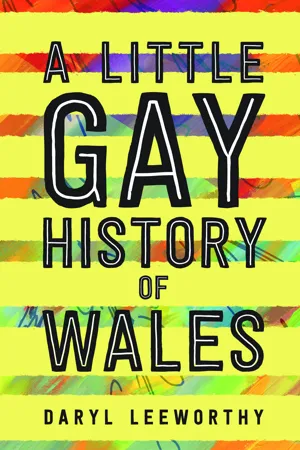
A Little Gay History of Wales
About this book
A Little Gay History of Wales tells the compelling story of Welsh LGBT life from the Middle Ages to the present day. Drawing on a rich array of archival sources from across Britain, together with oral testimony and material culture, this pioneering study is the first to examine the experiences of ordinary LGBT men and women, and how they embarked on coming out, coming together and changing the world. This is the story of poets who wrote about same-sex love and translators who worked to create a language to describe it; activists who campaigned for equality and politicians who created the legislation providing it; teenagers ringing advice lines for guidance on coming out, and revellers in the pioneering bars and clubs on a Friday and Saturday night. It is also a study of prejudice and of intolerance, of emigration and isolation, of HIV/AIDS and Section 28 – all features of the complex historical reality of LGBT life and same-sex desire. Engaging and accessible, absorbing and perceptive, this book is an important advance in our understanding of Welsh history.
Information
Topic
HistoriaSubtopic
Historia del siglo XXPART I
Coming Out
CHAPTER ONE
Hidden from View?
Tom Davies was born in 1899. His father, Benjamin Davies, was the minister at Caersalem Baptist Chapel in Abergwynfi and a prominent figure in the local temperance movement.1 His mother, Elizabeth, shared in the Nonconformist faith. Tom, on the other hand, frequently rebelled, sneaking next door to ‘drink eleven years of age’ with an older neighbour for whom he used to fetch beer from the off-licence. In May 1914, Tom left school and went to work in the drapery department of Glyncorrwg Co-operative Stores where he revelled in the opportunity to work with fabrics and contemporary fashion. A few months later, life in the Afan Valley was disrupted by war. Although too young to officially join the army, Tom was excited by an advert he saw in the newspaper calling for performers to join the entertainment corps: ‘So I told dad, “Dad, I’m going to write away now to London”, I said … and my father said, “don’t be so silly” “Yes I am”, I said’. Tom was invited to London to audition in singing and dancing and was given a place in the unit.
Tom trained with the noted instructor John Tiller at his school of dancing in London, where he learned high kicks, tap dancing, and how to do the splits. He could already sing very well, ‘I had a lovely voice, and really nicer than Vera Lynn, nicer than that’. Once he was finished with Tiller’s regimen, Tom joined the YMCA-funded Concert Party led by the actress and women’s suffrage campaigner Lena Ashwell. The first concerts were held in France early in 1915 – almost forty of them in a fortnight – but Tom found them too serious for his tastes and yearned to move on to something less formal where he could ‘work a bit of patter [into] my show’. He soon found himself in concert parties such as The Duds in areas such as Arras and Dieppe before moving on to work with The Bohemians at the Number 14 convalescent depot in Deauville, Normandy. There he became a member of the entertainment corps troupe based at the Casino Municipal in neighbouring Trouville-sur-Mer. Other shows took place in Paris and at the hospital in Saint-Pol-sur-Mer. As Tom recalled Saint-Pol
was the first hospital from the line and I was told I would have to give a show in one of the wards. Well the men were in such agony and groaning and in pain. I said to the … fellow that was running our show there and I said, I can never go in, sir, it is breaking my heart to see them, I said … you didn’t know what shape they were in you know because everyone was covered in a blanket up to here.
Tom’s show involved dancing on stage and signing popular wartime songs such as Keep an Eye on Tommy, the lyrics of which Tom clearly understood for their suggestive alterity:
Sergeant Brown, Sergeant Brown keep an eye on Tommy for me,He might go wrong on the contin-nound, when he reaches Paree,He’ll to parlez-vous, they always do, when the French girls they see,But if my Tommy wants to parlez vous, let him come home and parlez vous with me.
Without describing Tom’s stage costumery, none of this would seem at all unusual, it was straight out of the musical hall tradition. But Tom took to the stage in elaborate women’s costumes offering risqué routines that maintained a sense of mystery as to his gender:
I’d come out in this beautiful sequin gown you know, and then I used to take my gown off, and I had sequin briefs and a sequin bra, and I was naked then but for my tights. And I had these two big ostrich feather fans, and I had learned to manipulate them … they wouldn’t see anything, and I could hear them saying, Jock, how would you like her in the bunk tonight ….There were many who wouldn’t believe I was male, you know, because I was so dainty. And a funny thing whatever frock came from London I didn’t have to have it altered at all. I had a small waist.
Tom’s stage persona was Peggy Deauville. With a high, effeminate voice and slight frame, he readily passed for a woman and encouraged catcalls and wolf whistling from the all-male audience. On several occasions, Tom explained, ‘absolute filth’ was shouted at the stage:
I remember I was with Lew Stone, and he and I had a sketch that was very popular, and so now, there was a bedroom scene you see, so he’d pull me round and he’d throw me back on the bed, you see, and I’d fall in the most suggestive way like, you know, with this beautiful nightdress and all that on you know, and he’d go to the front of the stage … and say, ‘what can I do, I love this woman, I love this woman, what can I do’. And a voice at the back shouted, ‘oh for heaven’s sake’, he said, ‘get into bed with her’, he said, ‘get stuck into her and let’s get on with the show’.
After the war, Tom stayed on in Paris working in a variety of theatres, including the Folies Bergères. He began impersonating prominent contemporary figures such as the nurse Edith Cavell and actress Gaby Deslys and began attracting the attention of French magazines for his habit of travelling around the country in drag. He was photographed ‘wearing the conventional Pierrot costume with frilled collar and black pom-pom buttons but with the addition of high-heeled shoes and black net stockings and surrounded by a squadron of amused and admiring soldiers’.2 For a period Tom worked in Germany and after returning to Britain spent six years working for Bud Flanagan as a dancer and performer in the Victoria Palace and the London Palladium. By 1939, he had settled back in Blaengwynfi and worked once again for Glyncorrwg Co-op. After the war, he performed at British Legion clubs and other working-class venues in the Valleys.
In oral testimony, Tom never mentioned isolation or ostracism from the wider community for his performances, although this might have been different had he walked the streets of Glyncorrwg in drag as he walked the streets of Paris.3 For him the Valleys were accepting and embracing, and his father did not try to intervene even though as chapel minister he was regarded as a guardian of contemporary moral values. As Tom put it,
Oh Glyncorrwg people all of them knew me. Well they know me now because they make an awful fuss when I go up there. If I go up to Glyncorrwg, I’m not home here until about four o’clock in the morning. Men going to the Abbey bring me home, you know, we have a late drinking session.
In fact, Tom felt that his father’s knowledge of his career and his sexuality was a positive development because he was, in general, ‘very broadminded, everybody loved him for his broadmindedness’. By implication, this was also true of the wider community. Tom’s interest in dressing up in women’s clothes had begun early: ‘I was awfully interested in ladies clothes, and always dressing up as a woman, before I left school really. So now, and if my sisters had anything new, a hat, a coat, or a dress … I wasn’t happy until I tried it on.’ Many of his childhood friends were girls and he ‘never played football or cricket or anything’, preferring instead to join in with hopscotch and skipping on the pavement outside his house. Through these experiences, Tom picked up the mannerisms and comportments that he was later to use to great effect and to popular delight as a drag artist.
Tom Davies was not the only Welsh female impersonator in the early part of the twentieth century, although he was the only one whose memories were recorded and whose sexuality can be offered with any degree of certainty. The others, such as Percy Meye (or Maye, as it was sometimes written), Will Thomas, Louis van Della or Tom Barger, whose careers took them all over Wales between the mid-1890s and the end of the First World War, are much more secretive. Several of them married and regarded impersonation not as a transgressive act, necessarily, but as part of a legitimate career in the music hall and theatre. Some were feted as the favourite performers of the towns in which they most regularly performed, as Louis van Della was in Aberdare,4 although he had competition from Lawrence Lisle, an impersonator of burlesque routines.5 In the north, the most popular artist was Tom Barger, who promised audiences ‘hilarity without vulgarity’.6
Percy Meye had perhaps the highest profile of all and first came to notice performing at the opening ceremony of Aberystwyth pier in the summer of 1896. His ‘skirt dances’ were said to have caused ‘much amusement’ and he quickly established himself as an in-demand performer. He returned regularly as part of Henry Collins’s Minstrel Troupe until the turn of the new century when he moved to Rhyl and eventually to the Rhondda, where he found work in picture palaces and theatres. At the Tivoli in Pentre, Meye was introduced to audiences as ‘unique’, ‘realistic’ and able to impersonate ‘the lady artistes with perfect ease’.7 As the Rhondda Leader noted, ‘one who frequents the Tivoli thinks that Percy “Meye” be a lady for the following reasons. He sings fine “airs”, sports false “hair”, and seems fonder of the trousers than the skirt.’8 As an artist of growing stature, Meye appeared in theatres all over Britain in the early 1900s. In London, he was feted as ‘really startling in [his] realism’, in Bristol as one of the best impersonators to appear on stage in the city, and in Hartlepool as wearing ‘make-up [which] defies identity’.9 An essential part of Percy Meye’s act was his replication of the female voice both for singing and delivery of comedic turns. According to one industry journal, he had a ‘good falsetto’ which enhanced the perceived realism.10
It was easy to go to the theatre to watch a man dressed up as a woman performing on stage. It was regarded by Victorian and Edwardian audiences as entirely normal (as it had been for centuries). On the reverse, it was just as easy to sit in the same seats and watch women dressing up as men. Nationally famous male impersonators such as Vesta Tilley, Phyllis Broughton, Hetty King or Lillian Bishop travelled frequently to theatres in Wales where they were warmly welcomed, and there were local artists who mimicked their acts to more modest acclaim. When Vesta Tilley appeared at the Cardiff Empire in 1907, the venue was reportedly packed out by her many local fans.11 A decade earlier, to accompany an interview with the South Wales Echo, she was sketched in male attire complete with jacket and trousers, boater hat, and waistcoat.12 It was a remarkable presentation given the radical and political nature of women ‘donning male attire’ – suffrage campaigners wore men’s clothing to protest against their lack of voting rights – but it was consistent with the emerging idea of the New Woman who fought for rights and sexual and social freedoms and for greater recognition of the gender iniquities of turn-of-the-century Britain.13 As Phyllis Broughton explained to one Aberystwyth journalist, ‘I made a raid on my brother’s wardrobe, and for a fortnight, at home, I absolutely lived in a suit of his clothes in order to get thoroughly used to it.’14
Outside the theatre or music hall, for women to wear men’s clothing, especially trousers, was a striking act of defiance – sticking two fingers up to the authorities. Janet Pugh of Llangwm near Corwen, a prominent figure in the tithe wars of the 1890s, often adopted ‘a bowler hat and cord trousers’.15 Politics was not on the mind of Maria Evans when she appeared, heavily pregnant, before magistrates in Cardiff in 1856 charged with disorderly conduct in Bute Street. She did so ‘in male attire’ and claimed that she ‘only intended to have a bit of fun’. The magistrates were not amused and sent her to the workhouse.16 In court women wearing trousers was code for prostitution: ‘a woman might have been seen walking down Thompson Street, Barry Dock, last Thursday evening,’ remarked the Barry Dock News indicatively in 1892, ‘clothed in male attire.’17 The Evening Express sniped in similar terms a few years later about Ellen O’Neil. She was ‘a very advanced type of the New Woman. On Wednesday she appeared in the dock at Penarth Police Court fully accoutred in male attire.’18
In the decades before the moral panic around Radclyffe Hall’s 1928 novel, The Well of Loneliness, with its appeals to the naturalness of lesbian love and for ‘the right to our existence’, phrases such as ‘in male attire’ or ‘close companion’ could sometimes be read, by those in the know, as indications of same-sex attraction. But not always, and iterations need to be read with caution. Notions of clothing as an ‘encoded “uniform”’ evolved slowly, and ‘readings (whether of clothing, visual images, or stories about women living with other women in “Close companionship”) varied accordingly among those who knew, those who knew nothing, and those who wished they didn’t know.’19 It is problematic to assume that all women observed or arrested in male clothes were sexually transgressive, since the act meant various things to different individuals, but at the same time it is no less problematic to assume that there were no lesbians before the twentieth century even though the term did not gain popular currency until the 1930s. In the absence of a public culture of lesbianism, same-sex desire amongst women often passed by unnoticed and unremarked upon and cross-dressing frowned upon. ‘Where the fun lies’, blustered one Cardiff newspaper in 1869, ‘only the idiots who indulge in the practice would be able to explain. Perhaps the knowledge that the pastime is not unattended with risk may give it a zest which the casual observer would fail to appreciate.’20
The contrast to this complex world of cross-dressing, in which Tom Davies and others revelled and found sustainable employment, lay in the tortured self-marginalisation of men such as the novelist and short story writer Rhys Davies.21 For him, the coalfield was an impossible environment in which to live as a homosexual, and led to depression and isolation. The Valleys were possessed of a form of masculinity that the writer was unable to adjust to, and in later years he described the coal-field as a gaol from which he could not escape however much he tried. He would eventually find peace in London, a city which provided him with ‘a rainbow wash of the mind’.22 These themes underpinned his writing, although he went to great lengths to disguise the truth of his inner self: even his name was altered, he was born Vivian Rees Davies.
The experiences of Tom Davies and Rhys Davies, their separate reactions to their own sexuality and the social and cultural context into which they were born and grew up, serve as a reminder that personal experience of same-sex desire in the early twentieth century varied and was never uniformly negative. The southern coalfield, especially, was neither uniquely repressive, as most biographers and scholars of Rhys Davies have assumed, nor was it completely tolerant as Tom Davies’s experiences might suggest. The boundaries of sexuality and gender lay somewhere in between – hence the discrete responses to that world of he...
Table of contents
- Cover
- Title Page
- Copyright Page
- Dedication
- Contents
- Abbreviations
- Preamble
- Part I: Coming Out
- Part II: Coming Together
- Part III: Changing the World
- Acknowledgements
- Select Bibliography
- Notes
Trusted by 375,005 students
Access to over 1.5 million titles for a fair monthly price.
Study more efficiently using our study tools.
Frequently asked questions
Yes, you can cancel anytime from the Subscription tab in your account settings on the Perlego website. Your subscription will stay active until the end of your current billing period. Learn how to cancel your subscription
No, books cannot be downloaded as external files, such as PDFs, for use outside of Perlego. However, you can download books within the Perlego app for offline reading on mobile or tablet. Learn how to download books offline
Perlego offers two plans: Essential and Complete
- Essential is ideal for learners and professionals who enjoy exploring a wide range of subjects. Access the Essential Library with 800,000+ trusted titles and best-sellers across business, personal growth, and the humanities. Includes unlimited reading time and Standard Read Aloud voice.
- Complete: Perfect for advanced learners and researchers needing full, unrestricted access. Unlock 1.5M+ books across hundreds of subjects, including academic and specialized titles. The Complete Plan also includes advanced features like Premium Read Aloud and Research Assistant.
We are an online textbook subscription service, where you can get access to an entire online library for less than the price of a single book per month. With over 1.5 million books across 990+ topics, we’ve got you covered! Learn about our mission
Look out for the read-aloud symbol on your next book to see if you can listen to it. The read-aloud tool reads text aloud for you, highlighting the text as it is being read. You can pause it, speed it up and slow it down. Learn more about Read Aloud
Yes! You can use the Perlego app on both iOS and Android devices to read anytime, anywhere — even offline. Perfect for commutes or when you’re on the go.
Please note we cannot support devices running on iOS 13 and Android 7 or earlier. Learn more about using the app
Please note we cannot support devices running on iOS 13 and Android 7 or earlier. Learn more about using the app
Yes, you can access A Little Gay History of Wales by Daryl Leeworthy in PDF and/or ePUB format, as well as other popular books in Historia & Historia del siglo XX. We have over 1.5 million books available in our catalogue for you to explore.