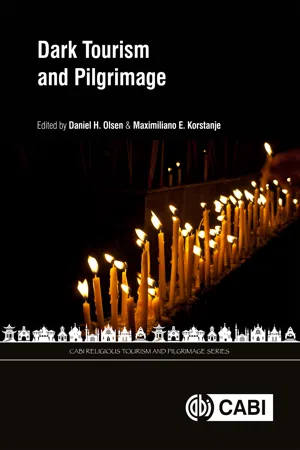
In recent years there has been a growth in both the practice and research of dark tourism; the phenomenon of visiting sites of tragedy or disaster. Expanding on this trend, this book examines dark tourism through the new lens of pilgrimage. It focuses on dark tourism sites as pilgrimage destinations, dark tourists as pilgrims, and pilgrimage as a form of dark tourism. Taking a broad definition of pilgrimage so as to consider aspects of both religious and non-religious travel that might be considered pilgrimage-like, it covers theories and histories of dark tourism and pilgrimage, pilgrimage to dark tourism sites, and experience design. A key resource for researchers and students of heritage, tourism and pilgrimage, this book will also be of great interest to those studying anthropology, religious studies and related social science subjects.
eBook - ePub
Dark Tourism and Pilgrimage
- English
- ePUB (mobile friendly)
- Available on iOS & Android
eBook - ePub
Dark Tourism and Pilgrimage
About this book
Information
1 Negotiating the Intersections between Dark Tourism and Pilgrimage
1Department of Economics, University of Palermo, Buenos Aires, Argentina;
2Department of Geography, Brigham Young University, Provo, UT, USA
* Corresponding author: [email protected]

Introduction
In recent decades, new forms of tourism consumption have captivated not only the attention of scholars but also the interests of journalists and the general public. Mass tourism and its sand, sun and sea orientation of the 1960s and 1970s has given way to a more nuanced and fragmented tourism market, as special interest tourism, beginning in the 1980s, focused on travel interests of tourists beyond the coastal regions of the world (Weiler and Hall, 1992; Trauer, 2006). Catering to the specialized needs of tourists, whether in terms of desired experiences or amenities needed when travelling, has led to a plethora of research related to adjectival niche markets, such as ‘ecotourism’, ‘heritage tourism’, ‘adventure tourism’, ‘culinary tourism’, ‘genealogical tourism’, ‘medical tourism’, ‘agritourism’, ‘rural tourism’, and so forth. The concern of this book is the interrelationships between ‘dark tourism’ and ‘pilgrimage’, the latter phenomenon sometimes subsumed under the term ‘religious tourism’.
Dark tourism can be defined as ‘the act of travel to sites associated with death, suffering and the seemingly macabre’ (Stone, 2006). However, there has been much discussion as to what exactly constitutes dark tourism; this, in part, because of the fragmentation of research related to dark tourism, with different terms being created to highlight specialized conceptual and practical aspects of this phenomenon (Strange and Kempa, 2003; Hooper and Lennon, 2016), such as ‘thana tourism’, ‘mourning tourism’, ‘grief tourism’ and ‘pain tourism’. The problem with this conceptual fragmentation is that the impression made is that each term and its associated research seems to connote that they are different concepts, when they are all studying, at root, the same thing. As such, this terminological fracturing has led to a dispersion of knowledge related to the consumption of death by tourists.
This fragmentation, however, does demonstrate a growing interest, both theoretically and practically, in this section of the tourism industry. This interest has come, in part, because of the rise of events that have harmed the functioning of the tourism system at various levels, ranging from terrorism to natural disasters (Sönmez et al., 1999; Blake and Sinclair, 2003; Ritchie, 2009; Korstanje and Olsen, 2011). Although theories of risk perception focused on locating and eradicating potential dangers that threatened domestic and international tourism destinations, a rapidly globalizing world and the role of the media in sensationalizing these tragic events has made the work of policymakers almost impossible (Roehl and Fesenmaier, 1992; Floyd et al., 2004; Reisinger and Mavondo, 2005; Kozak et al., 2007; Lepp and Gibson, 2008; Tarlow, 2014). The 9/11 attacks, in particular, made research related to risk-perception management a pressing issue, and subsequent concerns related to the intensification of natural disasters and the crisis of climate change only exacerbated the importance of this research (Hall and Higham, 2005). In destinations where these types of events occurred and resulted in the loss of life or livelihoods, some tourism marketers have used these events to promote forms of morbid consumption under the guise of dark tourism to help with economic and sociocultural revitalization (Korstanje and Ivanov, 2012).
This has also been the case regarding pilgrimage travel in the (post)modern era. Pilgrimage has, historically, been defined as ‘a journey resulting from religious causes, externally to a holy site, and internally for spiritual purposes and internal understanding’ (Barber, 1993, p. 1). While pilgrimages have existed, probably, from the beginning of humanity, pilgrimage is today generally viewed as a sub-niche of the religious tourism market (Timothy and Olsen, 2006b), in part because pilgrims, for the most part, utilize the same transportation, accommodation and amenities infrastructure as tourists. Like dark tourism, religious tourism has also become a fragmented area of interest for academics, with terms like ‘pilgrimage tourism’, ‘faith tourism’, ‘spiritual tourism’ and ‘tourism pilgrimage’ (Olsen, 2013) becoming widespread. However, unlike the fragmentation of dark tourism, where there is a deeper investigation into its various aspects, these terms are related to attempts to determine what exactly the boundaries of this niche market should be for scholars. As noted below, while research into religious tourism is as old as dark tourism, the field of religious tourism is not as deep theoretically. Pilgrimage studies, however, are more aligned with dark tourism research regarding focus and theoretical rigour (Albera and Eade, 2015, 2016; Coleman and Eade, 2018).
Preliminary Insights
One of the first scholars to study dark tourism was Rojek (1993), who coined the term ‘black spots’ to refer to places of morbid consumption oriented towards memorializing disasters, catastrophes and tragic events of mass destruction. Rojek’s work paved the way for the study of dark tourism. While Foley and Lennon (1996) explored the assassination of John F. Kennedy and Dann (1998) explored this new tourism niche market, it was with the release of Lennon and Foley’s (2000) seminal book Dark Tourism that academic interest in travel to death-related sites began to grow sharply. In the case of religious tourism and pilgrimage, while the number of people travelling to religious sites has been estimated to be between 300 and 600 million a year (Jackowski, 2000; McKelvie, 2005; Timothy, 2011, p. 387; World Tourism Organization, 2011, p. xiii), it was not until the publication of Vukonić’s (1996) book Tourism and Religion and subsequent books on the topic that scholars took interest in this small but growing tourism niche market (e.g. Badone and Roseman, 2004; Timothy and Olsen, 2006a).
According to Lennon and Foley (2000, p. 3), dark tourism, pilgrimage and heritage are conceptually and historically linked:
Several commentators view pilgrimage as one of the earliest forms of tourism....This pilgrimage is often (but not only) associated with the death of individuals or groups, mainly in circumstances which are associated with the violent and the untimely. Equally, these deaths tend to have a religious or ideological significance which transcends the event itself to provide meaning to a group of people.
There is strong archaeological evidence that shows how dark tourism and pilgrimage were historically intertwined (Lennon and Foley, 2000). Indeed, people in premodern ages were accustomed to death, as they were confronted by it daily – they believed in deity, an afterlife and had intimate relationships with their deceased ancestors. As such, religion was intertwined with cultural norms and values (Ariès, 1975).
However, in a modern and postmodern western context, medical understanding of the human body and breakthroughs in expanding life expectancy has undermined the influence of religiosity on society, as this medical reasoning has altered the ontology between humans and their place in the world. In addition, the secularization ‘thesis’ or ‘paradigm’ holds that with globalization came the ‘extension of science, technology, market rationality and associated organizational principles’ (McDonald, 2012, p. 1769), which, combined with ‘the global extension of the capitalist industrial complex, and with its rural-urban migration patterns and emphasis on production, rationalization, democratization, neoliberal market logics, the minimization of the power of the state, the deterritorialization and deregulation of labour, and individualization within modern societies’ (Olsen, forthcoming), would lead to the decline of the authority of religion as a ‘public good’.
While religion offered a mediatory role between life and death, MacCannell (1976) argues that tourism is one of the things that now subverts religion in a quest to find authenticity, and subverts the alienation that comes with postmodern life. This is done through looking at and seeking reality in other time periods and the lives of ‘others’. Ultimately, however, MacCannell argues that this quest for authenticity only serves to reaffirm the tourist’s own alienation; that the tourist is ‘an early postmodern figure, alienated but seeking fulfilment in their own alienation – nomadic, placeless, a kind of subjectivity without spirit, a “dead subject”’ (p. xvi). This process of secularization has not only divided the sacred from the profane in western societies but has also ignited a renewed emphasis on the preservation and conservation of heritage.
In this context, Stone (2005) argues that dark tourism represents an attempt by people to understand their own lives and deaths through engaging with the lives and, more importantly, deaths of others. If anything, visitors often feel a sort of empathy with the suffering ‘other’, which helps in interpreting their own lives. As such, dark tourism can be seen at some levels as an all-encompassing and mediating institution and a form of heritage in a secularized culture where death is no longer feared or at the forefront of people’s minds (Stone and Sharpley, 2008; Stone, 2012, 2013). Indeed, dark tourism can serve as a catalyst to deal with the feelings of pain and loss that come with death, particularly tragic death, particularly when viewed as a form of heritage. Heritage tourism, unlike other forms of tourism, opens the doors for the (re)articulation of new experiences, discourses and sensations through the (re)interpretation of past events and histories. This can apply to spaces of mass death and mourning, such as Alcatraz and Robben Island (Strange and Kempa, 2003). It can also apply to religious pilgrimage, where people seek authentic religious experiences through travel to religious heritage sites to interact with relics of saints or with other holy objects and engage with aesthetic spaces that allow for reflection and a potential encounter with the sacred (Bremer, 2004; Belhassen et al., 2008; Andriotis, 2009).
In examining the major themes studied in the dark tourism literature, Light (2017) notes six areas of research interest regarding dark tourism: definitions and typologies of dark tourism; ethical debates; the political functions of dark tourism; the nature of dark tourism demand; the management of dark tourism sites; and methodological discussions. In the context of religious tourism, there have been recent attempts to summarize the academic literature pertaining to this topic (e.g. Durán-Sánchez et al., 2018, 2019; Rashid, 2018). While these state-of-the-art articles are woefully incomplete, some of the themes the authors identify as arising from this research include supply-side typologizing; religious motivations; differentiating pilgrimage and pilgrims from tourism and tourists; marketing religious heritage sites catering to religious and spiritual needs in the tourism industry; and studying the intersections between religious tourism, wellness tourism and spiritual tourism. And within pilgrimage studies, research themes have included anti-structure (i.e. communitas and liminality) and ritual symbols; pilgrimage processes and institutions; sacred and profa...
Table of contents
- Cover
- Half-title Page
- Title Page
- Copyright
- Contents
- Contributors
- Preface
- Section 1: Theories of Dark Tourism and Pilgrimage
- Section 2: Pilgrimage to Dark Tourism Sites
- Section 3: Dark Tourism and Pilgimage Experiences
- Index
- About CABI
- Backcover
Trusted by 375,005 students
Access to over 1.5 million titles for a fair monthly price.
Study more efficiently using our study tools.
Frequently asked questions
Yes, you can cancel anytime from the Subscription tab in your account settings on the Perlego website. Your subscription will stay active until the end of your current billing period. Learn how to cancel your subscription
No, books cannot be downloaded as external files, such as PDFs, for use outside of Perlego. However, you can download books within the Perlego app for offline reading on mobile or tablet. Learn how to download books offline
Perlego offers two plans: Essential and Complete
- Essential is ideal for learners and professionals who enjoy exploring a wide range of subjects. Access the Essential Library with 800,000+ trusted titles and best-sellers across business, personal growth, and the humanities. Includes unlimited reading time and Standard Read Aloud voice.
- Complete: Perfect for advanced learners and researchers needing full, unrestricted access. Unlock 1.5M+ books across hundreds of subjects, including academic and specialized titles. The Complete Plan also includes advanced features like Premium Read Aloud and Research Assistant.
We are an online textbook subscription service, where you can get access to an entire online library for less than the price of a single book per month. With over 1.5 million books across 990+ topics, we’ve got you covered! Learn about our mission
Look out for the read-aloud symbol on your next book to see if you can listen to it. The read-aloud tool reads text aloud for you, highlighting the text as it is being read. You can pause it, speed it up and slow it down. Learn more about Read Aloud
Yes! You can use the Perlego app on both iOS and Android devices to read anytime, anywhere — even offline. Perfect for commutes or when you’re on the go.
Please note we cannot support devices running on iOS 13 and Android 7 or earlier. Learn more about using the app
Please note we cannot support devices running on iOS 13 and Android 7 or earlier. Learn more about using the app
Yes, you can access Dark Tourism and Pilgrimage by Daniel H Olsen, Maximiliano Korstanje, Daniel H Olsen,Maximiliano E Korstanje in PDF and/or ePUB format, as well as other popular books in Business & Industria dell'ospitalità e del turismo. We have over 1.5 million books available in our catalogue for you to explore.