A thought-provoking look at the Angevin aristocracy's literary practices and historical record
Coming upon the text of a document such as a charter or a letter inserted into the fabric of a medieval chronicle and quoted in full or at length, modern readers might well assume that the chronicler is simply doing what good historians have always done—that is, citing his source as evidence. Such documentary insertions are not ubiquitous in medieval historiography, however, and are in fact particularly characteristic of the history-writing produced by the Angevins in England and Northern France in the later twelfth century.
In History and the Written Word, Henry Bainton puts these documentary gestures center stage in an attempt to understand what the chroniclers were doing historiographically, socially, and culturally when they transcribed a document into a work of history. Where earlier scholars who have looked at the phenomenon have explained this increased use of documents by considering the growing bureaucratic state and an increasing historiographical concern for documentary evidence, Bainton seeks to resituate these histories, together with their authors and users, within literate but sub-state networks of political power. Proposing a new category he designates "literate lordship" to describe the form of power with which documentary history-writing was especially concerned, he shows how important the vernacular was in recording the social lives of these literate lords and how they found it a particularly appropriate medium through which to record their roles in history.
Drawing on the perspectives of modern and medieval narratology, medieval multilingualism, and cultural memory, History and the Written Word argues that members of an administrative elite demonstrated their mastery of the rules of literate political behavior by producing and consuming history-writing and its documents.
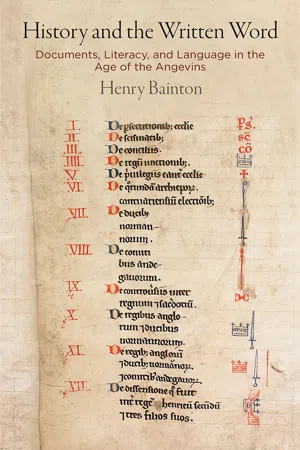
eBook - PDF
History and the Written Word
Documents, Literacy, and Language in the Age of the Angevins
- 209 pages
- English
- PDF
- Available on iOS & Android
eBook - PDF
History and the Written Word
Documents, Literacy, and Language in the Age of the Angevins
About this book
Information
Publisher
University of Pennsylvania PressYear
2019Print ISBN
9780812251906
9780812251906
eBook ISBN
9780812296761
Table of contents
- Cover
- History and the Written Word
- Title
- Copyright
- CONTENTS
- Note on Orthography and Translations
- Introduction
- Chapter 1. Defining Documents
- Chapter 2. Documentary Quotation
- Chapter 3. Literate Sociability
- Chapter 4. Literate Performances and Literate Government
- Chapter 5. Literate Languages
- Afterword
- List of Abbreviations
- Notes
- Bibliography
- Index
- Acknowledgments
Trusted by 375,005 students
Access to over 1.5 million titles for a fair monthly price.
Study more efficiently using our study tools.
Frequently asked questions
Yes, you can cancel anytime from the Subscription tab in your account settings on the Perlego website. Your subscription will stay active until the end of your current billing period. Learn how to cancel your subscription
No, books cannot be downloaded as external files, such as PDFs, for use outside of Perlego. However, you can download books within the Perlego app for offline reading on mobile or tablet. Learn how to download books offline
Perlego offers two plans: Essential and Complete
- Essential is ideal for learners and professionals who enjoy exploring a wide range of subjects. Access the Essential Library with 800,000+ trusted titles and best-sellers across business, personal growth, and the humanities. Includes unlimited reading time and Standard Read Aloud voice.
- Complete: Perfect for advanced learners and researchers needing full, unrestricted access. Unlock 1.5M+ books across hundreds of subjects, including academic and specialized titles. The Complete Plan also includes advanced features like Premium Read Aloud and Research Assistant.
We are an online textbook subscription service, where you can get access to an entire online library for less than the price of a single book per month. With over 1.5 million books across 990+ topics, we’ve got you covered! Learn about our mission
Look out for the read-aloud symbol on your next book to see if you can listen to it. The read-aloud tool reads text aloud for you, highlighting the text as it is being read. You can pause it, speed it up and slow it down. Learn more about Read Aloud
Yes! You can use the Perlego app on both iOS and Android devices to read anytime, anywhere — even offline. Perfect for commutes or when you’re on the go.
Please note we cannot support devices running on iOS 13 and Android 7 or earlier. Learn more about using the app
Please note we cannot support devices running on iOS 13 and Android 7 or earlier. Learn more about using the app
Yes, you can access History and the Written Word by Henry Bainton in PDF and/or ePUB format, as well as other popular books in History & European Medieval History. We have over 1.5 million books available in our catalogue for you to explore.