![]()
Chapter 1
General Introduction
概論 1-1. Introduction
Even though Chinese martial arts were imported into Western society more than fifty years ago, many questions still remain. The most common and confusing questions today are the following: Where does the style I am learning come from? What are its theoretical roots and foundation? How good are the styles which I am practicing? What are the differences between the internal styles and the external styles? What are the differences between the southern styles and northern styles? How do we define hard, soft-hard, and soft styles? How is Japanese karate different from Korean taekwondo, and how are these styles different from Chinese martial arts? How do these styles relate to each other? What is martial arts qigong? How different is this qigong from other schools of qigong, such as medical qigong, scholar qigong, and religious qigong?
In order to answer these questions, you must first study and understand the history of Chinese martial arts. Furthermore, you should search and comprehend its theoretical roots and cultural background. Knowledge of its past history and an understanding of its roots will enable you to appreciate the consequences that exist today.
Taijiquan, its theoretical roots and the concept of yin and yang itself, can be traced back four thousand years. From this root, the essence of taijiquan originated. Specifically, the style was created in the Daoist monastery of Wudang Mountain, Hubei province. The original motivation behind taijiquan creation was twofold: self-defense and spiritual cultivation.
Taijiquan is a slow and relaxed moving meditation. Through practicing taijiquan, you are able to calm your mind, locate your spiritual center, and consequently find your entire being. Moreover, from the relaxed moving exercises, you can bring your physical body to an ultimate level of relaxation and natural ease. This can result in smooth qi (inner energy or bioelectricity) and smooth blood circulation. This is the key to maintaining health and recovering from sickness.
Since taijiquan’s revelation to the Chinese public in 1926 by Yang, Chen-fu in Nanking Central Guoshu Institute, it has been widely welcomed and has gradually become one of the most effective ways of self-healing exercises or qigong in China. Unfortunately, it was also due to its popularity and emphasis on health promotion that the martial essence of taijiquan has been gradually lost. The forms have been changed and the quality has been worsened. The essence of every movement is no longer of importance to the general public.
When Taijiquan was introduced into Western society during the 1960s by Cheng, Man-ching, it was already popular in China. Before long, it had become a very popular exercise in the West. Today, it is commonly recognized that practicing taijiquan is able to help with many problems such as hypertension, high blood pressure, balance and stability, heart problems, lung-related illness, stomach problems, and many others. It is understood that through these relaxed movements, you can reach a state of self-relaxation and healing. The benefits of practicing taijiquan are reported again and again. In fact, many healthcare providers started encouraging their clients to practice taijiquan, and beginning in the 1990s, some insurance companies even began to contribute to the expense of learning in order to further the health and vitality of their members.
Since 1973 when President Nixon visited mainland China and opened the gate of China, many taijiquan masters have immigrated to the United States. Now, the Western taijiquan practitioners are starting to realize there are many styles of taijiquan that have originated from the same theoretical root. Unfortunately, two major parts of taijiquan essence are still missing. These two are the martial root of taijiquan and its relationship with qigong. The motivation for writing this book is to provide modern taijiquan practitioners with an understanding of the relationship between taijiquan and qigong. After studying this material, if you are interested in knowing more about the taiji qigong and martial applications of taijiquan, you may refer to these books: The Essence of Taiji Qigong, Tai Chi Theory and Martial Power, and Tai Chi Chuan Martial Applications, published by YMAA.
In the first chapter of this book, common martial arts knowledge will be introduced followed by a brief history of taijiquan. The meaning of taijiquan and its training guidelines, particularly that of Yang style, will then be discussed. After you are familiar with these general concepts, the most important essence of taijiquan will be introduced: the relationship between qi and taijiquan. This relationship will be explored in Chapter 2 through the means of taiji qigong. The third chapter will cover the external manifestations of the theory, as well as the external root of basic taijiquan movement, the thirteen postures. Finally, the traditional Yang Style Long Form of Taijiquan will be introduced in Chapter 4.
I believe that through effort and by coordinating both theory and the practice of qigong and external training, you can glimpse and begin to appreciate the profound essence of taijiquan, instead of just learning how to copy the forms.
1-2. Common Knowledge of Chinese Martial Arts
Since taijiquan is an internal martial art, in order to understand its origin and historical background, it would be wise for us first to learn some of the common knowledge behind Chinese martial arts.
In this section, we will explain some essential points, such as the general definition of Chinese martial arts, martial arts history, and comparisons of the different styles. Hopefully, through study of this section, you will gain a better understanding of Chinese martial arts.
This section will first survey Chinese martial arts history and its cultural relationship with neighboring countries in the past. From this survey, you will obtain a general concept of how this art developed. Then, we will trace how this art was developed and how it became popular today in the West. From this, you can analyze the style you are learning.
Next, we will summarize some of the important concepts in Chinese martial society, such as the differences between internal styles and external styles, how the southern styles developed differently from the northern styles, the definition of the hard, soft-hard, and soft styles, the four fighting categories of Chinese martial arts, and the Dao of Chinese martial arts.
General Definition of Chinese Martial Arts. The word for martial in Chinese is wu. This word is constructed from two Chinese words zhi and ge. Zhi means to stop, to cease, or to end and ge means spear, lance, or javelin, and implies “general weapons.” From this you can see that the original meaning of martial arts in China is “to stop or to end the usage of weapons”.
The name of Chinese martial arts has been changed from period to period. However, the most commonly-recognized name is wuyi. Wuyi means “martial arts” and includes all categories of martial arts which are related to battle, such as archery, horse riding, dart throwing, the design and manufacture of weapons, armor, or even the study of battlefield tactics.
In actual combat, individual fighting techniques are called wushu, which means “martial techniques.” This implies the techniques that can be used to stop a fight. This means that Chinese martial arts were created to stop fighting instead of starting it. It is defensive instead of offensive. This concept was very different from that which was obtained by Western society in the 1960s. At that time, Chinese martial arts were commonly lumped together under the term “kung fu” and were considered solely as fighting skills. In fact, the Chinese meaning of kung fu (gong) means energy and (fu) means time. If you are learning or doing something that takes a great deal of time and effort to accomplish, then it is called kung fu (gongfu.) This can be learning how to play the piano, to paint, to learn martial arts, or complete any difficult task that takes time and patience.
A Brief History of Chinese Martial Arts—East and West
It is impossible to survey the history of all the existing Chinese martial arts in a single book. There are two reasons for this:
- Since ancient times, there have probably been more than five thousand martial styles created in China. After long periods of testing and experimenting in martial arts society or in battle, the arts of quality continued to survive, while those that were ineffective slowly became disregarded and died out. According to recent reports out of China, there could be more than one thousand martial styles which still exist and are practiced there, each with its own several hundreds or even thousands of years of history. It is not possible to collect all of this history for every style.
- Since most martial artists in ancient times were illiterate, the history of each style was often passed down orally. After a few generations, the history would become like a story. In fact, there are only a few existing famous styles, such as Taijiquan, Shaolin Quan, and some military martial styles, in which the history was documented in writing. Moreover, the documentation for these styles was extremely scarce and its accuracy often questioned.
Therefore, in this sub-section, I would first like to briefly summarize a portion of the known history of the East. Then, based on my personal observations of the evolution of Chinese martial arts in the West for the past 35 years, I will offer my observations and conclusions on Chinese martial arts in Western society.
Historical Survey of Chinese Martial Arts. Chinese martial arts probably started long before history was recorded. Martial techniques were discovered or created during the long epoch of continuous conflict between humans and animals or between different tribes of humans themselves. From these battles, experiences were accumulated and techniques discovered that were passed down from generation to generation.
Later, with the invention of weapons—whether sticks, stones, or animal bones—different types and shapes of weapons were invented, until eventually metal was discovered. At the beginning, metal weapons were made from copper, tin, or bronze, and after thousands of years of metallurgical development, the weapons became stronger and sharper. Following the advancement of weapon fabrication, new fighting techniques were created. Different schools and styles originated and tested one another.
Many of these schools or styles created their forms by imitating different types of fighting techniques from animals (e.g., tiger, panther, monkey, bear, or snake), birds (e.g., eagle, crane, or chicken), or insects (e.g., praying mantis). The reason for imitating the fighting techniques of animals came from the belief that animals possessed natural talents and skills for fighting in order to survive in the harsh natural environment. The best way to learn effective fighting techniques was by studying and imitating these animals. For example, the sharp spirit of the eagle was adopted, the pouncing, fighting of the tiger and the eagle’s strong claws were imitated, and the attacking motions of the crane’s beak and wings were copied.
Since the martial techniques first developed in very ancient times, they gradually became part of Chinese culture. The philosophy of these fighting arts and culture has in turn been influenced by other elements of Chinese culture. Therefore, the yin and yang taiji theory was merged into techniques, and the bagua eight trigrams concept was blended into fighting strategy and skills.
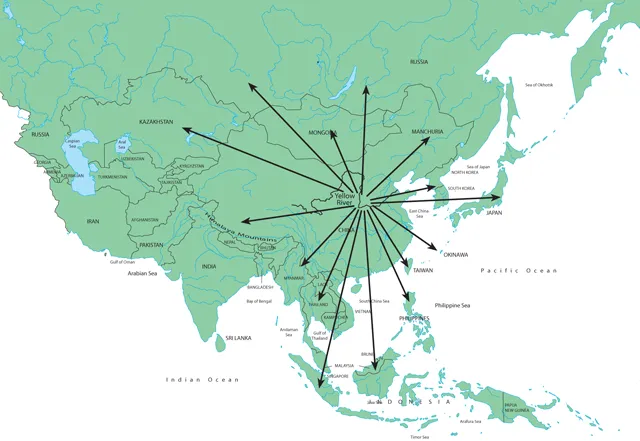
Chinese culture initially developed along the banks of the Yellow River (Figure 1-1). After many thousands of years, this culture spread so widely that it eventually reached every corner of Asia. China is called Central Kingdom (Zhong Guo) by its neighboring countries. The reason for this was because China possessed a much longer history in artistic, spiritual, religious, and scholastic fields, as well as many others; Chinese history stretches back more than seven thousand years. To the neighboring countries, China was an advanced cultural center from which they could learn and absorb cultural forms. Over thousands of years, the Chinese people themselves have immigrated to every corner of Asia, carrying with them their arts and customs. From this prolonged exchange, Chinese culture became the cultural foundation of many other Asian countries. Naturally, Chinese martial arts, which were considered a means of defense and fighting in battle, have also significantly influenced other Asian societies.
However, since the martial arts techniques and the methods of training could decide victory or defeat in battle, almost all Chinese martial arts were considered highly secret between countries, and even between different stylists. In ancient times, it was so important to protect the secret of a style that usually a master would kill a student who had betrayed him. It is no different from a modern government protecting its technology for purposes of national security. For this reason, the number of Chinese martial techniques that were revealed to outside countries was limited. Often, when an outlander came to China to learn martial arts, he first had to obtain the trust of a master. Normally, this would take more than ten years of testing from the teacher in order to achieve mutual understanding. Moreover, the techniques exported were still limited to the surface level. The deeper essence of the arts, especially the internal cultivation of qi and how to apply it to the martial techniques, normally remained a deep secret.
For example, it is well known in China that in order to compete and survive in a battle against other martial styles, each martial style must contain four basic categories of fighting techniques. They are kicking (ti), hand striking (da), wrestling (shuai), and joint locking or seizing and controlling techniques (qin na or chin na) (na). When these techniques were exported to Japan, they splintered over time to become many styles. For example, punching and kicking became karate, wrestling became judo, and qin na became jujitsu. Actually, the essence and secret of Chinese martial arts developed in Buddhist and Daoist monasteries were not completely revealed to Chinese lay society until the Qing dynastyA.D. 1644-1912). This secret has been revealed to Western countries only in the last three decades.
There was an extreme scarcity of documentation before A.D. 500 with regard to martial arts organization and techniques. The most complete documents that exist today concern the Shaolin Temple. However, since Shaolin martial arts significantly influence the overwhelming majority of Chinese martial arts society today (and this includes taij...