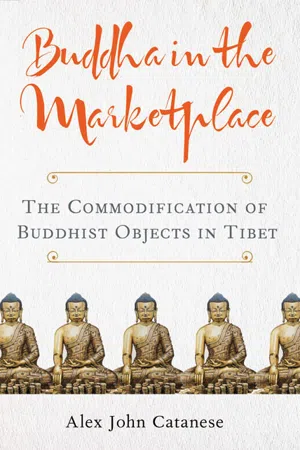
Classical Tibetan Buddhist scriptures forbid the selling of Buddhist objects, and yet there is today a thriving market for Buddhist statues, paintings, and texts. In Buddha in the Marketplace, Alex John Catanese investigates this practice, which continues to be viewed as a form of "wrong livelihood" by modern Tibetan Buddhist scholars. Drawing on textual and historical sources, as well as ethnographic research conducted in the region of Amdo, Tibet, Catanese follows the trajectory of Buddhist objects from their status as noncommodities prior to the Cultural Revolution to their emergence as commodities on the open market in the modern period. The book examines why Tibetans have more recently begun to sell such objects for their personal livelihoods when their religious tradition condemns such business activities in the strongest possible terms. Addressing the various societal and religious ramifications of these commercial practices, Catanese illustrates how such activity is leading to significant cultural and economic changes, transforming the "moral economy" associated with Buddhist objects, and contributing to a reinterpretation of Tibetan Buddhist identity.
eBook - ePub
Buddha in the Marketplace
The Commodification of Buddhist Objects in Tibet
- 334 pages
- English
- ePUB (mobile friendly)
- Available on iOS & Android
eBook - ePub
About this book
Information
Topic
Theology & ReligionSubtopic
Buddhism1

Early Prohibitions against Selling Buddhist Objects
Indian and Chinese Sources
The sale of Buddhist religious objects is ubiquitous throughout Tibet today; such objects have become part of the everyday commercial environment. The contemporary marketplace, therefore, hardly gives any indication that such goods were ever prohibited from being sold or that their sale, according to religious texts, is believed to constitute a sinful act. Yet, textual statements proscribing the sale of Buddhist objects—specifically, statues, paintings, and religious texts—have a long history, originating in India centuries before Buddhism entered Tibet in the eighth century and persisting up to the present day. There is, likewise, a substantial body of evidence that these concerns extended from India into China where they took on a life of their own, appearing in what are considered by scholars to be indigenous Chinese Buddhist works. Statements pertaining to these prohibitions later emerged in Tibet within a variety of literary genres: hagiography (rnam tar), artistic manuals, ritual texts, treasure literature (gter ma), and especially the stages of the path, or lamrim (lam rim), literature. Today, such prohibitions continue in the writings and discourses of popular Tibetan teachers, including those of the Fourteenth Dalai Lama. In order to provide a foundation for a discussion of these proscriptions in the Tibetan tradition, this chapter outlines the possible origins of these statements and focuses primarily on where and how they become articulated within the Indian and (to a lesser extent) Chinese Buddhist contexts. Although early explicit statements proscribing the sale of Buddhist religious objects are relatively scarce, the available literature suggests that such statements may have begun as early as the first or second centuries of the Common Era and as the primary concern of monks. Furthermore, it will be shown that this early literature contains at least two distinct themes. One theme reflects prohibitions against selling religious goods conceived of as the property of the monastery or of the Three Jewels (the Buddha, Dharma, and Saṅgha). Here, a moral infraction occurs as a result of wrongly appropriating, stealing, or selling this property. Another theme is reflective of more general prohibitions against selling religious objects that portray such acts as a form of immoral behavior or of wrong livelihood, in which (while not always stated explicitly) the sale of such objects is seen to violate the intended purpose, specialness, or sacrality of the object. While these two themes are closely related insofar as they both deal with objects that are proscribed from commercial activity, I suggest that they represent two separate doctrinal concerns, each following their own logic and reasoning. Such a distinction is important to the present discussion, for as will be observed later on, it is the latter theme which becomes emphasized and more fully elaborated in Tibetan articulations of proscriptions against the sale of Buddhist objects.
Selling Religious Objects—Early Indian Proscriptions
Early Indian vinaya texts, which contain the monastic disciplinary codes and regulations for monks, frame the selling of the property of the Three Jewels as an infraction to be avoided and as having serious negative consequences. Rules pertaining to divisions and uses of monastic property prohibit the personal appropriation and sale of those things owned by or dedicated to the Buddha, Dharma, and Saṅgha. Scholars working on various vinayas have long recognized that the Buddha was conceived of as a property owner, represented by the stūpa and by his image, and that the Saṅgha maintained rigorous rules with respect to the use or misuse of this property and the property held in common by the Saṅgha. According to Gregory Schopen, “ownership rights were clearly divided in a Mūlasarvāstivādin monastery: property belonged to the Buddha, the Dharma, or the Community. In each case such property could be used only for specific purposes and normally could not be transferred to another unit or purpose. This tripartite division of property rights, or some form of it, is recognized by virtually all the vinayas” (2004, 104–5). An alternative method of conceptualizing these monastic property divisions has been put forth by Joseph Walser (2005), who divides monastic property into three categories. First, according to Walser, there is “cultic property” (sometimes referred to as the “property of the Buddha” or the “property of the stūpa,” depending upon the particular vinaya text), which includes any objects used in ritual or worship (139). Next, there is “property of the Saṅgha,” which includes such things as monastic buildings, a monk’s bedding, and boats. And finally there is “personal property,” which includes the personal items of a monk, such as his robes, his bowl, his mat, and so forth. Commenting on the vinaya texts in general, Walser notes that a monk could sell, trade, or barter items considered his own personal property as he wished (141). Yet, the personal ownership of goods considered communal property or the property of the Buddha (or stūpa) was not permitted. Furthermore, the personal appropriation and/or sale of this property had its own respective consequences:
Whereas unlawfully appropriating property of the saṅgha as one’s own was a niḥsargika-pāccatika (an infraction requiring confession and relinquishment of the appropriated item), the separation of the saṅgha’s property from cultic property was much more rigid. Any monk caught using the property of the Buddha (or, in the case of the Mahāsāṅghika vinaya, “the property of the stūpa”) for the purposes of the saṅgha or selling the Buddha’s property to purchase property of the saṅgha was guilty of a parājika, an offense requiring expulsion. (Walser 2005, 142)
Thus, according to vinaya texts, any monk who was caught misusing or selling the property of the Buddha (which, here, would have included cultic property such as Buddha statues, paintings, and presumably any offerings made to such objects) was seen to be transgressing vinaya laws.
As for religious texts, evidence from the Mūlasarvāstivāda vinaya in particular suggests that Buddhist scriptures were likewise considered to be the property of the monastery and, as such, were prohibited from being owned by individual monks or sold. In one section of the Cīvaravastu of the Mūlasarvāstivāda vinaya, which discusses rules governing the death and distribution of the estate of a shaven-headed householder, the Buddha himself is made to proclaim that any texts designated as the “word of the Buddha” (buddhavācana) found to be in the possession of the deceased were not to be sold but were to be placed in the storehouse as common property of the entire monastic community.1 After describing what should be done with the property of such an individual—property such as children, animals, and spirituous liquor—the text describes what is to be done with any books:
With regard to precious objects, with the exception of pearls, divide all gems, [pieces of] lapis lazuli, and conch shells spiraling to the right, and so forth, into two parts. Give one to the Dharma and the other one to the Saṅgha. As for [the portion that was given to] the Dharma, it should be used to copy the word of the Buddha and to adorn the lion throne. As for [the portion that was given to] the Saṅgha, it must be divided by the monks. From among his books, those books that are the word of the Buddha are not to be distributed [among monks but] must remain in the general storehouse for the sake of the Saṅgha of the four directions. Books which are the treatises of non-Buddhists must be distributed by being put up for sale.2
Here, our passage suggests that only those books containing the views of non-Buddhist sects (which happened to be in the possession of the deceased) are permitted to be sold and the profits distributed. The word of the Buddha, on the other hand, is to become (or to remain) the property of the community.
Within Indian vinaya literature, therefore, not only do we observe prohibitions against selling Buddhist religious objects, such statements appear to be closely tied to prohibitions against taking the property belonging to the Three Jewels. In the case of religious objects, a monk could “possess” and/or use certain items that were considered communal or cultic property—as in the case of a Buddhist text—but he could neither appropriate them as his own nor sell them, for they were not considered his property but that of the Buddha, Dharma, or Saṅgha.
The idea that religious objects could not be sold because they were to be considered the property of the Three Jewels is also supported by statements pertaining to the movement and liquidation of property in some early Mahāyāna sūtras. For example, the Heap of Jewels Sūtra (Ratnarāśi Sūtra, ’Phags pa rin po che’i phung po zhes bya ba theg pa chen po’i mdo), one of the forty-nine texts belonging to the larger Jewel Peak (Ratnakūṭa) collection of sūtras, explains how an administrative monk must neither combine various types of monastic property nor tamper with the property or assets dedicated or belonging to stūpas. According to this text:
A monk should not think of himself as having power over [dbang bya ba] any wealth. And any action that is done, even a small one, must be done in accordance with the advice of the Saṅgha, and not done on one’s own. Whatever articles belonging to the local Saṅgha, the Saṅgha of the four directions [dge ’dun gyi phyogs bzhi], or the stūpa [mchod rten], should be left alone just as they are. [The wealth] of the Saṅgha of the four directions should not be mixed with that of the [local] Saṅgha; neither should the wealth of the local Saṅgha be mixed up with the wealth of the Saṅgha of the four directions. [Similarly], the wealth of local Saṅgha and of the Saṅgha of the four directions must not be combined with the wealth of the stūpa; and the wealth of the stūpa should not be combined with that of the local Saṅgha and of the Saṅgha of the four directions. [But] if the Saṅgha of the four directions becomes impoverished, and if the wealth of the [local] Saṅgha has become great, [then] the administering monk, at a gathering of the monastic assembly, by means of a vote, may transfer the wealth of the local Saṅgha to the Saṅgha of the four directions. Also, in a case where a stūpa for the Tathāgata should fall into ruin, if the wealth of the local Saṅgha and the Saṅgha of the four directions has become large, the administering monk, gathering the entire assembly of monks and then putting it to a vote, says, “This stūpa of the Tathāgata has fallen into ruin. Given that the wealth of the local Saṅgha and the Saṅgha of the four directions has become great, if, venerable ones, you see no harm in this, and if you accept it and grant your consent, I will take a little bit of the wealth from the wealth of the local Saṅgha and the Saṅgha of the four directions to mend this stūpa for the Tathāgata.” If the local Saṅgha allows it, that administering monk should do so accordingly. If, however, it is refused by the [local] Saṅgha, that administering monk should repair the stūpa for the Tathāgata, obtaining [the funds] by asking donors and patrons. Kāśyapa, whatever the wealth of the stūpa, even if it becomes abundant, the administering monk must not transfer [bshugs pa] it to the local Saṅgha or the Saṅgha of the four directions.3 Why? Because that which is offered to the stūpa by many faithful and sincere people, even merely a single thread of fabric, [belongs to] the stūpa [that is the property] of the entire world, including the gods. If that is the case, what need is there to say anything about jewels or precious substances [that are also dedicated to the stūpa]. In a case where cloth is offered to the stūpa, even if it has become deteriorated by wind, sun, and rain on that same stūpa for the Tathāgata, the cloth that is offered to the stūpa, which is a basis [for merit,] cannot be exchanged for the value of a jewel or [other] precious object. Why so? Because there is no price, not even in the slightest, [that can be placed] on the property of the stūpa, and the stūpa is not a matter for business in any case.4
Here, in a continuation of the same argument observed above, a monk is not allowed to sell something that is dedicated to or owned by the stūpa, for that which is so dedicated becomes its property and cannot be sold. Not only were these acts potentially grounds for a monk’s expulsion from the monastery, but the outcome of such actions is described as having grave karmic repercussions. In a passage that follows the one presented above, our text goes on to provide us with a clue as to the results of selling stūpa property by describing the consequences for a monk who keeps the property of the monastery for himself:
Kāśyapa, whatever administering monk collects the wealth of the Saṅgha and having brought it together does not give it [to the monks] from time to time, or if he gives it with an [attitude] of contempt, or if he gives away some of it and [then] does not give some of it away, or if he gives it to certain people, but does not give it to others, that person, on account of those nonvirtuous acts, will be born in the realm of hungry ghosts [yi dwags] in that [place] known as “sinking to the knee in mud and excrement” [rgyag ’jim byin pa nub]. Having been reborn in that place, he will be made to beg for food from other hungry ghosts. When it is shown to him, at the time it is displayed, he will look at that food with both eyes wide open, and enduring the feeling of suffering that is the pain [caused by] hunger and thirst, will not attain that food again for one thousand years. Even if he obtains that food at some time in the future, it will become vomit and pus and blood.5
Statements such as these likely served as a strategy to both preserve the wealth (and perhaps the legitimacy) of the monastery or Saṅgha and strike fear into the hearts of unscrupulous monks.6
The notion that Buddhist religious objects ultimately belonged to or were to be considered the property of the Three Jewels is also supported by particular statements surrounding the issue of the theft of monastic property found within the bodhisattva vow literature. For example, within the Ākāśagarbha Sūtra (’Phags pa nam mkha’i snying po zhes bya ba theg pa chen po’i mdo) and Asaṅga’s Bodhisattvabhūmi, or Bodhisattva Stages (Byang chub sems dpa’i sa), the theft of the property of the Three Jewels is articulated as a root transgression for an individual who has accepted the bodhisattva vows. In the Ākāśagarbha Sūtra, for example, a text which became the primary s...
Table of contents
- Cover
- Title Page
- Copyright Page
- Dedication
- Contents
- List of Illustrations
- Acknowledgments
- Introduction
- 1. Early Prohibitions against Selling Buddhist Objects: Indian and Chinese Sources
- 2. Selling Buddhist Objects in Tibetan Buddhist Literature
- 3. The Exchange of Buddhist Objects in Tibet up to the Cultural Revolution
- 4. The Sale of Buddhist Objects in Amdo: The Socioeconomic Context
- 5. The Sociopolitical Context of Commodification
- 6. Painters, Merchants, and Monks: Tibetan Perceptions of the Sale of Buddhist Goods
- 7. The Impact of Selling Buddhist Objects in Tibet: The Economic, Cultural, and Shifting Moral Dimensions of Commodification
- Notes
- References
- Index
- Series Info
Trusted by 375,005 students
Access to over 1.5 million titles for a fair monthly price.
Study more efficiently using our study tools.
Frequently asked questions
Yes, you can cancel anytime from the Subscription tab in your account settings on the Perlego website. Your subscription will stay active until the end of your current billing period. Learn how to cancel your subscription
No, books cannot be downloaded as external files, such as PDFs, for use outside of Perlego. However, you can download books within the Perlego app for offline reading on mobile or tablet. Learn how to download books offline
Perlego offers two plans: Essential and Complete
- Essential is ideal for learners and professionals who enjoy exploring a wide range of subjects. Access the Essential Library with 800,000+ trusted titles and best-sellers across business, personal growth, and the humanities. Includes unlimited reading time and Standard Read Aloud voice.
- Complete: Perfect for advanced learners and researchers needing full, unrestricted access. Unlock 1.5M+ books across hundreds of subjects, including academic and specialized titles. The Complete Plan also includes advanced features like Premium Read Aloud and Research Assistant.
We are an online textbook subscription service, where you can get access to an entire online library for less than the price of a single book per month. With over 1.5 million books across 990+ topics, we’ve got you covered! Learn about our mission
Look out for the read-aloud symbol on your next book to see if you can listen to it. The read-aloud tool reads text aloud for you, highlighting the text as it is being read. You can pause it, speed it up and slow it down. Learn more about Read Aloud
Yes! You can use the Perlego app on both iOS and Android devices to read anytime, anywhere — even offline. Perfect for commutes or when you’re on the go.
Please note we cannot support devices running on iOS 13 and Android 7 or earlier. Learn more about using the app
Please note we cannot support devices running on iOS 13 and Android 7 or earlier. Learn more about using the app
Yes, you can access Buddha in the Marketplace by Alex John Catanese in PDF and/or ePUB format, as well as other popular books in Theology & Religion & Buddhism. We have over 1.5 million books available in our catalogue for you to explore.