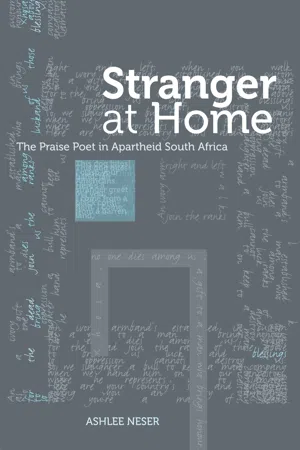
This book is about the poetry, vision and deeply inhospitable context of one of South Africas most talented praise poets.
The praise poet (imbongi) is a familiar cultural icon in contemporary South Africa. Public events as diverse as presidential inaugurations, openings of parliament, fashion shows and boxing contests begin with the rousing declamations of charismatic iimbongi. Yet until the institution of majority-rule, praise poets who sought to shock their audiences with dangerous truths could claim none of the prestige enjoyed by their present-day counterparts. Under apartheid, many praise poets either ceased to perform or abandoned the imbongi?s duty to diagnose and criticize political and social ills. There was, however, one brilliant Xhosa imbongi called David Manisi, a poet widely acclaimed in his youth as the successor to the great SEK Mqhayi, who refused to capitulate to the ease of silence or complicity. As documented by Jeff Opland in The Dassie and the Hunter (UKZN Press), Manisi worked tirelessly and in embattled contexts to address his audiences with demands, criticisms and aspirations they frequently misunderstood. The author of five volumes of Xhosa poetry and performer of inspired and elegantly crafted izibongo (praise poems), Manisi saw himself as a man of multiple places, allegiances and identities at a time when these markers of self were rigidly policed. Manisi's entrance on the local Transkeian poetry scene was legendary. He was for a time the most famous poet in Kaiser Mathanzima's court. He also wrote the first published poem about Nelson Mandela in 1954, hailing him prophetically as 'Gleaming Road'. Despite these early accomplishments, Manisi ended his career as a lonely performer in American and South African universities. He never met Mandela, his hero of old.
Ashlee Neser examines Manisi as an inventive negotiator of rural and urban spaces, modernity and tradition, performance and publication, the local and the foreign.
- English
- ePUB (mobile friendly)
- Available on iOS & Android
eBook - ePub
About this book
Information
Subtopic
Literary BiographiesIndex
Literatureone
Writing in a vacuum
Manisi’s public career began auspiciously in 1946 when he was invited to perform at one of the many celebrations organised to mark Ntsikana Day, an annual celebration of great significance to the Xhosa community of the eastern Cape. Such was the power of Manisi’s contribution to the occasion that in 1947 he was asked by the Ntsikana Day Committee to produce poetry at the main national event in East London. What remains of Manisi’s national debut is a sentence in an article published on 19 April 1947 in the Johannesburg newspaper Umteteli wa Bantu (‘The People’s Spokesman’). Reporting on the main celebrations for dispersed Xhosa audiences, the article recounts the day’s proceedings in some detail and recalls that ‘[a]s we were closing Mr Livingstone Manesi (a poet) spoke about the celebration and he reminded us of Mqhayi’ (in Opland 2005: 47). Until his death in 1945, SEK Mqhayi had held the distinguished position of official Ntsikana Day poet, an honour bestowed upon Manisi in 1947 by his audiences and by published reports like that quoted above.
The young poet’s early rise to prominence in the local popular imagination resulted in large measure from people’s experience and discussion of his talent. Yet his reputation was created in print as well as in performance contexts, with the result that he was known as Mqhayi’s successor beyond the confines of the local. After the 1947 Umteteli article, several newspaper reports of local events at which Manisi had performed augmented and circulated the poet’s literary reputation in Transkei, Johannesburg and beyond. A favourable review of his talent also featured in the published poetry of a notable contemporary, the writer St John Page Yako. In a poem commemorating the 1951 unveiling of Mqhayi’s tombstone, a public occasion attended by dignitaries and poets, Yako refers to the brilliance of Manisi’s performance at the event and berates Xhosa intellectuals, like AC Jordan, for their absence and for having lost an opportunity to hear Manisi, the nation’s newest talent:
Even Jordan of ‘The Wrath of the Ancestors’ has seen nothing
Since he has not seen the edge of Manisi’s hair,
As he gestured and acted up as if to stab the heavens.
Even Mdlele hid himself at Lovedale
Fearing for his egg-head
Lest Manisi’s dust should fall on and soil it. (in Kuse 1983: 143)
The newspaper reports and the extract from Yako’s poem suggest something of the early acclaim won by Manisi. They also indicate the symbiotic relationship between print and oral media in the making of the young poet’s reputation.
The medium of print in fact facilitated much of Manisi’s experience of Xhosa literature – that which had been recorded from oral sources as well as texts written for publication. Repeatedly in interviews, Manisi cites Mqhayi as the greatest among poets and as his main literary inspiration, yet Manisi neither met Mqhayi nor heard him perform except on record. It is certain that oral account was partly responsible for the widespread reputation attached to Mqhayi. However, Manisi’s experience of Mqhayi’s poetry was through print – he had read Mqhayi’s books and poetry collections at Lovedale as part of his literature syllabus. Manisi’s reception of Mqhayi’s poetry through print suggests the mutually implicating ways in which literacy, oral genre, Christian and book education, as well as early black nationalism operated in the young Manisi’s consciousness. Born into a community in which mission education had been available to at least four generations of Xhosa intellectuals, Manisi experienced print as one way of accessing people and ideas – and even, paradoxically, oral genres.
From the start of his public career, Manisi wrote praise poetry for newspaper and book publication in addition to performing izibongo for local audiences. Between 1947 and 1955 he contributed several poems to Umthunywa (‘The Messenger’), a Mthatha1 newspaper, and Umteteli wa Bantu (‘The People’s Spokesman’), a newspaper published from Johannesburg by the Chamber of Mines. Both newspapers catered for mixed-language audiences with sections in English and isiXhosa (and, in the case of Umteteli, other southern African languages as well). Except for one izibongo commemorating the death of a white Native Affairs administrator, which was published in isiXhosa and English in African Studies, Manisi’s poems were always published in his mother tongue, exclusively for isiXhosa-speaking readers. The main subjects of his newspaper poetry between 1947 and 1955 were identical to those of his performance izibongo – most of them identified, encouraged support for, and exhorted right action from Mathanzima and Sabatha Dalindyebo, the Thembu paramount. In 1983, after a considerable period of silence in the pages of newspapers, Manisi’s poem mourning the death of the Xhosa academic ZS Qangule appeared in the longest-running Xhosa newspaper, Imvo Zabantsundu (‘Native Opinion’).
In addition to his newspaper contributions, Manisi wrote original collections of poetry in isiXhosa for book publication. Lovedale Press published his first volume, Izibongo zeenkosi zamaXhosa (‘The Praise Poems of Xhosa Chiefs’), in 1952. It comprises several sections, the first containing 35 traditional-style poems about Thembu, Gcaleka and Rharhabe chiefs. Other sections consist of stylistically diverse poems including lyrics, laments and narratives. The book would have been suitable for school prescription had it not been printed in the New Orthography which had been introduced in 1935: when the Revised Standard Orthography for Xhosa was adopted in 1955, Izibongo zeenkosi zamaXhosa was not reprinted to reflect the change and became immediately redundant for school use. Since schools constituted the major market for books published in African languages, Manisi’s first publication was fatally timed: upon its publication, the poet earned £25; no royalties ever accrued to him and the book rapidly sank into obscurity.
Manisi’s second volume, Inguqu (‘A Return to the Attack’), appeared in 1954. The author bore the £69 cost of its 500-copy print run. The book contains poetry in a range of forms, including narratives, praise poems and lyrics. The izibongo invoke a variety of subjects – from the chief, Mathanzima, to the poet, Mqhayi, to the political moderniser, Mandela. Although, like all Manisi’s publications, Inguqu is unavailable for purchase and unobtainable except from a few archives, the poem for Mandela has begun to attract renewed attention and has been discussed and occasionally reprinted and retranslated in the pages of academic studies and in Krog’s A Change of Tongue (2003).
In 1977, the Institute of Social and Economic Research (ISER) at Rhodes University in Grahamstown published Manisi’s 39-page long poem about Transkei’s independence. Entitled Inkululeko: uzimele-geqe eTranskayi (‘Freedom: Independence in Transkei’), the izibongo was inspired by the poet’s performances at Transkei’s 1976 ‘independence’ celebrations and is dedicated to Mathanzima. Although, as Opland notes, Inkululeko catalogues Transkei’s socio-economic problems, refers to a wider African struggle, and cites Mandela as the kind of man needed to lead ‘experts and heroes/and drive slavery out of Africa/from the east to the west’ (2005: 148), it was to prove a source of shame for its author because it endorsed a political dispensation that was complicit with Pretoria’s grand design. Peter Mtuze, Xhosa poet and scholar, argues that, although Manisi was not easily ‘hoodwinked into adopting a stand that [could not] benefit the blacks in the end’, in Inkululeko the poet was ‘the mouthpiece of the Transkei authorities’ (1991: 18). It is perhaps symbolic of the increasingly incommensurate loyalties held by the poet that his first South African and academic-funded publication should defend a political order he had sought to escape by taking up academic invitations to perform poetry.
ISER published Manisi’s next two books in its ISER Xhosa Text series: in 1980, a collection of poems called Yaphum’ ingqina (‘Out Goes the Hunting Party’) containing 11 izibongo in honour of contemporary chiefs, and in 1983 Imfazwe kaMlanjeni (‘The War of Mlanjeni’), an epic about the 1850–53 frontier war fought against colonials by the Xhosa resistance leader Mlanjeni. In addition to these volumes, Manisi also wrote several unrealised manuscripts: one was lost by the publisher to whom it had been submitted, without any copies held in reserve; another, called ‘iRhodes’, was presented to Opland in 1979 for his assessment but remained unpublished because of its ungainly form and minimal prospect of attracting a readership. ‘iRhodes’ is housed as an unpublished manuscript in the Opland Collection of Xhosa Literature and substantial extracts of the long izibongo have been quoted in The Dassie. The poem provides a fascinating insight into the kinds of compromises Manisi tried to make to realise his vision of multicultural harmony for South Africa.
This chapter investigates the circumstances in and influences under which Manisi produced his written izibongo. The history of the poet’s publishing career is one of struggle and apparent failure: his newspaper contributions, although they showed every sign of attracting readers’ approval, were few; none of his books sold well or was widely read, and none is now in print. In Chapter 2, I discuss the peculiar adaptability of the izibongo form to print media, and argue that, as his chances of reaching immediate adult readerships diminished, Manisi began to value, above its circulatory function, the capacity of print to preserve texts so that his poems might address future readers in more congenial times. In this chapter, I discuss the political, intellectual and publishing context in which Manisi’s writing career grew increasingly marginalised, and investigate the reasons for his continuing to write tenaciously despite the obstacles that prevented him from finding a contemporary adult readership. I outline the historically interconnected factors that influenced Manisi as a writer and that shaped the world in which he wrote his early books and newspaper poetry: Christianity, literacy, mission education, black education debates, and the legacy of late nineteenth- and early twentieth-century Xhosa intellectual elites. The role of Christianity and the value of education were abiding concerns of Manisi’s written and performance poetry, in which references to missionaries and book learning often betray the poet’s deeply conflicted feelings about acculturation and the material legacies of the colonial encounter.
While the colonial occupation of Xhosa territory preoccupies much of Manisi’s poetry and attracts his angriest criticism, it was the constraints of his contemporary vernacular publishing industry and the increasingly polarised national politics of racial discrimination and resistance that pressured his career as a publishing and performing praise poet. Born into a world in which Xhosa writers like Tiyo Soga, WW Gqoba, IW Wauchope, Nontsizi Mgqwetho, Mqhayi and many others had published considerable numbers of poems and been widely influential contributors to Xhosa newspapers, Manisi wished to add to the intellectual exchange in isiXhosa.2 However, the relative political and publishing freedoms enjoyed by the isiXhosa-speaking elite of the late nineteenth and early twentieth centuries, as well as its claim on adult reading publics and an engaged sphere of intellectual exchange, were rapidly receding when Manisi’s writing career commenced. His early publications appeared at a time of paradigmatic change when large numbers of apartheid laws that intensified and entrenched racial segregation were being passed. In the 1950s, apartheid’s ideology of divisive ethnicity infused black education policy, was reflected in measures that constrained the vernacular publishing industry, and caused the decline of African-language newspapers. Those of Manisi’s contemporaries, like JJR Jolobe, EG Sihele, FB Teka and St John Page Yako, who had made significant literary contributions to newspapers, ceased to publish in the popular press within the first decade of apartheid rule.3
In this and the next chapter, I shall argue that Manisi’s hopes in his written poetry of addressing broad political communities on a range of subjects pertinent to black experience were frustrated by a political context in which, first, newspapers no longer hosted vigorous Xhosa intellectual and literary exchange as they had in the nineteenth and early twentieth centuries, second, publishers sought contributions solely for the publication of school textbooks, and third, resistance writers increasingly eschewed vernacular address in favour of publishing in urban contexts in the more widely accessible English medium, rejecting the rural polity as an anachronistic institution. In this chapter, I examine each of these areas (the Xhosa newspaper industry, book publishing and the rise of resistance literature) in turn, and outline the politics and perspectives of influential black writers who preceded and wrote contemporaneously with Manisi. I argue that the worldviews and literary opportunities that Manisi inherited were rapidly challenged by the apartheid context. Manisi’s intellectual and spiritual heritage and the polarised politics of his age informed his contradictory attitudes to the act of writing and the subject of education, which throughout his career he both criticised as a political imposition and championed as the means to black liberation. It is to these attitudes that I turn at the end of this chapter in an exploration of several of Manisi’s book and newspaper izibongo.
Early Xhosa intellectuals, debate and the newspaper
Michael Cross usefully divides black politics in South Africa into three broad periods: ‘(1) Christian-liberal reformism and moderation, 1884–1943; (2) pragmatic nationalism and Africanism, 1943–1976; and (3) critical nationalism and Africanism, 1976–1986’ (1992: 41). Although Manisi produced oral and written poetry between 1947 and 1988, a period that spans Cross’s second and third phases, Christian liberalism, which was perhaps ...
Table of contents
- Cover
- Halftitle Page
- Title Page
- Copyright Page
- Dedication
- Contents
- Acknowledgements
- Introduction
- part one
- part two
- Conclusion
- Appendix Note on genealogy
- Endnotes
- Bibliography
- Index
Trusted by 375,005 students
Access to over 1.5 million titles for a fair monthly price.
Study more efficiently using our study tools.
Frequently asked questions
Yes, you can cancel anytime from the Subscription tab in your account settings on the Perlego website. Your subscription will stay active until the end of your current billing period. Learn how to cancel your subscription
No, books cannot be downloaded as external files, such as PDFs, for use outside of Perlego. However, you can download books within the Perlego app for offline reading on mobile or tablet. Learn how to download books offline
Perlego offers two plans: Essential and Complete
- Essential is ideal for learners and professionals who enjoy exploring a wide range of subjects. Access the Essential Library with 800,000+ trusted titles and best-sellers across business, personal growth, and the humanities. Includes unlimited reading time and Standard Read Aloud voice.
- Complete: Perfect for advanced learners and researchers needing full, unrestricted access. Unlock 1.5M+ books across hundreds of subjects, including academic and specialized titles. The Complete Plan also includes advanced features like Premium Read Aloud and Research Assistant.
We are an online textbook subscription service, where you can get access to an entire online library for less than the price of a single book per month. With over 1.5 million books across 990+ topics, we’ve got you covered! Learn about our mission
Look out for the read-aloud symbol on your next book to see if you can listen to it. The read-aloud tool reads text aloud for you, highlighting the text as it is being read. You can pause it, speed it up and slow it down. Learn more about Read Aloud
Yes! You can use the Perlego app on both iOS and Android devices to read anytime, anywhere — even offline. Perfect for commutes or when you’re on the go.
Please note we cannot support devices running on iOS 13 and Android 7 or earlier. Learn more about using the app
Please note we cannot support devices running on iOS 13 and Android 7 or earlier. Learn more about using the app
Yes, you can access Stranger at Home by Ashlee Neser,Ashlee Neser in PDF and/or ePUB format, as well as other popular books in Literature & Literary Biographies. We have over 1.5 million books available in our catalogue for you to explore.