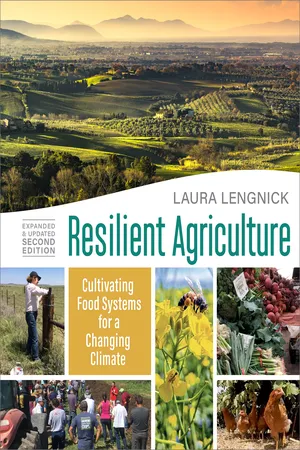
Resilient Agriculture: Expanded & Updated Second Edition
eBook - ePub

Resilient Agriculture: Expanded & Updated Second Edition

Cultivating Food Systems for a Changing Climate

  1. 304 pages
  2. English
  3. ePUB (mobile friendly)
  4. Available on iOS & Android
eBook - ePub

Resilient Agriculture: Expanded & Updated Second Edition

Cultivating Food Systems for a Changing Climate

About this book

Real world stories from the frontlines of climate change, resilience, and the future of food

Practical insights and plenty of examples of how we can reshape our food system to one that is resilient and regenerative.
Mathis Wackernagel, Ph.D., founder and president, Global Footprint Network, co-author Ecological Footprint

Inspiring and practical at a time when we desperately need both.
Dr. Anne Waple, founder and CEO, Earth's Next Chapter

Brilliantly argues that it isn't some vague notion of "technology" that will show us the way forward but people working together and carefully stewarding the land.
Mark Bittman, author, Animal, Vegetable, Junk and How to Cook Everything

CLIMATE CHANGE PRESENTS an unprecedented challenge to food and farming in the U.S. and beyond. Damaging weather variability and extremes capture the headlines, but more subtle changes caused by hotter summer nights, warmer winters, and a longer growing season have far-reaching effects on the land, people, and communities that feed us.

This expanded and updated edition of Resilient Agriculture takes you beyond the headlines and the hype to shine a light on agricultural climate solutions with the power to cultivate new American foodways that are just, sustainable, regenerative, and resilient.

Updated content includes:

  • Current and expected changes in regional weather patterns that disrupt food and farming
  • New adaptation stories from sustainable, climate-smart, organic, and regenerative farmers and updates on the producers featured in the first edition
  • Real-world applications of resilience thinking that connect the dots between food justice, sustainable development, regenerative economy, and planetary health
  • A companion website with stories, videos, issue briefs, reading guides, and more.

Whether you are working in food and farming or are simply an interested eater, Resilient Agriculture will take you on a journey into real-world resilience solutions with the power to regenerate the well-being of land, people, and community no matter the challenges ahead.

What would a more resilient food system look like? Lengnick answers that question with this path-breaking, delightfully informative book.
Richard Heinberg, senior fellow, Post Carbon Institute, author, Power: Limits and Prospects for Human Survival

A guidepost for building a better and more resilient food system.
Dr. Gabrielle Roesch-McNally, director, Women for the Land, American Farmland Trust

ACCESSIBILITY NOTES
This publication meets the EPUB Accessibility requirements and it also meets the Web Content Accessibility Guidelines (WCAG-AA). It is screen-reader friendly and is accessible to persons with disabilities. This book contains various accessibility features such as alternative texts for images, table of contents, landmarks, reading order, page list, Structural Navigation, and semantic structure. Blank pages have been removed from this EPUB.


Frequently asked questions

Yes, you can cancel anytime from the Subscription tab in your account settings on the Perlego website. Your subscription will stay active until the end of your current billing period. Learn how to cancel your subscription.
At the moment all of our mobile-responsive ePub books are available to download via the app. Most of our PDFs are also available to download and we're working on making the final remaining ones downloadable now. Learn more here.
Perlego offers two plans: Essential and Complete
  • Essential is ideal for learners and professionals who enjoy exploring a wide range of subjects. Access the Essential Library with 800,000+ trusted titles and best-sellers across business, personal growth, and the humanities. Includes unlimited reading time and Standard Read Aloud voice.
  • Complete: Perfect for advanced learners and researchers needing full, unrestricted access. Unlock 1.4M+ books across hundreds of subjects, including academic and specialized titles. The Complete Plan also includes advanced features like Premium Read Aloud and Research Assistant.
Both plans are available with monthly, semester, or annual billing cycles.
We are an online textbook subscription service, where you can get access to an entire online library for less than the price of a single book per month. With over 1 million books across 1000+ topics, we’ve got you covered! Learn more here.
Look out for the read-aloud symbol on your next book to see if you can listen to it. The read-aloud tool reads text aloud for you, highlighting the text as it is being read. You can pause it, speed it up and slow it down. Learn more here.
Yes! You can use the Perlego app on both iOS or Android devices to read anytime, anywhere — even offline. Perfect for commutes or when you’re on the go.
Please note we cannot support devices running on iOS 13 and Android 7 or earlier. Learn more about using the app.
Yes, you can access Resilient Agriculture: Expanded & Updated Second Edition by Laura Lengnick in PDF and/or ePUB format, as well as other popular books in Technology & Engineering & Agricultural Public Policy. We have over one million books available in our catalogue for you to explore.

PART 1 WHY THINK RESILIENCE?

I want to have hope, but I don’t know.
There’s also the reality of how we’re treating the planet right now. I think we are all going to be a little lost in the dark as the weather keeps getting more and more chaotic.
— Mary Berry, Southern Exposure Seed Exchange, Mineral, Virginia
Chapter 1

Waking Up to Climate Change

MY WAKE-UP CALL on climate change was an actual phone call. It was one of those quiet moments in life that at the time do not feel too important, but looking back is a clear point of change. I remember I was grading papers on a fall afternoon, and gazing out of my office window over corn fields shimmering golden in the setting sun. The phone rang, I answered, and a woman with a snappy English accent explained that she was organizing an event hosted by the local chapter of the Ameri can Meteorological Society. “I’m calling to invite you to speak in a public lecture series on climate change impacts in western North Carolina,” she said. “Sure, that sounds great,” I answered. “What would you like me to talk about?” “Well,” she said, “we need someone who is willing to talk about how climate change is changing the way we eat here in the mountains.”
My first thought was that she had the wrong person. I’m a soil scientist, not a climate scientist. On second thought, I wondered what was known about climate change effects in food and farming, which was rapidly followed by my third thought: Perhaps this is a good opportunity to learn something new! And so I agreed to do the lecture. We discussed a few details, and I hung up the phone.
I will never forget that call. Thinking back on it now, I remember, in that quiet moment after the call ended that I thought to myself, I guess it’s time for me to learn something about climate change.
Please understand. This was way back in 2008. It wasn’t that I didn’t know about climate change theory. I knew a lot about it. The Earth’s energy balance. The greenhouse effect. The global processes that create weather. How fossil fuel use changes the composition of the Earth’s atmosphere. Check, check, check and check — I taught these concepts every year to first- year students in my environmental studies classes. I also knew a lot about the lead antagonists in the climate change story, because I had researched the behavior of carbon and nitrogen in farming systems as a young scientist.
Besides all of that, I was one of those people who estimated my carbon footprint and made lifestyle changes to reduce it. I purchased green products, biked and carpooled when I could and voted for leaders who preached respect for our environment. I joined Transition Asheville and created an energy descent action plan for my community. I was one of the good guys.
Back then, I thought of climate change as something off in the distance — a hazy future threat. I knew it could be bad, but I also believed that we still had time to fix it. I knew it wouldn’t be easy, but I felt sure we could and would begin to act on climate change before it caused too much damage.
As I prepared for that public lecture, I was shocked to learn that climate change was already happening, that farmers and ranchers across North America were already suffering increasing losses from more variable and extreme weather. I learned that cities were struggling to manage more frequent and increasingly deadly flooding and heat waves, rising temperatures were beginning to interfere with air travel and tropical diseases were moving northwards. I was surprised to learn that the recent drought I had lived through here in the Southeast was just a glimpse of a future likely to be shaped by increasing competition for water. I was astonished to learn that the Environmental Protection Agency was busy making plans for a retreat from our nation’s coasts because of sea level rise. The evidence was clear: the fingerprints of climate change were already touching every part of our lives.
Learning these things changed me. I could not continue to move through a comfortable dream world that put climate change somewhere in the future. I knew that I had to shift my teaching to focus less on the processes of global warming, and more on the reality of climate change: what it is, how it is disrupting land, people, and community and, most important, what we can do about it. I needed to share what I had learned, as well as I could, and in as many places as I could:
  • Climate change is happening now.
  • Climate change is changing everything.
I needed to do what I could to help people understand that it was way past time for us to think about how we could adapt to climate change even as we worked to slow it down and reverse it.
In the years since giving that public lecture, I went on to lead the development of a national report on adapting U.S. agriculture to climate change, to write a book exploring climate change resilience and the future of food through the adaptation stories of some of America’s best farmers, and to resign my faculty position so that I could start a small business helping people take action on climate change.
All because of a phone call one lovely fall afternoon.

Unprecedented

My first big step into the world of climate action came as an invitation to join the U.S. Department of Agriculture (USDA) leadership team responsible for producing the very first national report exploring agricultural adaptation to climate change in the U.S. As a member of the lead author team and the lead scientist on adaptation, I worked with researchers from across the U.S. to gather, review, discuss and report on the state of scientific knowledge about current and future climate change effects on U.S. agriculture as well as effective agricultural adaptation options. It was in this work that I first learned the language of resilience, the ideas and language that I now use every day, ideas like vulnerability, exposure, sensitivity, adaptive capacity, climate risk, and climate equity.
In the 18 months I spent working on the USDA report, I learned many surprising things that caused both heartache and hope in equal measure:
  • Climate change is not changing weather patterns uniformly across the U.S. Where you live determines your experience of climate change.
  • Climate change is not only increasing the frequency and intensity of extreme weather. Climate change is behind subtle changes in seasonal patterns of temperature and water that rarely make the news, but can be incredibly damaging to agricultural businesses.
  • Climate change adaptation is not about figuring out how to adjust to a “new normal.” It is about figuring out how to manage the risks created by more variable weather patterns that are likely to change at a faster pace and grow more intense through at least mid- century.
As the leadership team worked to finish the report, we spent a considerable amount of time identifying the most important lessons learned in our 18 months of work. I want to share one of these lessons here, because I think it expresses very well the unique nature of the climate change challenge to U.S. food and farming systems:
Although agriculture has a long history of successful adaptation to climate conditions, the current pace of climate change and the intensity of the projected climate changes represent a novel and unprecedented challenge to the sustainability of U.S. agriculture.
Many concerns were raised about this statement by the authors and reviewers of the report: that it was too pessimistic; that we were getting ahead of the science; that it was not in the public’s best interest to admit that we didn’t have all the answers. The lead author team pushed back on these criticisms, because we felt confident that the data did support a statement of this nature. We understood it was a provocative statement. We understood that such a conclusion would cause serious concerns about our ability to sustain U.S. agriculture into the twenty-first century. And ...

Table of contents

  1. Cover
  2. Title Page
  3. Copyright
  4. Acknowledgments
  5. Part 1 — Why Think Resilience?
  6. Part 2 — The Rules of Resilience?
  7. Part 3 — What Path to Resilience?
  8. Part 4 — Real World Resilience: Stories of Land, People and Community
  9. Notes
  10. Index
  11. About the Author
  12. About New Society Publishers