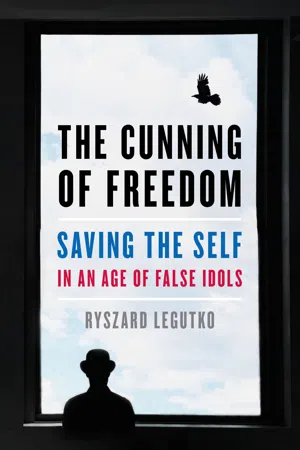
The book has two currents. The first is an analysis of the three concepts of freedom, which are called, respectively, negative, positive, and inner. Negative freedom is defined as an absence of coercion, positive freedom as an ability to rule oneself and rule others, inner freedom as being oneself, that is, being an author of one's decisions. Each concept is analyzed both in terms of its development in the history of ideas and in terms of its internal logic. The major problem of negative freedom is to find widely accepted rules according to which this freedom can be distributed. The major problem of positive freedom is to define what constitutes a free person. The major problem of inner freedom is how to correlate it with the proper interpretation of the human self. The book advances the thesis – and this constitutes the other current of its narrative – that we have been witnessing the advent of a new form of despotism, much of it being the effect of the dominant position of liberalism. Precisely because it took a reductionist position, liberalism has impoverished our view of freedom, and consequently, our notion of human nature with its political, moral, and metaphysical dimensions.
- 120 pages
- English
- ePUB (mobile friendly)
- Available on iOS & Android
eBook - ePub
About this book
Information
Subtopic
Political PhilosophyIndex
Economics
PART ONE

NEGATIVE FREEDOM


CHAPTER 1
ON NEGATIVE FREEDOM
Probably the most intuitive of all the meanings of the word “freedom” is the absence of coercion. I am free insofar as there is no one else to hinder or stop me from doing what I want to do and, most certainly, if no one forces me to do something I do not want to do. The presence of someone sitting next to me on a bench might prevent me from spreading out all of my belongings on it. He might force me not to light up a cigarette, saying it would be bad for his health, or that there is a no-smoking rule. He might even threaten to call the police and have me prosecuted. I would be subject to an even greater degree of coercion if someone not only prevented me from smoking in his presence but also made me do something else, such as read hefty books on smoking’s harmfulness, or drink milk and take medications.
This sense of freedom is usually referred to as “negative” freedom and is so elementary that it would seem to need no further justification. Though many people fear this kind of freedom, and are happy to relinquish some if not most of it, no one can honestly say that they no longer require some domain where they are free do what they want; that what they really desire is to be coerced by others. Throughout history’s innumerable struggles for freedom, it would be absurd to imagine anyone fighting for coercion as coercion; that is, with the clear and conscious intention of being seriously and systematically constrained by others. We all agree that being coerced is such an unpleasant experience that wanting it for ourselves would go against human nature. We can also agree that, just as the air we breathe is essential to us so, too, is a certain degree of freedom necessary for our natural development (even if sometimes we are more than ready to deny this to others).
The key issues concern the amount of freedom we actually want and which criteria we will use to distribute this free space. No irrefutable rule has been established yet. Perhaps the problem of distribution (to which we will return in detail later) has become even more engaging than freedom itself. Sometimes we might not be satisfied with the extent of our freedom, not because it is small in the objective sense, but because we consider it insufficient for our purposes and ambitions, or less than the amount others enjoy. Rarely are we sufficiently pleased with what we have to abandon attempts at improving or revising the criteria for its distribution.
Those who defend negative freedom agree that societies face destruction from uncontrollable conflicts in the absence of clear, stable criteria outlining how freedom is apportioned. But attempting to define such principles generates a far more profound problem than one of purely technical difficulties.
Our subjective sense of freedom conflicts fundamentally with any generally applicable principle about how it can be distributed. Negative freedom is always subjective because it applies to individuals. If we need a free space to live, just as we need air to breathe, then we necessarily bring freedom into the subjective realm. That we might make use of our freedom for the well-being of others, or mankind’s happiness, is irrelevant. We may indeed use our freedom in that way, but even if we do not, it does not follow that our degree of freedom should be reduced. On the other hand, the rule of distribution should be adopted as an objective principle, independent of the individual’s intentions. If we assume that everyone is given a certain degree of negative freedom as a birthright, then establishing rules for its distribution would be tantamount to setting up a social and political constitution.
A necessary tension exists between both of these elements and perspectives. The individual is driven by his own ego to defend his own interests. Society institutes a legal framework to coordinate all those individual egos and, like all systemic undertakings, this becomes an end in itself with no regard for individual preferences or needs.
But once we start building a system of distribution, we are in for more trouble. We might conclude that freedom is not as important a value as its regulation. If someone believes that negative freedom should be equally distributed (granting everybody the same amount) such a person places equality over and above freedom, and thus his sociopolitical system will take away certain freedoms from some people and give them to others. This may make his egalitarian system more restrictive to a particular part of society, thereby undermining its original mission of freedom. If someone else says that freedom should be distributed in accordance with justice, then he makes justice the supreme value. If it is distributed according to a given community’s moral values, or in accordance with human nature, then either that community’s well-being, or humanity’s welfare, becomes the supreme value.
If, however, freedom’s regulating principles are not such philosophically loaded notions but merely the product of political negotiations, then we are faced with a different but no less serious problem. Rules generated to serve the interests of those in power will hold only for as long as those egoistic desires are satisfied. But they might not necessarily last forever. Human self-interests are not obliged to observe any rules at all; they are far more likely to take control of them. In that instance, rules lose their inviolability because instead of regulating those self-interests, they become the product of them. Bending the law has been characteristic of all political systems from monarchy, to oligarchy, to democracy. Our current age of democracy is nourished by a belief that is as boastful as it is self-contradictory. It claims that democratic laws are both stable and responsive to people’s needs, more resistant than ever to arbitrary power, and more in tune with the new aspirations of our changing times. These claims are irreconcilable: democratic laws are far from stable and not at all resistant to arbitrary power.
The democratic system hopelessly confuses the self-interested aspect of freedom with the law’s supposed objectivity and often blends the two together. An individual might assume that his self-interests are restricted by rules not of his own making. However, a democratic majority, an ideologically powerful party, or an interest group that effectively influences the legislature can all pursue their self-interests and fashion the rules concerning how freedom is apportioned. This not only creates a serious constitutional problem of how a democracy secures the fair distribution of liberties, it also creates a linguistic problem. Once one particular group’s freedom is confused with the legal framework of freedom, then the language of freedom is likely to become mendacious. And this is what has happened over recent decades in the Western world.
Various interest groups have hijacked freedom and have made the success of their crusades their sole criterion. These groups have somehow managed to convince public opinion–or, more often, the ruling elites–that they pave the way for greater democracy by opening up more free space for hitherto marginalized groups. Identity politics, supported by ethnic studies and so-called gender studies, are cases in point. Whether their powerful effect upon educational institutions and legal systems has resulted in greater democratization is debatable. What cannot be doubted, however, is that they have greatly restricted liberties in practically every area of life, including free speech, free inquiry, and free thought. Additionally, contrary to obvious facts, their successes are generally officially sanctioned by legislatures and courts and presented as victories for freedom. The situation has become so pathological that there is practically no external body left that can question conclusively the constitutional dubiousness of limiting basic liberties and discredit the mendacity of the language in which it is described.
CHAPTER 2
THE WRETCHED WORLD OF ABSOLUTE FREEDOM
Negative freedom can best be understood as a sterile laboratory environment. Let us try to depict what life would be like if we could enjoy the full measure of freedom, without the need to negotiate its limits with anyone else. Such a world has a fictional portrayal: Robinson Crusoe’s desert island. Having survived a shipwreck, Crusoe was not disturbed by anyone. No one prohibited him from doing what he wanted, nor ordered him to do anything. Of course, such a world is completely unrealistic or only rarely encountered (serendipitously, if at all) by few individuals.
Let us take a closer look at Robinson Crusoe’s situation and determine how it might indeed be desirable. One doesn’t have to think too hard to realize that the human mind doesn’t often long for absolute freedom. This kind of freedom is not the same kind of desirable goal as, for instance, wealth or power, which can seem limitless in people’s imagination and aspirations, even if their boundless accrual might be unrealistic. We want to have greater riches and power, far more than is either attainable or enjoyed by others who have done better for themselves. We want to be richer than John Rockefeller or Bill Gates, more powerful than absolute monarchs or even, in other respects, Harry Potter. Even if such dreams are hatched in the harmless world of fantasy or fairy tales, the very fact of their ubiquity and persistence says something both about our deeply held attitudes towards these goals and about the goals themselves. Yet hardly anyone would want to have Robinson Crusoe’s degree of freedom. We might imagine solitary life on a deserted island as a potential short vacation, an occasional rest far away from the hubbub of civilization. We would never think of it with a mixture of craving and regret, as a destiny to be devoutly wished for, yet utterly unattainable and beyond our reach. Being marooned on a deserted island, in absolute freedom, would be more like a nightmare that we shake off with relief once we waken. Daniel Defoe’s protagonist was depressed when he realized he was all alone on an uninhabited island. He certainly did not experience the exhilaration he might have felt if instead fate had made him a rich man or a powerful prince.
Absolute negative freedom is therefore not only unreal, but there is no need for it–and not just in the sense that immeasurable riches or excessive power are unnecessary. We certainly have no need for either because, typically, they exceed human nature’s moral potential as well as our ability to use them sensibly. We do not require absolute freedom because it runs counter to human nature, so much so that the prospect of having it fills us with dread. We must surely realize that limits to our negative freedom are indispensable. We might be indignant when someone takes away part of our freedom, imposes prohibitions, or sets down orders that we must obey; but the prospect of living in a world devoid of such restrictions would fill us with anxiety. We might not exactly know why we need these restrictions; we would have to stop and think it over, and perhaps we would not all reach the same conclusion. Nonetheless, we would all immediately and unquestionably realize that we could not live without them.
We might claim that what troubled Robinson Crusoe was not so much the absolute negative freedom that suddenly befell him, but rather his loneliness. But absolute freedom is loneliness. If there is no one to enter my existence, no one to react or relate to my words and actions, then in point of fact I am entirely on my own, free to do anything I like, or nothing at all. Absolute freedom must always be accompanied by an extremely painful existential experiment consisting of severing off all of our commitments to others and removing them from beyond the limits of our existence.
We would probably feel a similar fear at the prospect of our freedom being radically deprived; for instance, if we were imprisoned. We dread the idea of life in prison and consider such a condition contrary to our elementary existential needs. Prison is quite rightly used as a place of punishment, not as a place for moral advancement. Understandably, attempts at making prison such a place have rarely been successful since the unnatural conditions of prison life cannot readily be turned into a means of preparing individuals for being in their natural condition, namely life in the company of others.
What is extraordinary is that the fear of prison has a lot in common with the fear of absolute freedom. Both situations are extreme. In both cases, we are condemned to total, unbearable isolation: in the former, on the grounds of a judge’s verdict; in the latter, by random chance or by choice. In certain respects, deprivation of freedom and absolute freedom overlap. Their external conditions are diametrically different, but their existential situations are similar. Robinson Crusoe felt as if he were in prison not only because he could not leave the island but also because, like a prisoner, he was condemned to his own company. We can do very few of the things we want to do in prison, while there is no one to stop us from doing anything on a desert island. Yet, despite this significant disparity, it does not alter the overriding experience of having life’s natural rhythm fundamentally disturbed. Some people might prefer being in jail; some might not be bothered by absolute solitude. The general, well-grounded consensus is, however, that such attitudes are anomalous.
Take, for instance, the simplest example of negative liberty: freedom of speech. The point of freedom of speech is not about prohibiting opposition to what someone says, but rather providing a space in which others can hear and respond to what they have to say. Supporters of free speech have complained that certain laws, institutions, and customs often prevent us from saying what we want. But it is not hard to see that some forms of external pressure (while sometimes annoying) are what make this liberty so attractive and worth striving for. The absence of such pressure renders a statement ineffectual, thereby making it socially redundant. An individual who finds himself in a world where freedom of speech is absolute would be reminiscent of Robinson Crusoe yelling out his opinions on the beach of his island, or a prisoner addressing the empty walls of his cell.
Absolute negative freedom is not a rational aspiration because for all practical purposes it is beyond our grasp and, above all, because it comes dangerously close to its exact opposite. This is not true of other aspirations. Striving for and accumulating great wealth would not lead us into a condition similar to that of a pauper; nor would we resemble the powerless if we gained exorbitant power (although it could give rise to a variety of contradictions). By its very nature, negative freedom must be limited, otherwise it would result in unwanted consequences that, paradoxically, we would choose freedom to avoid.
CHAPTER 3
MAXIMUM FREEDOM
MANKIND’S NATURAL CONDITION
Since the world of absolute freedom is never a reality to anyone save Robinson Crusoe, one has to look for a more realistic option. A world of maximum freedom would be such an option. In such a society, all individuals have as much freedom as possible, their only limitation being the greatest possible freedom of others. This is, obviously, a purely theoretical construct, a daring thought experiment that imagines a world from which all obstacles to freedom have been removed. Philosophers have found this idea intellectually tempting and called it “the state of nature” or “the natural condition of mankind.”
Why consider “the state of nature” only to imagine a world that does not exist? The answer is well-known. By framing a hypothetical reality of maximum freedom, we can see more clearly how many liberties have been taken away from us in the real world. Having discovered that, we can then reflect upon how to recover much of this lost freedom by abolishing the unnecessary limitations that have been created over time. Ultimately, this thought experiment typically serves as a vehicle for the thorough, even radical, reform of political structures.
Influential as it is, this reform strategy can be powerfully counterargued primarily because of the controversial theoretical assumptions underpinning the concept of mankind’s natural condition. Two constitutive principles have to be assumed for the world of maximum freedom to exist, and each has provoked serious doubts.
The first such principle holds that in the natural condition people are conceived as individuals, not as social beings. Communities such as families (if they exist) are considered secondary, often provisional, and temporary so as not to encroach on the liberty of individuals. These communities can be relatively easily dissolved or changed depending on the self-interests and desires of the people within them. Perhaps the most radical version of individualism can be found in the work of Rousseau, who claimed that individuals living in the state of nature were self-contained, pre-moral beings, motivated by the simplest and most natural desires. “If we consider man just as he must have come from the hands of nature,” he wrote, “we behold in him an animal weaker than some, and less agile than others; but, taking him all round, the most advantageously organized of any. I see him satisfying his hunger at the first oak, and slaking his thirst at the first brook; finding his bed at the foot of the tree which afforded him a repast; and, with that, all his wants supplied.”1
In the natural condition’s second organizing principle, all people are equal; their aspirations and goals are of equal value, and in this respect no individual is privileged. Hobbes wrote of physical and intellectual equality among people in the state of nature. “As to the strength of body,” he wrote, “the weakest has strength enough to kill the strongest, either by secret machination or by confederacy with others, that are in the same danger with himself.” Hobbes also believed men were equal intellectually: “For Prudence, is but Experience; which equall time, equally bestowes on all men, in those things they equally apply themselves unto.” He continued: “That which may perhaps make such equ...
Table of contents
- Cover
- Title Page
- Copyright
- Contents
- Introduction
- Part One: Negative Freedom
- Part Two: Positive Freedom
- Part Three: Inner Freedom
- Conclusion
- Notes
- Index
Trusted by 375,005 students
Access to over 1.5 million titles for a fair monthly price.
Study more efficiently using our study tools.
Frequently asked questions
Yes, you can cancel anytime from the Subscription tab in your account settings on the Perlego website. Your subscription will stay active until the end of your current billing period. Learn how to cancel your subscription
No, books cannot be downloaded as external files, such as PDFs, for use outside of Perlego. However, you can download books within the Perlego app for offline reading on mobile or tablet. Learn how to download books offline
Perlego offers two plans: Essential and Complete
- Essential is ideal for learners and professionals who enjoy exploring a wide range of subjects. Access the Essential Library with 800,000+ trusted titles and best-sellers across business, personal growth, and the humanities. Includes unlimited reading time and Standard Read Aloud voice.
- Complete: Perfect for advanced learners and researchers needing full, unrestricted access. Unlock 1.5M+ books across hundreds of subjects, including academic and specialized titles. The Complete Plan also includes advanced features like Premium Read Aloud and Research Assistant.
We are an online textbook subscription service, where you can get access to an entire online library for less than the price of a single book per month. With over 1.5 million books across 990+ topics, we’ve got you covered! Learn about our mission
Look out for the read-aloud symbol on your next book to see if you can listen to it. The read-aloud tool reads text aloud for you, highlighting the text as it is being read. You can pause it, speed it up and slow it down. Learn more about Read Aloud
Yes! You can use the Perlego app on both iOS and Android devices to read anytime, anywhere — even offline. Perfect for commutes or when you’re on the go.
Please note we cannot support devices running on iOS 13 and Android 7 or earlier. Learn more about using the app
Please note we cannot support devices running on iOS 13 and Android 7 or earlier. Learn more about using the app
Yes, you can access The Cunning of Freedom by Ryszard Legutko in PDF and/or ePUB format, as well as other popular books in Economics & Political Philosophy. We have over 1.5 million books available in our catalogue for you to explore.