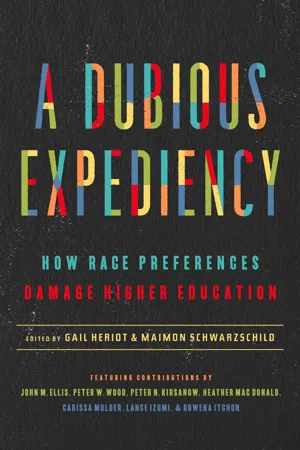
This book offers eight clear-sighted essays critical of racial "diversity" preferences in American higher education. Unlike more conventional books on the subject, which are essentially apologies for racial reverse discrimination, this volume forthrightly exposes the corrosive effects of identity politics on college and university life.
The fact-filled and hard-hitting chapters are by Heather Mac Donald, Peter N. Kirsanow, Peter W. Wood, Lance Izumi and Rowena Itchon, John Ellis, Carissa Mulder, and the editors Gail Heriot and Maimon Schwarzschild.
- 120 pages
- English
- ePUB (mobile friendly)
- Available on iOS & Android
eBook - ePub
About this book
Trusted by 375,005 students
Access to over 1.5 million titles for a fair monthly price.
Study more efficiently using our study tools.
Information
Topic
EducationSubtopic
Business EducationNOTES
STARTING DOWN THE SLIPPERY SLOPE
1 These federal grant programs were administered by the Department of Health, Education, and Welfare (as it was then known), and later the Department of Education, under the auspices of Title VI of the 1964 Civil Rights Act, 42 U.S.C. §§2000-2000d-7.
A DUBIOUS EXPEDIENCY
1 18 Cal. 3d 36, 62-63 (1976).
2 The justifications that were thought appealing in the past are sometimes forgotten. For example, in the decades following the American Civil War, anti-Chinese mobs in California used both physical and political force against Chinese laundry businesses. See, e.g., Yick Wo v. Hopkins, 118 U.S. 356 (1886). It was apparently their view that Chinese laundry businesses, of which there were many, were unfairly depriving white women, particularly widows, from earning a respectable living as laundresses and disrupting families by taking over traditional women’s work. See David Bernstein, Lochner, Parity, and the Chinese Laundry Cases, 41 WM. & MARY L. REV. 211, 224 (1999); Paul Ong, An Ethnic Trade: The Chinese Laundries in Early California, J. ETHNIC STUD. 95, 96 (Fall 1981).
3 ALLAN SINDLER, BAKKE, DEFUNIS AND MINORITY ADMISSIONS: THE QUEST FOR EQUAL OPPORTUNITY (1978).
4 Id. at 64.
5 Harriet Chiang & Bob Egelko, Stanley Mosk, 1912-2001, State Supreme Justice Dies at 88, S.F. CHRON., June 20, 2001.
6 438 U.S. 265 (1978).
7 See Peter Schmidt, U. of Colorado at Boulder Is Criticized for Its Diversity Expenditures, CHRON. HIGHER ED. (Jan. 17, 2007) (citing a report that states that “of the $21.8-million that the campus has reported spending on diversity programs, just $4-million goes toward student scholarships” and noting that “Chancellor Peterson has acknowledged that the $21.8-million figure is ‘not even close’ to a full total for the campus’s diversity expenditures.”), https://www.chronicle.com/article/u-of-colorado-at-boulder-is-criticized-for-its-diversity-expenditures. See also Heather Mac Donald, Multiculti U: The Budget-Strapped University of California Squanders Millions on Mindless Diversity Programs, CITY JOURNAL, Spring 2013, https://www.city-journal.org/html/multiculti-u-13544.html.
8 Grutter v. Bollinger, 539 U.S. 306 (2003).
9 See, e.g., STEPHEN COLE & ELINOR BARBER, INCREASING FACULTY DIVERSITY: THE OCCUPATIONAL CHOICES OF HIGH ACHIEVING MINORITY STUDENTS (2003); Frederick L. Smyth & John J. McArdle, Ethnic and Gender Differences in Science Graduation at Selective Colleges with Implications for Admission Policy and College Choice, 45 RES. HIGHER EDUC. 353 (2004); Richard H. Sander, A Systemic Analysis of Affirmative Action in American Law Schools, 57 STAN. L. REV. 367 (2004); Rogers Elliott, A. Christopher Strenta, Russell Adair, Michael Matier & Jannah Scott, The Role of Ethnicity in Choosing and Leaving Science in Highly Selective Institutions, 37 RES. HIGHER EDUC. 681 (1996).
10 Things are evidently not very different in medical schools. This is consistent with the results of a 1994 JAMA study, which reported that an astonishing 51.1% of African American medical students failed the Part I exam, as contrasted with only 12.3% of white medical students. See B. Dawson, C.K. Iwamoto, L.P. Ross, R.J. Nungester, D.B. Swanson & R.L. Volle, Performance on the National Board of Medical Examiners Part I Examination by Men and Women of Different Race and Ethnicity, 272 JAMA 674 (Sept. 7, 1994). Racial preferences almost wholly accounted for the gap. When African American medical students competed against white exam takers with similar academic credentials, they fared about the same.
R.C. Davidson & E.L. Lewis, Affirmative Action and Other Special Consideration Admissions at the University of California, Davis, School of Medicine, 278 JAMA 1153 (Oct. 8, 1997), has been touted by its authors as proof that relaxing academic standards in medical school admissions to admit more African American and Hispanic students is harmless—that it does not affect the quality of the doctors who graduate. The actual data, however, support the opposite conclusion. See Gail Heriot, Doctored Affirmative Action Data, WALL ST. J., Oct. 15, 1997.
11 Sander, supra note 9, at 427.
12 Id. at 431.
13 Id.
14 Id. at 427-36, Tables 5.1, 5.3 & 5.4.
15 See Ian Ayres & Richard Brooks, Does Affirmative Action Reduce the Number of Black Lawyers?, 57 STAN. L. REV. 1807, 1807 (2005) (“Richard Sander’s study of affirmative action at U.S. law schools highlights a real and serious problem: the average black law student’s grades are startlingly low”).
16 WILLIAM G. BOWEN & DEREK BOK, THE SHAPE OF THE RIVER: LONG-TERM CONSEQUENCES OF CONSIDERING RACE IN COLLEGE AND UNIVERSITY ADMISSIONS 72 (1998). The figures presented in Bowen & Bok for elite undergraduate institutions are not quite so alarming as the figures for law schools. But there are two ways in which they understate the problem. First, they report the average GPA for African Americans and not for African Americans who needed a preference to attend the school they attended. Second, the lack of a common undergraduate curriculum makes comparisons misleading. Minority students are less likely to choose tough majors like physics and chemistry, which are notorious for both their competitiveness and their low curve. See Peter Arcidiacono, Esteban Aucejo, & Ken Spenner, What Happens After Enrollment? An Analysis of the Time Path of Racial Differences in GPA and Major Choice, 1 IZA J. LAB. & ECON. art. 5 (2012). This artificially inflates pe...
Table of contents
- Cover
- Title Page
- Copyright
- Contents
- Introduction
- Starting Down the Slippery Slope
- A Dubious Expediency
- Diversity’s Descent
- Segregation Now
- Breaking the STEM
- The Sausage Factory
- Race Preferences and Discrimination against Asian Americans in Higher Education
- A Class Act? Social-Class Affirmative Action and Higher Education
- Acknowledgments
- Contributors
- Notes
- Index
Frequently asked questions
Yes, you can cancel anytime from the Subscription tab in your account settings on the Perlego website. Your subscription will stay active until the end of your current billing period. Learn how to cancel your subscription
No, books cannot be downloaded as external files, such as PDFs, for use outside of Perlego. However, you can download books within the Perlego app for offline reading on mobile or tablet. Learn how to download books offline
Perlego offers two plans: Essential and Complete
- Essential is ideal for learners and professionals who enjoy exploring a wide range of subjects. Access the Essential Library with 800,000+ trusted titles and best-sellers across business, personal growth, and the humanities. Includes unlimited reading time and Standard Read Aloud voice.
- Complete: Perfect for advanced learners and researchers needing full, unrestricted access. Unlock 1.5M+ books across hundreds of subjects, including academic and specialized titles. The Complete Plan also includes advanced features like Premium Read Aloud and Research Assistant.
We are an online textbook subscription service, where you can get access to an entire online library for less than the price of a single book per month. With over 1.5 million books across 990+ topics, we’ve got you covered! Learn about our mission
Look out for the read-aloud symbol on your next book to see if you can listen to it. The read-aloud tool reads text aloud for you, highlighting the text as it is being read. You can pause it, speed it up and slow it down. Learn more about Read Aloud
Yes! You can use the Perlego app on both iOS and Android devices to read anytime, anywhere — even offline. Perfect for commutes or when you’re on the go.
Please note we cannot support devices running on iOS 13 and Android 7 or earlier. Learn more about using the app
Please note we cannot support devices running on iOS 13 and Android 7 or earlier. Learn more about using the app
Yes, you can access A Dubious Expediency by Gail Heriot in PDF and/or ePUB format, as well as other popular books in Education & Business Education. We have over 1.5 million books available in our catalogue for you to explore.