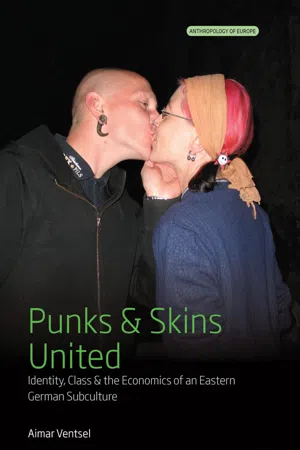
Germany has one of the liveliest and well-developed punk scenes in the world. However, punk in this country is not just a style-based music community. This book provides an anthropological examination of how punk reflects the larger changes and contradictions in post-reunification Germany, such as social segmentation, east-west tensions and local politics. Punk in eastern Germany is a reaction to the marginalization of the working class. As a cultural, social and economic niche, punks create their own controversial "substitute society" to compensate for their low status in mainstream society.
eBook - ePub
Punks and Skins United
Identity, Class and the Economics of an Eastern German Subculture
- 226 pages
- English
- ePUB (mobile friendly)
- Available on iOS & Android
eBook - ePub
Punks and Skins United
Identity, Class and the Economics of an Eastern German Subculture
About this book
Trusted by 375,005 students
Access to over 1.5 million titles for a fair monthly price.
Study more efficiently using our study tools.
Information
CHAPTER
1
THE TRANSFORMATION OF EAST GERMANY
Wende and the Socioeconomic Framework for the Ossi-Identity

This was no reunification, this was a sell-out!
—Thomas, 3 October 2010, on the Day of German Unity
The Berlin Wall was a symbol of the Cold War and its disappearance signalled the end of the Eastern Bloc and the Cold War. The German Democratic Republic (GDR) was an unusual socialist country for many reasons. First of all, Germans were the only people in Europe who were divided between a capitalist and socialist country that bore their name. After socialism, the GDR did not transform into a democratic state or fall apart, but was sucked into its neighbouring capitalist Federal Republic of Germany (FRG), being the only former socialist country that joined another state. East Germany was, if not the country with the highest living standard among socialist states, then one of the wealthiest. By the end of the GDR, the socialist side of Germany was an advanced state in Eastern Bloc terms, with respected universities, stylishly dressed people on the street and a relatively high living standard. Moreover, the GDR was the only socialist country with the Wall.1 The moment of collapse of the GDR and reunification with the FRG is colloquially referred to in Germany as Die Wende (the turn).2
The aim of this chapter is not to offer another analysis of these events, but to provide a certain framework for the following chapters. Therefore, this chapter will not provide an in-depth look at the Wende, but will examine the social, cultural and economic changes in East German society after the collapse of socialism that are relevant for this book.
The GDR existed from 17 October 1949 to 3 October 1990 as a socialist Soviet bloc state and part of a divided Germany. It was established on the basis of the Soviet-occupied zone and therefore it was smaller than the capitalist FRG (ca. 17 million inhabitants in the GDR in contrast to 60 million in the FRG in the 1973 census (ENE, 1975: 47)). During my school days in Soviet Estonia, I often heard the rumour that the Soviet Union planned to create a model socialist state of the GDR and, indeed, the economy and governmental structures of East Germany were seriously reformed from 1949 onwards (EE, 1995: 325). The GDR became an industrial state, with more than 60 per cent of its economy based on the industrial sector, including heavy machinery production, the chemical industry and energy production (mainly brown coal extraction) (ENE, 1975: 48). The GDR was also admired for its modernity, being for instance the state that introduced fashionable plastic into everyday use (see also Gorsuch and Koenker, 2013, p.12). Alongside Hungary, Poland and Czechoslovakia, the GDR was oriented towards so-called ‘consumer socialism’, providing its citizens with the best living conditions and rewarding them materially for their achievements in the work place (Gorsuch and Koenker, 2013: 11). Ironically, notwithstanding a short-lived flirtation with the ideology of a nonconsumer-oriented ‘alternative modernity’ in the late 1950s, the socialist society was as consumer-oriented and materialistic as Western society (Gorsuch and Koenker, 2013: 11; Peteri 2008: 934, 937). However, the policy of satisfying people’s needs was unsuccessful in the GDR, as was also the case throughout the Socialist Bloc. In fact, citizens in East Germany were not only disappointed by the quantity of goods but even more so by their quality, which was clearly inferior to the goods smuggled in from West Germany (Dennis and Kolinsky, 2004).
Before the Wende, the GDR was a socialist industrial state where industry contributed approximately 60 per cent to the national income and employed a workforce three times that of the agricultural sector, which provided less than 15 per cent of the state’s production (ENE, 1975: 48). One of the main branches of GDR industry was the chemical industry (which accounted for 15 per cent of national industrial production) centred in the area of Leipzig and Halle. In the 1950s, the state-owned VEB Leuna-Werke Walter Ulbricht was established south of Halle and the city served as one of the living places for the enterprise’s workforce.
Ruptures in the Socialist Bloc started with the reform policies of the Soviet leader Mikhail Gorbachev. The goal of the perestroika policy was to strengthen the Soviet Union and the Socialist Bloc in general (Gorbachev, 1987, 1993, 1995), but unexpectedly it initiated a series of popular pro-democracy movements in most socialist countries and caused the collapse of ‘actually existing’ socialism.3 The GDR was one of the last to join this wave. Apart from Berlin, another centre for big democratic street protests and demonstrations in the GDR was Leipzig, only 30 kilometres from Halle.
It should be noted that not all Germans were united in the end goal of the democratic movement in the GDR. The majority obviously supported the idea of German reunification, but there also existed quite strong scepticism as to its outcome and even people who opposed it. The research shows that some youth in East Berlin were afraid that in the event of reunification, East Germans would become second-class citizens in the reunified German state (Leidecker, Kirchhöfer and Güttler, 1991). Moreover, some East German intellectuals formed the so-called Third Way movement, arguing that the GDR should be maintained as an independent state and a reformed socialist state (Berdahl, 2011: 37). During my fieldwork, I encountered sentiments that the Third Way could have been successful. In 2011 one left-wing skinhead told me:
The GDR could have been a well-functioning state. We had very good industry and a well-organised economy. There should have been some redistribution of property but not in the way it was under Capitalism. I mean, more state owned smaller enterprises. Probably we all still would have jobs, with smaller salaries than in the West, but still working places. (Discussion with Mütze, field notes, 2011)
For the Third Way intellectuals, German reunification represented a ‘selling out’ to capitalism with the GDR being bought by Western capitalists (Berdahl, 2011: 37; Neubert, 2008: 383–84). Sadly, it must be noted that at least some of their warnings came true.
On 9 November 1989, the Berlin Wall fell, which was ‘the beginning of the end of the GDR’ (Lange and Shackleton, 1998: 5). The GDR and the FRG existed for a short time as a twin-state in monetary and social union until 3 October 1990, when the GDR officially joined the FRG and subscribed to its constitutional order (see Dennis and Kolinsky, 2004: 1). This was also the beginning of the Wende period, the above-mentioned transformation of the socialist society into a capitalist democracy. A reunified Germany continued to exist as the FRG, maintaining the institutions and official symbols (flag, coat of arms) of the former West Germany. East Germany was ‘sucked up’ (Solga, 2006; Ventsel, 2012) and had to go through far more radical reforms than its Western counterpart.
RESTRUCTURING OF THE FORMER GDR
First of all, East Germany had to undergo structural reforms. In this way, it was changed radically in order to be incorporated into the existing FRG. However, most of these transformations were ‘top-down-reorganization’ or decisions made at governmental level with very limited consultation with the people (Kollmorgen, 2005). In retrospect, it can be noted that this was the very beginning of East–West German tensions, with people from East Germany having the increasing feeling that they were thrown into turmoil and where they had very little control and participation in the ongoing transformation (Berdahl, 1999).
The old 15 Bezirk (district) system was reformed and five bigger Länder (or Bundesländer) were established, hence the popular term for the former GDR in the 1990s – neue Bundesländer or new federal districts. The East German universities were also reformed in a process called Abwicklung or implementation (Kollmorgen, 2005). The process of Abwicklung seems to have been especially radical in Berlin, where departments and faculties of West Berlin universities were unified with East Berlin universities and vice versa, with the aim of integrating Eastern academia with Western academia. Another result of the Abwicklung controversy was the re-evaluation of the former GDR academic staff. Notwithstanding that most former GDR professors believed that they were treated unfairly, the transformation brought with it changes in tenure, including positions with five-year contracts, downgrading former professors to assistants, former academic staff not being rehired and replacing East German professors with West German academics (Pritchard, 2004: 131).
However, the changes most strongly felt by everyone were those that related to the economy. After the introduction of the West German Deutsche Mark in what was known as the Währungsunion or currency union on 1 July 1990, East German products were rapidly replaced with Western consumables (Neubert, 2008: 385). The subsequent reunification quickly turned out to be a disappointment. While welcomed by citizens of the former GDR (who for a long time desired access to goods they knew mainly from West German TV), a change in prices ruined hopes (Berdahl, 2011), even among the punks. ‘We had saved money for a long time to buy a new guitar amp. Something proper, Western, a Marshall amp. We almost had our money together and we knew someone who was willing to sell his amp. Then the Wende came, the money we had saved was worth nothing. Goodbye, guitar amp!’, one older informant told me. However, access to Western goods generally meant that punks in the GDR spent their first Western money on items related to their subculture. ‘You know, before the Western Deutsch Mark was introduced, every East German was entitled to the Begrüssungsgeld [greeting money]. This was 100 DM they gave you when you entered the FRG. Everybody went to buy clothes and so on. We went to the first record store and spent everything we had on records’, one of my informants recalled with a smile.
The reform that affected more or less every East German inhabitant was the restructuring and privatization of the former socialist planned economy. This planned transformation was as ideological as it was economic. The ideological goal was to replace the socialist one party-ruled GDR economy with the free market, a private sector and democratic thinking (see Domdey, 1998). Simultaneously, it was believed that the GDR mode of production was unprofitable, outdated and nearly bankrupt. The state privatization agency Treuhand played a crucial role in the process of economic restructuring. ‘Treuhand destroyed the industry in the East, they sold out everything for a penny’, claimed Thomas, a punk in his mid-thirties in 2010. Treuhand remains in the narrative of the Wende as the central actor and its name is related to various myths and stories about injustice.
Treuhand existed between 1991 and 1994 as a controversial state agency of the FRG for the privatization and restructuring of the former GDR economy. In short, it was the largest holding in the world whose task was to privatize more than 8,500 or 95 per cent of former GDR enterprises with ca. four million employees (Roesler, 1994: 505). Treuhand was created to prevent ‘insider privatization’ to GDR nomenklatura, a task that was both ideological and economic (Siegmund, 1997: 6). The policy of the agency was to privatize enterprises as cheaply as possible in order to motivate new owners to invest in the newly obtained property. Enterprises that were not suitable for sale were broken up and sold off or liquidated. The expectations of the flow in investments and immediate economic growth were, in retrospect, unrealistic, but in the early 1990s managers of Treuhand apparently believed in it because they sold some enterprises for a symbolic one dollar price (Gibbon et al., 1995). On the other hand, it should be noted that there existed no precedent in terms of how to successfully privatize and reorganize a former socialist economy that also created a certain trial-and-error aspect in Treuhand’s strategies. Controversy still remains about the evaluation of the success of the agency in the restructuring process. When Treuhand ended its operations, it had amassed 270 million DM in debts, which was arguably caused by the low market value and poor shape of the former socialist enterprises (Nellis, 2007). Apologists of Treuhand argue that only via this ‘shock therapy’ was the state agency able to successfully privatize the former socialist state property and that without Treuhand, unemployment, which hit the former GDR hard after the Wende, would have been even higher (Carlin and Mayer, 1995; Pickel, 1997). The positive aspects of the privatization are believed to be the speed of the process, the complexity and scale, and ‘the creation of the institution and performance of these tasks when previous privatisation offered little guidance’ (Lange and Pugh, 1998: 56–57). Moreover, the supporters of Treuhand argue that the comparison with the Czech Republic shows that as an independent state, the former GDR economy would have obtained far lower levels of investment. For example, the increasing unemployment was part of the postsocialist transition process all over the former Socialist Bloc, but only East German unemployed and retired people were compensated by annual subsidies at such a high level (Lange and Pugh, 1998: 71). However, some experts argue that the low price policy and the subsidies of investments in former GDR enterprises were contributing factors to the rise in unemployment (Siegmund, 1997: 28). The opinions of the critics of Truehand confirm the common belief that Treuhand ‘de-industrialised the world’s tenth-largest industrial economy by deceiving the nation and selling out the East Germans’ (Gibbon et al, 1995: 20).
Treuhand’s role in contributing to the narrative of deindustrialization could end here, were it not for another controversial practice applied by the agency. Namely, Treuhand officials preferred West German buyers because it was considered that this way, there would be fewer problems with language and culture (Seliger, 2001). This sales strategy was accompanied by the appointment of West Germans to managerial positions in East Germany, not only in academia, as noted above, but also – and especially – in the larger economy. In 1996–97, only 2 per cent of East Germany’s top managerial and administrative positions were held by East Germans (Solga, 2006: 153). Such ‘Western imports’ (Solga, 2006: 153; see also Koch, 1999) was simultaneously a ‘straight East-West transfer of power’ (Domdey, 1998: 46). Moreover, West German enterprises also profited from the shift more than their East German counterparts. The monetary value of West–East ‘exports’ grew more than three times in 1991–92, while growth in the movement of goods from East Germany to West Germany was insignificant. The privatization provided access to state subsidies and investment orders for West German enterprises. Therefore, within the first three years following reunification, West German manufacturers received two-thirds of state investments (Domdey, 1998: 47).
These processes would have passed without initiating deep negative feelings had they not been accompanied by a rapid increase in unemployment. The entire workforce at the moment of German reunification was 10 million, but within a year it had shrunk to 6.6 million (Flockton, 2004: 39). When Treuhand took over responsibility for the former GDR industry, it also became the employer of 4.1 million workers (Domdey, 1998: 45). In the privatization process, only one million employees out of four million kept their jobs. It should be noted that unemployment was ‘virtually unknown in East Germany in 1989’ (Roesler, 1994: 51). Moreover, people who had grown up in socialist Germany also grew up with the notion that work was a ‘duty’ and an ‘honour’, which brought meaning to their lives (Berdahl, 2011; Eidson, 2003). The shock caused by the loss of work and the accompanying shame turned people against the privatization process and the associated Western companies. ‘The main reason for all this, Treuhand and so on, this was to buy up Eastern enterprises. The Western companies bought their competitors, closed them and took only a few specialists to the West. This was contrary to all the rules, they had to develop and invest in the new enterprise, but no one cared’, explained one of my East Berlin politically active skinhead friends who was in his forties when we discussed the Wende in the late 1990s. His statement was not the only one I have heard on the topic and it shows that grievances were still very much alive twenty years after the Wende began. These sentiments were fuelled by real life events that are still remembered today. A notorious case involved the optic company Carl Zeiss that existed both in West and East Germany. The West German Zeiss bought out its East German counterpart in 1992. After it was announced that only 2,800 of the original 25,000 workers would retain their positions, thousands of workers went out into the streets demanding the end of privatization. After the protests, the state of Thuringia repurchased 20 per cent of the assets and established the state-owned Jenoptik in order to save 6,800 jobs (Roesler, 1994: 513). However, even this intervention was not able to prevent jobs from being lost. According to Jenoptik’s website, in 2014 the enterprise had approximately 3,500 employees and that number increased to 4,043 in 2018.4
THE BIRTH OF OSSI
The economic, social and political transformation of the former GDR not only meant that the East became ‘an extended work-bench’ for the West German economy (Solga, 2006: 155), but also led to the development of a distinctive regional identity – the Ossi. Ossi is a German colloquial term for East Germans; the inhabitants of West G...
Table of contents
- Cover
- Title Page
- Copyright Page
- Dedication
- Contents
- List of Illustrations
- Preface
- Acknowledgements
- Introduction
- Chapter 1. The Transformation of East Germany: Wende and the Socioeconomic Framework for the Ossi-Identity
- Chapter 2. Punk Rock: Living Music
- Chapter 3. Ostpunk – Arbeitslos und stolz! (Unemployed and Proud!)52
- Chapter 4. One Law for Them, Another Law for Us: The Punk Rock Moral Economy
- Chapter 5. Tolerated Illegality
- Chapter 6. Gender in Punk Rock
- Chapter 7. Punk Rock Territory: The Construction of Enemies
- Conclusion
- References
- Index
Frequently asked questions
Yes, you can cancel anytime from the Subscription tab in your account settings on the Perlego website. Your subscription will stay active until the end of your current billing period. Learn how to cancel your subscription
No, books cannot be downloaded as external files, such as PDFs, for use outside of Perlego. However, you can download books within the Perlego app for offline reading on mobile or tablet. Learn how to download books offline
Perlego offers two plans: Essential and Complete
- Essential is ideal for learners and professionals who enjoy exploring a wide range of subjects. Access the Essential Library with 800,000+ trusted titles and best-sellers across business, personal growth, and the humanities. Includes unlimited reading time and Standard Read Aloud voice.
- Complete: Perfect for advanced learners and researchers needing full, unrestricted access. Unlock 1.5M+ books across hundreds of subjects, including academic and specialized titles. The Complete Plan also includes advanced features like Premium Read Aloud and Research Assistant.
We are an online textbook subscription service, where you can get access to an entire online library for less than the price of a single book per month. With over 1.5 million books across 990+ topics, we’ve got you covered! Learn about our mission
Look out for the read-aloud symbol on your next book to see if you can listen to it. The read-aloud tool reads text aloud for you, highlighting the text as it is being read. You can pause it, speed it up and slow it down. Learn more about Read Aloud
Yes! You can use the Perlego app on both iOS and Android devices to read anytime, anywhere — even offline. Perfect for commutes or when you’re on the go.
Please note we cannot support devices running on iOS 13 and Android 7 or earlier. Learn more about using the app
Please note we cannot support devices running on iOS 13 and Android 7 or earlier. Learn more about using the app
Yes, you can access Punks and Skins United by Aimar Ventsel in PDF and/or ePUB format, as well as other popular books in Social Sciences & Social History. We have over 1.5 million books available in our catalogue for you to explore.