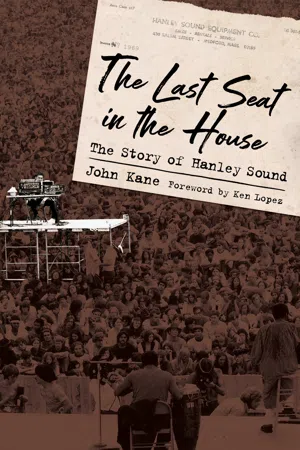
Known as the "Father of Festival Sound, " Bill Hanley (b. 1937) made his indelible mark as a sound engineer at the 1969 Woodstock Music and Arts Fair. Hanley is credited with creating the sound of Woodstock, which literally made the massive festival possible. Stories of his on-the-fly solutions resonate as legend among festivalgoers, music lovers, and sound engineers. Since the 1950s his passion for audio has changed the way audiences listen to and technicians approach quality live concert sound. John Kane examines Hanley's echoing impact on the entire field of sound engineering, that crucial but often-overlooked carrier wave of contemporary music. Hanley's innovations founded the sound reinforcement industry and launched a new area of technology, rich with clarity and intelligibility. By the early seventies the post-Woodstock festival mass gathering movement collapsed. The music industry shifted, and new sound companies surfaced. After huge financial losses and facing stiff competition, Hanley lost his hold on a business he helped create. By studying both his history during the festivals and his independent business ventures, Kane seeks to present an honest portrayal of Hanley and his acumen and contributions. Since 2011, Kane conducted extensive research, including over one hundred interviews with music legends from the production and performance side of the industry. These carefully selected respondents witnessed Hanley's expertise at various events and venues like Lyndon B. Johnson's second inauguration, the Newport Folk/Jazz Festivals, the Beatles' final tour of 1966, the Fillmore East, Madison Square Garden, and more. The Last Seat in the House will intrigue and inform anyone who cares about the modern music industry.
- 558 pages
- English
- ePUB (mobile friendly)
- Available on iOS & Android
eBook - ePub
About this book
Information
Subtopic
MusikbiographienChapter 1
FIRST GENERATION, SECOND GENERATION
Prior to Hanley’s emergence as a predominant force in his field, the area of sound reinforcement technology was evolving. These innovations etched an inevitable timeline that was foundational to Hanley from the outset of his career. A partial list of these developments follows.
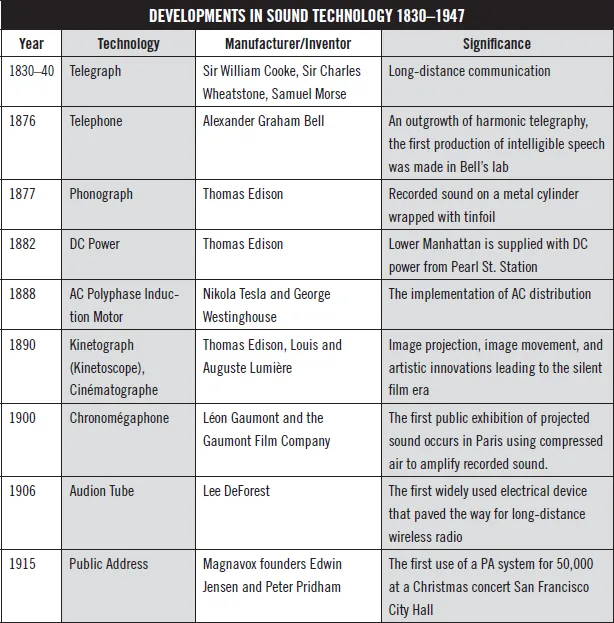
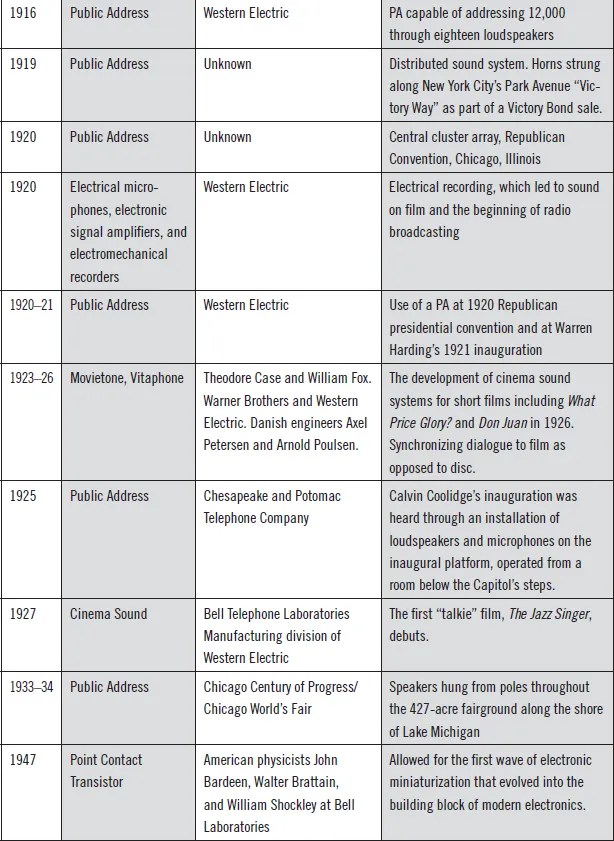
A highlight from these developments is sound for cinema. Although others had been experimenting with “talking pictures” since the early 1900s—usually unsuccessfully—most history books credit the 1927 film The Jazz Singer as the first successful talking picture. It was around this time, even slightly earlier in 1923, that the foundation of cinema sound loudspeaker technology was introduced. The ability to synchronize pictures with sound raised the cinema industry to new heights. Quality audio became necessary to support the influx of paying audiences, as in Radio City Music Hall, which opened in 1932 and seated around 6,000 people. Various manufacturers surfaced to serve this technological need.
One company that set out to develop products for motion pictures was AT&T’s Western Electric; around 1926 it established Electrical Research Products Incorporated (ERPI). In 1936 the ERPI division detached and renamed itself the All Technical Service Company.
In 1941 the Altec Lansing Corporation was created when it joined Lansing Manufacturing. By 1946 it was known as James B. Lansing Sound. When Lansing left, it was renamed JBL. Bell Laboratories, Western Electric, RCA, Altec Lansing, Shure Microphones, Electro-Voice, and other companies, had accommodated the need for public address. Eventually Hanley realized he could do better.1 2 3 4
The combination of cinema-quality speakers, home high fidelity, military amplification, and studio-quality microphones were all that early sound reinforcement engineers had to work with. Sound engineers before, contemporaneous with, and after Hanley had to formulate unique ideas on how sound reinforcement should be executed. Some of these groundbreakers include Richard Alderson, Stan Miller, Harry McCune, Art Swanson, and Jim Meagher.
When these various audio elements were intentionally and conspicuously pieced together, the result was a system of sound that could be applied to live music. Acquiring additional power by way of the deliberate placement and organization of such existing technologies was a disruptive tipping point for those embarking on this new technological field.
BEFORE HANLEY, AFTER HANLEY
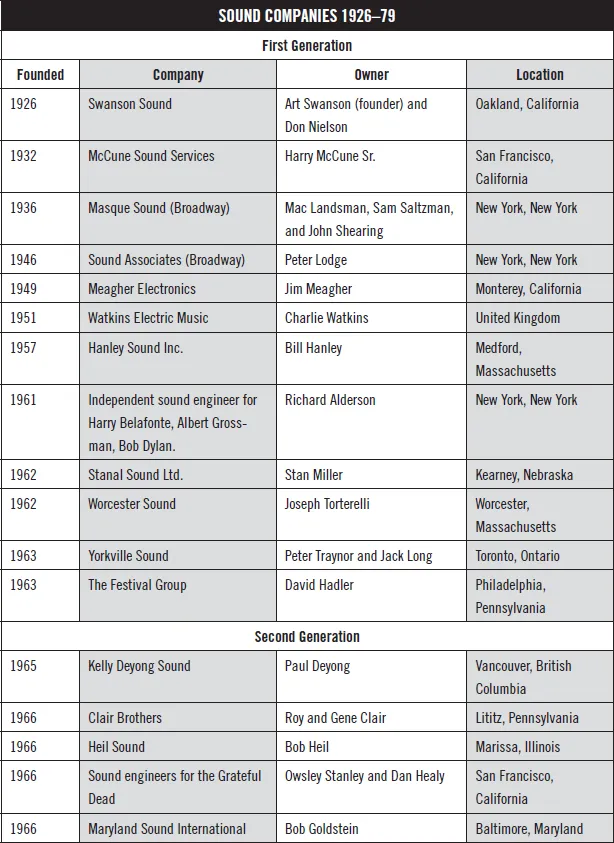
The term “first generation” sound engineer/company refers to those who were first involved with live concert and festival sound using a specially designed sound system other than a standard public address system. These creative minds carved out their own path toward jazz, big band, folk, and rock and roll sound innovation. In fact, many of these individuals had similar, if not nearly identical, beginnings as Hanley and his “focus” on sound. But during Hanley’s golden years (1957–69) the landscape of sound companies for live music remained small. Even though Hanley Sound was the primary East Coast sound company at the time, others were dispersed throughout the country, in New York City, Nebraska, and California. Nevertheless, there was plenty of room for success within this new and emerging industry.
From the late 1960s into the early 1970s, new sound companies surfaced in Florida, Maryland, Pennsylvania, Texas, and Hermosa Beach, California. This is when Hanley began to see his real competition. The developments and innovations of this “first generation” sound engineer became refined by 1965, giving birth to a whole new “second-generation” sound engineer and industry. A partial list of these firms and engineers is shown below.
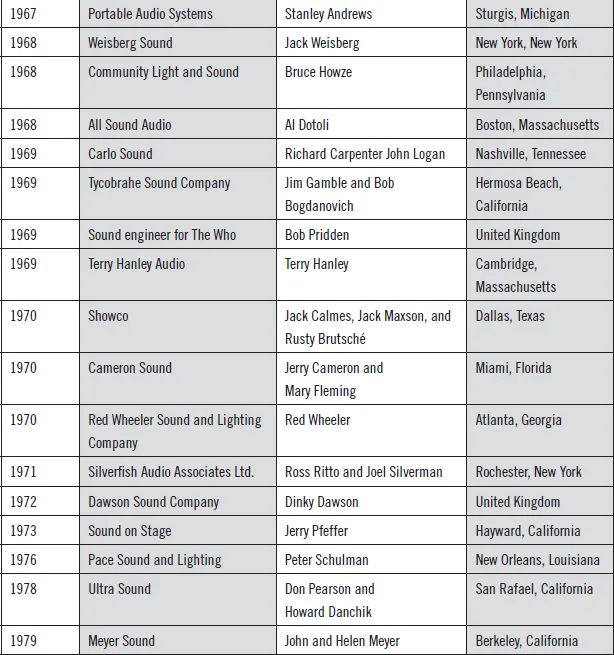
The old cliché “necessity is the mother of invention” rings true when referring to the early days of live concert sound. Just as in the great race for electricity that kept inventors and businessmen like Edison, Tesla, and Westinghouse on their competitive toes, the 1950s and 1960s were an exciting time for this group of sound engineers. They hustled to find inventive solutions, often under extremely adverse conditions. If you couldn’t buy it, you built it—or you simply adapted to whatever it was you were doing “until you damn well figured it out.” This was their credo. Even before this elite group surfaced, others had been toying with developments related to live sound and high fidelity. Our story begins with Bill Hanley and his company Hanley Sound Inc. of Medford, Massachusetts.
Chapter 2
THE NOT SO GLAMOROUS LIFE OF A SOUND ENGINEER
In an effort to remain historically accurate, the innovators mentioned above (see Table 1) will be called “soundmen” or “sound engineers” throughout this book. Acclaimed author and scholar on women in communications, Dr. Donna Halper, observes:
I understand, and fully agree, that in our modern day, we should not use sexist language. But the truth is that in the early days, it was generally a man, and the term was in fact “soundman.” In the 1920s, engineers who set up the live remote broadcasts for radio were called “pick-up men” because they were assigned to the site where the broadcast would be picked up and sent by wire to the radio studio.1
In the process of writing and researching, many questions surfaced for me: What does a soundman actually do? Who are these people working behind the scenes of our live recordings and sound reinforcement applications? What do they look like? What would the world of media, entertainment, and communications sound like without the mad scientists at the front of the house?
The answer to such questions can be found at the next festival, venue, or concert you attend. While you are nicely settled into your overpriced concert seat or lying on a plush green lawn at a local summer festival, look closely for the individual who walks (or crawls) casually across the stage and scaffolding. Perhaps this person is nimbly scaling a two-hundred-foot speaker array while random tools dangle from his or her tool belt. This individual might be laying hundreds of feet of cable or tweaking knobs. For the most part, their nerves are probably running high come showtime, but in reality it’s just another day at work. Their role is to not only interact with the artist but to get down and dirty with the weathered concertgoer. A journal excerpt from one of Hanley Sound’s former crew members, David Marks, insightfully reflects on his early days with the company:
It is the soundperson who has access to almost every confidential facet of production politics. Good or bad, for better or worse, the sound engineer, mixer, recordist, is the one person married into the production from the start and remains there until the last wire and words are wrapped. The first person to arrive at the gig and the last to leave; with a confidential all-access backstage pass to the dressing rooms, management and performers; as well as all manner of odds and ends, technical and political, that need to be ego and audibly reinforced or inflated. And then he/she goes out into the audience/crowds and feels their way around the rumor and the vibe. The world’s most celebrated artists often stoop to whisper in the lowly unkempt soundperson’s ear—Hey man, how was that? How am I doing out there? OK? What should I tell the people? A little more voice in the monitor.2
Some readers might be left with questions concerning hearing loss. Since these individuals are in front of loudspeakers for hours on end, one could assume they must be deaf. I hold no conclusive findings supporting such supposition, but Hanley’s hearing loss seems to be minimal considering the long list of shows he has attended. In general he refused to wear headphones or earplugs while he worked many of these gigs: “If you need earplugs then the music is too loud; loudness should never be confused with quality.”3 Hanley claims a simple yet logical belief that music should be heard in its most pure form: not loud, just clear. Many close to Hanley recall that he often disappeared into the crowd during a performance. At Woodstock, for example, the sound engineer walked the natural bowl listening for balance, clarity, and audibility without earplugs or headphones—for Hanley this was the only way.
Sound engineers and production crews are often the forgotten people of the music arena, although they are usually the first and last to leave the venue, breaking their backs setting up and striking heavy equipment. As facilitators of sound and production, they are there to make sure the show runs efficiently, so that the artists can play to their fullest potential. They are the gear-heads, the technologically savvy scientists within a laboratory of music production. It takes a certain type of person to execute such feats. Unable to fully describe the wizardry carried out by these individuals, this book only scratches the surface of how live concerts are produced. This unique group of people makes up the behind-the-scenes nuts and bolts of the concert business. It is my hope that what is written provides some acknowledgment of their arduous and sometimes thankless work.
Most if not all of the trailblazers mentioned in this book performed under varying degrees of adversity, resulting in some sort of innovation. Many of them share similar stories regarding the early landscape of the emerging sound industry. These include tall tales of “fly by the seat of your pants” innovation and chance encounters. The second-generation music industry people gave us mythical tales of rock and roll debauchery as well as backbreaking work, sweat, and hustle of roadies; riggers, stagehands, truck drivers, tour managers; lighting technicians, and even sound engineers. Forever integral to the classic American songbook is the tune “The Load-Out” by Jackson Browne.
Let the roadies take the stage
Pack it up and tear it down
They’re the first to come and the last to leave4
A poetically penned anthem commemorating the movers, shakers, and roadies of the concert industry, the artist sings as if the unkempt sweaty stagehand was his muse. Roadies yes, without a doubt. Still, soundmen should not be excluded.
Although we have come to celebrate the roadie in popular culture as the unsung hero of rock and roll myth and lore, it was not easier for people like Hanley decades earlier. In fact Hanley Sound might have even invented the modern roadie, as crew members spent continuous days on the road with bands during the early 1960s. All of it was arduous work, occasionally in disadvantageous and unsafe conditions. Night after night, Hanley and his crews spent endless hours on the road, setting up and breaking down equipment, hoisting heavy speakers onto towering scaffolding; it goes on and on.
Hanley supported numerous tours like the Beatles, the Beach Boys, and Jefferson Airplane, and these gigs were challenging as he and his crew were still finding their footing as a young touring sound company. According to Rusty Brutsché of the Dallas, Texas, second-generation sound company Showco: “I never thought of Hanley as a touring company. The rigors and challenges of touring were a systemization and packaging challenge. I saw Hanley Sound as a festival company.”5 Brutsché is correct, since the majority of what Hanley Sound is known for was a wave of pop festivals occurring in the country in the late 1960s. However, even before that, Hanley Sound supported many short tours via tractor-trailer for big-name performers, a first for the time, for sure.
By the early to mid-1970s, it became easier for those involved in the next phase of the concert production and sound industry. Smaller and more compact equipment in nicely built custom speaker boxes, road cases on rolling casters, better quality staging, portable lighting, and stadiums with an established infrastructure to work from made the job a hell of a lot easier. The aforementioned second-generation firms had begun to deploy concert sound on a more efficient scale. It was the beginning of the organization, systemization, and packaging of touring concert production.
By the mid-1970s to early 1980s, touring musical acts were performing at much larger venues. The result was an upsurge of sound companies that offered a more advanced approach and technical concert innovation designed to service arena rock.
Chapter 3
A BOY WHO LOVED SOUND
MEDFORD
Settled in 1630, Medford—or as Hanley and other blue-collar locals refer to it, “Meffa!”—is around five miles northwest of Boston. It has a population of around 60,000, and occupies about eight square miles. William Francis Hanley Jr. came into this world born on March 4, 1937, at the Lawrence Memorial Hospital, in Medford, Massachusetts. This small city was where Hanley, his family, and the Hanley Sound business lived for decades. It’s a diverse, strong, and proud community. As one historian claims: “It is several neighborhoods of variable terrain connected by the Mystic River. In fact Medford is a great deal like the river that flows through its heart. People of different social and economic levels created a community.”1 Hanley often reflects on the many Irish and Italian families that lived near his childhood home at 56 Farragut Avenue.
The city of Medford has boasted many innovators, entrepreneurs, and creative minds. For example, James W. Tufts invented the concept of the drugstore soda parlor here during the mid- to late 1800s.2 Medford also is home to Tufts University, where Boston’s first radio station AMRAD was located. Here the first female broadcast announcer, Eunice Randall, worked during the 1920s. Inspired by the winter sleigh races from Medford to the adjoining town of Malden, local resident James Pierpont penned the holiday song “One Horse Open Sleigh,” more commonly known as “Jingle Bells.” Other Medford idiosyncrasies include C. E. Twombley, owner of the magazine the Pigeon News, est. 1895, who “introduced Medford to the specialized world of pigeon fanciers, enthusiasts dedicated to the breeding, exhibiting and racing of fine homers, tumblers and other varieties.”3 Amelia Earhart lived in Med...
Table of contents
- Cover
- Title Page
- Copyright
- Dedication
- Contents
- Foreword
- Preface
- Acknowledgments
- Prologue: A Soundman and a Bomb
- Chapter 1: First Generation, Second Generation
- Chapter 2: The Not So Glamorous Life of a Sound Engineer
- Chapter 3: A Boy Who Loved Sound
- Chapter 4: Poor Sound All Around
- Chapter 5: Organ Music and Training
- Chapter 6: 430 Salem Street
- Chapter 7: Jazz!
- Chapter 8: Newport Needs a Home
- Chapter 9: Orchestra Sound
- Chapter 10: Folk and Distortion
- Chapter 11: The Inauguration of President Lyndon B. Johnson
- Chapter 12: Hanley Sound Needs a Manager
- Chapter 13: Go-go Dancers, Batman, and the Beach Boys
- Chapter 14: Hanley and the Family Band
- Chapter 15: Hanley and the Remains
- Chapter 16: The Beatles Face a Feverish Pitch
- Chapter 17: Beatles by Chance
- Chapter 18: Shea Stadium Sound
- Chapter 19: The Competition
- Chapter 20: Big Apple! Big Sound!
- Chapter 21: Down in the Village
- Chapter 22: More Monitor, Please!
- Chapter 23: A Frenchman and the Second Avenue Shuffle
- Chapter 24: The Victory Special
- Chapter 25: The White Man’s Apollo
- Chapter 26: It’s Loud!
- Chapter 27: Sight and Sound at the Fillmore
- Chapter 28: Getting Paid
- Chapter 29: The Festival Experience
- Chapter 30: The Festival Phenomenon Begins
- Chapter 31: All Roads Lead to Woodstock
- Chapter 32: The Golden Age of the Rock Festival
- Chapter 33: Woodstock
- Chapter 34: By the Time Hanley Gets to Woodstock
- Chapter 35: The Woodstock Crew
- Chapter 36: Going up the Country
- Chapter 37: No Console, No Food
- Chapter 38: Stage Announcements
- Chapter 39: The Nuts, Bolts, and Occasional Zap!
- Chapter 40: Woodstock, How Sweet the Sound … System
- Chapter 41: I’m Going Home
- Chapter 42: Madison Square Garden and the Unions
- Chapter 43: The Greatest Rock and Roll Band in the World
- Chapter 44: Demonstration Sound
- Chapter 45: The March Against Death
- Chapter 46: Student Strike
- Chapter 47: MAY DAY
- Chapter 48: A Sympowowsium and the Fate of the Festival
- Chapter 49: Woodstock South
- Chapter 50: Winters End
- Chapter 51: Oh, Canada
- Chapter 52: Hot ’Lanta and Love Valley
- Chapter 53: A Portrait of an Interrupted Festival and Grand Funk Railroad
- Chapter 54: The Festival That Never Was
- Chapter 55: A Festival under the Sun
- Chapter 56: Hanley’s Southern Truck, NOLA, and the Guru Maharaj Ji
- Chapter 57: Hanley’s Invention
- Chapter 58: Sound of Silence
- Epilogue
- Appendix: Sympowowsium Attendees
- Notes
- About the Author
Trusted by 375,005 students
Access to over 1.5 million titles for a fair monthly price.
Study more efficiently using our study tools.
Frequently asked questions
Yes, you can cancel anytime from the Subscription tab in your account settings on the Perlego website. Your subscription will stay active until the end of your current billing period. Learn how to cancel your subscription
No, books cannot be downloaded as external files, such as PDFs, for use outside of Perlego. However, you can download books within the Perlego app for offline reading on mobile or tablet. Learn how to download books offline
Perlego offers two plans: Essential and Complete
- Essential is ideal for learners and professionals who enjoy exploring a wide range of subjects. Access the Essential Library with 800,000+ trusted titles and best-sellers across business, personal growth, and the humanities. Includes unlimited reading time and Standard Read Aloud voice.
- Complete: Perfect for advanced learners and researchers needing full, unrestricted access. Unlock 1.5M+ books across hundreds of subjects, including academic and specialized titles. The Complete Plan also includes advanced features like Premium Read Aloud and Research Assistant.
We are an online textbook subscription service, where you can get access to an entire online library for less than the price of a single book per month. With over 1.5 million books across 990+ topics, we’ve got you covered! Learn about our mission
Look out for the read-aloud symbol on your next book to see if you can listen to it. The read-aloud tool reads text aloud for you, highlighting the text as it is being read. You can pause it, speed it up and slow it down. Learn more about Read Aloud
Yes! You can use the Perlego app on both iOS and Android devices to read anytime, anywhere — even offline. Perfect for commutes or when you’re on the go.
Please note we cannot support devices running on iOS 13 and Android 7 or earlier. Learn more about using the app
Please note we cannot support devices running on iOS 13 and Android 7 or earlier. Learn more about using the app
Yes, you can access The Last Seat in the House by John Kane in PDF and/or ePUB format, as well as other popular books in Medien & darstellende Kunst & Musikbiographien. We have over 1.5 million books available in our catalogue for you to explore.