- 224 pages
- English
- ePUB (mobile friendly)
- Available on iOS & Android
eBook - ePub
About this book
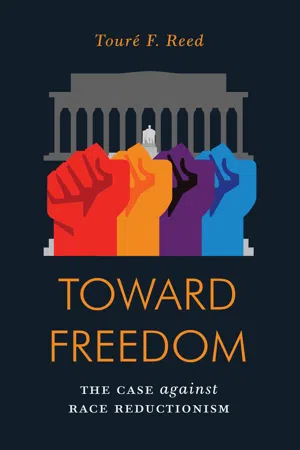
Reed contends that the road to a more just society for African Americans and everyone else is obstructed, in part, by a discourse that equates entrepreneurialism with freedom and independence. This, ultimately, insists on divorcing race and class. In the age of runaway inequality and Black Lives Matter, there is an emerging consensus that our society has failed to redress racial disparities. The culprit, however, is not the sway of a metaphysical racism or the modern survival of a primordial tribalism. Instead, it can be traced to far more comprehensible forces, such as the contradictions in access to New Deal era welfare programs, the blinders imposed by the Cold War, and Ronald Reagan's neoliberal assault on the half-century long Keynesian consensus.
Information
1
WHEN BLACK PROGRESSIVES DIDN’T
SEPARATE RACE FROM CLASS
SEPARATE RACE FROM CLASS
In the 1980s, president Ronald Reagan launched a racialized assault on the American welfare state. A Goldwater Republican, Reagan was philosophically opposed to the public interest model of government that had informed the New Deal and postwar liberalism. Though Reagan’s hostility to entitlements helped deny him the Republican presidential nomination in 1976, four years later he understood that the breadth of support for entitlements—welfare programs whose eligibility requirements transcend class—precluded a direct assault on programs like Social Security’s old age retirement benefits and Medicare. Instead, Reagan set his sights on hobbling meanstested programs—welfare programs whose beneficiaries are poor and disproportionately black and brown.
Reagan repealed President Nixon’s Comprehensive Employment and Training Act (CETA) and cut funding to programs such as Aid to Families with Dependent Children (AFDC), Medicaid and Social Security Disability Insurance.1 Reagan, who had been an outspoken critic of antidiscrimination legislation since the 1960s, also tried a number of schemes intended to undermine affirmative action. Despite his best efforts, Reagan failed to either narrow the scope of affirmative action compliance guidelines for government contractors or to end Nixon-era “goals and timetables.” He was, however, able to curtail enforcement of antidiscrimination policy by both cutting funding to the Equal Employment Opportunity Commission (EEOC) and appointing Clarence Thomas, a well-known black critic of affirmative action, as its director.2
Reagan’s assault on the American welfare state extended well beyond means-tested programs and antidiscrimination policies, as the nation’s first neoliberal president slashed both income tax and corporate tax, deregulated the banking, energy, telecommunication and transportation industries, and undercut consumer protections as well as labor and environmental laws by either underfunding the relevant federal agencies or by cynically appointing antagonists to direct them. Still, there is no denying that Reagan used a language steeped in racial resentment to attack the welfare state through its soft underbelly, means-tested programs and antidiscrimination policy.
Indeed, Reagan and his followers’ contention that permissive liberal social policies of the 1960s had spawned legions of parasitic black “welfare queens” who were bankrupting the nation one out-of-wedlock birth and tricked-out Cadillac at a time bound racial animus to economic anxiety in a narrative intended to nurture antistatist sensibilities among working-class and middle-class white Americans, whose prosperity was itself the product of the American welfare state.
As Reaganism became bipartisan consensus in the 1990s, scholars such as Michael K. Brown, Michael B. Katz, Jill Quadagno and Adolph L. Reed Jr. responded to neoliberalism’s racialized attacks on welfare by drawing attention to the uneven distribution of the American welfare state’s rewards. Specifically, they not only challenged the culturalist interpretations of poverty that informed the “welfare queen” and “crack baby” tropes, they also demonstrated the welfare state’s crucial role—in the form of New Deal labor and housing policy, entitlements and state stewardship of postwar economic growth—in the creation of the white American middle class. Indeed, Brown, Katz, Quadagno and Reed made clear that the white middle class reaped the lion’s share of the American welfare state’s benefits via the NLRA, the FHA’s mortgage policies, the GI Bill, the Federal-Aid Highway Act, entitlements and an elaborate private welfare system—including pensions and employer-sponsored health insurance—which most blacks had been denied access to thanks to discriminatory housing policies and employer and union discrimination (particularly in the elite building trades).3
Brown’s, Katz’s, Quadagno’s and Reed’s respective defenses of affirmative action and means-tested programs did not stop with the observation that state intervention in capitalist labor and housing markets had been crucially important to the expansion of the postwar white American middle class. To be sure, these left scholars were highly critical of New Democratic social scientists like Theda Skocpol, William Julius Wilson and Paul Starr, whose calls for universalism complemented the neoliberal assault on affirmative action and means-tested programs.4 Nevertheless, Brown, Katz, Quadagno and Reed were clear that—given the disproportionate impact of deindustrialization, the decline of the union movement and public sector retrenchment on blacks—truly universal redistributive programs, implemented equitably with the aid of the Voting Rights Act and antidiscrimination policy, were the only effective means of ending economic and racial inequality. In other words, their historically grounded defenses of the types of programs that benefited blacks disproportionately were wed to a broader case for a return to the public-interest model of government that had fueled the postwar expansion of America’s disproportionately white middle class.
As neoliberalism’s grip on the liberal-left imagination tightened during the first two decades of the twenty-first century, however, a new generation of students of race and inequality took the bifurcation of the New Deal and postwar welfare states as evidence of the inherent limitations of universal programs. Historians Jefferson Cowie and Nick Salvatore, for example, posit what political scientist Cedric Johnson has termed the “constraint of race” thesis. Arguing that New Deal liberalism was restrained by racist Southern Democrats, Cowie and Salvatore ultimately contend that racism has perpetually hobbled broad, class-based redistributive reforms.5
Public intellectual Ta-Nehisi Coates has made much the same case. Drawing from the work of political scientist Ira Katznelson, Coates takes FHA mortgage discrimination and the SSA’s exemptions for agricultural workers and domestic and personal servants as partial bases for his case for racial reparations—a redistributive agenda from which only African Americans might benefit. Specifically, Coates contends that, since the late colonial period, working-class whites’ pathological commitment to white-skin privilege has not only precluded interracial political alliances based on mutual economic interest, but ontological race/racism ensures that universal redistributive programs are incapable of redressing racial disparities.6
As I will discuss in detail in Chapter 4, the constraint of race thesis downplays capitalists’ sway over New Deal labor and housing policies. What is no less problematic, however, is that the framework looks past the New Deal’s much-studied, transformative effect on African American life and politics.
To be sure, New Deal programs, which were generally administered at the local level, were marred by discrimination. Nevertheless, millions of African Americans benefited from New Deal initiatives—sometimes in greater proportion than their share of the general population, even if they were underrepresented in relation to their need. Blacks were just 10 percent of the total population, for example, but accounted for 20 percent of all individuals on welfare rolls. Several hundred thousand African Americans, likewise, acquired work through the Civilian Conservation Corps (CCC), the Public Works Administration (PWA) and Works Progress Administration (WPA), while quotas, intended to ensure proportional representation, gave many African Americans access to newly constructed public housing projects in the era before public housing was a vehicle for warehousing poor people.7 Yes, the 23 percent of agricultural and domestic workers who happened to be black were, like their white counterparts, excluded from coverage under the NLRA, the FLSA, and the SSA. But African American industrial workers—such as the 500,000 blacks who comprised 8 percent of the Congress of Industrial Organizations’ (CIO) membership in 19458—were covered by each of these pieces of legislation.
There is no question that African Americans did not receive their fair share of New Deal programs—particularly in housing. But the now commonplace tendency to dismiss the Roosevelt administration’s crucial role in improving the material lives of millions of African Americans has obscured both the importance of the New Deal’s redistributive policies to blacks—who demonstrated their support for the administration with their votes—and the influence of New Deal liberalism over the scope of black political activism from the 1930s through the civil rights movement.
New Deal Industrial Democracy and Black Civil Rights
In 1978, historian Harvard Sitkoff’s A New Deal for Blacks laid the foundation on which a generation of civil rights scholarship would rest. Sitkoff’s ambitious study of Depression-era race relations and politics traced the origins of the modern civil rights movement to the 1930s and early 1940s. While Sitkoff was clear that African American civil rights advanced little during the New Deal, he convincingly argued that the so-called Depression decade was fertile ground for several political, social and intellectual developments that would eventually blossom into the insurgent black political activism of the 1950s and 1960s.
The Roosevelt administration’s emphasis on redistributive economic policies and the presence of civil rights advocates in key positions in New Deal agencies set the stage for the era of black Democratic interest-group politics. The left-labor militancy advanced by the Communist Party’s (CP) Popular Front and the CIO engendered racial liberalism among a stratum of white activists and rank-and-file unionists, opening access to good blue-collar jobs while providing African Americans useful political allies. Finally, the antifascist impulses influencing both left activism and America’s support for the European Allies strengthened the hand of social scientists and liberals who challenged notions of racial hierarchy rooted in eugenics or other biological metaphors. Each of the above, according to Sitkoff, not only informed the activist sensibilities of African Americans during the Depression and World War II, they also shaped the scope of the modern civil rights movement.9
While A New Deal for Blacks offered a compelling overview of the relationship between New Deal policy and the struggle for black equality, it did not explore the complex issues shaping civil rights institutions and their leaders during the 1930s. Thus, a great many scholars have since written books on each of the various themes Sitkoff first examined in 1978. The relationship between New Deal industrial democracy and civil rights activism during the 1930s and early 1940s has been of particular interest.
The New Deal’s efforts to redress the problem of under-consumption through unionization—best exemplified by the NLRA—transformed not just the workplace but American democracy. Aware of the contradictions between the Jeffersonian democratic ideal still celebrated by most Americans in the 1930s and the realities of industrial society, New Dealers sought to use government, as President Roosevelt stated, to “assist in the development of an economic declaration of rights, an economic constitutional order.”10 The right to unionize was at the center of this agenda.
Though today’s neoliberals generally disparage unions as “special interests,” New Dealers understood collective agitation in the workplace as a public good. Unionization enhanced consumer purchasing power and, along with entitlements, afforded dignity and security to the nation’s producer classes. This industrial democratic turn in political culture and the related rights discourse would, as I will discuss, shift the focus of African American civil rights away from narrow calls for racial equality—which basically took economic inequality as a given—toward broader demands for economic justice. New Deal industrial democracy would also encourage political militancy among black activists, who came to identify mass protest as a responsibility of citizenship.
New Deal labor law had a profound impact on the scope of African American activism during the 1930s and 1940s. Black unionists were the obvious beneficiaries of the Roosevelt administration’s efforts to enhance consumer purchasing power and workers’ rights. In 1937, for example, the Brotherhood of Sleeping Car Porters (BSCP) became the first African American labor union to successfully negotiate a contract with a major employer. As historian Beth Bates has argued, the BSCP’s success stemmed at least partly from the political acumen of the union’s leadership. Facing stiff opposition from a black elite dogmatically committed to clientage/petition politics, BSCP president A. Philip Randolph and his organizers framed the porters’ quest for recognition as a matter of African American civil rights. Thus, between 1925 and the start of the New Deal, the porters’ union not only established a deep base of support among blacks, but the BSCP itself helped legitimate African American protest politics.11 Still, the organizing genius of Randolph and associates notwithstanding, the BSCP owed its legal recognition to the protections afforded unions by the Norris–La Guardia Act (1932), the Railway Labor Act of 1934 and the 1935 NLRA, more commonly referred to as the Wagner Act.
The Norris–La Guardia and Wagner Acts not only played significant roles in labor disputes, they also influenced New Deal–era civil rights politics. Norris–La Guardia prevented the courts from issuing injunctions halting legitimate labor disputes, while the Wagner Act—like section 7A of the National Industrial Recovery Act (NIRA) that preceded it—enhanced workers’ rights to collective bargaining.
Together, they marked a major shift in American politics and life. In the three decades or so preceding the passage of the Wagner Act—a period known as the Lochner era—not only had the Supreme Court sanctioned employers’ use of intimidation and coercion to curb unions’ organizing campaigns, but it had also checked the government’s ability to intervene in the employer-employee relationship through the principle known as “freedom of contract.” Freedom of contract presumed that an employer and an individual employee came to the negotiating table as coequals. Taylorism should have made the absurdity of this premise plain; however, it would take the economic and political turmoil precipitated by the Great Depression to challenge the Lochner era’s employer-friendly conception of work and workplace regulations. Identifying collective bargaining as the most effective vehicle for bolstering workers’ negotiating strength with employers for more equitable wages, the NLRA’s architects—Senator Robert Wagner and his assistant, Leon Keyserling—believed that unionization was essential to stimulating consumer demand and ending the Great Depression.12 New Deal liberals likewise argued that unions held the potential to check managerial caprice by allowing workers to bargain collectively for contracts establishing formal guidelines for hiring, termination, promotions, raises and more.
To achieve its tandem goals of establishing a sustainable model of capitalism and addressing managerial authoritarianism, the Wagner Act eliminated the “yellow-dog” contract,13 established the closed shop and created the National Labor Relations Board (NLRB), which was responsible for mediating legitimate labor disputes.
As can be said of any institution in America, many unions—particularly in the skilled trades—were guilty of discrimination. The absence of an antidiscrimination clause from the Wagner Act thus alarmed many civil rights leaders, who feared that the closed shop would enable discriminatory unions to bar blacks from not just their collective bargaining units but the workplace itself. Nevertheless, mainstream civil rights leaders generally called for amending the NLRA rather than repealing it.
New Deal Civil Rights Activism Was Working Class
The civil rights community’s support for collective bargaining signified a notable turn in African Americans’ political sensibilities. As alluded to above, the protected status afforded labor unions both inspired and legitimated a new class-inflected militancy among African American civil rights activists. With black unemployment hovering around 50 percent in cities such as New York, Chicago and Baltimore in the early 1930s, African Americans began to mobilize protest campaigns aimed at expanding employment and housing opportunities. Working-class blacks participated in Communist Party–organized Unemployed Councils, taking to the streets both to demand jobs and to thwart evictions. They also organized “Don’t Buy Where You Can’t Work” campaigns.
The seeds of “Don’t Buy Where You Can’t Work” were sown in 1929, when Chicago Whip editor Joseph Bibb encouraged African American consumers to boycott businesses that relied on black patronage but refused to hire black employees. Bibb’s call resonated with African Americans shaped by both Depression-era unemployment and the race consciousness of the New Negro movement of the 1920s. Indeed, the earliest boycotts reflected a pronounced racial nationalism. Sufi Abdul Hamid’s 1932 boycott of Harlem’s Koch’s department store, for example, played on racial/ethnic tensions between blacks and Jews as well as color and class divisions among African Americans.
While Hamid briefly garnered the support of a small number of middle-class black leaders, including Reverend Adam Clayton Powell Jr., his bombastic style and anti-Semitic rhetoric quickly alienated most black elites. Hamid, who had a penchant for flowing robes and turbans, was an especially theatrical and controversial figure; nevertheless, the employment aims of early “Don’t Buy Where You Can’t Work” protests revealed a narrow racialism that unnerved many “respectable” black leaders.14 T. Arnold Hill of the National Urban League (NUL), for example, expressed concern as early as 1930 that these campaigns might fuel racial tensions, undermining the cau...
Table of contents
- Cover Page
- Halftitle Page
- Title Page
- Copyright Page
- Dedication
- Contents
- List of Abbreviations
- Introduction: The Era of Race Reductionism
- 1. When Black Progressives Didn’t Separate Race from Class
- 2. Oscar Handlin and the Conservative Implications of Postwar Ethnic Identitarianism
- 3. The Tragedy of the Moynihan Report
- 4. Obama and Coates: Postracialism’s and Post-postracialism’s Yin-Yang Twins of Neoliberal Benign Neglect
- Conclusion: Race Reductionism and the Path to Precarity for All but a Diverse Few
- Acknowledgments
- Notes
Trusted by 375,005 students
Access to over 1.5 million titles for a fair monthly price.
Study more efficiently using our study tools.
Frequently asked questions
Yes, you can cancel anytime from the Subscription tab in your account settings on the Perlego website. Your subscription will stay active until the end of your current billing period. Learn how to cancel your subscription
No, books cannot be downloaded as external files, such as PDFs, for use outside of Perlego. However, you can download books within the Perlego app for offline reading on mobile or tablet. Learn how to download books offline
Perlego offers two plans: Essential and Complete
- Essential is ideal for learners and professionals who enjoy exploring a wide range of subjects. Access the Essential Library with 800,000+ trusted titles and best-sellers across business, personal growth, and the humanities. Includes unlimited reading time and Standard Read Aloud voice.
- Complete: Perfect for advanced learners and researchers needing full, unrestricted access. Unlock 1.5M+ books across hundreds of subjects, including academic and specialized titles. The Complete Plan also includes advanced features like Premium Read Aloud and Research Assistant.
We are an online textbook subscription service, where you can get access to an entire online library for less than the price of a single book per month. With over 1.5 million books across 990+ topics, we’ve got you covered! Learn about our mission
Look out for the read-aloud symbol on your next book to see if you can listen to it. The read-aloud tool reads text aloud for you, highlighting the text as it is being read. You can pause it, speed it up and slow it down. Learn more about Read Aloud
Yes! You can use the Perlego app on both iOS and Android devices to read anytime, anywhere — even offline. Perfect for commutes or when you’re on the go.
Please note we cannot support devices running on iOS 13 and Android 7 or earlier. Learn more about using the app
Please note we cannot support devices running on iOS 13 and Android 7 or earlier. Learn more about using the app
Yes, you can access Toward Freedom by Touré Reed,Touré F. Reed in PDF and/or ePUB format, as well as other popular books in Politics & International Relations & Political History & Theory. We have over 1.5 million books available in our catalogue for you to explore.