Earthquake Engineering for Concrete Dams
eBook - ePub

Earthquake Engineering for Concrete Dams

Analysis, Design, and Evaluation

  1. English
  2. ePUB (mobile friendly)
  3. Available on iOS & Android
eBook - ePub

Earthquake Engineering for Concrete Dams

Analysis, Design, and Evaluation

About this book

A comprehensive guide to modern-day methods for earthquake engineering of concrete dams

Earthquake analysis and design of concrete dams has progressed from static force methods based on seismic coefficients to modern procedures that are based on the dynamics of dam–water–foundation systems. Earthquake Engineering for Concrete Dams offers a comprehensive, integrated view of this progress over the last fifty years. The book offers an understanding of the limitations of the various methods of dynamic analysis used in practice and develops modern methods that overcome these limitations.Ā 

This important book:

  • Develops procedures for dynamic analysis of two-dimensional and three-dimensional models of concrete dams
  • Identifies system parameters that influence their response
  • Demonstrates the effects of dam–water–foundation interaction on earthquake response
  • Identifies factors that must be included in earthquake analysis of concrete dams
  • Examines design earthquakes as defined by various regulatory bodies and organizations
  • Presents modern methods for establishing design spectra and selecting ground motions
  • Illustrates application of dynamic analysis procedures to the design of new dams and safety evaluation of existing dams.Ā 

Written for graduate students, researchers, and professional engineers, Earthquake Engineering for Concrete Dams offers a comprehensive view of the current procedures and methods for seismic analysis, design, and safety evaluation of concrete dams.

Frequently asked questions

Yes, you can cancel anytime from the Subscription tab in your account settings on the Perlego website. Your subscription will stay active until the end of your current billing period. Learn how to cancel your subscription.
No, books cannot be downloaded as external files, such as PDFs, for use outside of Perlego. However, you can download books within the Perlego app for offline reading on mobile or tablet. Learn more here.
Perlego offers two plans: Essential and Complete
  • Essential is ideal for learners and professionals who enjoy exploring a wide range of subjects. Access the Essential Library with 800,000+ trusted titles and best-sellers across business, personal growth, and the humanities. Includes unlimited reading time and Standard Read Aloud voice.
  • Complete: Perfect for advanced learners and researchers needing full, unrestricted access. Unlock 1.4M+ books across hundreds of subjects, including academic and specialized titles. The Complete Plan also includes advanced features like Premium Read Aloud and Research Assistant.
Both plans are available with monthly, semester, or annual billing cycles.
We are an online textbook subscription service, where you can get access to an entire online library for less than the price of a single book per month. With over 1 million books across 1000+ topics, we’ve got you covered! Learn more here.
Look out for the read-aloud symbol on your next book to see if you can listen to it. The read-aloud tool reads text aloud for you, highlighting the text as it is being read. You can pause it, speed it up and slow it down. Learn more here.
Yes! You can use the Perlego app on both iOS or Android devices to read anytime, anywhere — even offline. Perfect for commutes or when you’re on the go.
Please note we cannot support devices running on iOS 13 and Android 7 or earlier. Learn more about using the app.
Yes, you can access Earthquake Engineering for Concrete Dams by Anil K. Chopra in PDF and/or ePUB format, as well as other popular books in Technology & Engineering & Civil Engineering. We have over one million books available in our catalogue for you to explore.

1
Introduction

1.1 EARTHQUAKE EXPERIENCE: CASES WITH STRONGEST SHAKING†

As far as can be determined, no large concrete dam with full reservoir has been subjected to extremely intense ground shaking. The closest to such an event was the experience at Koyna (gravity) Dam (Figure 1.1.1), with the reservoir nearly full, during the 1967 earthquake (Chopra and Chakrabarti 1973). Ground accelerations recorded at the dam site during a nearby earthquake of magnitude 6.5 had a peak value of 0.38 g in the stream direction and strong shaking lasted for 4 sec. Significant horizontal cracking occurred through a number of taller non‐overflow monoliths at or near the elevation where the downstream face changes slope; however, the dam continued to retain the reservoir even though the water level was 25 m above the cracks (Figure 1.1.2). A similar experience had occurred in 1962 at Hsinfengkiang (buttress) Dam (Figure 1.1.3) during a magnitude 6.1 earthquake in close proximity. Although not recorded, ground motions were probably quite intense causing cracking at 16 m below the crest (Figure 1.1.4); the dam continued to retain the reservoir though the water level was 3 m above the cracks.
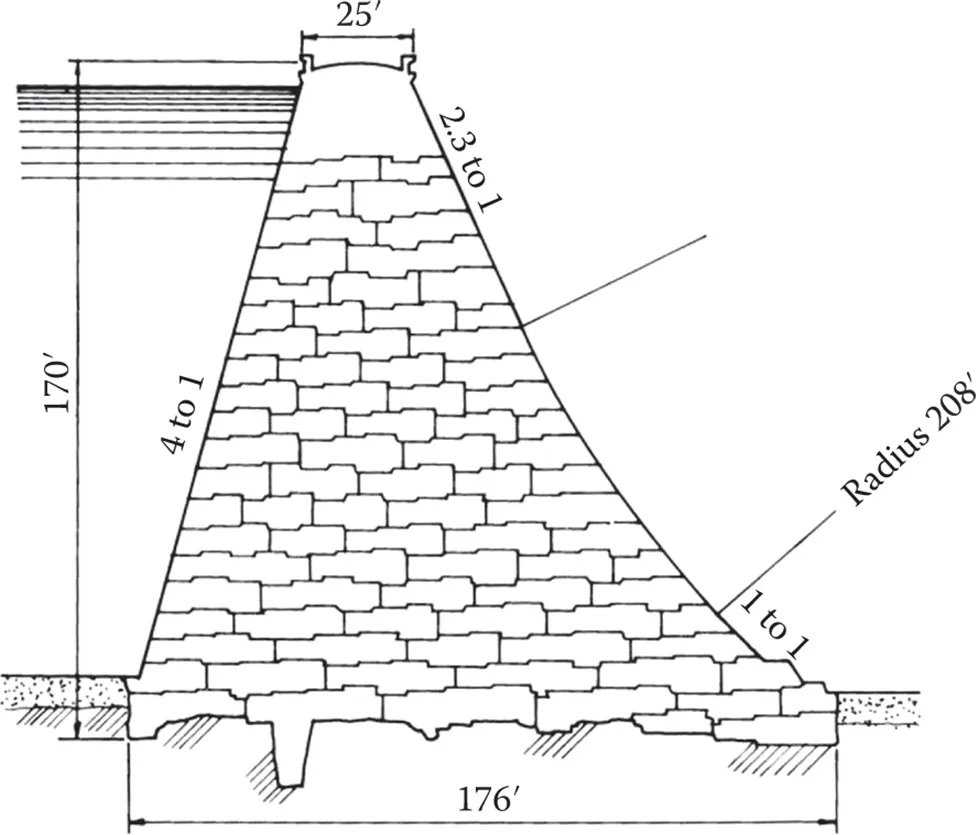
A few dams have withstood very intense ground shaking with little or no damage because of their unusual design or low water level. Perhaps the strongest shaking experienced by a concrete dam to date was that at Lower Crystal Springs Dam, a 42‐m‐high curved gravity structure (Figure 1.1.5) dam with nearly full reservoir, located within 350 m of the San Andreas fault that caused the magnitude 7.9 1906 San Francisco earthquake. Built with interlocking concrete blocks, the dam was undamaged, even though its reservoir was full. However, the earthquake resistance of this dam greatly exceeds that of typical gravity dams due to its curved plan and a cross section that was designed thicker than normal in anticipation of future heightening, which was never completed; a section view of this dam is shown in Figure 1.1.6.
Photograph of the Konya Dam in India constructed during the years 1954 to 1963.
Figure 1.1.1 Koyna Dam, India, constructed during 1954–1963; this dam is 103 m high and 853 m long.
Cross section of the Koyna Dam depicting water level during the 1967 earthquake and regions where principal cracking at the upstream and downstream faces was observed.
Figure 1.1.2 Cross section of Koyna Dam showing water level during 1967 earthquake and regions where principal cracking at the upstream and downstream faces was observed.
Source: Adapted from National Research Council (1990).
Photograph of the Hsinfengkiang Dam in China; completed in 1959, this dam is 105-meter high and 440 m meter long.
Figure 1.1.3 Hsinfengkiang Dam, China. Completed in 1959, this dam is 105 m high and 440 m long.
Diagram of a cracking that occurred in Hsinfengkiang Dam, China, due to an earthquake on March 19, 1962.
Figure 1.1.4 Cracking in Hsinfengkiang Dam, China, due to earthquake on March 19, 1962.
Source: Adapted from Nuss et al. (2014).
Photograph of the Lower Crystal Springs Dam, California, United States, which was built in 1888.
Figure 1.1.5 Lower Crystal Springs Dam, California, USA. Built in 1888, this 45‐m‐high curved‐gravity dam is located within 350 m of the San Andreas Fault, which is under the reservoir, oriented roughly parallel to the dam.
Diagram of a section of the Lower Crystal Springs Dam.
Figure 1.1.6 Section view of the Lower Crystal Springs Dam (adapted from Nuss et al. [2014] and Wieland et al. [2004]).
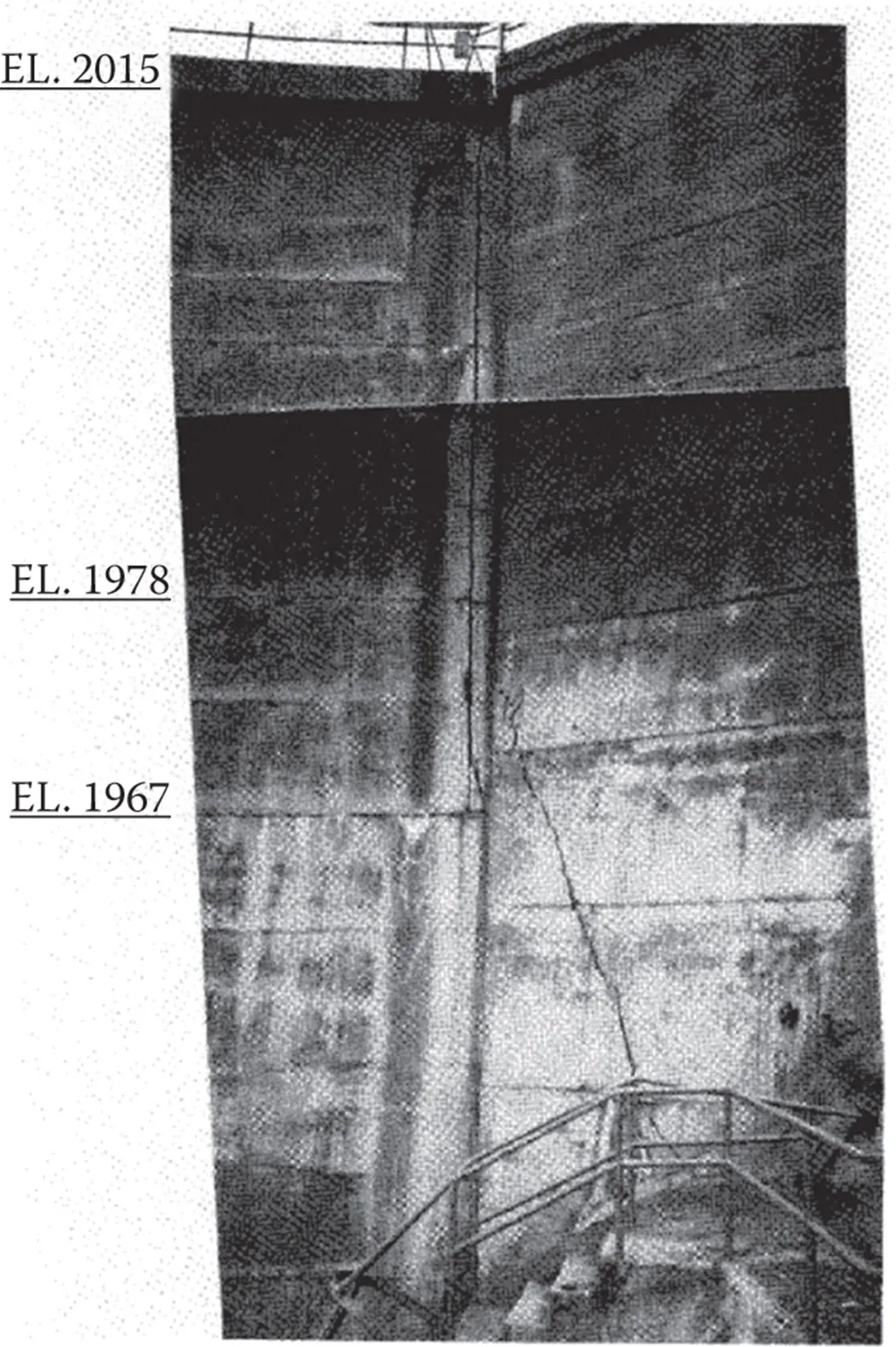
Another example of a concrete dam subjected to very intense shaking is the 113‐m‐high Pacoima (arch) Dam (Figure 1.1.7). During the 1971 magnitude 6.6 San Fernando earthquake, an accelerograph located on the left abutment ridge recorded a peak acceleration of 1.2 g in both horizontal components and 0.7 g vertical, with strong shaking lasting for 8 sec, suggesting that the excitation at the dam–foundation— interface – which was not recorded – must have been very intense. However, the only visible damage to the dam was a ā…œ in. opening of the contraction joint on the left thrust block and a crack in the thrust block. During the 1994 magnitude 6.7 Northridge earthquake, peak accelerations recorded ranged from 0.5 g at the base of the dam to about 2.0 g along the abutments near the crest. The damage sustained was more severe than in 1971. The contraction joint between the dam and the thrust block in the left abutment again opened, this time by 2 in. at the crest level (Figure 1.1.8), decreasing to ¼ in. at the bottom of the joint (60 ft below the crest), at which point a large crack extended down diagonally through the lower part of the thrust block to meet the foundation (Figure 1.1.9). The good performance of the dam can be attributed primarily to the low water level – 45 m below the dam crest – at the time of both earthquakes. Additional information is available in Scott et al. (1995).
Photograph of the Pacoima Dam, California, United States; completed in 1929, this dam is 113 meters high and 180 meters long at the crest.
Figure 1.1.7 Pacoima Dam, California, USA. Completed in 1929, this dam is 113 m high and 180 m long at the crest.
Image depicting a two-inch separation between Pacoima Dam Arch (left) and the thrust block (right) on the left abutment.
Figure 1.1.8 Two‐inch separation between Pacoima Dam Arch (left) and the thrust block (right) on the left abutment (Scott et al. 1995).
Image depicting a crack at the joint between the Pacoima Dam arch and the thrust block and diagonal crack in the thrust block.
Figure 1.1.9 Crack at the joint between the Pacoima Dam arch and the thrust block and diagonal crack in the thrust block (Scott et al. 1995).
Photographs of the Shih-Kang Dam, Taiwan, (a) before and (b) after the Chi-Chi earthquake. This dam was completed in 1977.
Figure 1.1.10 Shih‐Kang Dam, Taiwan, (a) before and after the Chi‐Chi earthquake; (b) close‐up of damaged bays. Completed in 1977, this gated spillway is 21 m high and 357 m long.
(a) Two photos courtesy of C.‐H. Loh, National Taiwan University, Taiwan.
(b) Photo courtesy of USSD.org.
Shih‐Kang Dam in Taiwan (Figure 1.1.10) – a 70‐ft (21.4‐m)‐high, 18‐bay gated spillway – located directly over a branch of the Che‐Lung‐Pu fault that caused the 1999 magnitude 7.6 Chi‐Chi earthquake represents the first known dam failure during an earthquake. However, this failure was caused primarily by fault rupture, not ground shaking, although it was very intense, as indicated by the peak ground acceleration of 0.5 g recorded at a location 500 m from the dam. During the Chi‐Chi earthquake the branch fault rupture...

Table of contents

  1. Cover
  2. Preface
  3. Acknowledgments
  4. 1 Introduction
  5. Part I: GRAVITY DAMS
  6. Part II: ARCH DAMS
  7. Part III: DESIGN AND EVALUATION
  8. References
  9. Notation
  10. Index
  11. End User License Agreement