Combines chemistry and material science in order to provide a complete overview of the design, synthesis, and applications of organo-silica
This book offers comprehensive and systematic coverage of the latest developments in functional hybrid silicon copolymers, their applications, and how they were developed in relation to previous works in the preparation of various functional groups terminated silicone materials.
Silicon Containing Hybrid Copolymers begins with a chapter that introduces readers to organo-silicon materials. It then presents a chapter on reactive functionally terminated polyorganosiloxanes, and contains a section on the methods and advances of functionalized polyhedral oligomeric silsesquioxanes (POSS) and copolymers. Nanostructured self-assemblies from silicon containing hybrid copolymers are discussed?as are superhydrophobic materials derived from hybrid silicon. Other chapters examine silicone copolymers for healthcare and personal care applications; construction of organic optoelectronic materials by using polyhedral oligomeric silsesquioxanes (POSS); and 3D printing silicone materials and devices. The book also includes an overview of material toughening and fire retardancy in regards to hybrid POSS nanocomposites. This title:
-Focuses on design and synthesis strategies, providing a valuable resource for researchers in academia and industry
-Presents recent applications, with emphasis on the underlying strategies and the influence from previous designs, in fields such as healthcare and consumer care
-Combines synthetic pathways with design specific considerations to provide the reader with greater control over the design process
Silicon Containing Hybrid Copolymers is an ideal book for materials scientists, polymer chemists, and bioinorganic chemists.
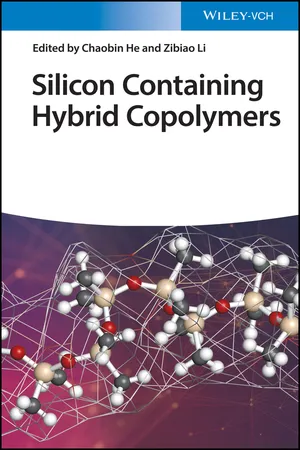
- English
- ePUB (mobile friendly)
- Available on iOS & Android
eBook - ePub
Silicon Containing Hybrid Copolymers
About this book
Information
1
Introduction of Organosilicon Materials
Huihui Shi1, Jing Yang2, Zibiao Li2, and Chaobin He1,2
1 National University of Singapore, Department of Materials Science and Engineering, 9 Engineering Drive 1, Singapore 117576, Singapore
2 Institute of Materials Research and Engineering, A*STAR (Agency for Science, Technology and Research), 2 Fusionopolis Way, Innovis, #08-03, Singapore 138634, Singapore
1.1 Introduction
The chemistry of organosilicon polymers has reached a high level of maturity during the past century, which established a fundamental basis for their application in materials science. Because of their inorganic–organic chemical compositions, the unique dual nature of organosilicon polymers makes them an important bridge between inorganic and organic polymers and contributes to an interesting combination of properties [1–3]. According to the structural differences in the backbone, organosilicon polymers can be mainly divided into polysiloxanes (Si–O), polysilsesquioxanes (Si–O), polysilanes (Si–Si), polycarbosilanes (Si–C), and polysilazanes (Si–N) [4]. Compared to carbon, the size and electronegativity of silicon significantly affect the structural properties of the bond and endow polymeric organosilicon with unique features [5]. Polysiloxane-based materials are attractive because of their high backbone flexibility, low glass transition temperatures, good thermal and oxidative stability, high gas permeability, excellent dielectric properties, and biocompatibility [6]. Polysilsesquioxane-based materials, mostly referred to as polyhedral oligomeric silsesquioxane (POSS)-based materials, demonstrate improved mechanical and thermal properties, oxidation resistance, gas permeability, reduced flammability, and antibiofouling and antibacterial properties [7]. Polysilane-based materials are characteristic of fantastic optical and electronic properties owing to delocalization of σ-electrons and conjugation along the σ-bonds of backbone [8]. Polycarbosilane-based materials can exhibit excellent thermal stability at relatively low temperature and pyrrolytic properties at high temperature as well as high mechanical strength and ultralow dielectric constant [9]. Polysilazane-based materials are best known not only for pyrrolytic properties but also for possessing some similar or preferable properties relevant to polysiloxane-based materials as a result of their isoelectronic molecular structure, such as thermal stability, low fire hazard, high mechanical resistance, and high surface energy [3].
In recent years, considerable attention has been drawn to the research of novel silicon-containing hybrid copolymers for further expansion and improvement of materials possessing specific useful properties [10]. Thanks to the fast development of polymer science, a variety of such copolymers with well-defined architectures as well as elements of selectivity and self-assembly has been reported [6, 7]. Distinguishing from pure organosilicon materials, the properties of hybrid materials include not only the sum of the individual contributions of their components but also the strong synergy created by extensive hybrid interfaces [11]. For the preparation of silicon-containing copolymers, a very popular and simple strategy is to synthesize organosilicon oligomers/polymers with reactive functionally terminated groups first by different approaches, which will be discussed in detail later. As preformed segmental components, they can go on to copolymerize with a wide range of (i) monomers via step growth [12], anionic [13], ring-opening [14], or living free radical polymerization [15, 16] or (ii) polymer blocks via coupling reaction such as click chemistry [17] and hydrosilylation [18], constructing well-defined architectures such as block [19], graft [20], and star-like [21] copolymers. The significant advantages of the silicon-containing copolymers are their flexible chemistry, which manifests as a wide selection of substituents on the silicon atom of the backbone, controlled molecular weight of copolymers, and tailor-designed backbone composition, implementing the facile tunability of specific material properties [6].
Organosilicon polymers with versatile properties hold great interest for a wide range of potential applications including biomaterials [22], functional coatings [23], electronic and photic devices [24], catalysts [25], ceramics [26], membranes [27], additives, and modifiers [28]. More details on this topic will be discussed later. There is no doubt that their integration with organic polymers can further enlarge the compatibility for an expansion in breadth as well as in depth of utilitarian scope. A myriad of literature has proved the emergence of quite...
Table of contents
- Cover
- Table of Contents
- 1 Introduction of Organosilicon Materials
- 2 Reactive Functionally Terminated Polyorganosiloxanes
- 3 Functionalized Polyhedral Oligomeric Silsesquioxanes (POSS) and Copolymers: Methods and Advances
- 4 Nanostructured Self-assemblies from Silicon-containing Hybrid Copolymers
- 5 Superhydrophobic Materials Derived from Hybrid Silicon Copolymers
- 6 Silicone Copolymers for Healthcare and Personal Care Applications
- 7 Construction of Organic Optoelectronic Materials by Using Polyhedral Oligomeric Silsesquioxanes (POSS)
- 8 Hybrid POSS Nanocomposites: An Overview of Material Toughening and Fire Retardancy
- 9 3D Printing Silicone Materials and Devices
- Index
- End User License Agreement
Trusted by 375,005 students
Access to over 1.5 million titles for a fair monthly price.
Study more efficiently using our study tools.
Frequently asked questions
Yes, you can cancel anytime from the Subscription tab in your account settings on the Perlego website. Your subscription will stay active until the end of your current billing period. Learn how to cancel your subscription
No, books cannot be downloaded as external files, such as PDFs, for use outside of Perlego. However, you can download books within the Perlego app for offline reading on mobile or tablet. Learn how to download books offline
Perlego offers two plans: Essential and Complete
- Essential is ideal for learners and professionals who enjoy exploring a wide range of subjects. Access the Essential Library with 800,000+ trusted titles and best-sellers across business, personal growth, and the humanities. Includes unlimited reading time and Standard Read Aloud voice.
- Complete: Perfect for advanced learners and researchers needing full, unrestricted access. Unlock 1.5M+ books across hundreds of subjects, including academic and specialized titles. The Complete Plan also includes advanced features like Premium Read Aloud and Research Assistant.
We are an online textbook subscription service, where you can get access to an entire online library for less than the price of a single book per month. With over 1.5 million books across 990+ topics, we’ve got you covered! Learn about our mission
Look out for the read-aloud symbol on your next book to see if you can listen to it. The read-aloud tool reads text aloud for you, highlighting the text as it is being read. You can pause it, speed it up and slow it down. Learn more about Read Aloud
Yes! You can use the Perlego app on both iOS and Android devices to read anytime, anywhere — even offline. Perfect for commutes or when you’re on the go.
Please note we cannot support devices running on iOS 13 and Android 7 or earlier. Learn more about using the app
Please note we cannot support devices running on iOS 13 and Android 7 or earlier. Learn more about using the app
Yes, you can access Silicon Containing Hybrid Copolymers by Chaobin He, Zibiao Li, Chaobin He,Zibiao Li in PDF and/or ePUB format, as well as other popular books in Technology & Engineering & Materials Science. We have over 1.5 million books available in our catalogue for you to explore.