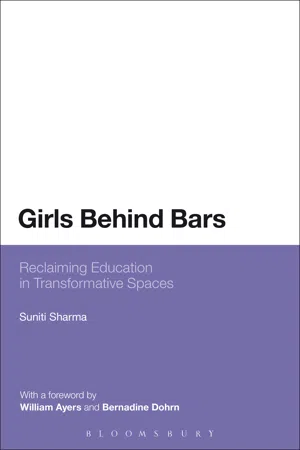
While scholarship on the education of youth behind bars has largely focused on boys, more than one in three youth arrests in the USA is female, and Girls Behind Bars sets out to address this imbalance.
The book offers autobiographies, life-stories, and counter-stories in order to challenge simplistic generalizations and empirical prescriptions. Girls Behind Bars provides the educational community with critical perspectives that examine empiricist epistemologies and positivist methodologies that label certain groups of girls as delinquent and mark them for punitive and corrective treatment behind bars. Sharma opens up the discussion on girls' gender, desire, and sexuality by offering a language for these issues absent in educational discourse. Finally, the book supports calls for educators and practitioners in their desire to envision and create transformative spaces that enable young girls behind bars to reclaim their education.
Including a foreword by William Ayers and Bernadine Dohrn, this important and powerful book gives voice to a neglected, silenced, and misrepresented population - young girls behind bars.
- 224 pages
- English
- ePUB (mobile friendly)
- Available on iOS & Android
eBook - ePub
About this book
Information
1
Mapping the journey
Introduction
In the spring of 2003, I accepted a teaching position in a detention school for young women in the United States. While searching for a new position in New Delhi, India through an employment agency online, a series of communication gaps resulted in a phone interview with the detention facility in the United States searching for an English teacher. In a bizarre conversation with the Director of the detention facility, I misunderstood the American accented English on the phone, so when the Director said he was based in Indiana, I assumed he said India. Oddly, when I said I was in Delhi, he later told me he assumed I was from Delhi, a small town in Texas, familiar to him. I had not applied for an overseas assignment; therefore, I was not thinking outside India at all. The next day the employment agency clarified the mistake to both of us; however, the Director of the facility made a job offer. I accepted.
The move, thousands of miles away from home in India, created major ripples within my personal and professional life. You could call this move a mid life crisis—empty nest syndrome, placid domesticity, or intellectual boredom; perhaps it was a combination of all three. I had been teaching English in India for 15 years. Surely I could teach anywhere in the world—that is, the western world. Like many middle class English-speaking women in India, I was part of the colonial hangover: well-schooled in western philosophy, literature, and the arts—one could call me an anglophile. That was 10 years ago. As I map this journey, I realize I can no longer specify the locations from where I speak—a woman, an Indian woman, a feminist, a teacher, a mother, a writer, an immigrant, a researcher, an autoethnographer—, and a recovering anglophile. What follows is my journey into unlearning what it means to be a teacher, of undoing what it means to be a woman, an autoethnography of my lived experiences teaching girls behind bars.
This book maps a seven-year journey into my experience teaching girls behind bars. What interests me is the intersection of my life history, the lived educational experiences of girls behind bars, and the search for curriculum change. Within the eight chapters, I explore the following questions in relation to teaching in a detention classroom for girls behind bars: What is a young girl behind bars? How do historical apriori conditions constitute certain groups of girls as objects to make detention possible? How might the notion of a multiply constituted subject of discourse contest historical apriori conditions that predicate detention? How does my teaching and learning intersect with the life stories of students? How do girls behind bars create transformative spaces for reclaiming education? What are the implications of such curriculum transformations for educational change? In this chapter, Mapping the Journey, I position the study within a historical, social, educational, and cultural context—mine, as well as my students’—to explore the above questions.
What is juvenile detention?
What is a detention school for girls, one might ask. Who is a young girl behind bars? How is she framed differently from other young girls? A detention school in the United States specifically for young girls is part of a detention facility, a place of temporary care for young girls in custody of the juvenile justice system. Young girls aged 7 to 21 who are in custody of the juvenile justice system for “criminal acts” such as arson, robbery, drug and alcohol abuse, and sex offenses are placed in detention (Chesney-Lind 2001). Other young girls enter the juvenile justice system for noncriminal offenses such as running away, truancy, not going to school, incorrigibility, promiscuity, prostitution, and behaviors at school deemed out of control (Brunson and Miller 2001). A number of young girls enter the juvenile justice system for being victims of various forms of sexual violence and physical and mental abuse (Krisberg 2005). An unexpected number of young girls are placed in detention, as they have nowhere else to go. Families, schools, and law enforcement agencies have the authority to place children and youth in custody of the juvenile justice system (Meiners 2007). Additionally, girls behind bars are also referred to as juvenile offenders, juvenile detainees, juvenile delinquents, and even inmates and prisoners.
According to Office of Juvenile Detention and Delinquency Prevention (OJDDP), an official wing of the US Department of Justice, the number of girls in the juvenile justice system has increased dramatically despite a drop in the overall juvenile crime rates (see Snyder and Sickmund 2006). Young women are the fastest growing segment in the juvenile justice population with a national rate increase by 83 percent between 1988 and 1997 and reported to further increase exponentially in the next decade (see American Bar Association and the National Bar Association 2001). Within this fast growing population, is a sub-group of “young people who are disproportionately minority, undereducated, and female” (Fine and McClelland 2006, p. 303), indicating the fast-tracking of school-to-prison pipeline for many minority women. By 2003, 61 percent of all juveniles in custody were minority youth. Among young women in custody, 35 percent are African American, 15 percent Hispanic, and the rest distributed among other minority groups (American Civil Liberties Union 2006).
All detention facilities, including those that are privately owned, are required by the US Department of Justice to abide by the rules and regulations specified by their respective state departments of corrections. For example, all detention facilities in the state of Indiana are required to follow the policies mandated by the Indiana Department of Corrections. In accordance, the explicit goals of the detention facility where I worked were threefold. The first goal was to discipline girls behind bars; the second was to ensure that the disciplinary measures facilitated rehabilitation; and the third was to assist all the young girls at the facility with their education. The above statistics on juvenile crime, what is labeled as juvenile delinquency, who is labeled as a juvenile offender, and the social, educational, legal, and institutional response to juvenile crime suggest an urgent need for studies on how and why young minority women are locked up in disproportionate numbers and what this means in terms of social justice practiced within institutions such as the juvenile justice and the school system.
The geography of the facility
As soon as I first arrived, getting familiar with the location of the facility, the layout of the building, and the unique architecture was foundational to understanding the aim and process of education in detention. The facility was situated on the main street of a small rural town surrounded by cornfields. The street to the facility had a very small sign indicating the facility’s presence, almost hidden between some trees. The building was located at the end of a paved street with tall trees at the back of its chain-linked perimeters. The wired fencing and the cameras all along the perimeter were intrusive and recorded all arrivals and departures from the building. The oblong shaped parking lot circled back upon itself on the lower portion of a sloping acreage to serve its panoptic purpose.
As I stepped on the concrete sidewalk, I noticed the entrance door with large glass windows where black-backgrounded crayon drawings showed brilliant displays of etched out pictures. These approximately 7″ by 8″ pictures of rainbows and greetings covered each window, giving a welcome, sunny first impression that contrasted sharply with the signboard. The single signboard proclaimed the status of the facility—Correctional Juvenile Facility for Girls. The facility housed 88 young girls aged 10 to 21. This was a privately owned for-profit facility. Private facilities in the United States make up 60 percent of all residential detention facilities and account for 80 percent of facilities that hold 10 or fewer residents (Snyder and Sickmund 2006).
The main door to the building and thereafter all doors were securely locked and operated through a buzzer that connected to the main control office. Entry into a rectangle shaped area inside the first door is obtained by responding to the buzzer’s voice request for information. Inside is a second waiting area where a view of a long hall can be glimpsed. At this checkpoint, every employee must swipe a card and pass an identification check while visitors’ IDs are thoroughly scrutinized by security guards before they are escorted elsewhere in the building. At all times, security guards accompanied students wherever they went and student movement was in a straight line, single file, face forward, hands folded across the chest. The entire process from the parking lot, through the heavy doors, and inside the waiting area felt like a prison, the kind often portrayed in the media.
The students wore a uniform—blue shorts and white t-shirts—and at night they wore the same t-shirts with a different pair of shorts, which was strictly enforced by the security guards. They were not allowed any personal belongings, and all personal items, including underwear, was provided by the facility. I also learned that every item of clothing went into a collective pool and a fresh, clean set was handed to students each morning, regardless of who wore them the previous day. I was afraid that these were ways to strip students of all rights including that of owning their own clothes. Having studied in a boarding school since I was 4 years old, I was familiar with school uniforms and dress codes. What I was not familiar with was the depersonalizing of students who were not allowed to take ownership of anything that would individualize them.
Policies of the detention facility
Did this rigorous prison-like routine come as a shock to me? Yes, many things shocked me because this concerned children and youth. This was no media image but a real juvenile detention facility that housed (imprisoned?) young girls considered delinquent. I was most horrified at the blanket rule that students were not allowed to speak to one another, and had no activities, extra-curricular activities, or books to read besides self-help books and the Bible in every part of the building and the classroom was no exception. Students had to raise their hands and request permission to speak, move, or walk in the classroom. I wondered how students were expected to be socialized back into life outside under the restrictions and the deprivations of a detention classroom.
As a new teacher, I was expected to attend 120 hours of intensive training before I stepped into the classroom. Subsequently, every year I had to complete 40 hours of training. The first part of my training was learning the organizational and institutional policies and procedures of juvenile detention. Through lectures, simulation, role-play, and drill, followed by tests, I was initiated into the policies of teaching in a detention classroom. I was informed my overarching concern at all times must be the safety and security of students. The daily schedule was structured and timed with clockwork precision by the facility’s administrators. There were no bells to mark the transition from one activity to another. Students were not allowed any contact with their family and friends, nor were they allowed to go out of the building. Every exterior door was locked and could only be opened by remote from a central keyboard at the control center. The center monitored and recorded what transpired in every classroom at all times. There were security cameras and guards inside and outside every classroom. This kind of omnipresent surveillance was unnerving because it felt invasive in a forbidding manner. I was being monitored too.
The policies of the facility were explained through terminology specific to detention. I learned that the control center in the reception area is simply called “control,” from where cameras digitally monitor and record every corner of the facility, except the rest rooms and the shower. I had to learn crisis prevention intervention (CPI), a physical intervention, which meant “restraining” a student down onto the ground and immobilizing her until help arrived. A “lockdown” was when security officers at the facility ordered all movement to come to a standstill in the event of an impending threat. For example, if a staff member lost a bunch of keys, the building went into lockdown as each student was “strip searched” for the keys—a full body search minus the clothes. Every employee had to carry a radio transmitter and stay in constant touch with “control.”
Inside the classroom, I was to make sure students did not speak with each other, walk around, or carry any pencil or paper out of the class. I wondered how I was going to teach without interacting with the students. Surely, I could work around this rule, I thought. I was naive enough to ask why students were not allowed to speak and was told, “These girls are prisoners, they think like prisoners, so we have to monitor them like prisoners. Our first rule is to keep them locked up, theirs is to escape” (personal communication). My desk was to be routinely locked. I was told that the locking of desks was necessary, as the students were capable of abusing themselves with objects and destroying property as a way of escape. In the classroom, there were only desks and chairs, the teacher’s desk and chair, and a blackboard. Students stayed in the school area from 7:30 a.m. to 4 p.m., after which they ate dinner and moved to the dorms, where they were expected to sit in silence until bedtime at 8:30 p.m.
The rationale for education in detention
While the technicalities of my training might sound quite textured, a sense of the structured and controlled everyday life in detention is necessary for understanding the second part of my training. The second part of training focused on education and entailed learning the officially sanctioned psychological and educational theories used to rationalize education in detention. The juvenile justice system was created in nineteenth century America to correct juvenile delinquent behavior. It was informed by the social theory that by virtue of social conditions, such as poverty and bad parenting, some children are deviant from the norm and therefore exhibit antisocial behaviors and commit criminal acts (DuBois & Karcher 2005). Hence, it was considered necessary to correct such deviancy through discipline and punishment of youth who did not conform to the norm (Bleschman & Bopp 2005). I was hopeful that time-tested theories on learning and behaviors would equip me to understand my role as a teacher in a detention classroom.
In order to establish rigorous discipline in the classroom, I had to observe strict codes and rules. For example, no teacher was allowed to exchange personal information with students, give rewards to students, and have any conversations with students other than school work. In accordance with psychological theories of correcting juvenile behaviors, the relation between teachers and students was expected to be based on rationality and objectivity. I was informed that detention, based on the principle of discipline and correction, had no room for building sustained relationships. I saw this as compromising the rehabilitative goals of detention because I felt it would be impossible to make an impact on students’ behaviors if I was not emotionally connected.
With the emergence of psychology and the study of human behavior, the juvenile justice system added the “rehabilitative ideal” approach to reforming deviant behavior of youth (Blechman & Bopp 2005). The rehabilitative school of thought focused primarily on addressing deviancy by controlling deviant minds and behaviors. The rationale for the rehabilitative ideal was based on claims from evidence-based research that youth differ from adults and need to be treated differently; their behaviors could be scientifically observed, clinically diagnosed, and effectively treated; and prescriptive plans would address youth offenders’ rehabilitation by altering and modifying undesirable behaviors (Rhodes 2001). Relying on empirical studies of human behavior that suggest the focus should be on the offender rather than offense, the rehabilitative ideal aimed at transforming character, habits, and attitudes of youth. Here the aim was to prevent recidivism (relapse into deviant behavior) and enable readjustment into family, school, and community.
In keeping with the institutional goals of detention, my first and foremost goal was to focus on rehabilitation of students. A combination of the social theory of deviance and a psychological approach to rehabilitation pave the way for the cognitive development theory (Piaget 1947) of education in detention. Piaget’s cognitive development theory plays an important role in the application of cognition to deviant and criminal behavior in youth. According to Piaget, cognition is a normal development in youth, but this ability may be damaged in some children and youth due to harmful social experiences or physical trauma, making them deficit in cognitive capacities. The deficit explained deviancy, which was measured from the norms of behavior, attitude, and ability. As a deficit model, Piaget’s and Vygotsky’s theories were critical to explaining deviancy control, especially in juvenile detention, and opened the possibility for education as an intervention or a tool for addressing cognitive deficiencies or deviancies (see Daniels 2007). Therefore, learning was seen as key to the rehabilitative process of detention.
As a teacher, I was expected to address specific cognitive defects, deficiencies, and deviancies by focusing on teaching girls behind bars how to think, develop decision-making skills, and make correct choices. Thus, the goal of education was to retrain behaviorally deviant and cognitively deficit students to conform to the norm. I was also expected to develop a curriculum that would combine the rehabilitative goal of detention with the educational reforms of the NCLB Act (2001). Finally, I was given a valuable and trusted resource—the “golden” tool that was supposed to guide my practices as a teacher: Reasoning and Rehabilitation: A Handbook for Teaching Cognitive Skills to Female Juvenile Offenders (compiled by the detention facility). This handbook, I was told, would help smooth the transition from a teacher-outsider to a teacher inside a detention classroom.
The entire process of my training was punctuated with detainee stories, detention lore, prison and prisoner myths and stories, the dos and don’ts of detention, and a shared sisterhood of the “secrets of surviving” among staff members in a detention facility. In fact, we were forbidden from discussing the facility’s happenings outside the premises. Breaking any of the rules was taken seriously, and employees at the facility were fired on a weekly basis for going against the rules.
What did I think?
My training at the facility and the discussions that followed introduced me to the American penal system, prison culture, and the language of prisons. Prison-talk concerning adult prisoners did not overwhelm me. I was familiar with prisoner stories. In the 1970s and 1980s, while most young women in India my age were raising children, decorating, and redecorating their homes, I was busy on a typewriter or a telex machine deciphering prison stories told by members of the then banned African National Congress of South Africa (ANC). This was my ANC phase, when I was 21 and drunk on the idea of freedom and democracy—I believed in the fight for the release of Nelson Mandela...
Table of contents
- Cover
- Half-Title
- 1 Mapping the Journey
- 2 Foucault’s Conditions without a Subject
- 3 Making, Unmaking, and Resituating the Subject
- 4 Qualitative Methodology, Critical Autoethnography, and Self-reflexivity
- 5 Embodied Life-stories and Counter-stories
- 6 Guilty Readings of Other People’s Stories
- 7 Agents of Change, Not Subjects or Objects of Discourse
- 8 Girls Behind Bars Reclaiming Education in Transformative Spaces
- Author’s Notes
- List of References
- Index
Trusted by 375,005 students
Access to over 1.5 million titles for a fair monthly price.
Study more efficiently using our study tools.
Frequently asked questions
Yes, you can cancel anytime from the Subscription tab in your account settings on the Perlego website. Your subscription will stay active until the end of your current billing period. Learn how to cancel your subscription
No, books cannot be downloaded as external files, such as PDFs, for use outside of Perlego. However, you can download books within the Perlego app for offline reading on mobile or tablet. Learn how to download books offline
We are an online textbook subscription service, where you can get access to an entire online library for less than the price of a single book per month. With over 1.5 million books across 990+ topics, we’ve got you covered! Learn about our mission
Look out for the read-aloud symbol on your next book to see if you can listen to it. The read-aloud tool reads text aloud for you, highlighting the text as it is being read. You can pause it, speed it up and slow it down. Learn more about Read Aloud
Yes! You can use the Perlego app on both iOS and Android devices to read anytime, anywhere — even offline. Perfect for commutes or when you’re on the go.
Please note we cannot support devices running on iOS 13 and Android 7 or earlier. Learn more about using the app
Please note we cannot support devices running on iOS 13 and Android 7 or earlier. Learn more about using the app
Yes, you can access Girls Behind Bars by Suniti Sharma in PDF and/or ePUB format, as well as other popular books in Education & Education General. We have over 1.5 million books available in our catalogue for you to explore.