This book argues that European citizenship is transnational, a status that has emerged incrementally during the European integration process.
Transnational Citizenship in the European Union follows an institutionalist approach and traces the development of citizenship discourse from the founding treaties of the EU to the most recent effort of constitution-making and the Lisbon Treaty. This helps demonstrate that such discourse has followed a path based on the foundational principles of free movement and non-discrimination rather than revolutionary ideas of a postnational citizenship beyond the nation-state.
This in-depth analysis of citizenship in the EU takes into account the institutional configuration of membership, rights, identity, and participation. It also brings in the domestic level of the debate through the examination of national positions on reform proposals and the interplay between EU and member states conceptions of citizenship.
Lastly, by investigating citizenship practices, the book helps foster understanding of how the EU works as a political system, and the relationship between European institutions and the recipients of their integrative politics , i.e., the citizens.
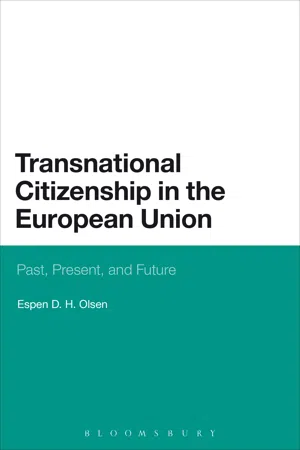
eBook - ePub
Transnational Citizenship in the European Union
Past, Present, and Future
- 208 pages
- English
- ePUB (mobile friendly)
- Available on iOS & Android
eBook - ePub
About this book
Information
Chapter 1
The Founding Decades
When the “group of six”1 established the European Coal and Steel Community (ECSC) in 1951, no-one could have foreseen an EU of 27 member states, with a directly elected EP, wide-reaching policies, and a common currency.2 For sure, we can imagine that they would also not have anticipated all the talk about European citizenship that has emerged after Union citizenship was institutionalized in the Maastricht Treaty (1992). Still, the European project of unification was something different in the history of international organizations already from its modest, sectoral beginnings. Already the choice of “community” over other concepts such as “association” or “organization” signified common interests and ideas that would go beyond mere economic cooperation (Dinan 2004). In the aftermath of two wretched wars in two generations, European leaders, federalists, and political entrepreneurs created a community of states which would bring political institutions and “citizens” closer together.
The exclamation marks on “citizens” here are not coincidental. In fact, they go to the core of this book. In what ways have European institutions related to individual citizens, to the “groundworkers” of the integration project? Indeed, this chapter shows how member state citizens turned out to be important pieces in the puzzle that would be European unification. From the onset, integrationists acknowledged the strong symbolism and practical consequences of borders between states. This is important as the modern vocabulary of citizenship has been intimately connected to the nation-state, a vocabulary that further relates to the understanding of territorial borders and communal boundaries of the political as stable and fixed (Migdal 2004: 16). Consequently, free movement across borders would be a central theme of the negotiations on the ECSC Treaty. In the end, this vision would also include citizens—or workers—after the Italian government pushed for this toward the end of the negotiations (Maas 2007).
When European integration finally became a reality, the institutional setup and policy approach was geared toward the dual aim of integrating previous enemies through the pooling of sovereignty and upholding national independence (see Dinan 2004; Moravcsik 1998). Yet, the specific institutional and policy-oriented approaches would have a strong impact on the developments of European institutions in the first two decades of integration. Thus, although European integration at the outset was about the “high politics” of institutional integration, market building, and political interdependence, it would also have an impact on issues outside the restricted domains of the first communities. The evolving and dynamic character of European integration was evident already in its first phase, and it is, therefore, crucial to investigate how the status of individuals was framed within the founding treaties and subsequent political and judicial developments. In so doing, this chapter highlights how international treaties are not static texts: they are always working within given contexts. Hence, while the ECSC Treaty was limited in the scope of policies it covered, it would raise certain issues that already at the outset went beyond “coal and steel” integration. Fundamental issues were at stake. When devising a framework for integrating previous enemies, these adversaries sought solutions that could not be easily disbanded because of enduring interests or fleeting power struggles. To use Wiener’s (2008) nice phrase, there was already in the first Treaty an “invisible constitution of politics” that would be the starting point of later efforts of further integration and of linking citizens with supranational institutions. Indeed, Maas (2005b: 985, 997) has shown that arguments over European rights were present at the beginning of European integration, and even predated the negotiations on the ECSC Treaty.
This chapter charts, therefore, the minuscule elements of citizenship and individual rights that were constructed in the first two treaties. It traces citizenship in the Treaty texts and how such issues were later interpreted by the ECJ as fundamental for the status of individuals in relation to European institutions. Finally, the chapter shows how the early issues of basic principles for the functioning Community was concretized in remarkable policy-making on the issue of free movement some 20 years after the launch of European integration in Paris. The main argument that is developed through the empirical analyses of these critical junctures is that, in overall terms, the embryonic and incipient conceptions of citizenship evident in the founding treaties provided the frame upon which later conceptions were constructed and developed. In other words, if we want to understand the potential and limits of European citizenship in a transformed Union we must start with the origins of integration itself.
Integrating Coal and Steel Markets: Whither Citizenship?
The ECSC Treaty signed in Paris (1951) marks the institutional advent of European integration. Through this treaty, the BeNeLux, France, Germany, and Italy sought to create a single market in coal and steel (Dinan 2004: 52). At the outset, this integrative effort was thus highly sectoral and limited, both in political and territorial terms. While limited in sectoral reach, the ECSC Treaty was still rather comprehensive in laying out the historical and political foundations for such a community. It stated aims of the ECSC such as “maintenance of peaceful relations,” “the establishment of common bases for economic development,” and to increase “the standard of living and . . . furthering the works of peace.” Finally, it stated that historic rivalries were to be counteracted “by creating an economic community, the foundation of a broad and independent community among peoples, . . . and giving direction to their future common destiny.” Obviously one must be careful of exaggerated interpretation regarding “lofty” considerations in a preamble. Still, it is important to note that the limited fields of coal and steel led to such towering assertions of the “rationale” behind integration. What does the “high politics” of peace and international cooperation have to do with citizenship? It is a well-known fact in the history of European integration that the “founding fathers” foresaw a more comprehensive future Community or Union. While this supranational vision did not necessarily have to include individual rights and discussion on identity, it was clear that it proffered an institutional system and a set of basic principles that would go beyond the template for “classic” international organizations or regimes. This would have lasting effects, not only on institutional developments of European integration, but also on individual citizens.
While European leaders foresaw an expanding Community and binding rules and institutions, there was no direct assertion of citizenship in the ECSC Treaty. What would constitute membership and linkage to European institutions and laws for member state citizens was not part of the equation at this point in time. In fact, there was furthermore no direct reference even to rights of individuals that could emanate from the Treaty. Against this backdrop, Neunreither (1995: 5) claimed that the ECSC represented “European integration without the citizens.” Still, a central argument of this book is that citizenship develops not only as a result of “explicit” citizenship policies, but also as a consequence of political, cultural, and legal practices that frame norms of membership, the scope of rights, notions of identity, and modes of participation for individuals. Based on a contextualized reading of the Treaty one can therefore discern an already present notion of individual citizens and their rights under the remit of supranational integration. While this was not comprehensive or perhaps even anticipated by its signatories and “founding fathers,” the history of citizenship shows that demarcations of political communities can take many forms. Isin (2002) highlights how citizenship historically has been marked by struggles over its content (rights and obligations) and scope (criteria for inclusion). While citizenship struggle is not the word one would choose to portray the negotiations on the ECSC, they were marked by extensive debate on the scope of free movement (Maas 2007). This was in the end extended also to individuals as market participants. Hence, to the extent that individuals were accorded a status within the framework of the treaty, it was primarily in the capacity of consumers, workers or producers.3 It seems obvious that within the prevailing understandings of citizenship at the time these roles would not be seen as part of citizenship. To be sure, the skepticism of Aron (1974) concerning even the conceptual possibility of European citizenship as something similar to the national counterpart would possibly have rung even more true in 1951. I nevertheless argue that while the modicum of free movement rights in the ECSC Treaty were in no way comparable to nation-state citizenship, they created the impetus for a discourse on citizenship-related issues that have lasted to this day of postconstitutional crisis management.
The ECSC Treaty did, then, activate issues of citizenship. The thrust of provisions on individuals in the Treaty is found in Article 69. This refers to the renouncement of employment restrictions based on nationality for workers in the coal and steel industries. Hence, the lofty assertions of promoting peace did not foster any direct assertion of measures to integrate member state citizens further. There was no explicit notion of a European identity common to citizens of diverse nation-states. The Treaty dealt explicitly with the status of individuals in their limited capacity as potential workers in a clearly defined sector of production and market transactions. The basis for individual membership under the ECSC thus emerged as an effect of other elements: it was linked, not to formal membership criteria, but to participation as a prospective individual activity, sectorally defined and circumscribed.
The rights attached to this status as a limited “coal and steel worker-citizen” were further meant to facilitate what the Treaty referred to as “movement of labor.” The dominance of mobility in the construction of rights and citizenship in European integration is a central theme of this book. Important as this was in the vision of a Europe where borders would be less essential and permeable by the interests of peaceful cooperation between previous enemies, it is to this day at the core of European individualism and conceptions of citizenship (Somek 2008). The practice of the individual citizen that transcends national borders is key to policy-making, identity debates, and the European economy. The theme of mobility is furthermore important in theoretical terms, as the possibility to move freely across national boundaries constituting the reach of state jurisdiction and citizenship rights can be interpreted as the so-called “abolition of the disabilities of alienage” (Preuss 1998a: 145). Being an alien—a noncitizen—is then no longer such a precarious status given that rights of free movement to some extent “trump” the state’s exclusive right to deny the access of foreigners to its territory. But, given the clearly limited character of movement provisions under the ECSC, this cannot be interpreted as the backbone of a genuine citizenship status cross-cutting national citizenship institutions and territorial jurisdictions. The free movement provision inherent in Article 69 of the ECSC Treaty was even stated under the heading “movement of labour,”4 rather than, say, “free movement of persons” which would have signified a broader curbing of the traditional exclusiveness of states in terms of territorial control. Hence, while not comparable to national citizenship in any way, the ECSC Treaty created a citizenship “embryo” in European integration. Participation as workers through the exercise of free movement led to a minuscule status of rights-holding citizens. Moreover, this was related not only to European institutions, but also to member states of the Community. Hence, elements of citizenship already in the ECSC Treaty were dynamically interconnected in generating a thin status for individuals. While not widely acknowledged in EU scholarship,5 this “embryo” would prove strong and worthy of continued life.
The Treaty of Rome: The Market Citizen Appears
The European Economic Community (EEC) would build on the embryonic conception of European citizenship from the ECSC based on abolishing restrictions on nationality regarding the movement of workers across state boundaries. The designation of the new community as “economic” in the Treaty of Rome rather than confined to two narrow sectors in the previous treaty clearly signified the widened scope of institutionalized European integration. In fact, on the back of the failure regarding the European Political Community in 1954 (see Griffiths 2000), one of the priorities of that process was retained: the establishment of a common market in Europe (Dinan 2004: 64). This more complete vision of economic integration and the broader scope of integration would have further ramifications for citizenship in European integration.
The more comprehensive scope of integration in the Treaty of Rome is evident in its preamble. The “loftiness” of the preceding treaty was retained, however, with a somewhat different slant to it. It reiterated the aims of fostering peace through “eliminating the barriers which divide Europe,” by “constantly improving the living and working conditions of their [the member states’] peoples,” and finally “to strengthen the safeguards of peace and liberty.” What is further striking about the preamble in terms of citizenship is the emphasis on integration, not only between member state citizens as such, but also the determination to establish “an ever closer union among the European peoples.”6 This did by no means bring the single citizen to the forefront of the aims of European integration. Still, the focus on peoples, rather than merely states, signaled a direct link between the institutions of the integrative process and individual citizens. This was, therefore, not mediated exclusively through the member state level. In this sense, European integration signified something more than a simple international treaty or regime. European leaders did, then, understand the Treaty to have effects for the collectives of individuals underpinning the nation-states in terms of community and legitimacy.
It is thus not surprising, notwithstanding the lack of focus on integration among citizens as such, that issues pertaining to citizenship were scattered throughout the Treaty of Rome. Again, the prevailing image is one of a focus on citizens as workers and producers.7 Yet, there was some development compared to the ECSC. The Treaty explicitly stated in Article 7 that “any discrimination on the grounds of nationality shall hereby be prohibited,” without specifying the specific circumstances to which this principle would apply.8 The principle of nondiscrimination was thus wider in scope—at least in terms of the exact wording of the provision—than a narrow focus on proscribing such measures for specific groups, such as workers. The designation of membership, the criteria for who were seen as members and on what basis, were thus not straightforward in the Treaty of Rome. On the one hand, it is clear that it established the individual as meaningful within the framework of European integration in his/her capacity as a worker, albeit on a general level. Membership was related to participation contingent on the crossing of political borders. Workers within the common market were still the primary actors “on the ground” also in the Treaty of Rome. Without the primacy of such work-related participation through market-oriented rights there would be no activated rights status of individuals under the EEC. On the other hand, the broad wording of the general article on nondiscrimination points to a tension between a conception of the “worker-citizen” and an individual citizen to be protected from discrimination on the basis of his/her nationality per se. There thus seems to have been a tension inherent in the Treaty between the practical and functional focus on market integration and the more general “vision” of overcoming the national divisions of the two wars. While this would not have important implications immediately, this conflict was a precursor to later, more explicit (constitutional) debates on how far one could extend European rights and identity issues without diminishing the status of national citizenship.
Individual rights provisions were linked to the principle of free movement.9 This was clearly related to the notion of workers as the primary individual actors in European integration. Still, it was not a universal principle. First, the right was bestowed on member state nationals only. Secondly, free movement could be curtailed by arguing for reasons of public order and public safety. Grounding European rights on prior national membership as well as emphasizing exceptions to the principles of free movement and free right of establishment based on such reasons underline that there were no explicit state-aspirations inherent in the Treaty foundation of the EEC. When theorizing types of boundaries involved in “polity-making” in modern Europe, Bartolini (2006: 7–13, 28) has underlined that the limits surrounding market transactions can be seen as fringes, that is, rather malleable boundaries subject to on-going developments of market relations and practices, while politico-administrative units are delineated by more settled borders. Thus, the principle regarding free movement of persons that was to facilitate a common European market through the “abolishment” of the fringe boundaries between national markets could cut across the borders of politico-administrative units previously holding exclusive jurisdiction over national territory. In light of the pervasiveness—in theoretical and practical terms—regarding the unitary character of modern nation-states encompassing citizenship, identity, political institutions, and territory, principles “overriding” these interlocking boundaries were clearly powerful. Ultimate decisions about citizenship did, however, remain national, perhaps due to the persistent frontiers of states in the final instance: “Territorial integrity of states is a deeply entrenched norm in the international state system” (Bauböck 2003: 8). Moreover, the potential challenge to the link between citizens and political units from free movement was clearly thwarted by the onus on economic integration and market-making in the EEC. The range of rights linked to free movement did not entail a deep “intrusion” into the political territory of member states, as if they had been complemented, say, by political rights. In addition, the emphasis that exceptions could be made by reference to reasons of public order and public safety clearly show that there was no vocabulary ready at the time of the Treaty of Rome to challenge the ultimate boundaries of states and thus of national citizenship institutions.
The answer, then, to “who are the Europeans?” in the Treaty of Rome was obviously not the democratic citizen as a participant in a political community, but rather the individual-as-worker and market participant. As Preuss (1998b: 11) points out, “[t]he political term citizen was thoroughly alien to the wording of the original Treaty.” There was no clear notion of a broader identity transcending the links generated by integrating markets, common institutions, and legal framework on the European level. It is unsurprising that the construction of citizenship in the first treaties was fully linked with the aims of market integration. It is nevertheless striking that the market impetus of linking member state citizens, new European institutions, and bindin...
Table of contents
- Cover
- Half-Title
- Introduction: The Challenge of European Citizenship
- 1. The Founding Decades
- 2. Bringing Identity, Rights, and Elections In
- 3. The European Parliament and the Spinelli Project
- 4. Europe of “No Borders”
- 5. The Maastricht Process
- 6. The Years In-Between: From Maastricht to Constitutional Projects
- 7. The Convention on the Future of Europe and Its Aftermath
- 8. European Projects, Resilience of the “National,” and Citizenship in the EU
- Conclusions, Questions, and Challenges
- Notes
- Bibliography
- Index
Trusted by 375,005 students
Access to over 1.5 million titles for a fair monthly price.
Study more efficiently using our study tools.
Frequently asked questions
Yes, you can cancel anytime from the Subscription tab in your account settings on the Perlego website. Your subscription will stay active until the end of your current billing period. Learn how to cancel your subscription
No, books cannot be downloaded as external files, such as PDFs, for use outside of Perlego. However, you can download books within the Perlego app for offline reading on mobile or tablet. Learn how to download books offline
Perlego offers two plans: Essential and Complete
- Essential is ideal for learners and professionals who enjoy exploring a wide range of subjects. Access the Essential Library with 800,000+ trusted titles and best-sellers across business, personal growth, and the humanities. Includes unlimited reading time and Standard Read Aloud voice.
- Complete: Perfect for advanced learners and researchers needing full, unrestricted access. Unlock 1.5M+ books across hundreds of subjects, including academic and specialized titles. The Complete Plan also includes advanced features like Premium Read Aloud and Research Assistant.
We are an online textbook subscription service, where you can get access to an entire online library for less than the price of a single book per month. With over 1.5 million books across 990+ topics, we’ve got you covered! Learn about our mission
Look out for the read-aloud symbol on your next book to see if you can listen to it. The read-aloud tool reads text aloud for you, highlighting the text as it is being read. You can pause it, speed it up and slow it down. Learn more about Read Aloud
Yes! You can use the Perlego app on both iOS and Android devices to read anytime, anywhere — even offline. Perfect for commutes or when you’re on the go.
Please note we cannot support devices running on iOS 13 and Android 7 or earlier. Learn more about using the app
Please note we cannot support devices running on iOS 13 and Android 7 or earlier. Learn more about using the app
Yes, you can access Transnational Citizenship in the European Union by Espen D. H. Olsen in PDF and/or ePUB format, as well as other popular books in Politics & International Relations & Civics & Citizenship. We have over 1.5 million books available in our catalogue for you to explore.