- 208 pages
- English
- ePUB (mobile friendly)
- Available on iOS & Android
eBook - ePub
Borges, between History and Eternity
About this book
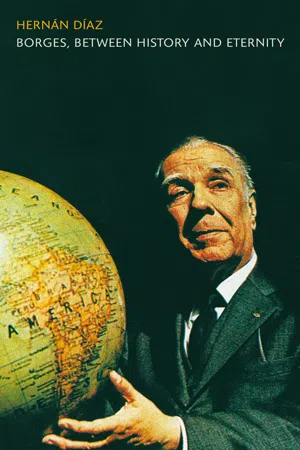
That Borges is one of the key figures in 20th-century literature is beyond debate. The reasons behind this claim, however, are a matter of contention. In Latin America he is read as someone who reorganized the canon, questioned literary hierarchies, and redefined the role of marginal literatures. On the other hand, in the rest of the world, most readers (and dictionaries) tend to identify the adjective "Borgesian" with intricate metaphysical puzzles and labyrinthine speculations of universal reach, completely detached from particular traditions. One reading is context-saturated, while the other is context-deprived. Oddly enough, these "institutional" and "transcendental" approaches have not been pitched against each other in a critical way. Borges, between History and Eternity brings these perspectives together by considering key aspects of Borges's work-the reciprocal determinations of politics, philosophy and literature; the simultaneously confining and emancipating nature of language; and the incipient program for a literature of the Americas.
Information
PART ONE
Political Theology
Introduction
If Borges is often perceived as a writer utterly detached from reality, dealing in abstractions, literary puzzles, and unsolvable philosophical riddles, it is mostly because of his own doing. He cultivated this myth in his texts (“Borges,” the shy bibliophile, is a character in several of his stories and poems), and in the all too numerous interviews he indiscriminately granted toward the end of this life, where he played the part of the blind sage, slightly confused by the world, surprised to find himself, somehow, in the present, turning every earthly matter into a literary one. To his credit, he famously denounced his own affectations and how they had become “attributes of an actor” [“atributos de un actor”] in “Borges and I” (SF 324) [“Borges y yo” (OC 808)]. In that same text, he admits that his “games with time and infinitude” [“juegos con el tiempo y con lo infinito”] have also become clichés of his public act.1 It is these “games with time and infinitude,” supposedly removed from reality and concerned only with speculative, esoteric matters, that most readers (and dictionaries) quickly identify with the adjective “Borgesian”—how reality can be perforated by fiction, how our waking life may be someone else’s dream, how memory may completely overtake the present, how actuality can turn out to be a representation staged for our benefit, and how infinitude lurks everywhere, in the imploding subdivisions of the most insignificant segments of time and matter. All these are clearly “Borgesian” commonplaces. Yet, all these supposedly abstract brainteasers question the stability of our place in the world and expose the precariousness of the categories that rule our perception of it. In this, oddly enough, they reveal themselves to be profoundly terrestrial, inasmuch as they examine how our reality is administered, rather than merely “given.” And this issue can quickly become a political one—political power is always concerned with the imposition of a reality.2 Borges’s obsession with dreams, his often outrageously skeptical arguments, his solipsistic plots, and his theological conundrums can therefore be read as the juncture where literature, metaphysics, and a general reflection on power (and the institutions that embody it) come together.
In 1933, in the magazine Contra, Borges wrote: “It is an insipid and notorious truth that art must not serve politics. To speak about social art is like speaking about vegetarian geometry or liberal artillery or hendecasyllabic pastry making” [“Es una insípida y notoria verdad que el arte no debe estar al servicio de la política. Hablar de arte social es como hablar de geometría vegetariana o de artillería liberal o de repostería endecasílaba” (TR II: 343)]. He considered this statement to be true enough to reproduce it verbatim in 1964 in another magazine, La Rosa Blindada. Even though this passage targets different opponents in each context,3 the main point is the same—literature constitutes an autonomous sphere that must not be subordinated (“estar al servicio”) to anything beyond itself. There are, however, ways in which literature can be political without being in an ancillary position, and Borges’s own work offers many examples of this.
Borges was, perhaps despite himself, an overtly political writer, and there are a vast number of his own texts to prove it, from a few forgotten poems to the Russian Revolution written in his youth in Switzerland to his last book of verse, Los conjurados (1985), whose title poem is, coincidentally, an ode to Swiss cosmopolitanism and neutrality. Several of his first essays, published in the 1920s, are strong manifestos, almost populist harangues (which he later regretted and refused to reprint), where he articulates clear cultural programs for Argentina (Borges even intended to “instigate a politics of language” [“instigar una política del idioma” (TE 39)] in these texts, some of which are written following an “Argentinean” orthography).4 Borges also wrote several historical poems, which are, given their subject matter, necessarily political (“Rosas,” “General Quiroga Rides to His Death in a Carriage” [“El general Quiroga va en coche al muere”], “Conjectural Poem” [“Poema conjetural”], “Sarmiento,” “La tentación,” and “Juan López y John Ward” are just a few and random examples of many). During World War II, while Argentina remained neutral (and notwithstanding a widespread philo-Nazi atmosphere), he produced essays denouncing the Nazi regime (such as “Two Books” [“Dos libros”], “An Essay on Neutrality” [“Ensayo de imparcialidad”], “A Comment on 23 August 1944” [“Anotación al 23 de agosto de 1944”], “Definition of a Germanophile” [“Definición de germanófilo”], his review of Watherhouse’s A Short History of German Literature, and “1941”). He also wrote politically outspoken fiction: “Deutsches Requiem” (the soliloquy of a Nazi officer the night before his execution), “The Secret Miracle” [“El milagro secreto”] (about the execution of a Jewish scholar and playwright during the Czech occupation), “The Simulacrum” [“El simulacro”] (narrating the staging of Evita’s fictitious funeral in a small town), or “La fiesta del monstruo” (an anti-Peronist, and, to an enormous extent, classist and xenophobic satire written together with Bioy Casares) are a few of the stories of this nature.
Finally, Borges’s tightest connection with politics comes from the fact that he had an extremely personal relationship with Argentine history. In a 1967 interview published by The Paris Review, Borges offered a succinct account of his lineage:
I come from military stock. My grandfather, Colonel Borges, fought in the border warfare with the Indians and he died in a revolution; my great grandfather, Colonel Suárez, led a Peruvian cavalry charge in one of the last great battles against the Spaniards; another great uncle of mine led the vanguard of San Martín’s army—that kind of thing. And I had, well, one of my great-great-grandmothers was a sister of Rosas—I’m not especially proud of that relationship, because I think of Rosas as being a kind of Perón in his day; but still all those things link me with Argentine history and also with the idea of a man’s having to be brave, no? (122)5
Given his lineage, Borges often sees the national past in a romantic light, as an extension of his own family romance. He writes of himself (in the third person), at the end of his Obras Completas, in an entry of an imaginary future encyclopedia, supposedly published in 2074: “He [Borges] was of military lineage, and felt nostalgic about the epic destiny of his ancestors” [“Era de estirpe militar y sintió la nostalgia del destino épico de sus mayores” (OC 1144)]. This is also why, according to Borges himself, he felt attracted to knife fights, gangsters, hoodlums, and other violent figures—he believed this fascination was a degraded, distorted (even secular) embodiment of the epic, and quasireligious exaltation of his elders: “He thought,” Borges continues in the apocryphal encyclopedia, “that courage was one of the few virtues men are capable of, but idolizing it led him, as it did many others, to the clumsy veneration of criminals” [“Pensaba que el valor es una de las pocas virtudes de que son capaces los hombres, pero su culto lo llevó, como a tantos otros, a la veneración atolondrada de los hombres del hampa” (OC 1144)]. Ancestry, history, and literature intersect in many of his texts, for instance the second of his Two English Poems, included in The Other, the Same [El otro, el mismo, 1964], a collection of poetry published in 1964 (sometimes translated, mysteriously, as The Self and the Other):
I offer you my ancestors, my dead men, the ghosts that living men have honoured in marble: my father’s father killed in the frontier of Buenos Aires, two bullets through his lungs, bearded and dead, wrapped by his soldiers in the hide of a cow; my mother’s grandfather—just twentyfour—heading a charge of three hundred men in Peru, now ghosts on vanished horses. (OC 862)
Borges made sure to keep these heroic myths alive by conjuring up the ghosts of his forefathers in numerous poems—“Inscripción sepulcral,” “Dulcia linquimus arva,” “Alusión a la muerte del coronel Francisco Borges (1833–74),” “Página para recordar al coronel Suárez, vencedor en Junín,” “Cosas,” “Una mañana,” “1972,” “Coronel Suárez,” and “La suerte de la espada” are a few of the poems where Borges engages in “the hero worship of dead soldiers” (SP 325) [“el culto idolátrico de militares muertos” (OC 1115)], as he writes in “The Watcher” [“El centinela”].
The purpose of the following chapter is not to determine Borges’s political consistency, or lack thereof—as said, he wrote poems for the Russian Revolution,6 though he repeatedly declared to be an Anarchist,7 flirted with Rosas and rebuffed Sarmiento in his youth,8 later became an extreme anti-Peronist,9 joined the conservative party,10 and declared overtly to be antidemocratic11. Neither do the following pages aim to establish how progressive or reactionary he was on the ideological dial. I do not intend to show how, secretly, Borges was an “engaged” writer—“The notion of art as engagement,” he wrote, “is naive, for no one knows entirely what he is doing” (SP 343) [“El concepto de arte comprometido es una ingenuidad, porque nadie sabe del todo lo que ejecuta” (OC III: 75)]. Finally, I will not try to “deduce” similarities between Borges and different political philosophies—how, for instance, Borges is (without even suspecting so himself) related to Mikhail Bakunin, or secretly indebted to Max Weber, or tacitly addressing Walter Benjamin or Louis Althusser, or following Menard’s “technique of deliberate anachronism” (CF 95) [“la técnica del anacronismo deliberado” (OC 450)], engaging in dialogue with Robert Nozick or Giorgio Agamben. Instead, the main purpose of the following two sections is to reveal how certain basic political concepts present in Borges’s texts (such as his ideas of nation, power, and representation) relate to the view of metaphysics present in his texts (such as his concern about idealism and his syncretic approach to theology). I will show how Borges’s metaphysical discussions have, to a large extent, political connotations and, conversely, how his idea of the nation, its history, and its institutions is supported and informed by Metaphysics.
The purpose of the following two sections (“God and Country” and “When Fiction Lives in Fiction”) is to explore the dissonance between what could hastily be called the “metaphysical” and the “political” sides of Borges’s literature. I claim that both these sides coexist simultaneously and inform each other. Borges’s view of metaphysics ultimately becomes a political philosophy—the question of god, for instance, is the question of power taken to its highest instance. Conversely, beyond Borges’s take on certain historical or present events (be it Rosas, Hitler, or the Malvinas War), his overtly political texts tend to slide toward metaphysics and theology.
Notes
1 Ironically enough, denouncing his own tics became Borges’s most notorious tic. Over the years, Borges kept belittling himself for having turned into his own epigone. In the foreword to In Praise of Darkness (Elogio de la sombra [1969]), he deplores his own gimmicks and refers to “the mirrors, labyrinths, and swords that my resigned reader expects” (SP 265) [“los espejos, laberintos y espadas que ya prevé mi resignado lector” (OC 975)]. A similar self-deprecating objection can be found in “The Watcher” [“El centinela”], a poem in The Gold of the Tigers (El oro de los tigres [1972]) (SP 326; OC 1115). And yet again in “The Other” [“El otro”], a late short story included in The Book of Sand [El libro de arena (1975)]. Bioy Casares criticizes the stereotypical self-portrait that Borges draws in this last text in a 1972 entry of his journal: “Borges dines at home. He tells me the plot of his new story [“The Other”]. Admirable, with the sole flaw of being ‘The Other Borges’ or ‘Borges and I’ once again [English and italics in original]” [“Come en casa Borges. Me cuenta su cuento [“El otro”]: admirable, con el defecto de ser ‘El otro Borges’ o ‘Borges y yo’ once again” (1430)]. For the historical and literary resonances of this calculated shyness, see Alan Pauls’s brilliant analysis of what he aptly calls Borges’s “politics of modesty” [“política del pudor”] (47–56).
2 Sarlo eloquently summarizes this relationship between fantastical literature and politics in the introduction to the last chapter of her book (177–78).
3 In 1933, the jab is aimed at the heirs of “Boedo,” Argentina’s openly “social” (to use Borges’s term) literary group in the 1920s. The Boedo group (named after a working-class neighborhood in Buenos Aires) was opposed to that of Florida (in reference to the posh downtown section). Borges downplayed the rivalry between the politically engaged faction and the decadent one and even claimed that the whole affair was a hoax (see “La inútil discusión de Boedo y Florida” in TR I: 365 and “‘Florida’ y ‘Boedo’” in TR III: 325). In its 1964 incarnation, the provocation is directed against the new generation of “engaged” writers inspired by Sartre.
4 “Queja de todo criollo” (in Inquisiciones [1925]), “La pampa y el suburbio son dioses,” and “Las coplas acriolladas” (in El tamaño de mi esperanza [1926]) are some examples of these exalted essays.
5 Edmund Williamson gives a more detailed chronicle of Borges’s ancestry: “On his mother’s side, Fancisco de Laprida was president of the congress that declared the independence of the ‘United Provinces of South America.’ General Miguel Estanislao Soler commanded a division in the patriot army that the great Argentine liberator, San Martín, lead across the Andes to free Chile and then Peru from the Spanish yoke. On his father’s side, Juan Crisóstomo Lafinur was one of the first poets of Argentina and a friend of Manuel Belgrano, a founding father of the nation. . . . Isidoro Suárez, a great-gr...
Table of contents
- Cover-Page
- Half-Title
- Title
- Copyright
- Dedication
- Contents
- Preface: South, north, beyond
- Part One: Political Theology
- Part Two: The United States of America
- Note on the translations
- Abbreviations of Borges’s titles
- Works cited
- Acknowledgments
- Index
Trusted by 375,005 students
Access to over 1.5 million titles for a fair monthly price.
Study more efficiently using our study tools.
Frequently asked questions
Yes, you can cancel anytime from the Subscription tab in your account settings on the Perlego website. Your subscription will stay active until the end of your current billing period. Learn how to cancel your subscription
No, books cannot be downloaded as external files, such as PDFs, for use outside of Perlego. However, you can download books within the Perlego app for offline reading on mobile or tablet. Learn how to download books offline
Perlego offers two plans: Essential and Complete
- Essential is ideal for learners and professionals who enjoy exploring a wide range of subjects. Access the Essential Library with 800,000+ trusted titles and best-sellers across business, personal growth, and the humanities. Includes unlimited reading time and Standard Read Aloud voice.
- Complete: Perfect for advanced learners and researchers needing full, unrestricted access. Unlock 1.5M+ books across hundreds of subjects, including academic and specialized titles. The Complete Plan also includes advanced features like Premium Read Aloud and Research Assistant.
We are an online textbook subscription service, where you can get access to an entire online library for less than the price of a single book per month. With over 1.5 million books across 990+ topics, we’ve got you covered! Learn about our mission
Look out for the read-aloud symbol on your next book to see if you can listen to it. The read-aloud tool reads text aloud for you, highlighting the text as it is being read. You can pause it, speed it up and slow it down. Learn more about Read Aloud
Yes! You can use the Perlego app on both iOS and Android devices to read anytime, anywhere — even offline. Perfect for commutes or when you’re on the go.
Please note we cannot support devices running on iOS 13 and Android 7 or earlier. Learn more about using the app
Please note we cannot support devices running on iOS 13 and Android 7 or earlier. Learn more about using the app
Yes, you can access Borges, between History and Eternity by Hernan Diaz in PDF and/or ePUB format, as well as other popular books in Literature & Literary Criticism. We have over 1.5 million books available in our catalogue for you to explore.