- 176 pages
- English
- ePUB (mobile friendly)
- Available on iOS & Android
eBook - ePub
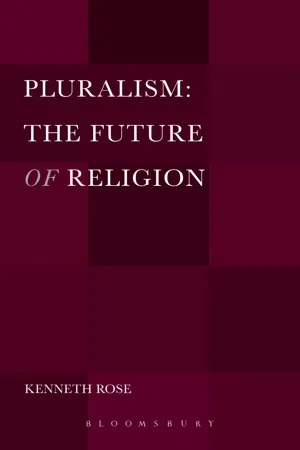
Pluralism: The Future of Religion
About this book
Theology of religions has defaulted in the last two decades to an epicyclic inclusivism which seeks to undermine pluralism with claims that it is covertly triumphalistic and that it mirrors the logic of exclusivism. With the exception of pioneers in the field such as John Hick and Paul Knitter, most major figures in this theological field have retreated from pluralism and promote versions of particularism and inclusivism. Pluralism: The Future of Religion argues for an apophatic pluralism that is motivated by the insight that it is impossible to secure universal assent for changeable bodies of religious teachings. This insight implies the non-finality and consequent 'departicularization' of all religious teachings and their inclusivistic defenses. These conclusions point us inevitably toward pluralism and lead us out of the inclusivistic impasse of contemporary theology in religions.
Information
1
Impasse in the Theology of Religions
The inclusivistic caricature of pluralism
The theology of religions, which is an emerging theological subdiscipline addressing issues raised by religious diversity, has reached an impasse.1 The currently dominant inclusivist theologies of religions, which defend the inclusive finality of specific religions, have calcified and now spin inwardly in self-justificatory spirals—or perhaps epicycles—of increasingly self-consistent but dialogically barren arguments. S. Mark Heim, a leading antipluralist theologian of religions, equates the pluralist stance of liberal Christian theologies with the exclusivist stance of conservative theologies because both supposedly claim exclusive finality for their religious views.2 Gavin D’Costa3 and Aimee Upjohn Light4 view theologies and philosophies of religious pluralism as covertly exclusivistic and triumphalistic because they promote as the one truth of all religions the claim that an essentialistic, universally applicable doctrine is the essence of all religions.5 Naïve and cognitively imperialistic, pluralists are guilty, claim these antipluralists, of the same kind of exclusivistic thinking that they reject in others.6 For example, Light characterizes the influential views of the leading pluralist, John Hick, as “a meta-position claiming to represent the world religions [that] actually contradicts them all.”7 In clever moves such as these, antipluralist theologians of religions have, for two decades now, tried to parody pluralist interpretations of the undeniable fact of religious diversity as self-contradictory and religiously imperialistic, or hegemonic, expressions of “liberal universalism.”8 Pluralist interpretations of religious diversity, conclude the antipluralists, should be dismissed as instances of the exclusivistic error that they were designed to counter, and theological inclusivisms centered upon tradition-specific beliefs should become the basis for theological reflection on the reality of religious diversity.
But this specious argument fails for two reasons: first, it relies on a strategic misreading of theories of religious pluralism as reducible either to the crypto-exclusivism (“All religions teach x and nothing else”) that is the straw-man argument of many particularistic opponents of pluralism or to the crypto-inclusivism (“All religions are true”) that defines true in generic terms, reflecting the definer’s biases. But the theory of religious pluralism that will be outlined in these pages begins from the apophatic insight that human languages are incapable of generating a final and irreplaceable body of teachings about the nature of being, which eludes the power of language to express it exhaustively and definitively (an insight that has been reinforced in many of the world’s leading mystical traditions). And given the limitations of language, the plurality of bodies of religious teachings follows as a matter of simple logic as well as a matter of historical fact.
Second, this specious, antipluralist argument can easily be turned against antipluralism itself: Since antipluralists claim that pluralism replaces the particularity of religious teachings with an essentialist doctrine toward which all religions supposedly point, antipluralists claim to know better than pluralists themselves what pluralists believe, which is a situation that, of course, no pluralist would accept. Ironically, this antipluralist claim that pluralism equals exclusivism is itself a form of exclusivism that claims to represent all forms of pluralism while actually contradicting most if not all of them. But an attempt to discredit antipluralism as exclusivism in this way is as sterile a move as the logically identical move of trying to undercut pluralism by calling it a form of exclusivism. A priori reasoning of this sort is a kind of intellectual activity at which religious apologists excel, whether in the epicycles of academic antipluralist apologetics or in the exclusivistic antipluralism of popular apologetics.
With the undermining of the claim that pluralism equals exclusivism, antipluralist inclusivism’s only defense against pluralism dissolves, and, barring a retreat into exclusivism or obscurantism, the door opens to apophatic pluralism, which sees the rise of the world’s many religious traditions and teachings as a logical outcome of the cultural and historical conditions that necessarily limit every form of religious language (appeals to revelation or to divine preservation of tradition are compromised by the fact that these kinds of claims have been made for many traditions). This plurality further implies that there can be no generally accepted, nontradition-specific method of determining which one of humanity’s religious traditions, if any, is correct at the expense of the others. Nor can any religious tradition evade the departicularizing changes brought about by converts, heretics, the churning of syncretism, the formation of new religious movements, the development of hybrid religious personalities, and the supersession or annulment of older religious forms by new religious forms. Since no historically arising form of religious practice and conviction can permanently survive these processes intact, apophatic pluralism rules out the possibility that any religious tradition or interpretation of religion can gain universal acceptance or reasonably claim universality and finality for itself. Consequently, apophatic pluralism rules out every form of theological inclusivism as implausible and obscurantistic and asserts that inclusivism cannot be the basis for responsible reflection about the world’s religious tradition.
Although inclusivism can be shown to be inadequate to the diversity of the world’s religious traditions, the inclusivist parody of pluralism has become an article of common sense among leading inclusivist theologians of religions. This rise to dominance of inclusivism as the default theology of religions for many theologians is an unanticipated and ironic outcome for the theology of religions, which seemed to be boldly moving toward pluralism from its origins over 40 years ago. A glance at the recent history of the theology of religions will show how the field has landed in an inclusivist impasse.
The Copernican revolution in the theology of religions
Early in 1972, a time when virtually no Christian theologians were pluralists9 and when the inclusivist moves of Vatican II still seemed bold and were at the edge of the conceivable, even in liberal Christian theologies, John Hick, a renowned theologian and philosopher of religion, boldly called for a revolution in theology as radical as Copernicus’s revolution in astronomy.10 Just as Copernicus had displaced the earth from the center of the universe in favor of the sun, Hick boldly removed Christianity from the center of what he called “the universe of faiths” in favor of God.11 Hick ingeniously assailed stopgap interpretations of doctrine like Karl Rahner’s notion of anonymous Christians and Hans Küng’s distinction between the Catholic Church as the extraordinary means of salvation and other religions as ordinary means of salvation as theological analogues to the Ptolemaic epicycles that extended with increasing implausibility the explanatory power of geocentrism.12 Hick pointed out that while these adaptations of doctrine are capable of limitless adaptation, they are ultimately “artificial,” “burdensome,” “antiquated,” and “improbable.”13
Although Hick’s incisive criticism of theological inclusivism will stand the test of time, given the inevitable failure of every inclusivist ad hoc and ex post facto argument that tries to keep Christianity—or any other tradition—at the center of the universe of faith, it is likely that the call was issued too early for mainstream theology, since the reaction to the Copernican revolution has overall been more negative than positive.14 And while numerous progressive, revisionist, and radical theologians heeded the call, many other theologians struggled against it, usually by attempting to turn the tables on the Copernican revolution by claiming that it is itself a form of exclusivism,15 or by claiming that it would be unacceptable to all religious thinkers except for nondualist Vedāntists,16 or by asserting that it postulates a concept of God that is empty of all content, thus opening the door to skepticism and noncognitivism.17 So forceful was the counterassault on the Copernican revolution in theology from the middle and right wings of the theological spectrum that just ten years after its declaration, one of its leading foes, Gavin D’Costa, could boast that it is “widely thought that the debate [over the validity of the Copernican revolution] is today a dead one.”18
While this may have seemed the final word about the Copernican revolution to some in 1983, the refusal to embrace pluralism in favor of renewed attempts to create inclusivist theologies of religions has led to the current impasse in the field in which inclusivist tu quoque rejections of pluralism as itself just a veiled and naïvely universalized expression of exclusivism have stalled all efforts to move beyond religious chauvinism. The only way forward for stalled inclusivist theologies of religions that want to avoid fideism or authoritarianism is to recognize the inevitability of pluralism, as Hick did, as well as the process of departicularization through which pluralism is actualized. As can be seen from the history of religions, this process of departicularization has always been at work, as for example in the startling claim of the Upaniṣads that the knower of brahman becomes the self (ātman) of the Vedic deities, thereby rendering these deities superfluous for the knower of brahman.19 Other examples of departicularization include the often ecstatic writings of the highly influential Christian mystical theologian Pseudo-Dionysius in which he calls upon a Trinity beyond being, goodness, and most daringly, beyond God (hypertheos), and in which he urges his readers to go beyond all of the seemly and unseemly images of cataphatic religion;20 scholastic Christian theologian Meister Eckhart’s distinction between the god (got) of conventional piety and the hidden depths of the godhead (gotheit), which led him to “ask God to free us from ‘God’”21; the negation of conventional religious and philosophical language in the Kena Upaniṣad and the Daodejing; and the apophatic quest for a religious depth or ground beneath the façade of conventional religious imagery in the writings of recent theologians and spiritual writers including Paul Tillich, who wrote about “the God above God,”22 Gordon Kaufman, who distinguished between “the available God” and “the real God,”23 and Thomas Merton, who cultivated a protopluralist stance of apophatic openness to an inscrutable reality beyond the machinery of institutional religion and the ordinary economy of theology and Christian redemption.24 It can also be seen in every movement that attempts to improve upon, supersede, overthrow, reinterpret, fulfill, or replace earlier forms of religion. Every cry of the reformer, heretic, or prophet, and every innovation of the theologian and religious thinker is an instance of departicularization and evidence for pluralism. And in any theological discussion of God conducted in a pluralistic setting, the apophatic pluralist insight will almost inevitably emerge, as when Harvard Indologist and scholar of religious pluralism Diana L. Eck reminds her readers that “the one we Christians call ‘God’ . . . transcends our i...
Table of contents
- Cover-Page
- Half-Title
- Title
- Copyright
- Dedication
- Contents
- Acknowledgments
- Introduction
- 1 Impasse in the Theology of Religions
- 2 The Inclusivist Counterrevolution
- 3 The Impossibility of an Inclusivist Theology of Religions
- 4 The Syncretistic Basis of the Theory of Apophatic Pluralism
- 5 Hinduism, the Upaniṣads, and Apophatic Pluralism
- 6 The New Testament and Apophatic Pluralism
- 7 The Parable of the Prisoners
- 8 Apophatic Pluralism and the Study of Religion
- Bibliography
- Index
Trusted by 375,005 students
Access to over 1.5 million titles for a fair monthly price.
Study more efficiently using our study tools.
Frequently asked questions
Yes, you can cancel anytime from the Subscription tab in your account settings on the Perlego website. Your subscription will stay active until the end of your current billing period. Learn how to cancel your subscription
No, books cannot be downloaded as external files, such as PDFs, for use outside of Perlego. However, you can download books within the Perlego app for offline reading on mobile or tablet. Learn how to download books offline
Perlego offers two plans: Essential and Complete
- Essential is ideal for learners and professionals who enjoy exploring a wide range of subjects. Access the Essential Library with 800,000+ trusted titles and best-sellers across business, personal growth, and the humanities. Includes unlimited reading time and Standard Read Aloud voice.
- Complete: Perfect for advanced learners and researchers needing full, unrestricted access. Unlock 1.5M+ books across hundreds of subjects, including academic and specialized titles. The Complete Plan also includes advanced features like Premium Read Aloud and Research Assistant.
We are an online textbook subscription service, where you can get access to an entire online library for less than the price of a single book per month. With over 1.5 million books across 990+ topics, we’ve got you covered! Learn about our mission
Look out for the read-aloud symbol on your next book to see if you can listen to it. The read-aloud tool reads text aloud for you, highlighting the text as it is being read. You can pause it, speed it up and slow it down. Learn more about Read Aloud
Yes! You can use the Perlego app on both iOS and Android devices to read anytime, anywhere — even offline. Perfect for commutes or when you’re on the go.
Please note we cannot support devices running on iOS 13 and Android 7 or earlier. Learn more about using the app
Please note we cannot support devices running on iOS 13 and Android 7 or earlier. Learn more about using the app
Yes, you can access Pluralism: The Future of Religion by Kenneth Rose in PDF and/or ePUB format, as well as other popular books in Theology & Religion & Philosophy of Religion. We have over 1.5 million books available in our catalogue for you to explore.