eBook - ePub
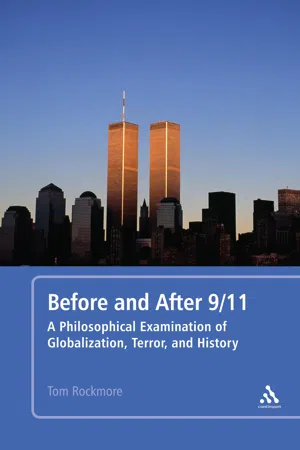
Before and After 9/11
A Philosophical Examination of Globalization, Terror, and History
- 194 pages
- English
- ePUB (mobile friendly)
- Available on iOS & Android
eBook - ePub
About this book
This clearly written and accessible work presents a philosopher's response to the series of events known as "9/11" and the global culture in the United States -and global society-that followed. It provides a comprehensive analysis of the emerging post-9/11 culture, situating it in a broad context that includes politics, religious discourse, economic theory, and philosophical orientation. Before and After 9/11 reconstructs the events that led to and departed from the attacks on September 11, 2001. It criticizes the attempts to explain 9/11 by George W. Bush, his administration's neo-conservatives, Samuel Huntington, and Bernard Lewis. It also pays particular attention to the importance of the economic dimension in the emergence of conflicts in an age of globalization. The aim is to provide a philosophical overview of 9/11, understood as a series of connected events within an ongoing historical context. This unique work will appeal to anyone seeking to understand the current world, including the ongoing wars in Iraq and Afghanistan.
Information
CHAPTER ONE
Bush’s Religious Interpretation of Terrorism
Since it occurred, 9/11 has been the object of intensive discussion from many points of view. Many suggestions have been offered.1 These analyses tend to coalesce around three main lines of interpretation, which can be identified with the names of George W. Bush, Samuel Huntington, and Bernard Lewis.
This is the first of three chapters devoted to examining these three lines of interpretation as part of the process of arriving at an analysis of this series of events. Throughout I will consider the various actors in the context of a single overriding conceptual framework, intended not to judge one participant in the conflict by the standards of another, since this is not a work in moral (or ethical) theory, but rather an endeavor to understand the main (causal) factors governing the ongoing interaction of these actors. In other words: it is not my intention to pass (moral) judgment on the actors in the interlocking series of problems that led up to, and are now leading away from, 9/11. My sole aim is to understand the process.
In what follows, I will consider in cursory fashion the view of 9/11 and terrorism that I attribute to Bush, and the views of Huntington and Lewis in more detail. In each case, I will be concerned with evaluating these approaches on their own inherent merits, hence not with respect to another, presupposed view. When I refer to Bush I have in mind not only opinions he may or may not privately hold and publicly represent, but also the convictions held by those who worked together with him in forging, amending, and defending the religiously based policies that characterized his administrations. In discussing religion, I will have in mind the series of Christian beliefs motivating his actions, as distinguished from their theological justification.2
The views of 9/11 I will be attributing to Bush, Huntington, and Lewis obviously differ. Bush, who is not an academic, always approached 9/11 as a politician. The politician is almost by definition someone who needs to act, often to act quickly in a relatively short interval, which can preclude careful consideration of what is known about a particular situation as well as alternative policy recommendations, and so on. On the contrary, Huntington and Lewis, who were academics, and who came to 9/11 from their respective fields of political science and Middle Eastern history, were more interested in arriving at a theoretical explanation of these events.
All three views overlap in a number of ways, including sharing a recognizably Western bias. There is a common tendency to assess the conflict from a dualistic, Western perspective based on prior adoption of Western standards, as well as a further tendency to reject even the semblance of adopting Islamic standards of evaluation. This bias results in three limitations, rendering them unsuitable for an overall interpretation of the ongoing events. First, this bias creates a spurious link between the problem of understanding the ongoing struggle between Islam and the West by tending to evaluate it in familiar Western moral terms. Yet, since neither the non-Muslim West nor the Muslim world has a monopoly on morality, the impression that moral right is uniquely situated on one side but absent on the other is misleading. Second, since a moral judgment cannot be formulated before the problem has been successfully characterized, it is premature to render a moral judgment prior to identifying the problem. Third, identification of any kind with one of the parties to the conflict prevents the formulation of a general theory encompassing all the parties within the wider framework of a single analysis.
Terrorism and 9/11
Since 9/11 involved a series of terrorist acts, it will be useful to clarify the meaning of “terrorism.” There is profound ambiguity about “terrorism.” It is well said that one person’s terrorist is another person’s freedom fighter. Terrorism takes many different forms, running from assassination—widely practiced by many, perhaps all the major industrialized countries as well as many third and fourth world nations—to instilling a sense of deep, paralyzing fear, or terror.
Western definitions tend to associate terrorism with physical force, especially assassination. Terrorism consists in the use of violence and intimidation in the pursuit of political aims. “Terrorism,” from the word “terror,” seems to have originated in the aptly named period of terror (la terreur, 1793–94) during the French Revolution. The term refers to a series of measures taken during the emergency situation, or state of exception, decreed by the revolutionary government from the time of the fall of the Girondins to the fall of Robespierre.
Terrorism is notoriously difficult to define. Virginia Held offers two somewhat different definitions of “terrorism” as “political violence that usually spreads fear beyond those attacked” and “perhaps more than anything else . . . resembles small-scale war”3; and as political violence employed with “the intention either to spread fear or to harm non-combatants.”4 Both definitions appear to run war and terrorism together in implying that an act of war, proper, which is aimed at a legitimate military target, counts as terrorism. For, as Trotsky points out in his defense of the “red terror,” “war . . . is founded upon intimidation. . . [It] destroys only an insignificant part of the conquered army, intimidating the remainder and breaking their will.”5
Understood as physical violence, terrorism has a long history, going back to ancient times.6 A well known early instance is the Athenian intimidation, and finally mass murder, of the Melians during the Peloponnesian Wars. Much later, terrorism became firmly associated with assassination. The term “assassin” apparently derives from the Hashshashin, also known as the Hashishin, or Hashashiyyin, a group of Ismali Muslims from the Nizari subsect, whose members are believed to have been active in the eighth to the fourteenth centuries, and who specialized in assassinating members of the Abbasid elite.
Terrorism is a constant of modern life. Such incidents include the St. Bartholomew’s Day massacre of thousands of French Protestants in 1572, atrocities committed by Spanish troops in the Netherlands, and, in perhaps the single most notorious incident, the Gunpowder Plot in which Guy Fawkes, who thought that Catholicism was being persecuted in England, attempted to blow up Parliament on November 5, 1605.
Terrorism has long been a part of Russian life. Russian nihilists attempted to assassinate Tsar Alexander II in 1866. Stalin infamously orchestrated a reign of terror in Russia, including show trials, mass starvation, a series of prisons and concentration camps based on forced labor chronicled by Solzhenitsyn, and so on. The most recent instance of Russian terrorism is the ongoing war against the Tchechens in Tchechnya, which has resulted in thousands of deaths.
Terrorism plays an important role in American history. The Ku Klux Klan arose after the Civil War to counter Reconstruction by enforcing white supremacy. Until relatively recently, it was a significant source of terrorism directed by whites against black people. In 1868, there were some 336 cases of murder or attempted murder of blacks by the KKK in Georgia alone. In 1886, during a strike at the McCormick Reaper plant in Chicago, a bomb exploded during the so-called Haymarket Riots, killing six policemen and wounding some 60 others. Eight people were indicted and four were later hanged for this incident. In 1892, during the Homestead Strike at the Carnegie plant in Homestead, Pennsylvania, near Pittsburgh, the managing director of the plant, Henry Clay Frick, brought in the Pinkertons. In the resulting battle, 12 people—three detectives and nine workers—lost their lives.
Terrorism has long been a part of American presidential politics. Roughly every tenth president in American history has been assassinated. President Abraham Lincoln was shot and killed in 1865 by John Wilkes Booth, in turn later shot during his escape. President James Garfield was assassinated in 1881 by Charles Guiteau. In 1901, President William McKinley was killed by Leon Czolgosz, later electrocuted for his crime. President John F. Kennedy was assassinated in 1963 by Lee Harvey Oswald, subsequently killed by Jack Ruby, a nightclub owner, a shooting seen on live television.
The infamous Japanese attack on Pearl Harbor in 1941, perhaps the only single event to occur in the United States comparable to 9/11 in terms of loss of life, is too well known to require description here. Yet unlike 9/11, since the attack on Pearl Harbor did not take place in the continental US, its effect was perhaps felt less acutely. In 1954, four Puerto Rican nationalists opened fire from the Ladies’ Gallery in the US House of Representatives, wounding five representatives. Recent incidents cited as contributing to the present American focus on terrorism include the World Trade Center bombing in 1993, the 1998 US embassy bombings, suicide bombings in Israel, and the Lockerbie, Scotland, bombing in 1998. Major international terrorist incidents after 9/11 include the Bali nightclub bombing, the Madrid train bombing, and the London underground bombings.
Some observers take terrorism, understood as physical violence or intimidation in the pursuit of political aims, to be new, even the salient fact of our times. It is sometimes asserted that the supposed pervasiveness of terrorism justifies emergency measures, even something like a permanent state of emergency that has increasingly become the norm in the United States.7 Terrorism is not new in the US. What is new is the palpable uncertainty raised about the ability of the world’s only remaining superpower to defend itself. In the general political euphoria following the collapse and breakup of the Soviet Union in the 1980s, many incorrectly believed the US would henceforth be able to dictate its policies, wishes, and desires to the rest of the world. An attack on some of its most visible symbols has shown that, despite its unprecedented economic and military strength, the US, like other modern industrialized countries, is probably unable despite the midst stringent measures devised by the Department of Homeland Security as well as other government agencies to protect itself against the permanent possibility of terrorism.
Bush’s Political Approach to 9/11
We can be relatively brief in discussing the views of George W. Bush as illustrated during his two administrations. As the political leader of the US, in his role as president of the United States (often regarded as the most powerful person in the world), and as supposedly the main architect of an ongoing series of responses to the initial attacks, Bush played a major role in determining US foreign policy in this period of crisis. One can acknowledge the obvious influence of his views on the world stage, while denying that those views need to be taken seriously as an interpretation of the causes of 9/11.
Bush’s approach to 9/11 is political (and religious) but not intellectual in even an extended, attenuated sense of the term. As President of the United States, Bush’s job was not to formulate intellectual theories, but to exert political guidance for the country as a whole, specifically in rallying American citizens after a large-scale attack on important symbols of the nation and in organizing the reaction against terrorism. In the immediate wake of 9/11, he was responsible for taking a long series of defensive measures against terrorism, such as creating the Office of Homeland Security, improving security for air travel in the US, and for rallying North Atlantic Treaty Organization (NATO) members, as well as other countries, to the defense of American interests.
Yet he was also responsible, at least in principle, for articulating an American analysis, thus for guiding the American response to 9/11. Capable intellectuals have sometimes occupied high office in the US—Woodrow Wilson was an important historian and political scientist before becoming president—but Bush was not one of them. His views are conceptually undeveloped, on examination even incoherent— as could be anticipated, since he is a politician, neither an academic nor a scholar. This is not necessarily a defect, at least not for someone in his line of work, since his aim was not to convince the American public through reasoned argument, which is not relevant to the office of the president of the US, but, whenever possible, convince them through political rhetoric. Yet, it can be a defect if he (or perhaps more precisely those around him, since his own precise role in formulating policies he represents is not known) is intellectually incapable of articulating a credible American vision of these events or at least of identifying and espousing such a vision created by someone in his administration.
Presidents are neither foreign policy analysts, political theorists, nor philosophers. They are obviously often under considerable pressure (especially in cases of grave national emergency like 9/11) to react as quickly as possible to events as they occur. Though they have an array of advisors, they themselves have little time to work out anything so grand as general principles of political action. Under the pressure of events, politicians tend to adhere to slogans, to make vague and contradictory statements providing their reaction to ongoing events, perhaps to fall back on campaign statements, to continue to curry favor with the electorate—for instance in claiming that the other party is “soft” on defense—and whenever necessary to deflect rather than answer embarrassing questions.
Bush never showed deep knowledge of, or curiosity about, the world outside the United States, about which he knew little when he became president. He never formally worked out a theory of political beliefs. This was hardly surprising, since nothing in Bush’s background indicated his capacity to do so, not even interest in such an exercise. Yet, since actions are motivated by intentions, his core beliefs can be inferred from his actions.
It will be useful to distinguish between the public actions, including typical statements about Muslim terrorists, and the beliefs we can suppose are behind those statements. Like other politicians, Bush’s references to Muslim terrorists, which routinely accused them of perpetrating a heinous attack on the US on 9...
Table of contents
- Cover
- Halftitle
- Chapter One Bush’s Religious Interpretation of Terrorism
- Chapter Two Huntington’s Political–Scientific Analysis of the Clash of Civilizations (or Cultures)
- Chapter Three Lewis’s Historical Account of Religious Difference
- Chapter Four Models of Historical Knowledge
- Chapter Five Economics, Globalization, and History
- Chapter Six Globalization and Terrorism: Modernity or Jihad?
- Chapter Seven Economic Globalization and Empire
- Index
Trusted by 375,005 students
Access to over 1.5 million titles for a fair monthly price.
Study more efficiently using our study tools.
Frequently asked questions
Yes, you can cancel anytime from the Subscription tab in your account settings on the Perlego website. Your subscription will stay active until the end of your current billing period. Learn how to cancel your subscription
No, books cannot be downloaded as external files, such as PDFs, for use outside of Perlego. However, you can download books within the Perlego app for offline reading on mobile or tablet. Learn how to download books offline
Perlego offers two plans: Essential and Complete
- Essential is ideal for learners and professionals who enjoy exploring a wide range of subjects. Access the Essential Library with 800,000+ trusted titles and best-sellers across business, personal growth, and the humanities. Includes unlimited reading time and Standard Read Aloud voice.
- Complete: Perfect for advanced learners and researchers needing full, unrestricted access. Unlock 1.5M+ books across hundreds of subjects, including academic and specialized titles. The Complete Plan also includes advanced features like Premium Read Aloud and Research Assistant.
We are an online textbook subscription service, where you can get access to an entire online library for less than the price of a single book per month. With over 1.5 million books across 990+ topics, we’ve got you covered! Learn about our mission
Look out for the read-aloud symbol on your next book to see if you can listen to it. The read-aloud tool reads text aloud for you, highlighting the text as it is being read. You can pause it, speed it up and slow it down. Learn more about Read Aloud
Yes! You can use the Perlego app on both iOS and Android devices to read anytime, anywhere — even offline. Perfect for commutes or when you’re on the go.
Please note we cannot support devices running on iOS 13 and Android 7 or earlier. Learn more about using the app
Please note we cannot support devices running on iOS 13 and Android 7 or earlier. Learn more about using the app
Yes, you can access Before and After 9/11 by Tom Rockmore in PDF and/or ePUB format, as well as other popular books in Philosophy & Political Philosophy. We have over 1.5 million books available in our catalogue for you to explore.