States define who their citizens are and exert control over their life and movements. But how does such power persist in a global world where people, ideas, and products constantly cross the borders of what the states see as their sovereign territory?
This groundbreaking work sets to examine and interprets such challenges to offer a new way of thinking about citizenship. Abandoning the sovereignty principle, it develops a new image of citizenship using the connectedness principle. To do so, it interprets acts of citizenship by following "activist citizens" across the world through case studies, from Wikileaks and the Gaza flotilla to China's virtual world and Darfur.
Written by a leader in the field, this accessible and original work imagines citizens without frontiers as a politics without community and belonging, inclusion without exclusion, where the frontier becomes a form of otherness that citizens erase or create. This unique work brings forth a new and creative way to approach citizenship beyond boundaries that will appeal to anyone studying citizenship, social movements, and migration.
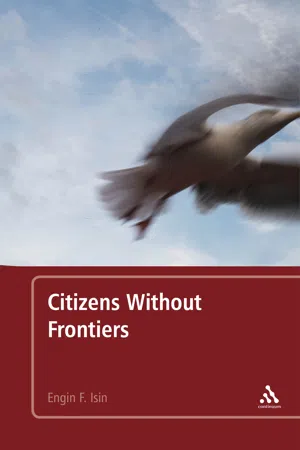
- 240 pages
- English
- ePUB (mobile friendly)
- Available on iOS & Android
eBook - ePub
Citizens Without Frontiers
About this book
Information
CHAPTER ONE
Of those whose acts traverse frontiers
Of all those movements with the name ‘without frontiers’ we have witnessed since the 1970s, Médecins Sans Frontières (MSF) is perhaps the most recognizable. What does that name signify? It is translated from French as ‘doctors without borders’. But the French word ‘frontières’ does not mean simply borders or at least, if it does, only marginally so. Rather, it also indicates front lines, extremities or edges of something. Used figuratively, it implies limits (e.g. frontiers of science) and, by extension, it is used to indicate the unknown (e.g. the final frontier). Used literally, it indicates the outer borders of a settlement or, more importantly, defending or protecting them. So translating ‘frontières’ as ‘borders’ loses its nuance and translating ‘sans frontières’ as ‘without borders’ loses its performative force. As regards MSF what limits are we talking about then? Is it simply that its practitioners – in this case doctors – declare their loyalty beyond the frontiers of the jurisdiction that accredited and licensed them? MSF was founded in 1971 in Paris as an international aid group and evolved into an organization whose mission ranged ‘from emergency medical assistance and healthcare training to humanitarian assistance’.1 It is run by medical professionals but can also be joined by professionals in other fields. That sounds very much like a standard international non-profit organization.2 So why is the name ‘without frontiers’ used then? At first glance, the limits that these professionals declare themselves ‘without’ appear to be those laws and norms that govern their profession. Today, every profession, unlike the thirteenth- and fourteenth-century guilds, is governed by rules that are typically made or enforced by the authority of the state. The modern medical profession recognizes that authority. Does it mean that doctors are against the state and want to operate regardless of its authority?3 Does it mean that doctors want to belong to another authority that is beyond the state?
What does ‘without frontiers’ signify?
Although there may be practitioners who harbour such ideals, MSF, to my knowledge, never rejected the authority of the state as such – at least not at the outset.4 Moreover, the limits that MSF declares itself ‘without’ are more than an aspiration to practise medicine without rules especially not those made by the state. Clearly, we need to look deeper into the logics of the movement to make sense of that name ‘without frontiers’. These logics become apparent in its practices and ethos of not only serving patients, the ill, the victims, and the wounded, but also in creating autonomy and authority to function beyond the limits of the state. How does MSF define those limits? It turns out that those are both the political and practical limits of the state as such. I would like to propose that MSF is, above all, a movement ‘traversing frontiers’. I will certainly elaborate on this phrase but it indicates that rather than merely interrogating the rules that govern the medical profession, it actually extends its reach beyond limits that are imposed on its practitioners by the state.
This traversing is significant. Perhaps implicit in it is the fact that national, corporate and religious powers are not only the causes of wars, deprivation, oppression, violence and other forms of domination but they also actively block assistance to those who are adversely affected by such violence. The declaration ‘without’ acknowledges that doctors must act against frontiers, reaching beyond the limits imposed on them by states, corporations and religious authorities. Also implicit in its traversing is the recognition and revelation that there are vast inequalities in the world that divide those who have access to proper care and those who do not. Thus, for those who have the privileges and accreditation, traversal becomes an obligation as the foundation of their autonomy.
To avoid misunderstanding, the suggestion here is not to overlook how, over the last 40 years, MSF has changed and grown more complex, especially with its development in several other countries.5 I will come back to this. But I want to isolate the logics of this movement in order to understand the broader appeal of the name ‘without frontiers’. As I mentioned, over the last 40 years, we have seen academics, accountants, architects, engineers, lawyers, reporters, teachers and other professionals organizing or identifying themselves with that name.6 That is why we have perhaps become accustomed to the name ‘without frontiers’. Taken together, ‘without frontiers’ signifies a number of crucial issues. These movements are radically different from business, professional and diplomatic travellers. First, travelling business people, professionals and diplomats are protected in the practice of their profession. Particularly in the last 20 years under the banner ‘globalization’, the movements of such people have become much easier, smoother and more straightforward. For them, travel and work are increasingly asserted, claimed and obtained as of right. Second, corporations, organizations and governments remunerate professional services and they engage in exchange and transactions. By contrast, movements without frontiers are neither commercial nor protected. In fact, state, corporate and religious authorities often do not endorse or support their movements and attempt to inhibit their activities. It is in this sense that I think the founding aspect of these movements is traversing frontiers.
It is about time I explain that phrase ‘traversing frontiers’. There are four distinct but related senses of the word ‘traverse’.7 It first refers to the act to ‘traverse’ in a physical sense. The actions involve passing through a gate, or crossing a river, bridge or other place forming a boundary. The actions of ‘traverse’ also involve passing over, or going through (a region, etc.) as well as passage or crossing from side to side and from end to end, or in any course. In this first sense, its usage closely resembles to that of ‘across’. However, its second meaning involves non-physical acts such as opposition or thwarting: something that crosses, thwarts or obstructs; or something that can form opposition, an obstacle or an impediment; things that constitute a trouble, vexation, a mishap, misfortune, adversity can all be called traverses. In fact, in law, it can mean denying an alleged misdeed by the other side. These two meanings (physical and non-physical) coming together and indicating not simply a crossing but with obstruction (or obstructed) or thwarting (or thwarted) is one reason why I want to use traversing frontiers rather than crossing to capture these frictions. Moreover, in its third sense, ‘traverse’ denotes the way across, path, track or course. So traverse is not only action but also that which it produces: a path, track or trace. In this sense, it denotes the remains and traces of acts of traversing frontiers as courses and paths that we can recognize, and follow. Finally, and in a concrete sense, ‘traverse’ denotes something that is placed or extends across, a kind of bridge or connection. With these two added senses, ‘traverse’ not only denotes acts of crossing against but also leaving remains or traces and building bridges. Clearly, taken together, these four senses signify ‘without frontiers’ much more strongly than merely crossing, across or even without or beyond frontiers.
To understand all these movements ‘without frontiers’ is a difficult task. At the outset, it would be wrong to give only a positive image of academics, accountants, architects, engineers, lawyers, reporters and teachers claiming to act without frontiers. These movements raise various troubling questions about the dominant humanitarian or human rights politics. To mark its fortieth anniversary, for example, MSF itself recently discussed the difficult compromises that it makes to negotiate its activities.8 Marie Noelle Rodrigue, operations director of MSF in Paris, accepted ‘. . . the price it is necessary for an organization to pay so that you are helping the victims’ and recognized that ‘often that means making a compromise to a degree where you are helping the authorities’.9 Clearly, although such movements, or at least some of them, have been increasingly subsumed under human rights politics, it is important to recognize that movements ‘without frontiers’ cannot be seen only as human rights politics or as transnational (or global) activism that is mobilized through human rights. Admittedly, they are implicated in human rights regimes and their compromises, but they also operate with quite distinct principles, and we ought not to see these movements as identical or equivalent to what has come to be known as ‘global activism’ or ‘international volunteerism’.10 To be sure, movements without frontiers share a non-commercial and non-profit ethos with activism and volunteerism. They can even be considered as a species of global activism and perhaps share some elements with international volunteerism. Yet, these movements indicate a new kind of politics for which we do not yet have a name; or perhaps we have not yet taken seriously the name they have given themselves.
Professions, citizens, activists
Going back to MSF – its ethos, concerns and limits or, more precisely, its logics – it is well worth critical consideration.11 The claims that the movement does not differentiate creed, religion, politics or race when providing medical assistance, that it exercises ‘universal medical ethics’ and that it maintains independence from established political, economic or religious authorities all indicate an aspect of traversing frontiers. MSF clearly distinguishes between those norms that it accepts as given and those that it establishes without limits. In fact, our professional lives may well consist in managing the tension or even conflict between direct, intentional, regulated and recognizable duties and indirect, unintentional, open, indeterminate and yet affective obligations that implicate our lives in the lives of others. MSF’s ethos illustrates this tension or conflict. When MSF was awarded the Nobel Peace Prize in 1999, James Orbinski, its then director, stated this in his acceptance speech quite well. He named this tension or conflict as the most important thing that mobilized the movement. He said ‘. . . we push the political to assume its inescapable responsibility’.12 He added ‘humanitarianism is not a tool to end war or to create peace. It is a citizen’s response to political failure. It is an immediate, short term act that cannot erase the long term necessity of political responsibility.’13 The use of ‘citizen’ is ambiguous here. Why is it used when a professional ethos is being discussed? What is implicit in this push for the political to assume its responsibility is that rules and regulations that order our professional lives do not necessarily exhaust our responsibilities towards ourselves and others. We are answerable beyond the direct responsibilities that govern our lives so that we can modify them. It establishes a capacity to act with certain autonomy. We, of course, learn, endorse and uphold laws and norms under which we live and responsibilities that we must fulfil. We also engage ourselves with others and question our relationships and the effects of our actions or inactions on others. This engagement often implicates us in tension or conflict with laws and norms that we uphold. That much is clear. What is ambiguous is whether citizens have the same capacity as professionals to make these claims.
It is this tension (and conflict) that perhaps explains the proliferation of movements called ‘without frontiers’ since the 1970s. Acting as responsible professionals within the confines of the state that define those responsibilities can no longer answer our obligations to others elsewhere; nor can it answer the consequences of the actions or inactions of our governments in our name. These movements, despite their differences, operate with similar logics of answerability: that their obligations are principled, that such obligations extend beyond or across frontiers and that these obligations are not expressly authorized by established nationa...
Table of contents
- Cover
- Half-Title
- 1 Of those whose acts traverse frontiers
- 2 ‘We, the people’
- 3 ‘We, the connected’
- 4 Enacting citizenship
- 5 Citizens without frontiers
- 6 Emancipating (acts of) citizenship
- Bibliography
- Index
Trusted by 375,005 students
Access to over 1.5 million titles for a fair monthly price.
Study more efficiently using our study tools.
Frequently asked questions
Yes, you can cancel anytime from the Subscription tab in your account settings on the Perlego website. Your subscription will stay active until the end of your current billing period. Learn how to cancel your subscription
No, books cannot be downloaded as external files, such as PDFs, for use outside of Perlego. However, you can download books within the Perlego app for offline reading on mobile or tablet. Learn how to download books offline
Perlego offers two plans: Essential and Complete
- Essential is ideal for learners and professionals who enjoy exploring a wide range of subjects. Access the Essential Library with 800,000+ trusted titles and best-sellers across business, personal growth, and the humanities. Includes unlimited reading time and Standard Read Aloud voice.
- Complete: Perfect for advanced learners and researchers needing full, unrestricted access. Unlock 1.5M+ books across hundreds of subjects, including academic and specialized titles. The Complete Plan also includes advanced features like Premium Read Aloud and Research Assistant.
We are an online textbook subscription service, where you can get access to an entire online library for less than the price of a single book per month. With over 1.5 million books across 990+ topics, we’ve got you covered! Learn about our mission
Look out for the read-aloud symbol on your next book to see if you can listen to it. The read-aloud tool reads text aloud for you, highlighting the text as it is being read. You can pause it, speed it up and slow it down. Learn more about Read Aloud
Yes! You can use the Perlego app on both iOS and Android devices to read anytime, anywhere — even offline. Perfect for commutes or when you’re on the go.
Please note we cannot support devices running on iOS 13 and Android 7 or earlier. Learn more about using the app
Please note we cannot support devices running on iOS 13 and Android 7 or earlier. Learn more about using the app
Yes, you can access Citizens Without Frontiers by Engin F. Isin in PDF and/or ePUB format, as well as other popular books in Politics & International Relations & Civics & Citizenship. We have over 1.5 million books available in our catalogue for you to explore.