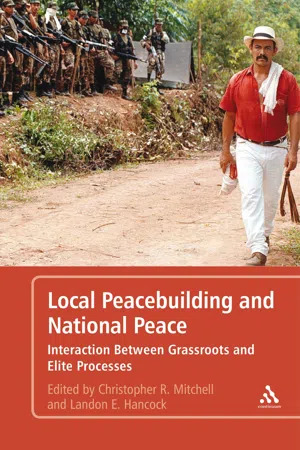
Local Peacebuilding and National Peace is a collection of essays that examines the effects of local peacebuilding efforts on national peace initiatives.
The book looks at violent and protracted struggles in which local people have sought to make their own peace with local combatants in a variety of ways, and how such initiatives have affected and have been affected by national level strategies.
Chapters on theories of local and national peacemaking are combined with chapters on recent efforts to carry out such processes in warn torn societies such as Africa, Asia, and South America, with essays contributed by experts who were actually actively involved in the peacemaking process.
With its unique focus on the interaction of peacemaking at local and national levels, the book will fill a gap in the literature. It will be of interest to students and researchers in such fields as peace studies, conflict resolution, international relations, postwar recovery and development.
eBook - ePub
Local Peacebuilding and National Peace
Interaction Between Grassroots and Elite Processes
- 200 pages
- English
- ePUB (mobile friendly)
- Available on iOS & Android
eBook - ePub
Local Peacebuilding and National Peace
Interaction Between Grassroots and Elite Processes
About this book
Information
1
Introduction: Linking national-level peacemaking with grassroots peacebuilding
Christopher Mitchell
The search for peace, a multi-level undertaking
Recent decades have seen a great deal of scholarly and practical interest in the development of local, grassroots peacebuilding before, during and in the aftermath of violent civil strife—an interest which matched the longstanding focus on negotiations to end such conflicts undertaken at the national level. However, much less attention has been paid to the question of how these two levels of effort to bring peace—or at least an end to violence—might affect one another. It often seems to be assumed that two obviously “good” processes must complement one another and make a durable peace much more likely. Indeed, much thinking about local peace efforts in the 1980s and 1990s often seemed to assume that the establishment of local zones of peace or peace communities, of small humanitarian zones, of regional zones of tranquility and of informal, triadic negotiations between local leaders, insurgents and government security forces would help to start, re-start or accelerate peacemaking at the national level, perhaps through encouraging a general “culture of peace.” One clear example of this hope was expressed in the preamble to a bill introduced into the Philippines House of Representatives in 2000 (The Peace Zones Policy Act) which stated that peace zones were primarily to protect civilians but “also to contribute to the more comprehensive peace process.” One common metaphor was of some kind of expanding “leopard spot” process, whereby “patches of peace” gradually spread themselves throughout society, crowding out violence and those wishing to continue using it.1
Subsequent events and analysis seem to have shown that the relationship between local and national peace processes is more complicated than was first assumed. Practically speaking, experience has shown that, in some strife prone societies, local efforts to encourage national peace or to establish peace locally, have been encouraged and supported by national authorities and by insurgent leaders. In other cases, they have been regarded by these elites and authorities as interfering with “serious” national efforts to bring about peace (whether through coercion or negotiation) and, in some cases, as another form of challenge to the authority of government or aspiring governments. In some countries, local peacebuilders have been included in national-level negotiations between incumbents and insurgents, yet in others they have been deliberately excluded from having any voice at all in efforts to end a conflict through talks—and even from the “talks about talks” stage. The record of the range of possible relationships between local and national-level processes is a mixed one and it is difficult to come up with any patterns or even repetitions amid the welter of different details from case to case.
Academics and activists actually involved in local peacebuilding processes have themselves attempted to analyze those processes that they have been involved in and have thrown some light on what effects these have had, locally and nationally, and what obstacles they have had to overcome. In the Philippines, for example, which is the country which has possibly seen the most active involvement of civil society in both local peacebuilding and national peacemaking efforts, many have made a distinction between “horizontal” and “vertical” peacebuilding. Talking about the recent peace process in Mindanao, Father Roberto Layson, the Co-chairman of the MPC (the Mindanao Peoples Caucus), a regional NGO in Mindanao,2 who had been intimately involved in the establishment of the pioneering “space for peace” in the village of Nalapaan,3 persuasively argued that there were two levels or “arenas” where peace processes take place—the vertical and the horizontal. “The vertical aspect is the formal Peace Talks or negotiations between the GRP (Government of the Republic of the Philippines) and the MILF (Moro Islamic Liberation Front) and the horizontal is the peace process within and among communities at the grassroots level ...” (Layson 2003, 1).
Fr. Layson went on to comment that, while national-level peace agreements may create a conducive space, “they are not a guarantee that there will be instant peace in our communities.” Therefore a lot of work would still need to be done “in the grassroots level” (Layson 2003, 1).
Given this as a starting point, it is not surprising that some attention has been focused on efforts (1) to undertake activities that create or extend non-violent relationships at the local level between mistrustful constituencies; and (2) to influence warring elites, incumbent and insurgent, at the national level to engage seriously in efforts to mitigate the effects of violence, to undertake confidence-building measures and to conduct meaningful negotiations to resolve the conflict. Again, taking the Philippines and the conflict on Mindanao as an example, local initiatives there have involved developing institutions that involve membership from all three communities (Moro, Catholic and Lumad) on the island;4 holding dialogues and seminars on differing histories and different cultures on Mindanao; training peace workers, for example at annual meetings of the Mindanao Peace-building Institute; providing relief and refuge for IDPs; providing micro-credit facilities; analyzing the effects of partisan journalism on the conflict; establishing trilateral “spaces for peace,” “sanctuaries for peace” or—via UNDP—“peace and development communities;” and lobbying for and the involvement of civil society organizations in official peace processes at the national level.5
As always, it is hard to trace through the precise impact of all these locally based initiatives to build cross-community bridges, create a “culture of peace,” diminish local violence or lessen mistrust and hostility among local communities, particularly those who have felt the impact of local combat—although it seems clear that pressure from civil society groups on Mindanao at least contributed to President Arroyo’s decision to put together an all Mindanaon peace panel to face the MILF peace negotiators. Similar lobbying led to Lumad representatives being included in the government’s negotiating team. However, the point is that Philippine experience seems to bear out the widely held contention that there are many positive ways in which the two dimensions—or peacebuilding arenas—can be linked, as illustrated in Figure 1.1 below:
However, this approach to the links between arenas of the peace process, and the horizontal–vertical model of peacebuilding it implies, often seems to leave out of consideration one other relationship that is important—perhaps because that relationship seems so obvious as to require little direct comment. This is the undoubted influence on local peacebuilding processes exercised by relationships at the national level between incumbents and insurgents. It seems banal to point out that it will make a huge difference to the effectiveness of local peace efforts whether the incumbents and insurgents are locked in intense conflict—the “all-out war” waged by President Estrada’s Philippine government between 2000 and 2001—or are actively involved in the search for a negotiated peace under a continuing ceasefire—such as the “all out peace” campaign waged briefly by Estrada’s successor, President Arroyo, from 2001 to breakdown in 2003. Again, what might be the “vertical” effects on local peacebuilding processes of a complete breakdown of elite-level negotiations on which many hopes had been built, such as occurred in February 2002 when—following the hijacking of a Colombian airliner by the FARC—a frustrated President Pastrana abruptly ended the faltering negotiating process with the guerrillas and resumed full scale military operations? Even peacemaking “success” at the national level is no guarantee that peace arrangements will work at local levels, particularly if elite-level negotiations have been held separately and at a distance from non-involved local people. The failure of the “Special Zone for Peace and Development” (SZOPAD) established on Mindanao by President Ramos’ own directive as part of the 1996 settlement with the MNLF was largely because local support was taken for granted but proved largely absent in the months that followed. The governing “Southern Philippines Council for Peace and Development” set up to lead development in the 14 provinces of SZOPAD turned out to have no resources, no police powers and no real voice at the national level. Just as importantly, it proved also increasingly lacking in local credibility as time went on. As many observers of this and other peace processes have argued (see in this respect the chapter on Northern Ireland by Landon Hancock in this volume) there is always a need for careful coordination of efforts at both elite and grassroots social levels, as both levels interact in complex ways, as illustrated in Figure 1.2:

Figure 1.1 Dimensions of Peacebuilding.
The point to be made here is that acknowledging the existence of such a relationship between arenas adds still further to the task of disentangling the complexities of possible inter-actions between national peacemaking and local peacebuilding. Developing some usable analytical framework - even to start the task - appears a monumental challenge.
The influence of differing political environments

Figure 1.2 Expanded Dimensions of Peacebuliding.
One likely starting point for explaining the huge variation in inter-actions between national peacemakers and local peacebuilders might well be sought in the “stage” of the conflict in which both sets of protagonists find themselves operating.6 If local intermediaries are attempting to negotiate local-level agreements about, for example, non-violent zones, prisoner release, times of local truce, the de-mining of a locality or the inviolability of a particular development project, it will surely make a major difference to them and their combatant contacts if the incumbents and insurgents are killing each other in (relatively) large numbers, are in the midst of a fragile ceasefire or are engaged in promising talks about a final end to coercion and violence.
Hancock and Iyer (2007, 29–31) have proposed a useful typology of stages in a protracted, intra-state conflict in which local peacebuilding initiatives (in this case local zones of peace) might well take place. The framework makes a distinction between initiatives which take place (1) while violent combat continues; (2) during a peace process—that is, while negotiations are taking place or, an agreement having been reached, while strategies to implement the terms of the agreement are being put in place; and (3) in the long term, during the post-conflict period. This is a useful framework, and what follows in Table 1.1 is partly based in the Hancock–Iyer distinction between the stages of all-out combat with no negotiations in sight and (2) the existence of some kind of elite-level peace process—although it does seem useful to divide this second stage into two sub-processes; during actual negotiations and during the implementation of any agreement that might be reached.7
However, the changing circumstances brought about by the relationship between incumbents and insurgents represent only one set of factors likely to affect the relationship between local peacebuilding and national peacemaking. Others can include the nature of the local peacebuilding activities themselves and the differing reactions—levels of approval and disapproval—that might well be exhibited by the adversaries, incumbent and insurgent. Compare, for example the widely different attitudes of the two sides to any local peace promoting efforts that involve making it far, far easier for local youngsters to abandon life with insurgents or paramilitary groups and to return home in order to resume some kind of civilian life.8 Again, the same government side might display very different reactions to localized declaration of neutrality from communities in strategically important communications centers compared with those from remote and isolated communities on the geographical periphery on a widespread struggle.
Table 1.1 National and local strategies
| National-Level strategies | ||||
| Violence | Negotiating | Implementing | ||
| Local-level strategies | Violence | Civil war | ? | Civil unrest |
| Peacebuilding | ? | Multi-level peace process | Reconstruction & reconciliation | |
There is a great deal of research currently needed into the different ways in which combatant strategies affect the circumstances in which local initiatives take place, and how changes in those strategies can either make it easier or harder to continue to pursue those strategies. Then again, local communities are not simply reactors to national policies nor—as has been implied thus far—are they always pacific groups constantly seeking an end to violence in which they are caught up. There are enough examples of local people being encouraged to take up arms—initially, at least, in “self-defense”—and through the formation of such organizations as the Tadtad in the Philippines or the Civilian Defense Patrols in Guatemala, widening the scope of the violence.9
Furthermore, one has to take account of the large number of situations of protracted conflicts where a conflict system involves multiple, interlocking conflicts taking place at different levels, and where peacemaking at a national level is by no means a guarantee that peace will break out locally. Indeed, it may be that peace made at the nati...
Table of contents
- Cover-Page
- Half-Title
- Title
- Copyright
- Dedication
- Contents
- Contributors
- Preface
- 1 Introduction: Linking nationallevel peacemaking with grassroots peacebuilding
- 2 A ZoPs approach to conflict prevention
- 3 Against the stream: Colombian zones of peace under democratic security
- 4 Colombia: From grassroots to elites – how some local peacebuilding initiatives became national in spite of themselves
- 5 South Africas infrastructure for peace
- 6 Belfast’s interfaces, zones of conflict or zones of peace
- 7 Zones of peace in the South Caucasus: Polyphonic approaches to state-building
- 8 Between local and national peace: Complementarity or conflict?
- Index
Trusted by 375,005 students
Access to over 1.5 million titles for a fair monthly price.
Study more efficiently using our study tools.
Frequently asked questions
Yes, you can cancel anytime from the Subscription tab in your account settings on the Perlego website. Your subscription will stay active until the end of your current billing period. Learn how to cancel your subscription
No, books cannot be downloaded as external files, such as PDFs, for use outside of Perlego. However, you can download books within the Perlego app for offline reading on mobile or tablet. Learn how to download books offline
Perlego offers two plans: Essential and Complete
- Essential is ideal for learners and professionals who enjoy exploring a wide range of subjects. Access the Essential Library with 800,000+ trusted titles and best-sellers across business, personal growth, and the humanities. Includes unlimited reading time and Standard Read Aloud voice.
- Complete: Perfect for advanced learners and researchers needing full, unrestricted access. Unlock 1.5M+ books across hundreds of subjects, including academic and specialized titles. The Complete Plan also includes advanced features like Premium Read Aloud and Research Assistant.
We are an online textbook subscription service, where you can get access to an entire online library for less than the price of a single book per month. With over 1.5 million books across 990+ topics, we’ve got you covered! Learn about our mission
Look out for the read-aloud symbol on your next book to see if you can listen to it. The read-aloud tool reads text aloud for you, highlighting the text as it is being read. You can pause it, speed it up and slow it down. Learn more about Read Aloud
Yes! You can use the Perlego app on both iOS and Android devices to read anytime, anywhere — even offline. Perfect for commutes or when you’re on the go.
Please note we cannot support devices running on iOS 13 and Android 7 or earlier. Learn more about using the app
Please note we cannot support devices running on iOS 13 and Android 7 or earlier. Learn more about using the app
Yes, you can access Local Peacebuilding and National Peace by Christopher R. Mitchell, Landon E. Hancock, Christopher R. Mitchell,Landon E. Hancock in PDF and/or ePUB format, as well as other popular books in Politics & International Relations & Arms Control. We have over 1.5 million books available in our catalogue for you to explore.