Most contemporary versions of moral realism are beset with difficulties. Many of these difficulties arise because of a faulty conception of the nature of goodness. Goodness, God, and Evil lays out and defends a new version of moral realism that re-conceives the nature of goodness.
Alexander argues that the adjective 'good' is best thought of as an attributive adjective and not as a predicative one. In other words, the adjective 'good' logically cannot be detached from the noun (or noun phrase) that it modifies. It is further argued that this conception of the function of the adjective implies that recent attempts to provide necessary a posteriori identities between goodness and something else must fail.
The convertibility of being and goodness, the privation theory of evil, a denial of the fact-value distinction, human nature as the ground of human morality and even a novel argument for the existence of God are some of the implications of the account of goodness that Alexander offers.
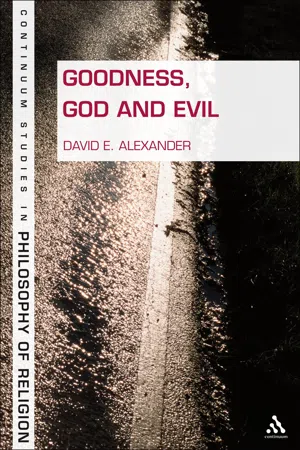
- 168 pages
- English
- ePUB (mobile friendly)
- Available on iOS & Android
eBook - ePub
Goodness, God, and Evil
About this book
Information
CHAPTER 1
CONTEMPORARY MORAL REALISM:
PROBLEMS WITH A COMMON ASSUMPTION
PROBLEMS WITH A COMMON ASSUMPTION
Contemporary versions of moral realism assume that the term “good” refers to a property that falls within the scope of Kripkean and Putnamian developments in philosophy of language and metaphysics (hereafter I will use the less cumbersome KP developments). Put briefly, KP developments refer to a cluster of theses on the anti-descriptivist side of the meaning and referring divide. These theses include the claim that it is possible for certain terms—most notably proper names—to refer without descriptive content. Thus, the notion of a rigid designator—a term that refers to the same thing in every circumstance—is introduced, and the term “good” is viewed by many as being a plausible candidate for being a rigid designator. Various metaethical theories within the moral realism camp were then developed that took advantage of these insights. But these versions of moral realism face challenges strong enough to warrant an investigation into an alternative account of moral realism.
In order to defend these claims, I first explain the account of moral realism common to contemporary moral realists. Contemporary accounts of moral realism have developed in large part as a response to G. E. Moore’s Open Question Argument (OQA). The OQA assumes that goodness is a property. Thus, moral realists who share this assumption must respond to the OQA by denying one of its premises. Two representative versions of moral realism, which both assume that goodness is a property that falls within the scope of KP developments and attempt to deny one of the OQA’s other premises, are Richard Boyd’s moral naturalism and Robert Adams’s moral supernaturalism.1 In the second section of this chapter I explain the version of naturalistic moral realism represented by Boyd. I argue that Boyd’s moral realism is not plausible because of its reliance on KP styles of analysis. In the third and final section, I explain the version of supernaturalistic moral realism presented by Adams. I argue that Adams’s version likely fails for reasons that he himself worries about. Thus, contemporary versions of moral realism are either in need of serious repair or should be abandoned. I will leave the repairing to their advocates. In subsequent chapters, I lay the foundations for a new version of moral realism that avoids the problems presented here.
1 Moral Realism: The Contemporary Account
In this section I argue that standard formulations of moral realism assume that “good” refers to a property susceptible to KP developments. More generally, standard forms of moral realism imply that if statements of the form “x is good” are true, goodness must be a property, that is, at least capable of figuring into synthetic a posteriori identity statements. With this purpose in mind, I limit my discussion of moral realism to two recent accounts.
In his introduction to the Oxford Handbook of Ethical Theory, David Copp argues that moral realism consists of the following five doctrines: “(1) There are moral properties (and relations). . . . (2) Some moral properties are instantiated. . . . (3) Moral predicates are used to ascribe moral properties. . . . (4) [M]oral assertions express moral beliefs. . . . (5) The moral properties, in that they are properties, have the metaphysical status that any other property has, whatever that status is.”2
Copp’s account of moral realism includes metaphysical and semantic claims. The metaphysical part of the account states that moral properties are on a par with other non-moral properties and that some things have moral properties. In a footnote Copp writes, “. . . [T]he first realist doctrine is to be interpreted such that the term ‘property,’ as it occurs there, ascribes the same metaphysical status to moral properties, such as wrongness, as it ascribes to a non-moral property such as redness when it is predicated of such a property.”3 Note that Copp’s account is perfectly compatible with versions of moral realism that take the property goodness to be identical to some other property, where the identity is either analytic or synthetic.4
The semantic component of Copp’s account of moral realism is comprised by points (3) and (4). With the assumption that moral beliefs are truth-apt, point (4) commits the Coppian moral realist to cognitivism. Cognitivism does not entail moral realism—in Copp’s sense—but moral realism—again in Copp’s sense—does entail cognitivism.
Copp’s account of moral realism implies that moral realists must countenance moral properties and that moral properties are no different, in terms of their metaphysical status, than non-moral properties. Since, there are non-moral properties that are susceptible to KP developments, Copp leaves it open that moral properties may be susceptible to such developments as well. Copp aims to provide a general account of the commitments of moral realism, and thus leaves room for moral realists to take advantage of the semantic and metaphysical developments introduced by Kripke and Putnam. Whatever its merits or demerits, Copp’s account is evidence in favor of my claim that contemporary versions of moral realism build in a commitment to moral properties that are capable of receiving a KP analysis.
Geoffrey Sayre-McCord gives a different definition of moral realism:
Moral realists hold that there are moral facts, that it is in light of these facts that peoples’ moral judgments are true or false, and that the facts being what they are (and so the judgments being true, when they are) is not merely a reflection of our thinking the facts are one way or another. That is, moral facts are what they are even when we see them incorrectly or not at all.5
Sayre-McCord’s characterization differs from Copp’s in some crucial respects. For our purposes, the most important difference is that Sayre-McCord’s account does not mention moral properties. The omission of moral properties from his account suggests that one could be a moral realist and deny the existence of moral properties (but not moral facts). Nevertheless, appearances are misleading.
Sayre-McCord explains moral facts in terms of moral properties. He provides two accounts of moral facts. According to the first, “. . . moral thought and talk [is] committed to properties, and facts, and truths, that could just as well be expressed in nonmoral terms”.6 The first account goes further and claims that moral properties are identical with either natural or supernatural properties depending on who is articulating the view. The identity between moral properties and non-moral ones is thought to be knowable through analysis of moral concepts. Moore’s OQA challenged the idea that an analysis of moral concepts reveals an identity between moral properties and non-moral ones. Thus, assuming Moore is right, if moral properties are identical to non-moral ones, mere analysis of moral concepts is not sufficient to reveal the identity.
Sayre-McCord’s second account of moral realism is an attempt to bypass the OQA by showing that moral properties can be identical with non-moral ones even though the identity cannot be known via conceptual analysis. This account of moral realism relies on Saul Kripke’s pioneering work in 1972.7 Kripke introduced a new way of discovering property identities. Most assumed that the only way to discover property identities was via conceptual analysis. Thus, a claim that properties F and G are identical was, if true, thought to be both necessary and analytic. Kripke argued that many property identities are not knowable a priori and hence not knowable via conceptual analysis. This new wave in philosophy of language and metaphysics opened the door for a new response to Moore’s OQA. Moral properties could be identical with non-moral properties without there having to be synonymy between the moral predicate and the non-moral predicate that refer to these properties. In Sayre-McCord’s view:
But the most powerful grounds for rejecting the Open Question Argument came with the realization that two terms, say “water” and “H2O,” could refer to one and the same property, even though one would be asking a substantive question (that can be settled only by investigating the world) in asking whether H2O is water. The realization that a proposed identity could both be true and yet fail the test of the Open Question Argument encouraged the hope that, after all, a naturalized metaphysics for moral properties could be defended.8
Despite the fact that Sayre-McCord’s characterization of moral realism does not mention moral properties, it is clear from his exposition that moral facts include moral properties. Indeed, as is clear from the above quotation, Sayre-McCord’s account of moral realism explicitly includes reference to moral properties that are capable of KP analysis.
Standard accounts of moral realism include, either explicitly or implicitly, reference to moral properties that are capable of figuring in analytic or synthetic property identities. In particular, most moral realists are committed to the claim that goodness is a property that is either analytically or synthetically identical to some other property. Consequently, the moral anti-realist need only show that each project fails in order to establish her/his position.9 If the anti-realist can show that moral properties are neither analytically equivalent to non-moral properties, nor synthetically equivalent to non-moral properties, then moral realism is false, given the assumption that these are the only two options.
The chief aim of this book is to argue that the standard account of moral realism implicitly assumes a false dichotomy (or trichotomy if we insert moral non-naturalism back into the list of options for moral realists). There is another option for moral realists besides the analytic and synthetic ones currently offered. Before providing the details of this third option, however, it is important to see some of the shortcomings of the analytic and synthetic accounts.
2 From Moore’s OQA to A Posteriori Moral Naturalism
In order to be a moral realist one must be a naturalist, non-naturalist, or a supernaturalist. If G. E. Moore is correct, moral naturalism is a non-starter. Moore’s OQA aimed to show that no naturalistic definition of a moral term is possible. Here is a reconstruction of Moore’s main argument: Either goodness is simple or goodness is complex.10 If goodness is complex, then analysis should reveal its constituents. But analysis does not reveal the constituents of goodness. Hence, goodness is not complex. The OQA is Moore’s defense of the minor premise. Any identification of the property goodness with some other property (i.e. goodness = F) will always leave it an open question whether the other property is indeed good. But since property identifications are a matter of analysis, and if goodness is in fact identical with F, the question “is F good?” should never be open. Since it is open, there is no property that goodness is identical with, and hence goodness is not complex. Since analytic moral naturalism and analytic moral supernaturalism, which claim that the definition of “good” is both analytic and purely descriptive, appeared to be the only options for the moral naturalist and supernaturalist, these versions of moral realism looked doomed. Hence, if one opts for moral realism, and the OQA is sound, then one must be a non-naturalist. But non-naturalism falls prey to a host of objections that have convinced most that non-naturalistic moral realism is plainly false.11 Hence, given the soundness of the OQA, moral realism is false.
Through the work of Saul Kripke and Hilary Putnam, a plausible semantics for synthetic property identities was developed.12 Moral naturalists and supernaturalists attempted to appropriate this work in order to show that the nature of goodness is entirely natural or supernatural but cannot be known a priori. Hence, it is possible, according to their theory, to provide a definition of “good” that is purely descriptive but not analytic. If this appropriation is successful, a version of moral naturalism emerges that avoids the OQA. To date, Richard Boyd’s “How to be a Moral Realist” is the most discussed account of a semantics for “good” that attempts to show that like “tiger,” “water,” and other natural kind terms, “good” may refer to a property or kind that can be synthetically identified with a natural property.13 In the next section I present a novel argument that Boyd’s account fails.14
2.1 Moore’s OQA, Boyd’s Response, and Trouble
The motivation behind moral realists’ turn toward the work of Kripke and Putnam comes primarily from G. E. Moore’s OQA. By allegedly showing that neither moral naturalism nor moral supernaturalism is correct, Moore’s commitment to moral realism forced him to embrace a version of moral non-naturalism. But Moore’s conclusion that goodness is simple, unanalyzable, and knowable only through intuition has left most moral realists unsatisfied.15
In the early 1970’s Kripke and Putnam put forth a new semantics that explained how synthetic property identities are possible. Kripke and Putnam supported their semantics by arguing against the then prevalent descriptivism. One of the assumptions of descriptivism is that necessary truths and a priori truths are co-extensive. The identity of water and H2O appears to show that it is possible for at least some statements—that is, water is H2O—to be necessarily true but not knowable a priori. This advance opened the way for those moral realists not willing to embrace non-naturalism to respond to the OQA.
If synthetic property identities are possible with respect to natural kinds and if “good” is a natural kind term (or something like one), it may be that the proposition expressed by “good = F” is necessary but not knowable a priori. Thus, the OQA is unsound, since one of its assumptions—that property identifications are a matter of analysis—is false. Richard Boyd’s semantics for “good” argues just that. According to Boyd:
The reference of a term is established by causal connections of the right sort between the use of the term and (instances of) its referent. . . . Roughly, and for nondegenerate cases, a term t refers to a kind (property, relation, etc.) k just in case there exist causal mechanisms whose tendency is to bring it about, over time, that what is predicated of the term t will be approximately true of k (excuse the blurring of the use-mention distinction). Such mechanisms will typically include the existence of procedures which are approximately accurate for recognizing members or instances of k (at least for easy cases) and which relevant...
Table of contents
- Cover
- Half-Title
- Introduction
- Chapter 1 Contemporary Moral Realism: Problems with a Common Assumption
- Chapter 2 Geach’s Claim: Explication and Defense
- Chapter 3 Some Metaethical Implications of the Attributive Account of “Good”
- Chapter 4 The Function of “Good” and Good Functions
- Chapter 5 From the Attributive Account to God
- Notes
- Bibliography
- Index
Trusted by 375,005 students
Access to over 1.5 million titles for a fair monthly price.
Study more efficiently using our study tools.
Frequently asked questions
Yes, you can cancel anytime from the Subscription tab in your account settings on the Perlego website. Your subscription will stay active until the end of your current billing period. Learn how to cancel your subscription
No, books cannot be downloaded as external files, such as PDFs, for use outside of Perlego. However, you can download books within the Perlego app for offline reading on mobile or tablet. Learn how to download books offline
Perlego offers two plans: Essential and Complete
- Essential is ideal for learners and professionals who enjoy exploring a wide range of subjects. Access the Essential Library with 800,000+ trusted titles and best-sellers across business, personal growth, and the humanities. Includes unlimited reading time and Standard Read Aloud voice.
- Complete: Perfect for advanced learners and researchers needing full, unrestricted access. Unlock 1.5M+ books across hundreds of subjects, including academic and specialized titles. The Complete Plan also includes advanced features like Premium Read Aloud and Research Assistant.
We are an online textbook subscription service, where you can get access to an entire online library for less than the price of a single book per month. With over 1.5 million books across 990+ topics, we’ve got you covered! Learn about our mission
Look out for the read-aloud symbol on your next book to see if you can listen to it. The read-aloud tool reads text aloud for you, highlighting the text as it is being read. You can pause it, speed it up and slow it down. Learn more about Read Aloud
Yes! You can use the Perlego app on both iOS and Android devices to read anytime, anywhere — even offline. Perfect for commutes or when you’re on the go.
Please note we cannot support devices running on iOS 13 and Android 7 or earlier. Learn more about using the app
Please note we cannot support devices running on iOS 13 and Android 7 or earlier. Learn more about using the app
Yes, you can access Goodness, God, and Evil by David E. Alexander in PDF and/or ePUB format, as well as other popular books in Teologia e religione & Semantica linguistica. We have over 1.5 million books available in our catalogue for you to explore.