Are we allowed to choose where we belong? What pressures make us feel that we should belong somewhere? This book brings together four major poets-Heaney, Mahon, Zagajewski, and Hartwig-who ask themselves these questions throughout their lives. They start by assuming that we can choose not to belong, but know this is easier said than done. Something in them is awry, leading them to travel, emigrate, and return dissatisfied with all forms of belonging.
Writer after writer has suggested that Polish and Irish literature bear some uncanny similarities, particularly in the 20th century, but few have explored these similarities in depth. Ireland and Poland, with their tangled histories of colonization, place a large premium upon knowing one's place. What happens, though, when a poet makes a career out of refusing to know her place in the way her culture expects? This book explores the consequences of this refusal, allowing these poets to answer such questions through their own poems, leading to surprising conclusions about the connection of knowledge and belonging, roots and identity.
eBook - ePub
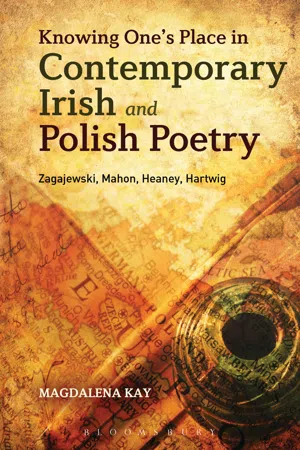
Knowing One's Place in Contemporary Irish and Polish Poetry
Zagajewski, Mahon, Heaney, Hartwig
- 272 pages
- English
- ePUB (mobile friendly)
- Available on iOS & Android
eBook - ePub
Knowing One's Place in Contemporary Irish and Polish Poetry
Zagajewski, Mahon, Heaney, Hartwig
About this book
Information
1
The dynamic ideal and the protean self: Adam Zagajewski
Adam Zagajewski, one of the foremost Polish poets writing today, rejects the traditional equation of belonging with rootedness. Instead, he depicts an imaginative home that is dynamic, changing together with the protean poet himself. The speaker of his poems is a traveler who views each new locale as a potential home, even if his sense of belonging to it is momentary. His focus is, therefore, on discovering moments of belonging, most often in the present and the future, not in the past. In this way, Zagajewski’s poetry upsets the common association of home with stability (one may leave one’s home, yet it will remain as a stable point of return).1 His poetry explores the idea of belonging as a temporary relationship of the self to a place that can be found anywhere: any place has the potential to be a home. This fluid notion is based on a constant recognition of otherness and concomitant negotiation between the self and the other, harmony and disjunction, unity and dissolution. The self, meanwhile, is itself unstable. It clings to its surroundings and its perceptions, sometimes on the brink of dissolution. The moment of choice, for Zagajewski, is valuable for its openness—its freedom from the restriction of the already made choice—but this moment cannot serve as a permanent dwelling. Zagajewski has dramatically changed as a poet from the time of his first volumes in the 1970s, yet his early mode of writing crucially influences his development: in particular, his focus on an anonymous, mutable, traveling self may have its roots, paradoxically, in his early political poetry, with its focus on the anonymous citizen.
Zagajewski’s celebration of dynamism and mutability, however, can be understood as a gesture of rebellion against his previous mode of writing. Zagajewski made his debut in 1972 as a very different poet from the one he is today. Like Julia Hartwig, he was associated with his politics before he definitively came of age as a poet. In his youth, Zagajewski was one of the four main members of the “Generation ’68” (together with Stanisław Barańczak, Ryszard Krynicki, and Julian Kornhauser), a group of young poets who wrote in opposition to the Communist régime. The massive student protest against artistic censorship in 1968 served as a common background for these poets, who were united politically and poetically in an effort to unmask the brutal reality of life under Communism.2 At the time in Polish literature, there were few plain statements about the political here and now; this group sought to fill that gap. In Zagajewski’s words, literature had been “abstract and elegant,” holding itself “above the state” and beyond concrete details.3 This trend abruptly changed. The poetry of this group, also called the “New Wave” (“Nowa Fala”), gave a bleak, yet emotionally impassioned, portrait of life in a totalitarian state. It addressed itself to the consciences of its readers. This poetry focused on the actual, as opposed to Zagajewski’s later work, which frequently explores imaginative states.
Although this group shared an ideological program, its poetic output was quite varied and becomes even more so with the passage of time. Krynicki’s work grows increasingly metaphysical, his forms simpler, and his tone quieter. Barańczak combines an almost baroque verbal dexterity with an attack against Communist “new-speak” (“nowo-mowa”; Orwell’s term is frequently used in Polish). Flashes of humor enliven the work of Barańczak and Kornhauser. Each poet eventually chose his own path. Each poet of this exceptional generation develops a recognizable individual style while maintaining a tone of ethical watchfulness in his verse.4 The Generation ’68 is, significantly, the last major literary movement that took Romanticism as its foundation, and its belief in literature as a vehicle for collective expression, even while it begins to seem anachronistic. Małgorzata Szulc Packaleń notes that “the [single] poet writing in the name of the multitude is the basic Romantic topos” (130–1). Zagajewski interprets this topos in a manner that makes its oppressiveness evident: “Polish culture has a communal character and it is at once splendid and painful . . . Every word belongs to everybody. Every silence becomes public property.”5 His poetic father figure, Czesław Miłosz, takes this sort of criticism further, noting with some rancor that “Whoever writes in Polish must soberly tell himself that Polish readers only pretend that they are interested in various human problems.” What really interests them is what novelist Tadeusz Konwicki calls the “Polish Complex”: the state of the victimized nation.6 The Generation ’68, however, initially embraced this public function. The speakers of their poems are individuals, but speak as members of the crowd. This is why the anti-Communist protests of the Generation ’68 are popularly called Romantic, in keeping with the fighting spirit of Polish Romanticism. It was, after all, arch-Romantic Adam Mickiewicz’s visionary drama Forefathers’ Eve that ignited the initial protests after being banned from the theater by Communist authorities in 1968. The poet was a political rebel and a literary traditionalist.
The central change that these poets brought about was a change of speaker. When the Generation ’68 poets announced that their protagonist would be an average man (lit. “szary człowiek”—a grey man, colorless), they declined to present him as a Romantic hero, though their average protagonist invariably carries the potential for heroism. The imperative to serve a greater good is a central component of Generation ‘68’s Romanticism. “Tell the truth that’s what you serve,” writes Zagajewski in the early poem “Truth” (Prawda).7 Man has the tools to do good and to do evil; in “Truth,” he holds love in one hand, hatred in the other. Zagajewski’s claim to eschew abstraction is not entirely correct—love, hatred, truth, good, and evil are present in this poetry as characters (in a direct contrast to Heaney and Mahon’s work, where the abstraction must always be an image). Yet Zagajewski’s abstractions are grounded in situations; the best poems of this time translate the urgency of their appeal into an emotional correlative, a felt compulsion to act. They are objectively based—communicating a situation and holding a reified “truth”—and differ fundamentally from Zagajewski’s subjectively based poetry, which relies on the imaginative transmogrification of the objective world.8
When Zagajewski turned away from political poetry in the early 1980s, readers accused him of losing his chance to give testimony to the fall of Communism. One must not, however, exaggerate this rift in his oeuvre. Until today, he defends the notion that truth may be stable, and spurns relativism, holding that skepticism is a Western luxury that East Europeans cannot often afford. Zagajewski’s early desire to awaken consciousness becomes aesthetic and ontological in his later work, not moral and political, and the social position of his speaker becomes less discernible—yet he is still frequently anonymous, not a personality. In his transitional volume List. Oda do wielości, the “I” is not yet biographical, as it becomes, increasingly, in his later work. The “here and now” is predominantly a site of aesthetic epiphany, while its unique, ambiguous, and changeable qualities are emphasized. In keeping with this emphasis, Zagajewski’s primary persona wanders and searches; he is no longer a citizen rooted to his sociopolitical situation.
This turning point is best exemplified by the forceful “Fire” (“Ogień”) (1982).
Probably I am an ordinary middle-class
believer in individual rights, the word
“freedom” is simple to me, it doesn’t mean
the freedom of any class in particular.
Politically naïve, with an average
education (brief moments of clear vision
are its main nourishment), I remember
the blazing appeal of that fire which parches
the lips of the thirsty crowd and burns
books and chars the skin of cities. I used to sing
those songs and I know how great it is
to run with others; later, by myself,
with the taste of ashes in my mouth, I heard
the lie’s ironic voice and the choir screaming
and when I touched my head I could feel
the arched skull of my country, its hard edge.9
The poem begins on an equivocal note—“Probably I am”—with the effect that, immediately, the reader is alerted to the possibility of reversal or recognition. The speaker, however, insists upon his own mediocrity, which makes the poem’s rising tide of emotion almost incredible, yet this is part of its significance: even an “ordinary” and “naïve” man—especially a naïve man—can be subsumed into collective emotion. Does it matter if the fire is stoked by hatred or by a positive thirst for freedom (the poem was written in the early ‘80s, while Poland suffered under martial law)?10 The focus here is on the extremity of collective emotion, its destructive capacity, and its ability to drown individual judgment.
The destabilization of the speaker’s position in its opening lines (“Probably”), and the irony that turns into impassioned sincerity, make the reader circle back. The first word, “Jestem” (“I am”) establishes the poem as an act of self-definition, though the second word, “chyba” (“perhaps”), renders it dubious. The first seven lines highlight the banal, even off-putting, character of the very “average man” that the Generation ’68 addressed in its work. The opening is dull, the verbs lack momentum, and adjectives are almost aggressively deflated. “Freedom” is, literally, “without extraordinary class limitations” in the original Polish, and this speaker’s refusal of the extraordinary continues until the pivotal “I remember.” Its tone is conciliatory—he is trying not to stand out of the crowd—and “clear vision” (literally illumination, “jasność”) is tucked away in parentheses. The tinge of self-confidence in this opening voice, of one who doesn’t hesitate to label himself (“I am a --”) and to assure us of his transparency, suddenly gives way to profound, impassioned self-reflection in the middle of the poem. We leap from the banal to the remarkable: the tonal quiver of “clear vision” heralds this change. The poem’s language thickens: dull words give way to dense ones that are sensory and symbolic. The verbs burst into action, as the fire’s momentum (“parches,” “burns,” “chars”) is transferred into the self (“I used to sing . . .”), and its debris, ash, can be tasted physically. The speaker evokes his personal trauma by moving from a description of large-scale destruction into intimate sensual apprehension (ashes in his mouth).
“Fire” shows how the “szary człowiek,” the colorless man, can be subsumed into a collective mania; how a song becomes a scream and brings about a re-evaluation of the “I.” He comes to terms with his responsibility, which is the price of collective belonging; at the same time, he recognizes the penetrative power of the individual self (the crowd will never see itself as such). The original poem has no periods, no semicolons, and no end-stopped lines—it is a continuous utterance, its progression arduous; its tonal shift is, consequently, even more surprising. The voice longs to recuperate from the trauma that his words re-enact, yet his final word—“edge” (“brzeg”)—strikes a dissonant note. It is ambiguous (edge of skull or of country?) and its sound in Polish is hard. It is not echoed by any other line-ending.11 The “edge” remains a problem that is unassimilated, thematically and melodically, into the poem. The poem grapples with the boundary between “freedom” as a slogan—freedom for a cer...
Table of contents
- Cover-Page
- Half-Title
- Title
- Copyright
- Dedication
- Contents
- Acknowledgements
- Introduction: The margins of Europe–a new comparison
- 1 The dynamic ideal and the protean self: Adam Zagajewski
- 2 Figuring otherness in the work of Adam Zagajewski
- 3 Belonging on the edge: Derek Mahon's outsider poetics
- 4 Inhabiting the earth: Derek Mahon's dissonances and harmonies
- 5 Belonging as mastery in the poetry of Seamus Heaney
- 6 Examining the structures of selfhood: Seamus Heaney
- 7 Holding one's self outside: Julia Hartwig
- 8 Learning to speak from inside: Julia Hartwig
- Conclusion: Knowing one's self
- Bibliography
- Index
Trusted by 375,005 students
Access to over 1.5 million titles for a fair monthly price.
Study more efficiently using our study tools.
Frequently asked questions
Yes, you can cancel anytime from the Subscription tab in your account settings on the Perlego website. Your subscription will stay active until the end of your current billing period. Learn how to cancel your subscription
No, books cannot be downloaded as external files, such as PDFs, for use outside of Perlego. However, you can download books within the Perlego app for offline reading on mobile or tablet. Learn how to download books offline
Perlego offers two plans: Essential and Complete
- Essential is ideal for learners and professionals who enjoy exploring a wide range of subjects. Access the Essential Library with 800,000+ trusted titles and best-sellers across business, personal growth, and the humanities. Includes unlimited reading time and Standard Read Aloud voice.
- Complete: Perfect for advanced learners and researchers needing full, unrestricted access. Unlock 1.5M+ books across hundreds of subjects, including academic and specialized titles. The Complete Plan also includes advanced features like Premium Read Aloud and Research Assistant.
We are an online textbook subscription service, where you can get access to an entire online library for less than the price of a single book per month. With over 1.5 million books across 990+ topics, we’ve got you covered! Learn about our mission
Look out for the read-aloud symbol on your next book to see if you can listen to it. The read-aloud tool reads text aloud for you, highlighting the text as it is being read. You can pause it, speed it up and slow it down. Learn more about Read Aloud
Yes! You can use the Perlego app on both iOS and Android devices to read anytime, anywhere — even offline. Perfect for commutes or when you’re on the go.
Please note we cannot support devices running on iOS 13 and Android 7 or earlier. Learn more about using the app
Please note we cannot support devices running on iOS 13 and Android 7 or earlier. Learn more about using the app
Yes, you can access Knowing One's Place in Contemporary Irish and Polish Poetry by Magdalena Kay in PDF and/or ePUB format, as well as other popular books in Literature & English Literary Criticism. We have over 1.5 million books available in our catalogue for you to explore.