The book examines the rising influence of emerging powers in global politics, with a special focus on the BRIC countries (Brazil, Russia, India, China).
Chapters contributed by international scholars first look at the changing status of the US in the 21st century and at the EU as both an emerging and innovative power. China's rising power status, India's regional and global influence, Russia's re-emergence, and Brazil's growing regional and international role are then analyzed comparatively to explain how the BRIC states are poised to become vital players not only in politics and economy, but also in key international concerns such as terrorism, globalization, and climate change.
The book provides a detailed analysis of political, economic, security, and foreign policy trends in the BRIC countries to address such questions as to whether they will seek to revise the international order or work within it and how they will deal with transnational global problems. Using a unique comparative approach, the text will appeal to undergraduate students in world politics, international relations, and foreign policy.
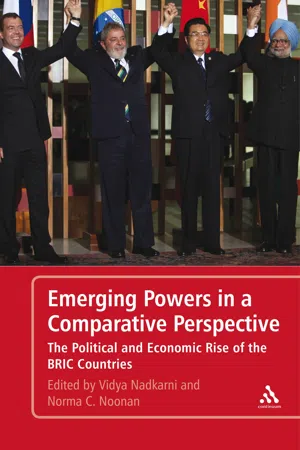
eBook - ePub
Emerging Powers in a Comparative Perspective
The Political and Economic Rise of the BRIC Countries
- 256 pages
- English
- ePUB (mobile friendly)
- Available on iOS & Android
eBook - ePub
Emerging Powers in a Comparative Perspective
The Political and Economic Rise of the BRIC Countries
About this book
Information
chapter one
Introduction
China’s rapid emergence as a major power became a subject for scholarly speculation as early as the mid-1990s.1 By the turn of the twenty-first century, the combined effect of China’s remarkable economic performance, its rising military capabilities, and its growing global presence was reflected in unqualified acceptance in the world’s major capitals of China’s “arrival” as a great power. China is viewed as the nearest peer competitor of the United States of America (USA). Russia, India, and Brazil rank in the next tier of powers. India’s potential as a great power began to be noted in the early years of the twenty-first century. While lagging behind China in economic growth rates and military strength, India’s global profile has benefited from US endorsement of its role as a great power in-the-making.2 Brazil and Russia have, as has India, sought to become regionally and globally assertive. In his 2001 paper titled “Building Better Global Economic BRICs,” Goldman Sachs economist Jim O’Neill popularized the BRIC acronym to bring attention to the rising economies of Brazil, Russia, India, and China and inaugurated serious scholarly efforts devoted to understanding the impact of these countries on world affairs.3
This book represents one such attempt by bringing together a group of scholars who examine the coming power-shift from the perspective of established (the USA, Europe, and Japan) and rising (China, India, Russia, and Brazil) powers and the roles that these powers are likely to play in the twenty-first century. While there has been much scholarly debate and discussion over the nature, implications and durability of American global preeminence, there have been few systematic inquiries into the nature of the challenges the USA may face from likely competitors. In the globalized world of the twenty-first century, power is diffused among multiple state and non-state actors and the challenges to security are multifaceted. Thus, questions related to the rise and decline of powers have to range beyond a mere tally of the hard capabilities of states.
For most of the second half of the twentieth century, West European countries and Japan were able to forge a new path to power based on pursuing trade and commerce—a circumstance enabled by the security umbrella provided by the USA. The Cold War had generated a very specific set of norms that underpinned a competitive international security order guided largely by the dictates of East-West strategic and ideological rivalry. The East-West thaw brought an end to an almost half-century of assiduous US-Soviet efforts to devise elaborate measures to compete while avoiding the escalatory dangers inherent in any direct military confrontation between the nuclear-armed powers. While fears of apocalyptic nuclear war have receded in the twenty-first century, the rise of transnational problems like terrorism and climate change has brought to the forefront normative questions about the kind of global leadership required for multilateral cooperation.
The collapse of the Soviet Union and demise of its East European Empire expanded the boundaries of the European Union (EU) within the institutional ambit of which former East European satellite states could be socialized into EU norms. As a “civilian power,” the EU seeks to project global influence based on the concept of international responsibility by fostering multilateral cooperation in achieving its objectives.4 The success of this global socialization project is likely to hinge to a large degree upon the role that Russia will seek to play in Eurasia and elsewhere. Japan’s twenty-first century role will be intimately bound up with the nature and form of China’s rising power. The latter, in turn, will be affected by the tempo of India’s rise in Asia and the world. Brazil’s emerging role will create a new center of power in the Americas. The international political, security, and economic implications of these developments are of great significance in anticipating the nature of the coming international order.
As China, Russia, India, and Brazil assume a larger role in the global economy, these countries will, as a consequence of their economic weight and political aspirations, become vital players in addressing the transnational challenges of globalization, climate change and terrorism. Additionally, their emergence begs answers to several interesting questions about traditional inter-state security concerns: How will the coming power transition affect the preeminent role of the USA? Will the rising powers seek to revise the international order or work within it? How will the salience of transnational global problems affect questions of international and world order? Understanding the national aspirations of China, India, Russia, and Brazil will be of great significance in answering these questions and in understanding the shape of the twenty-first century world.
In the sections below, we examine themes that will allow us to construct the conceptual scaffolding for the arguments presented in the chapters that follow. These sections cover the nature of the anticipated power transition; the significance of the international hierarchy of power; the importance of national role conceptions; the impact of globalization; and the effect of demographic pressures on established and rising powers.
The Coming Power Transition
A protracted process of power transition is underway from long dominant centers of power in the west to countries in the eastern and southern hemispheres. The gradual rise of the West in the sixteenth century was prefaced by seafaring voyages spearheaded by Portugal and Spain that began in the early fifteenth century, which opened up the promise of trade and settlement in territories previously uncharted by Europeans.5 In time, due largely to their military and technological superiority and willingness to use force, most of the major European powers colonized vast regions in the Americas, Australasia, and Africa. Growing European ascendancy received an added fillip from the rise of the industrial revolution in the eighteenth century. By the nineteenth century, major European capital cities had become colonial metropolises and the epicenters of global commerce. European dominance continued until the mid-twentieth century, when World War Two (1939–45) devastated the European continent. The process of decolonization, which unfolded in the latter half of the twentieth century, further crippled Europe’s big powers. The post-1945 emergence of a bipolar world led by a preeminent USA, with the Soviet Union in the role of a challenging power, ended the period of European dominance.
Until the turn of the nineteenth century, the continent of Asia had cut a high economic profile in the world. Asia produced much of the global wealth and accounted for a significant percentage of world trade. According to Angus Maddison, China and India together accounted for 48.9 percent of world GDP (gross domestic product) in 1820 compared to 23 percent for Western Europe.6 By 1913, Western Europe accounted for 33 percent of world GDP compared to a China-India total of 16.3 percent.7 If the twenty-first century is an Asian century, one may therefore more aptly refer to the “return” of Asia after centuries of dormancy during which the Asian continent had ceded its position of primacy first to European powers and later to the USA. While the relative positions of currently dominant states is declining vis-à-vis the emerging powers, it will most likely be decades before rising Asian states will have the capacity to eclipse the combined economic and military might of the USA, the European countries and Japan. China and India are joined by Russia and Brazil as contesting claimants to great power status.
The problem of change in world politics continues to vex scholars and policy makers alike. If, as realists argue, dominant powers shape the international order to conform to their particular interests and value preferences, then two important questions arise: (1) what is the process by which dominant powers rise and decline; and (2) how may we ascertain the nature and likelihood of normative changes to the international order following periods of power transition? These considerations are of critical relevance in the twenty-first century during which the USA with its European and Japanese allies have to assess the implications of the rising global reach of China, of the ascending trajectories of India and Brazil, and of the resurgence of Russia.
Power transition literature has suggested that the process of international systemic change is fraught with violence. A readjustment in the power hierarchy of states in the international system that reorders earlier patterns of relations between super-ordinate and subordinate states comes about when there is a significant change in the distribution of power. The rise of new powers, dissatisfied with the status quo and possessing the capabilities to challenge the prevailing order, creates disequilibrium in the system. Such a state of affairs often results in efforts by the new powers to challenge the position of the dominant state(s).8 Writing from a realist perspective, Robert Gilpin noted that power shifts have occurred when the international system is in disequilibrium and rising powers calculate that the benefits accruing from challenging the dominant ...
Table of contents
- Title
- Copyright
- Dedication
- Contents
- Contributors
- List of Abbrevations
- 1 Introduction Vidya Nadkarni
- 2 The Global Leadership of the USA and the Emerging Powers Norma C. Noonan
- 3 Europe: Global Power in the Making Mary Troy Johnston
- 4 Japan and the Emerging Powers: Toward Middle Power Realism? David Fouse
- 5 China: A Reluctant Global Power in the Search for its Rightful Place Suisheng Zhao
- 6 India–An Aspiring Global Power Vidya Nadkarni
- 7 Russia in the New Distribution of Power Tatiana Shakleina
- 8 Brazil as an Emerging Power in the Twenty-first Century João Augusto de Castro Neves
- 9 Conclusion: Global Leadership in the Twenty-first Century Vidya Nadkarni and Norma C. Noonan
- Glossary
- Index
Trusted by 375,005 students
Access to over 1.5 million titles for a fair monthly price.
Study more efficiently using our study tools.
Frequently asked questions
Yes, you can cancel anytime from the Subscription tab in your account settings on the Perlego website. Your subscription will stay active until the end of your current billing period. Learn how to cancel your subscription
No, books cannot be downloaded as external files, such as PDFs, for use outside of Perlego. However, you can download books within the Perlego app for offline reading on mobile or tablet. Learn how to download books offline
Perlego offers two plans: Essential and Complete
- Essential is ideal for learners and professionals who enjoy exploring a wide range of subjects. Access the Essential Library with 800,000+ trusted titles and best-sellers across business, personal growth, and the humanities. Includes unlimited reading time and Standard Read Aloud voice.
- Complete: Perfect for advanced learners and researchers needing full, unrestricted access. Unlock 1.5M+ books across hundreds of subjects, including academic and specialized titles. The Complete Plan also includes advanced features like Premium Read Aloud and Research Assistant.
We are an online textbook subscription service, where you can get access to an entire online library for less than the price of a single book per month. With over 1.5 million books across 990+ topics, we’ve got you covered! Learn about our mission
Look out for the read-aloud symbol on your next book to see if you can listen to it. The read-aloud tool reads text aloud for you, highlighting the text as it is being read. You can pause it, speed it up and slow it down. Learn more about Read Aloud
Yes! You can use the Perlego app on both iOS and Android devices to read anytime, anywhere — even offline. Perfect for commutes or when you’re on the go.
Please note we cannot support devices running on iOS 13 and Android 7 or earlier. Learn more about using the app
Please note we cannot support devices running on iOS 13 and Android 7 or earlier. Learn more about using the app
Yes, you can access Emerging Powers in a Comparative Perspective by Vidya Nadkarni,Norma C. Noonan in PDF and/or ePUB format, as well as other popular books in Politics & International Relations & Comparative Politics. We have over 1.5 million books available in our catalogue for you to explore.