From Technicians to Teachers provides theoretical and practical reasons for suggesting that widespread, international curriculum reform of the post-1990 period need not deprofessionalise teaching. The widely held deprofessionalisation thesis is both compelling and fatalistic, leading to a despairing sense that teachers are either no more than technicians, or that they can be reprofessionalised through definitions of 'effective teachers' promoted by the reforms. However, there are many teachers who do not see their work in either of these ways.
The book is structured around an in-depth case study detailing the implementation of The New Zealand Curriculum in that nation - one of the best international examples of neoliberal reform. Benade argues that curriculum policy can and should be analysed critically, while pointing out the dangers for ethical teachers that can exist in national or state curricula.
Energising and inspiring, this book reminds teachers and teacher educators that although they work in a globalised context, their own role is fundamental and has a profoundly ethical basis, despite the negative impacts of three decades of education reform.
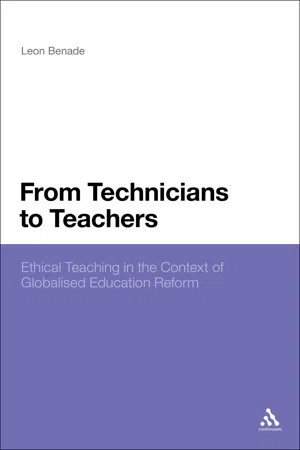
eBook - ePub
From Technicians to Teachers
Ethical Teaching in the Context of Globalised Education Reform
- 296 pages
- English
- ePUB (mobile friendly)
- Available on iOS & Android
eBook - ePub
From Technicians to Teachers
Ethical Teaching in the Context of Globalised Education Reform
About this book
Information
Chapter 1
From Neoliberalism to Third Way
The charge that education reforms of the late twentieth and early twenty-first centuries have marketized education, and led to the deprofessionalization of teachers’ work, is based on an interpretation of several theoretical elements that underpin education reform. The claim made in this book that the deprofessionalization of teachers’ work can be challenged is based on an interpretation of certain additional theoretical elements. The purpose of this chapter is to clarify the first set of elements, which relate to the concept of neoliberalism, and the additional set of elements, which relate to the concept of Third Way.
New Right and Neoliberalism
New Right is associated with “Reaganomics,” the economic policies of Ronald Reagan (President of the United States of America, 1981–89) and “Thatcherism,” the economic policies of Margaret Thatcher (Prime Minister of the United Kingdom, 1979–90). A local New Zealand version was “Rogernomics,” the economic policies of David Lange’s Fourth Labour Party government of 1984–90, where it was applied to Finance Minister, Roger Douglas (1984–88). What these administrations had in common was their use of monetarist policies that slashed public spending, and introduced privatization and deregulation of local markets. However, these administrations (particularly the USA and UK) also emphasized a brand of moral authoritarianism.
Olssen, Codd and O’Neill (2004) refer to the New Right as the grouping or alliance of market liberals and moral conservatives, where New Right is the alliance and neoliberalism its underlying ideology. Apple (2004) distinguishes neoliberals from neoconservatives, treating the former as the market liberals and the latter as the moral conservatives in the conservative alliance. This distinction lacks the clarity of that offered by Olssen and his colleagues, whose interpretation is preferred here. Market liberals seek limited government that does not interfere with the free market, while moral conservatives seek authoritative pro-family government that has little tolerance for crime. What the two groups have in common is their belief in individual freedom expressed as competitive individualism in a free market and a government that limits social spending (Olssen, Codd and O’Neill 2004). What follows is an analysis of the intellectual foundations of that position.
At the core of neoliberalism is the liberal belief in the a priori right to individual freedom, requiring that state legislation be justified as it inevitably encroaches on individual freedom. However, tensions exist between liberal conceptions of negative freedom and positive freedom (Benn and Peters 1959; Berlin 1958; Gaus and Courtland 2010; Strike 1982). Negative freedom can be understood to be freedom from coercion, power or use of force by others over the individual (Berlin 1958), or as the absence of restraint (Benn and Peters 1959). It is an opportunity concept (Gaus and Courtland 2010) that enables capacities (such as rational enquiry) to be developed (Strike 1982) through unobstructed action (Berlin 1958). Positive freedom focuses on the freedom of individual to self-actualize (Gaus and Courtland 2010). A rational, autonomous being is the objective (Berlin 1958) of this more expansive interpretation of the liberty principle, which has the advantage over the former in that it recognizes several varieties of constraints on individual liberty (Benn and Peters 1959). For example, one may be fettered by addiction to a vice or by inability to send one’s child to a successful state school because it is zoned for a neighborhood that is beyond one’s means. Thus positive freedom is an exercise or ability concept (Gaus and Courtland 2010).
These propositions imply different levels of government involvement, where negative freedom requires minimal government, ensuring only that citizens do not coerce or unnecessarily impede one another (Gaus and Courtland 2010), whereas positive freedom leads to an active state that sees itself as a collective extension of the individual rational will (Berlin 1958). Liberal belief is thus neither unitary nor without elements of self-contradiction. Liberal ethics are similarly divided. In On Liberty, J. S. Mill argued that
in things which do not primarily concern others, individuality should assert itself. Where, not the person’s own character, but the traditions or customs of other people are the rule of conduct, there is wanting one of the principal ingredients of human happiness, and quite the chief ingredient of individual and social progress ([1859] 1979, 185).
Therefore, Mill argued that individual and social creativity is encouraged by individual liberty, and self-perfection is each individual’s first priority ([1859] 1979, 188). In contrast is the contractualist position such as that proposed by John Locke, who posited a “state of nature” in which people are free to act without let, but who choose to sacrifice some of that freedom to live in a lawful society of equals to guarantee self-preservation. Members of that society are mutually bound to one another:
Every one, as he is bound to preserve himself, and not to quit his station wilfully, so by the like reason, when his own preservation comes not in competition, ought he as much as he can to preserve the rest of mankind, and not unless it be to do justice on an offender, take away, or impair the life, or what tends to the preservation of the life, the liberty, health, limb or goods of another (Locke [1690] 1976, 6).
These positions lead to theories that variously consider society to be an aggregation of private individuals, to those that emphasize its collectivist or communitarian qualities. Mill’s notion of negative freedom led him to regard government as inimical to the pursuit of individuality and an incursion on personal freedom. In particular, he was suspicious of popular democracy ([1859] 1979, 129). Isaiah Berlin (1958, 51) noted that there is not a logical connection between individual liberty and democracy; the question of coercion and obedience turns on the extent of authority in the hands of the government, not on who has that authority. This highlights one of the tensions that exist whenever the concept of liberal democracy is used, namely that the ends of liberty do not necessarily coincide with the ends of democracy. Berlin argued that a source of these tensions lies in the conflation of liberty with equality and fraternity (1958, 30, 43). Equality demands levels of social control to prevent domination of the weaker by the stronger, while fraternity makes totalitarian government permissible as long as it acknowledges and guarantees the recognition and status of all citizens.
A further matter of contention in liberal thinking is over the question of material circumstances, as alluded to above. An important source of such status is property. Classical liberalism unites freedom and property, although there are some differences within this position. One view within classical liberalism treats property as freedom, embodied by the free market. The state simply ensures that the free market can exist (Gaus and Courtland 2010). Alternatively, individuals are regarded as free to make contracts, sell their labor, acquire and accumulate capital, and to deploy capital. The role of the state is to guarantee this freedom by regulation. Locke, for example, regarded one of the chief aims of government to be the mutual preservation of private property ([1690] 1976, 73).
In contrast, welfare liberalism, which gives rise to social democracy, has a tenuous link between property and liberalism, because at its basis is a doubt that the free market can distribute resources equitably. Consequently, welfare liberals look to the state to proactively smooth free-market variations, and prefer the state to guarantee a range of liberties and rights rather than property freedoms (Gaus and Courtland 2010).
Neoliberalism has a conception of the individual that shifts from the classical liberal homo economicus (Olssen, Codd, and O’Neill 2004; Olssen and Morris Matthews 1997), to the perpetually responsive individual. Whereas the classical position acknowledges the self-directed, self-actualizing individual whose interests coincide with the interests of society, the neoliberal position regards the individual as slothful, but amenable to development by the state as an enterprising individual. The key intellectual trends that led to the development of neoliberal thought include the rising influence of monetarism, the work of theorists linked to the Austrian and Chicago schools of economics, and the emergence of theories of human capital, public choice and agency.
Monetarism
Usually associated with Milton Friedman and the Chicago School (Olssen and Peters 2005), monetarists keenly support a laissez-faire market, thereby rejecting Keynesian welfare economics and attendant public spending. Monetarist policy extends economic and market principles to traditional non-economic sectors, such as public services and education. The demand-side, centralized control and manipulation of the market by the welfare state is replaced by supply-side interventions, such as investment in education, so that individuals are better able to capitalize on the market or add value to it by their enhanced skills. A self-regulating market is considered to be virtuous and better able to distribute resources, thus requiring less state intervention.
The Chicago School, of which Friedman was a notable figure, and the Austrian School, with which Frederick Hayek was closely associated (Olssen and Peters 2005) concur in their adherence to methodological individualism and political individualism. The former views society as a myth, and provides explanations in terms of individual motivations, while the latter has the related notion of society as an aggregate of private individuals who should be left free to pursue their own interests. While the Chicago School generally refers to a group of individuals (including Hayek) who taught at the University of Chicago School of Economics, the Austrian School refers to a school of thought that included late nineteenth-century and early twentieth-century Austrian economists, Menger, von Mises and Hayek (Devine n.d). Significant differences include the extreme laissez-faire position of the Austrian school that resisted state intervention, whereas the Chicago monetarists allowed for some state intervention, especially control of money supply and inflation. While the latter are positivists relying on empirical data and value-free economics, the former argued the primacy of a priori knowledge and introduced the notion of “subjective theory of value” (Devine n.d) rejecting empirical notions of calculating a fixed value of commodities based on the labor required to create them. Instead the Austrian economists posited that value is determined by the subjective preferences of individuals (Olssen and Peters 2005), the point being that Hayek vigorously promoted the notion that the rational individual can use personal knowledge of the market to freely choose among options, rather than relying on an expert state planner who is not privy to the same knowledge (Olssen and Peters 2005), and is too distant from the fragmented knowledge emanating from the market to be able to coordinate it (Peters 1999).
Human Capital Theory
Human Capital Theory (HCT) is the notion that capital investment in education leads to enhanced skills and knowledge for individuals, representing a return on investment for the state. This theory is however flawed for several reasons, including its ahistorical assumptions, its notion that individuals behave rationally (Fitzsimons 1999a), and the assumption that there is a linear relationship between education and later economic success (Brown and Lauder 1996; Codd 2005a; Fitzsimons 1999a; Fitzsimons and Peters 1994; Olssen, Codd and O’Neill 2004). HCT features strongly in the discourse of international agencies such as the Organisation for Economic Cooperation and Development (OECD) and the World Bank, where it is promoted as a significant factor in creating competitive advantage for nations (Olssen, Codd and O’Neill 2004).
Public Choice Theory
Public Choice Theory (PCT) postulates the extension of market and business principles to all sectors of life. Its exponent, James Buchanan (Olssen, Codd and O’Neill 2004), advanced the notion that state management of the market as a regulator could become a model for the regulation of the public sphere (Olssen and Peters 2005). In this regard, Buchanan advanced significantly from the Hayekian notion of the invisible hand of unfettered markets acting as self-regulators that had influence over private transactions, to believing that the state could manipulate and create quasi-market conditions to influence public-sector transactions. Because PCT is underpinned by methodological individualism, it rejects the possibility of public interest, thus postulating “provider capture,” the likelihood that public service delivery will favor bureaucrats, who will act only to maximize personal utility. Therefore, schools are economic “black holes” that fail their “consumers” (Apple 2004). A solution is the eradication of potential conflicts of interest by separating policy, implementation and regulation in public services. Quasi-markets are created by uncoupling services from the parent organization, placing these services in competition with each other, and requiring the parent organization to engage in contestable practices with the now outsourced providers. Agents who are also separated from the parent organization apply rigorous accountability from policy-making to implementation (Olssen, Codd and O’Neill 2004; Olssen and Peters 2005; Peters 1999).
Agency Theory
Agency Theory (AT) postulates that individual personal relationships in public organizations are formalized contracts that manage the relationship between superiors (“principal”) and subordinates (“agent”), to whom specific tasks are delegated. AT and PCT share a distrust of individual motivations. Essentially, AT dwells on the “agency problem” where “asymmetrical” knowledge exists between the parties. The principal expends resources to keep the agent under surveillance, while the agent withholds information from the principal, making the task of the principal more challenging. Each party is motivated to achieve their respective self-interest. AT therefore focuses on balancing the monitoring of behavior against the offer of rewards in return for desirable action by the agent (Eisenhardt 1989). The relevance of AT is its contribution to understanding the place of accountability systems and the restructuring of the public sector (Olssen, Codd and O’Neill 2004). Taken together, these strands of neoliberal thought have influenced both New Zealand education reform and one of the central responses to those reforms.
Neoliberalism Shapes the Deprofessionalist Case
The essence of the deprofessionalization argument is that neoliberal education reforms have contractualized teachers’ work, thus eroding trust in the professional relationship. Olssen and Peters (2005) regard contractualization as a product of Public Choice Theory that has extended neoliberal market norms to the public sector. This in turn has created workplace relations that can be explained in terms of Agency Theory. The work of the agent (the teacher) is shaped, monitored and appraised by the principal (the school principal or other delegated person) so that the productive requirements of the organization are achieved efficiently and competently (Olssen and Peters 2005). For Codd (2005a; 2005d), contractualization was a product of the intrusion in schools of a “culture of managerialism.” This culture is a concern with quality that reduces education to a pursuit of observable and measurable outcomes at the expense of professional trust, democratic values or moral vision (2005d). Both accounts can be related to Lyotard’s (1984) notion of performativity, and both argued that contractualization undermines the traditional notions of professional work, pointing out in particular the loss of autonomy and sense of public trust (Olssen and Peters 2005) and the erosion of critical reflection and professional judgment (Codd 2005d). Indeed, Codd referred to teachers as having become “managed professionals” who can be seen only as “skilled technicians” (2005d, 202). The case for deprofessionalization goes deeper, however.
Government influence over curriculum (which has emerged as a consequence of reforms that will be described in Chapter 4) and shifts in the meaning and purpose of knowledge (as described in Chapter 8) distances teachers from the creation of their work, obliging them instead to perform new roles now demanded of them. These changes come about amid a growing emphasis on competencies, reflecting the international pressure on countries to have citizens able to adapt to the demands of the global knowledge economy, leading in turn to a growing vocationalization of the school curriculum. A hollowed-out curriculum, reflecting a postmodern, postindustrial conception of knowledge, sees “key competencies” in the ascendant, with knowledge as the mere handmaiden to competencies. The development of competencies through the curriculum aims at enabling students to become efficient and effective users of knowledge, and this instrumental sense of “use” is well represented in a selection of national curriculum statements, such as The New Zealand Curriculum outline of key competencies (Ministry of Education 2007, 12–13), the “general capabilities” of the new Australian Curriculum (Australian Curriculum Assessment and Reporting Authority 2010), and the “critical and developmental outcomes” of the South African Revised National Curriculum Statement (Department of Education of South Africa 2005).
Teachers too are required to exhibit these competencies, so that they can effectively model them (Warner 2006), demonstrating that they can work effectively in “teams” with their students to create “knowledge” that will enable students to develop the relevant competencies. The developments described here are a product of the late twentieth and early twenty-first centuries, and to some extent have accelerated beyond neoliberalism, thus demanding different political thinking. One such response came to be termed Third Way.
Third Way
Third Way was a political response shaping center-left politics, particularly in the Anglo West, for over two decades beginning as early as 1983. By 2003, the use of the term Third Way began to fall from circulation, so that by the time of writing, Third Way discourse, in name at least, “has been gently allowed to lapse” (Holmes 2009, 251). Nevertheless, the effects and intent of Third Way have lingered, being evident in policies such as the exemplar national curriculum considered in this book, The New Zealand Curriculum. Readers will discern the links between that curriculum and Third Way, and in turn curricula within their own jurisdictions.
Third Way modernized the left, enabling it to challenge the New Right conservative governments that entrenched neoliberalism, especially in the USA and UK. However, evidence of Third Way is seen in the Hawke and Keating Australian Labor Party (Romano 2006; Whyman 2006) of 1983–1996, and in various forms in non-Anglo ...
Table of contents
- FC
- Title
- Copyright
- Dedication
- Contents
- Acknowledgments
- List of Tables and Figures
- List of Abbreviations
- Introduction
- Chapter 1: From Neoliberalism to Third Way
- Chapter 2: Professionality, Professions, and Teachers’ Work
- Chapter 3: Ethical Teacher Professionality and the Ethical Teacher
- Chapter 4: Understanding the Context
- Chapter 5: New Zealand Curriculum Reform, 2002–2007: Break or Continuity?
- Chapter 6: Policy
- Chapter 7: Seeking out Spaces
- Chapter 8: Challenges to the Development of Ethical Teacher Professionality in The New Zealand Curriculum
- Chapter 9: Critical Implementation of The New Zealand Curriculum: Building a Knowledge Democracy
- Bibliography
- Notes
- Index
Trusted by 375,005 students
Access to over 1.5 million titles for a fair monthly price.
Study more efficiently using our study tools.
Frequently asked questions
Yes, you can cancel anytime from the Subscription tab in your account settings on the Perlego website. Your subscription will stay active until the end of your current billing period. Learn how to cancel your subscription
No, books cannot be downloaded as external files, such as PDFs, for use outside of Perlego. However, you can download books within the Perlego app for offline reading on mobile or tablet. Learn how to download books offline
Perlego offers two plans: Essential and Complete
- Essential is ideal for learners and professionals who enjoy exploring a wide range of subjects. Access the Essential Library with 800,000+ trusted titles and best-sellers across business, personal growth, and the humanities. Includes unlimited reading time and Standard Read Aloud voice.
- Complete: Perfect for advanced learners and researchers needing full, unrestricted access. Unlock 1.5M+ books across hundreds of subjects, including academic and specialized titles. The Complete Plan also includes advanced features like Premium Read Aloud and Research Assistant.
We are an online textbook subscription service, where you can get access to an entire online library for less than the price of a single book per month. With over 1.5 million books across 990+ topics, we’ve got you covered! Learn about our mission
Look out for the read-aloud symbol on your next book to see if you can listen to it. The read-aloud tool reads text aloud for you, highlighting the text as it is being read. You can pause it, speed it up and slow it down. Learn more about Read Aloud
Yes! You can use the Perlego app on both iOS and Android devices to read anytime, anywhere — even offline. Perfect for commutes or when you’re on the go.
Please note we cannot support devices running on iOS 13 and Android 7 or earlier. Learn more about using the app
Please note we cannot support devices running on iOS 13 and Android 7 or earlier. Learn more about using the app
Yes, you can access From Technicians to Teachers by Leon Benade in PDF and/or ePUB format, as well as other popular books in Education & Education General. We have over 1.5 million books available in our catalogue for you to explore.