This book offers a unique analytical investigation of the international politics of the EU, China, and India in the context of their security strategies in Central Asia. It shows how the interaction between these three actors is likely to change the frameworks and practices of international relations. This is studied through their interactions with central Asia, using the framework of normative powers and the concept of regional security governance.
Briefly, a normative power shapes a target state's attitudes and perceptions as it internalizes and adopts the perspectives of the normative power as the norm. The work comparatively studies the dynamics that have allowed Beijing, Brussels, and New Delhi to articulate security mechanisms in Central Asia, and become rising normative powers.
This innovative study does not aim to catalog foreign policies, but to uncover the dominant perceptions, cognitive structures and practices that guide these actors' regional agency, as exemplified through the context of Central Asia. It will be an essential resource for anyone studying international relations, international relations theory, and foreign policy analysis.
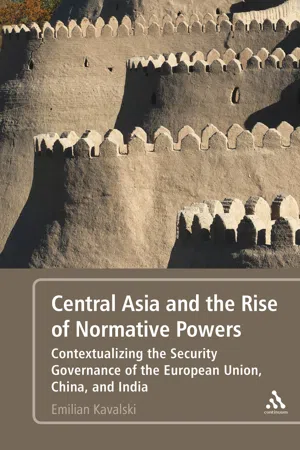
eBook - ePub
Central Asia and the Rise of Normative Powers
Contextualizing the Security Governance of the European Union, China, and India
- 240 pages
- English
- ePUB (mobile friendly)
- Available on iOS & Android
eBook - ePub
Central Asia and the Rise of Normative Powers
Contextualizing the Security Governance of the European Union, China, and India
About this book
Information
PART ONE
Context and frameworks for the engagement with the rise of normative powers in Central Asia
1
Involving Central Asia in world politics
[T]he region appears as a sort of black hole in the middle of the world. . . it is hugely dark or darkly huge. . . Yet, Central Asia is perhaps both the most important and the most neglected part of the world. . . Therefore, the millennial centrality of Central Asia in inter- “national” relations goes virtually unnoticed.
Andre Gunder Frank (1992, pp. 43–5)
[T]here must be many people who would like to be given some account of this romantic part of the world, provided that it comes to them in palatable form.
Wilfrid Blunt (1973, p. 9)
Introduction
This chapter looks at the space(s) that Central Asia occupies in world politics. The contemporary positioning of Central Asia in the study of world politics reveals the unease of mainstream frameworks for explanation and understanding to render legible the complex and contradictory patterns of regional affairs. This seems to be particularly the case when grappling with the trajectories of Central Asian statehood molded by the simultaneous agency of discordant state-elites and contending international actors. The claim is that the region emerges as a context for the international agency of normative powers. In this respect, the ramifications of Central Asia on the mental maps of global life attest to distinct processes for its security governance.
This tendency has conjured up memories of the nineteenth-century “great game” played in the region by Britain and Russia. Bringing together a host of international organizations, states, multinational corporations, and nongovernmental actors, its contemporary re-enactment has rekindled the clichéd imagery of “land of discord,” “pulpit of the world,” “geographic pivot of history,” “grand chessboard,” “the disparate and anarchic theatre of global geopolitics,” etc. The affective economy of these depictions befuddles the study of the historical and institutional legacies, cross-regional patterns, and socioeconomic structures impacting the shape, processes, and content of statehood across Central Asia.
The chapter proceeds with a brief overview of the engagement of Central Asia in world affairs. While cursory, it nevertheless prompts an understanding of the genealogy of the region’s conceptualization as a context for external agency. The analysis then moves on to discuss the location of Central Asia on the mental maps of international politics. It suggests that because of the region’s treatment as a context for the policies of international actors, the positioning of Central Asia on the spatial, temporal, and cognitive geographies of international politics has remained open to contestation. The chapter draws attention to the “awkwardness” of regional statehood and the dynamics of the “new great game” as key contributing factors for the complex overlay of security governance regimes spanning the region.
Brief history of the engagement of Central Asia in world affairs
The location of Central Asia on the stage of world politics seems to have been perennially informed by the discourses of its orientalization. Wilfrid Blunt’s statement in the epigraph to this chapter confirms such strategy for the construction of a “palatable form” for the narrative of “the most romantic part of the world.”1 As a governing strategy, the orientalization of Central Asia echoes the disciplining approaches through “which European culture was able to manage—and even produce—the Orient politically, sociologically, militarily, ideologically, scientifically, and imaginatively during the post-Enlightenment period” (Said, 1978, p. 3). Unlike Said’s narrative of othering, however, such orientalization of Central Asia was not only the property of the Western beholder. Instead, Central Asia has tended to be othered as the context for their external agency by different “outsiders, whether they be Muslim or Christian, European or Asian” (Rashid, 1994, p. 9).
While such perceptions present reductive moves that befuddle the engagement of Central Asia in international relations, they do not prevent an interrogation of the regional involvement in the history and patterns of world affairs (Heathershaw, 2010, p. 96). It would appear, therefore, that “rivalry” between different extraregional actors pockmarks the genealogical account of Central Asian affairs. Observers have, nevertheless, queried the objectivity of this contextualization and have suggested that such representations merely reflect the attitudes of their proponents which then get projected back onto the (account of the) past (Sengupta, 2009, p. 131). While bearing these nuances in mind, for the purposes of brevity and clarity, the contestations of external actors over Central Asia are surveyed in four main periods: pre-Islamic, Islamic, Russian/Soviet, and post-Soviet (Peimani, 1998, p. 23).
The pre-Islamic period saw the strong Persian influence in the region and its ultimate integration into the empire of the Achamenids around the sixth century BC (Peimani, 1998, p. 23). In this period, Central Asia came on the radar of world history in the process of Alexander’s foray into the region. While the passage of Macedonian troops was not indicative of a major “turning point in the history of Central Asia” (Holt, 1988, p. 52),2 it marked a defining moment in the history of its location in world affairs. Imagining the region became inflected by the myths of Alexander’s exploits. In particular, such narrativization of the regional experience has provided the origins for the treatment of Central Asia as a context for the agency of external actors. At the same time, while temporally distant, the significance of this period lies in the initiation of the division of Central Asia between nomadic and settled populations. This distinction has had (and some would argue that it still does have) an important impact on regional developments. In fact, it is often claimed that the division between nomadic and sedentary populations is a contributing factor to Central Asia’s hallmark “chronic affliction” with a conspicuous “reflexive resistance to, and distrust of, official authority” (Meyer, 2003, p. 168).
While acknowledging the developments in the pre-Islamic period, the historian Svat Soucek avers that 622AD is the crucial year for the meaningful engagement of Central Asia in the dynamics of world affairs. As he argues, “the birth of Islam” has produced a radical change in regional interactions by introducing “a new and uncompromising way of life, both spiritual and temporal” (Soucek, 2000, p. 49). It was during this period that the first Central Asian polities emerged. The Islamic period also saw the emergence of large-scale contestation over the region between Arab, Persian, Turkic, and Mongol armies. One of the long-term implications of Islam in Central Asia is its gradual emergence as a potent source for resistance and popular mobilization. For instance, Ahmed Rashid (1994, p. 42) uncovers instances of this dissident role of Islam both during Soviet times and in the post-Soviet period. Likewise, Laura Adams asserts that prior to the Soviet period, the people inhabiting the region “were united by a common identity as Muslims, which for many was as much a cultural as a religious identity” (Adams, 2008, p. 621).3
Russia’s involvement in Central Asia was initially part of retaliatory activities against Mongol invasions. In time, such interest was motivated by Russia’s protracted confrontation with the Ottoman Empire and its alleged Muslim affiliates in the region. It should not be overlooked that on a functional level, the Russian incursion into the region was instrumentally motivated both by the defeat in the Crimean War, which constrained Russia’s colonial gaze toward the European territories of the Ottoman Empire, and by the distortion of cotton supplies as a result of the American Civil War, which turned Central Asia into a lucrative supplier of cheap cotton (Lloyd, 1997, p. 104).4 At the same time, the conquest of Central Asia had become a critical part of Russia’s civilizing Eurasian “manifest destiny” (Bassin, 1999).5 Russian involvement in the region coincided with Chinese, Iranian, and British interests in Central Asia, which prompted the now hackneyed imagery of a “great game” among them.6
The gradual incorporation of Central Asia into the Russian Empire initiated one of the most comprehensive transformations of the polities, culture, and economy of the region. There has been some debate on how appropriate it is to attach the label of colonization to this experience. On the one hand, Edward Said has suggested that “[u]nlike Britain or France. . . Russia moved to swallow whatever land or peoples stood next to its borders.” His claim, therefore, is that because of its focus on “adjacency,” the Tsarist imperial project has to be set apart from the experience of other European colonial powers (Said, 1994, p. 10). On the other hand, however, Richard Pierce contends that on an ideational level, the Russian colonization of Central Asia was motivated by a very similar desire for security through the subjugation of the allegedly uncivilized and threatening (even though neighboring) others as that of any other colonial power. His claim, therefore, is that Russia advanced into the region “until [it] could establish secure frontiers” for itself (Pierce, 1960, p. 20).7 These debates, notwithstanding, most commentators agree that Russia’s incursion into Central Asia is a major juncture for the historical trajectories of the region.
The significance of Russia’s imprint was further intensified as a result of the overthrow of the monarchy and the establishment of a Soviet state. As Adeeb Khalid (2006, p. 232) intimates, “the Soviet remaking of Central Asia makes sense only as the work of a different form of modern polity.”8 The distinguishing features of the Soviet polity were embedded in the Marxist-Leninist ideology underpinning its statehood, which also shaped the transformation of the region.9 On the one hand, it was this experience that produced the current boundaries and states (and some would argue, the nations) of Central Asia. On the other hand, the incorporation of Central Asia into the Soviet Union “pushed” the region into a “diplomatic limbo where the outside world could only be viewed through Moscow’s eyes” (Rashid, 1994, p. 208). Probably the most significant impact from the incorporation of the region into the USSR has been the dramatic overhaul of the traditional political, cultural, social, and economic relations in Central Asia. As a result, regional political developments were driven by an ideologically motivated reorganization. In this context, the observation of a contemporary rise of normative powers in the region can be interpreted as a comparable attempt to radically refocus the lenses of Central Asia’s engagement in world politics (although in a less invasive and noncoercive manner).
The dissolution of the Soviet Union has set into motion the current fourth period in the regional engagement in the history of international interactions. For some, the Soviet breakup seems to have quite literally “tossed Central Asia back into the melting pot of history” (Hopkirk, 1992, p. xviii). For others, the significance of this event emerges from the opportunity for independent agency of regional actors. In particular, the claim has been that Central Asian states have finally taken “their rightful place in the world community and they have done so with a vengeance” (Soucek, 2000, p. 283). Yet, the paradox of such “return” of the region to world politics was not lost on Gregory Gleason. As he points out, “the greatest irony of independence in Central Asia [was that it arrived just] as has Soviet-style colonialism several decades before—it was imposed by Moscow” (Gleason, 1997, p. 15). Thus, while the comparison between Central Asia’s position in 1917 and 1991 is an important one, other observers stress that both events have plunged the region into “the throes of an internal revolution, in which Islam, tribalism, nationalism, and socialism were fiercely competing for ideological dominance among the local elites and the masses” (Rashid, 1994, p. 25).10 Moreover, developments in the post-Soviet period have suggested the need to “jettison the notion that Central Asia is a single strategic piece forged from the experience of being the object of Russia’s foreign policy for several centuries” (Wimbush, 2011, p. 259).
While the discussion of the four main periods of Central Asia’s engagement in the history of world affairs is necessarily cursory, its intention is to stress the punctuation of the regional developments by external agency. As Will Myer (2002, p. 28) poignantly observers, many of the major historical events in Central Asia have gained their regional significance because of their interpretation by outside actors. At the same time, even such a brief encounter with the international history of Central Asia uncovers some of the key trends that inform the social, cultural, economic, and political complexity defining the region today. Such a brief historical overview of Central Asia’s location in the patterns of international politics intends to elucidate the futility of looking at security governance merely as part of the ruthless machinery of geopolitics. As the following sections will explain (and the analysis of Chapter 3 will demonstrate), territorially framed understandings of security governance miss the practical dimensions through which actors exert influence over the region (Krahman, 2003a, pp. 331–3).
Thus, by acknowledging the relational nature of external involvement in Central Asia, the suggestion is that the region’s location on the stage of world affairs reflects “complex articulations of dislocations and rupturing breaks that are, in turn, always worked out through local and historical resources and institutions” (Pickles, 2008, p. 260). Consequently, since observers insist that the account of Central Asia’s engagement in the process and practice of international politics is not tantamount to the individual experience of “the five Central Asian countries,” but to that of “the region” (Peimani, 1998, p. 23), the following section undertakes a study of the meanings and content that the label of “Central Asia” has acquired in world affairs.
Locating Central Asia on the mental maps of international politics
Central Asia has become one of the emblematic features of the post-Cold War geography of international relations. During the 1990s, the region became an idiom symbolizing the pervasive uncertainty of the post-Cold War climate of global life. Thus, rather than a transitory stage, the persistence of the seemingly erratic character of Central Asian trends has challenged the dominant frameworks for the study of both global and regional patterns. Yet, despite the seeming coherence of the mental maps that Central Asia generates, the regional appellation remains one of those labels whose ramifications are still open to contestation. Some have even questioned the extent to which Central Asia exists as a region at all (Delcour, 2011, p. 107).
Thus, since thinking about Central Asia (i.e. defining and mapping its design...
Table of contents
- Cover-Page
- Half-Title
- Title
- Copyright
- Contents
- Acknowledgements
- List of abbreviations
- List of figures and map
- Introduction: Framing the normative foreign policy agency of the European Union, China, and India in Central Asia
- PART ONE Context and frameworks for the engagement with the rise of normative powers in Central Asia
- PART TWO Following the Central Asian agency of normative powers
- Conclusion: The (struggle for) recognition of adaptive normative powers
- Notes
- Bibliography
- Index
Trusted by 375,005 students
Access to over 1.5 million titles for a fair monthly price.
Study more efficiently using our study tools.
Frequently asked questions
Yes, you can cancel anytime from the Subscription tab in your account settings on the Perlego website. Your subscription will stay active until the end of your current billing period. Learn how to cancel your subscription
No, books cannot be downloaded as external files, such as PDFs, for use outside of Perlego. However, you can download books within the Perlego app for offline reading on mobile or tablet. Learn how to download books offline
Perlego offers two plans: Essential and Complete
- Essential is ideal for learners and professionals who enjoy exploring a wide range of subjects. Access the Essential Library with 800,000+ trusted titles and best-sellers across business, personal growth, and the humanities. Includes unlimited reading time and Standard Read Aloud voice.
- Complete: Perfect for advanced learners and researchers needing full, unrestricted access. Unlock 1.5M+ books across hundreds of subjects, including academic and specialized titles. The Complete Plan also includes advanced features like Premium Read Aloud and Research Assistant.
We are an online textbook subscription service, where you can get access to an entire online library for less than the price of a single book per month. With over 1.5 million books across 990+ topics, we’ve got you covered! Learn about our mission
Look out for the read-aloud symbol on your next book to see if you can listen to it. The read-aloud tool reads text aloud for you, highlighting the text as it is being read. You can pause it, speed it up and slow it down. Learn more about Read Aloud
Yes! You can use the Perlego app on both iOS and Android devices to read anytime, anywhere — even offline. Perfect for commutes or when you’re on the go.
Please note we cannot support devices running on iOS 13 and Android 7 or earlier. Learn more about using the app
Please note we cannot support devices running on iOS 13 and Android 7 or earlier. Learn more about using the app
Yes, you can access Central Asia and the Rise of Normative Powers by Emilian Kavalski in PDF and/or ePUB format, as well as other popular books in Politique et relations internationales & Relations internationales. We have over 1.5 million books available in our catalogue for you to explore.