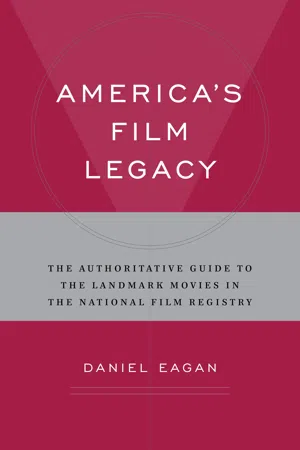
America's Film Legacy is a guide to the most significant films ever made in the United States. Unlike opinionated "Top 100" and arbitrary "Best of" lists, these are the real thing: groundbreaking films that make up the backbone of American cinema. Some are well-known, such as Citizen Kane, The Jazz Singer, All Quiet on the Western Front, The Birth of a Nation, and Boyz n the Hood. Others are more obscure, such as Blacksmith Scene, The Blue Bird, The Docks of New York, Star Theatre, and A Bronx Morning. Daniel Eagan's beautifully written and authoritative book is for anyone who loves American movies and who wants to learn more about them.
eBook - ePub
America's Film Legacy
The Authoritative Guide to the Landmark Movies in the National Film Registry
- 848 pages
- English
- ePUB (mobile friendly)
- Available on iOS & Android
eBook - ePub
America's Film Legacy
The Authoritative Guide to the Landmark Movies in the National Film Registry
About this book
Information
| Blacksmithing Scene |

An old technology captured by the new: W.K.L. Dickson’s Blacksmithing Scene. Courtesy of Kino International
Edison Manufacturing Company, 1893. Silent, B&W, 1.33. 30 seconds.
Credits: Filmmakers: W.K.L. Dickson, William Heise. Filmed before early May 1893. Exhibited May 9, 1893.
Available: Kino Video DVD Edison: The Invention of the Movies (2005). UPC: 738329038328.
Movies would not exist the way we know them today if it weren’t for Thomas Alva Edison, the country’s most famous inventor. Most of the technical aspects of film—the size, sprocket holes, vertical orientation, etc.—can be traced back to Edison’s factory in Menlo Park, New Jersey. Although many inventions and devices exploited the persistence of vision, using shutters to suggest that individual pictures were moving together as one motion, Edison was the prime instigator of a machine that utilized photographs on film.
Edison, inspired by the work of photographer Eadweard Muybridge, embarked on his motion picture project in 1888. In October of that year he wrote, “I am experimenting upon an instrument which does for the Eye what the phonograph does for the Ear, which is the recording and reproduction of things in motion, and in such a form as to be both Cheap practical and convenient. This apparatus I call a Kinetoscope ‘Moving View.’” As Charles Musser notes in Before the Nickelodeon, Edison took the phonograph analogy seriously. He originally envisioned a cylinder covered with thousands of tiny photographs arranged in spirals. A microscope lens would pass over them as the cylinder turned. Edison wanted the machine connected to a phonograph, so the user could hear sound while watching what would work out to a half-hour film.
The inventor may also have been inspired by the stereopticon, an extremely popular parlor toy that gave viewers three-dimensional views of almost anything on the planet. It was the single most widespread visual toy for decades, and even today it’s easy to find piles of stereopticon slides moldering in flea markets and antique stores. (The devices themselves have become more expensive.) Edison originally saw film as a single-user medium, like the stereopticon, with one person at a time looking through a lens or “peephole” into a darkened area where photographs were exhibited. Possibly he thought the machine would be a consumer item, like the stereopticon.
But the device proved impractical on so many levels that it had to be abandoned. By this time Edison had assigned William Kennedy Laurie Dickson, one of the key figures in early film, to the project. Born in France to British parents, Dickson was fascinated by Edison’s work, and paid his way to New Jersey when he was twenty-three in order to work for the inventor.
During a trip to Europe in 1889, Edison saw work by Étienne-Jules Marey, a Frenchman who had found a way to photograph images on a film strip. Edison incorporated Marey’s ideas into his designs. In October 1890, Dickson and his assistant William Heise built a camera that advanced a ¾ inch strip of film through a horizontal feeder. Edison exhibited the device in May 1891. Again, it was a machine that only one person at a time could use.
Dickson and Edison built a vertical-feed motion picture camera in the summer of 1892. This one used a film strip that was 1½ inches wide. (Two apocryphal stories surround the size of film. One has Edison using his thumb and forefinger to indicate the approximate size he wanted, which came out to be close to 35mm. Another, from a Kodak historian, says that readily available 70mm strips were cut in half to supply Edison with film stock.) Surviving footage includes A Hand-Shake (1892), which documents Dickson and Heise demonstrating exactly that.
Musser, the preeminent historian of early film, has reconstructed two of the earliest Edison films from notebook pages covered with photographs. Musser oversaw the re-animation of the photographs, and the results are almost unbearably exciting glimpses into the past. Monkeyshines, as Musser has named the two films, has the inexplicable power and urgency of a nightmare. This is the first recorded motion that survives, a poignant look into vanished lives.
Edison planned to display his invention at the World’s Columbian Exposition in Chicago. He needed films to show, and authorized construction of the world’s first movie studio in December 1892. Finished in February 1893, the tiny, wood-frame building was covered with tarpaper and dubbed the “Black Maria.” Its roof could be opened to let in sunlight, and the entire building rotated to follow the sun. Blacksmithing Scene was one of the first films shot there. In fact, it is one of the first extant attempts to “make” a film rather than simply record an action. While photography was still prized by many at the time for recording the “truth,” nothing about Blacksmithing Scene is true—not even its title, which was supplied later. The three men in the film aren’t blacksmiths, they aren’t in a smithy, and they aren’t working on metal. (It’s also doubtful that they’re drinking alcohol.) They are instead performers on a set pretending to be doing something. Even in 1893, Edison’s workers are confronted with the conflict between capturing and representing reality. Dickson is well aware of this split, because he plays the scene for laughs.
It’s surprising how much attention to detail Dickson, Heise, and the others paid to their sets and costumes, already a crucial part of filmmaking. The anvil and sledgehammers used in the film are real, as are the leather aprons worn by the actors. No one worried about the background, which is left black. The lens Dickson used worked best for medium and medium close-up shots. The camera was probably stationed ten to twelve feet away, enabling the crew to capture the actors in full figure. (Another apocryphal early film story has cameramen shooting full-length shots of people because they were afraid audiences wouldn’t understand figures whose feet were out of frame. But Dickson had composed three-quarter and close-up shots before Blacksmithing Scene.) Musser points out the possibly intentional contrast between Edison’s state-of-the-art machine shop and the primitive smithy shown in the film, adding a level of self-awareness and irony that we don’t usually attribute to early films.
On May 9, 1893, a talk at the Brooklyn Institute compared various motion picture devices, most based on “magic lanterns.” Frames from Blacksmith Scene were projected onto a screen, and after the talk the four hundred audience members were allowed to watch the film, individually through an Edison peephole Kinetoscope. That makes Blacksmithing Scene the first film to be shown publicly.
The following April, a kinetoscope parlor opened in Manhattan. Each film cost five cents to see, and Blacksmithing Scene was one of the films on display. Dickson continuted to make films for Edison, notably the Dickson Experimental Sound Film.
| Dickson Experimental Sound Film |
Edison Manufacturing Company, 1894–95. Sound, B&W, 1.33. 21 seconds at 30 fps.
Cast: W.K.L. Dickson, other unidentified workers.
Credits: Directed by W.K.L. Dickson. Photographer: William Heise.
Additional Credits: Produced between September 1894 and April 2 1895 in the Black Maria studio in West Orange, New Jersey. Note: Title supplied later.
Available: Online at the Library of Congress American Memory (memory. loc.gov) and Internet Archive (www.archive.org) websites. Image Entertainment DVD More Treasures from American Film Archives, 1894–1931 (2004). ISBN: 0-9747099-1-3. UPC: 0-14381-2271-2-3.
Inventor Thomas Alva Edison had always envisioned combining sound and images for motion pictures, which, as he put it, would do “for the Eye what the phonograph does for the Ear.” In The Conversations, a series of interviews between Oscar-winning editor Walter Murch and novelist Michael Ondaatje, Murch notes that “Edison’s rationale was that people might be interested to see the faces of the people who sang on his records. Cinema began as a music video!”
William Kennedy Laurie Dickson, perhaps the most significant figure in the early development of movies, was also a violinist who assisted in the Edison recording department. This department prepared material for another of Edison’s inventions, the wax cylinder phonograph. Dickson later testified that he completed a successful sound film in 1889 in which he greeted Edison upon the inventor’s return to his lab after a European trip. This footage no longer exists.
Sometime between September 1894 and April 1895, Dickson synchronized sound to film for what later historians have called the Dickson Experimental Sound Film. He did this by playing a violin into a recording horn attached to a wax cylinder machine and simultaneously filming the scene with a camera. While this film was not intended for public viewing, Edison workers did complete other sound films for a new invention, the “kinetophone.” This device combined the single-user kinetoscopes with phonographs. Customers could hear music for films through rubber earphones attached to the machines.
The device was not a success, possibly because of its expense (some $400). According to film historian Charles Musser, by 1900, only forty-five had been sold. By that point the industry trend had shifted from peep show viewers to movies projected onto screens, which made synchronizing sound considerably more difficult. Edison would try again in 1913 with a complicated process that ran cables from a phonograph behind the screen back to projectors, but abandoned this as well by 1915.
When Edison died in 1931, his archives became part of the Edison Historical Site, under the control of the National Park Service. In 1942, the Museum of Modern Art copied the Dickson piece from nitrate to safety film, but it wasn’t until 1960 that the accompanying wax cylinder was found in a metal canister by the Edison Historical Site staff. It was labeled “Dickson—Violin by W.K.L. Dixon with Kineto.” (National Park Service catalog number: EDIS 30142; E-number: E-6018-1.) Four years later they discovered that the cylinder had broken into two pieces.
In 1998, members of the Domitor society, a group devoted to the study of early cinema, were instrumental in trying to recover sound from the broken cylinder. Funded in part by the Library of Congress, curators rerecorded the sound onto tape. On June 5th, the film was seen with its music track for the first time in a hundred years. Synchronization was poor, but the viewers succeeded in identifying the music being played as the “Song of the Cabin Boy” from Les cloches de Corneville, an 1877 opera by Robert Planquette. It was a popular enough work to be translated in English as The Chimes of Normandy; according to historian Spencer Sundell, the opera had a longer run than the original production of H.M.S. Pinafore.
In 2000, while working on Apocalypse Now Redux, Walter Murch took over the task of synching sound and film. As he wrote on the online Cinema Audio Society Discussion Board, “[The] problem was the film was shot at 40fps [frames per second], not 24, and the sound was running wild on a cracked 1890’s cylinder. Plus inter-government agency red tape (the film is in the hands of the Library of Congress, the sound is at the National Park Service). So they sent it to me (neutral mediator) to put in synch, which was easy enough given the time-stretching and compressing powers of the Avid [a computer editing program].” With his assistant Sean Cullen, Murch selected synchronization points—when the violinist starts playing, for example—and then adjusted the music track. “Before the film begins you hear someone say ‘The rest of you fellows ready? Go ahead!’ (the first ‘speed’ and ‘action’ captured on wax),” he wrote. “It was very moving, when the sound finally fell into synch: the scratchiness of the image and the sound dissolved away and you...
Table of contents
- Cover page
- Title page
- Copyright
- Table of Contents
- Acknowledgments
- Introduction
- How to Read the Entries
- The 500 Films, in Chronological Order
- An Alphabetical List of the Films
- The 500 Films – Section 1
- The 500 Films – Section 2
- The 500 Films – Section 3
- The 500 Films – Section 4
- The 500 Films – Section 5
- The 500 Films – Section 6
- The 500 Films – Section 7
- The 500 Films – Section 8
- The 500 Films – Section 9
- The 500 Films – Section 10
- The 500 Films – Section 11
- The 500 Films – Section 12
- The 500 Films – Section 13
- The 500 Films – Section 14
- The 500 Films – Section 15
- The 500 Films – Section 16
- The 500 Films – Section 17
- The 500 Films – Section 18
- The 500 Films – Section 19
- The 500 Films – Section 20
Trusted by 375,005 students
Access to over 1.5 million titles for a fair monthly price.
Study more efficiently using our study tools.
Frequently asked questions
Yes, you can cancel anytime from the Subscription tab in your account settings on the Perlego website. Your subscription will stay active until the end of your current billing period. Learn how to cancel your subscription
No, books cannot be downloaded as external files, such as PDFs, for use outside of Perlego. However, you can download books within the Perlego app for offline reading on mobile or tablet. Learn how to download books offline
Perlego offers two plans: Essential and Complete
- Essential is ideal for learners and professionals who enjoy exploring a wide range of subjects. Access the Essential Library with 800,000+ trusted titles and best-sellers across business, personal growth, and the humanities. Includes unlimited reading time and Standard Read Aloud voice.
- Complete: Perfect for advanced learners and researchers needing full, unrestricted access. Unlock 1.5M+ books across hundreds of subjects, including academic and specialized titles. The Complete Plan also includes advanced features like Premium Read Aloud and Research Assistant.
We are an online textbook subscription service, where you can get access to an entire online library for less than the price of a single book per month. With over 1.5 million books across 990+ topics, we’ve got you covered! Learn about our mission
Look out for the read-aloud symbol on your next book to see if you can listen to it. The read-aloud tool reads text aloud for you, highlighting the text as it is being read. You can pause it, speed it up and slow it down. Learn more about Read Aloud
Yes! You can use the Perlego app on both iOS and Android devices to read anytime, anywhere — even offline. Perfect for commutes or when you’re on the go.
Please note we cannot support devices running on iOS 13 and Android 7 or earlier. Learn more about using the app
Please note we cannot support devices running on iOS 13 and Android 7 or earlier. Learn more about using the app
Yes, you can access America's Film Legacy by Daniel Eagan in PDF and/or ePUB format, as well as other popular books in Media & Performing Arts & Film History & Criticism. We have over 1.5 million books available in our catalogue for you to explore.