eBook - ePub
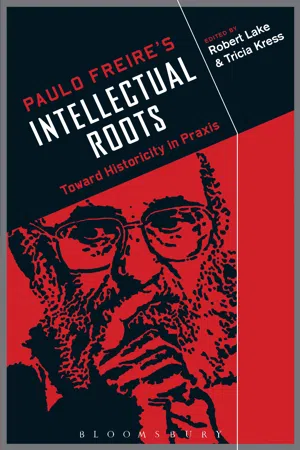
Paulo Freire's Intellectual Roots
Toward Historicity in Praxis
- 280 pages
- English
- ePUB (mobile friendly)
- Available on iOS & Android
eBook - ePub
Paulo Freire's Intellectual Roots
Toward Historicity in Praxis
About this book
Paulo Freire's critical pedagogy has had a profound influence on contemporary progressive educators around the globe as they endeavor to rethink education for liberation and the creation of more humane global society. For Freire, maintaining a sense of historicity, that is, the origins from which our thinking and practice emerges, is essential to understanding and practicing education as a means for liberation. Too often, however, critical pedagogy is presented as a monolithic philosophy, and the historical and intellectual roots of critical pedagogy are submerged. Through a compilation of essays written by leading and emerging scholars of critical pedagogy, this text brings history into the present and keeps Paulo's intellectual roots alive in all of us as we develop our praxis today.
Information
1
Contradiction, Consciousness, and Generativity: Hegel’s Roots in Freire’s Work
Andy Blunden
Paulo Freire owes a great deal to the nineteenth-century German philosopher Hegel, whose work has directly or indirectly inspired every current of genuinely critical thought since his death in 1831.
Hegel’s legacy
The most radical movement in Marx and Engels’ student days was a group of Hegel’s students known as the Young Hegelians. But by the mid-nineteenth century Hegel’s philosophy had been eclipsed by positivism and the rising influence of natural science. Marx sought to retain the revolutionary dialectical character of Hegelianism, while responding to the need for a scientific theory for the workers’ movement, by interpreting Hegel in terms of activity (or practice). It is via Marx’s interpretation that Hegel’s philosophy was most influential during the twentieth century.
Still, very few of the leaders of the socialist movement 100 years ago had any real knowledge of Hegel’s philosophy. Probably the most influential leader of Social Democracy who had studied Hegel independently was Georgi Plekhanov, the leader of the Russian Social Democrats. Plekhanov was Lenin’s teacher, and Lenin went on to lead the 1917 Russian Revolution. During his exile in Switzerland in 1914–15, Lenin read Hegel’s The Science of Logic (1969/1816) (both the long and short versions) and his History of Philosophy (1955), and made annotations on his reading. There is no doubt that Lenin learnt a lot from Hegel, and Lenin meant it when he wrote: “It is impossible completely to understand Marx’s (1996/1867) Capital, and especially its first chapter, without having thoroughly studied and understood the whole of Hegel’s Logic. Consequently, half a century later none of the Marxists understood Marx!”
Lenin’s annotations were published in Volume 38 of his Collected Works (1972/1916), and were the basis on which Marxists of the Third and Fourth Internationals understood Hegel. These annotations tended to function, however, as a substitute for an actual study of Hegel, which may be forgivable, as Hegel is very difficult to read and understand. Nonetheless, Lenin’s attention to Hegel legitimized and inspired the serious study of Hegel, and some outstanding Hegelians emerged out of the Soviet Union and other parts of the Communist International and the Trotskyist movement.
It was however the independent study of Hegel by Georg Lukács, a leader of the Hungarian communists, and a genuine intellectual in his own right, that recovered the full depth of Hegel’s legacy for the Communist movement. Lukács inspired the formation of the Frankfurt School, and although Lukács himself never joined it, the Frankfurt School continued a tradition of Critical Theory and the study of Hegel in the tradition initiated by Lukács.
Hegelian thought appeared in the late nineteenth century in the United States of America where the Pragmatists, especially John Dewey and George Herbert Mead, developed a form of Hegelianism in which Hegel’s name is rarely mentioned. Rather, similar to Marx’s original appropriation of Hegel, they substituted for Hegel’s Spirit the sum total of interactions between individuals.
Hegel also developed his own theology and while he remained a minority figure in theology generally, his ideas are influential among proponents of Liberation Theology, where Christianity and Marxism found an area of common ground. Quite separately from these currents, in the 1930s, Hegel’s influence in France took a surprising turn. The only translations of Hegel available in French had been the very poor translations of Augusto Vera, and as a result the French had taken no interest in Hegel. Despite the efforts of the French Hegelian Alexandre Koyré, like England, France remained firmly in the grip of analytical philosophy. But in 1933, the Russian emigré Alexander Kojève presented an astounding series of lectures on the master-servant narrative in Hegel’s Phenomenology of Spirit (2011/1807), which electrified the French Left. Jean Hyppolite published a fine translation of Phenomenology and very soon new interpretations and translations of this book exploded in France. This movement fostered a new understanding of the anti-colonial movement, including support for the Algerian resistance to French rule, and Simone de Beauvoir’s The Second Sex. This exclusive focus on the master-servant narrative, or more generally, focus on Recognition as elaborated in Hegel’s early works, has tended to overshadow all other interpretations of Hegel and flowed over into the Frankfurt School and the American Pragmatists, leading to a current of social theory based on interactionism and the struggle for recognition.
Freire’s Hegelianism is sensitive to this current, evidenced in his interest in Sartre and Fanon, but tends to draw on the same broad sources of Hegelianism that inspired Marx and twentieth-century Marxists.
An easy way to get a grasp of Hegel’s idea is the concept of Zeitgeist, or “spirit of the times.” Geist, or spirit, is the central concept for Hegel and its meaning is retained in the concept of Zeitgeist with which we will all be familiar. The Zeitgeist is the overall dominant consensus on what are the main questions in life and the kind of answers that can be given. This includes oppositional ideas as well as the dominant view, as those who oppose the answers given by those in power, still find themselves having to answer the same questions and in much the same terms. The Zeitgeist reflects the whole way of life of a community, the way they make a living, the kinds of behavior that are rewarded, and the sense of justice and what kind of thing is seen as despicable or threatening. Zeitgeist carries the implication that one and the same spirit affects everyone, and of course this is not true of modern societies. The point is: if you want to understand how a society ticks it is better to start from the whole, and then move down to finer and finer grains of detail—the various classes, subcultures, and so on—than to try to understand society by adding up the nature of isolated individuals, because individuals, on their own, have no nature whatsoever.
Further, Hegel believed that while individuals all shared a common culture, a people was only really alive to the extent that their most basic beliefs and principles were under continual criticism and skeptical challenge. As soon as a society stopped questioning its fundamental beliefs then “the spirit left them” and moved on elsewhere. Cultural criticism was thus the heart and soul of the community for Hegel.
How Hegel transcended the problems of philosophy
Since the beginning of modern philosophy with Descartes in the 1630s, philosophy had posed for itself the problem of an individual human being confronting a natural world, and how it was possible for an individual to have knowledge of that world. If the world is given to us only in sensations, then how do we know what exists “behind” sensation? And how do people acquire Reason, and is Reason a reliable source of knowledge? Is Reason innate, and if not how can a capacity for Reason spring from sensations alone? These questions proved insoluble because they were wrongly posed in terms of an individual person passively observing Nature from outside—just like the typical philosopher.
Hegel saw that a person’s relation with Nature was mediated by the use of tools and all the artifacts that had been created by previous generations, while a person’s relation to their community was mediated by language, education, and their participation in common projects. People did not confront Nature as naked individuals. Rather an individual’s relationship was with the culture into which he had been raised. And how this culture—the various tools, domestic animals, crops, buildings, and so on—worked was no mystery, because these were objects created by human activity. The problem of Nature was one of the adequacy of the entire way of life and way of thinking of which they were part, living in some community, at some definite juncture in the history and development of culture.
Hegel then began his study with the whole community, and asked how a certain form of life, a certain way of thinking was possible and then asked how individual consciousness developed out of the whole collective way of life in which the individual participated. The individual “subject” then was not an isolated person confronting Nature, but a subject situated in some historically developed form of society, dealing with Nature from within a definite form of life.
Hegel called this collective form of life a “formation of consciousness” (“formation” is a translation of the German word, Gestalt). Hegel conceived of this “formation of consciousness” as simultaneously a way of thinking and acting, a way of life or a form of social practice, and a constellation of artifacts (this means everything from land and crops to artworks and language). It was this moving Gestalt that was the substance and subject of his philosophy. Individuality and the whole variety of ways of life within any given community arises through differentiation within this whole. The development of this whole is driven by contradictions within its core principles, which, sooner or later, comes under challenge and the whole system fails and opens the door for a new system. And so it goes on. As Goethe said, “All that exists deserves to perish” (cited in Engels, 1997, p. 185).
Hegel saw the state not as a limitation on freedom, as libertarians do, but rather as an expression and guarantor of freedom: a person only has freedom to live and flourish to the extent that they are part of a state (meaning not just a government but a whole system of life governed by the rule of law) that expresses their aspirations and protects them from outside threats, crime, and injustice. Hegel did not see the class struggle in the way it later came to be seen. Hegel lived before the Chartist movement in England, before the first proletarian uprisings in France in the 1830s, and he had no conception of the poor masses becoming a progressive force.
This may seem odd to people living in a modern bureaucratic state today, but Hegel’s situation was more like that of people in Vietnam or Cuba in the 1950s, fighting for a state of their own. In Hegel’s lifetime, Germany did not have a state. Until 1815, Germany was part of what was still called the Holy Roman Empire, made up of over 300 small principalities, some Catholic some Protestant, each with their own class structure and traditions. They had a total population of about 25 million, that is, an average of about 86,000 per state, about one-third that of the London Borough of Hackney today. So the “state” that Hegel talks about is more comparable to the ancient Greek polis, the ideal size of which was, according to Aristotle, such that the entire city could be surveyed from a hilltop. After 1815, the German Federation was composed of 38 states, comparable in size to the Paris of the Paris Commune, and, given a decent constitution, capable of controlling its own destiny, despite predatory neighbors like England, France, Russia, and Austria-Hungary.
In fact, what Hegel calls a “formation of consciousness” is best imagined as a social movement, or something like a branch of science or a religious community: a group of people bound together by the common pursuit of an idea, adhering to a system of social practices in line with that ideal. A modern multicultural state is made up of a whole bunch of such communities, social movements, and institutions, with individuals defining themselves in relation to a number of such projects.
Spirit and activity
In his earliest works, Hegel theorized “spirit” in much the same way we would today, as a something that expressed a way of life and its ideas, but then he turned this around: Spirit became something that pre-existed human life and manifested itself in human activity. The difference between these two ways of understanding “spirit” is subtle, but it does have methodological implications. Marxists interpret “spirit” as activity, or practice. In fact, this idea of understanding life as activity, or praxis, pre-dates Hegel.
As is well-known, Descartes’ philosophy was plagued by a dualism between thought and matter. Spinoza had endeavored to overcome this dualism by declaring that thought was just a property of matter, not a separate substance. However, Spinoza had retained Descartes’ mechanical conception of Nature, and this left human beings trapped in a fatalistic determinism. It was Johann Gottfried Herder—a friend of Goethe and a contemporary critic of Immanuel Kant—who made a crucial revision of Spinoza: Nature was active. Whereas Descartes had seen intentions as something that could only be attributed to human beings, Herder said that intentions, struggle, and contradiction were part of Nature. Spinoza and Herder were Pantheists, so God did not make Nature, God is Nature.
Another critic of Kant, Fichte, took up this idea and made activity the foundation of his system. Activity, or practice is both subjective and objective; it is subjective in the sense that it expresses a person’s intentions, but objective in the sense that it is in the world, subject to the constraints of Nature. But Fichte was an extreme individualist. The Ego was pure activity and Fichte aimed to build a social theory and an entire philosophy on the basis of this Ego, an extreme version of liberalism, and in fact, Fichte was a supporter of the Jacobins. So Hegel appropriated this idea of activity that was both subjective and objective, but instead of beginning with the activity of individuals and adding them up to the state, Hegel took activity as Spirit, expressed in the subjective/objective activity of individuals.
In 1843, Moses Hess, a student of Fichte’s, published a founding work of communism, The Philosophy of the Act, and he was one of the people Marx met in Paris in the early 1840s, who won Marx to communism. In the spring of 1845 Marx responded with his own version of the philosophy of the act, Theses on Feuerbach (1975/1845). The change from Spirit to Activity, or praxis, was not just a semantic point. When Marx and Engels wrote the Communist Manifesto (1976/1848) they did not declare that the workers movement had to do what was logical, and Marx did not try to foresee the future of the workers’ movement. On the contrary, he studied the workers movement as it actually was, its ideas and its aspirations, and gave voice to these in the Manifesto. This was the main methodological difference: the point was to understand activity, make it intelligible, and give voice to it. But Marx remained dedicated to the study of Hegel to the end of his days, and his theories are much closer to Hegel’s ideas than is generally realized.
The cell form
“[P]roblem-posing education seeks out and investigates the ‘generative word.’”
Freire, 2011, p. 110
So far so good, but this still left Hegel with the problem of how to grasp a complex entity like a nation-state as a whole, as a Gestalt. Here the answer came from Goethe. Although renowned as a poet and novelist, Goethe was an avid student of Nature as well, but he was hostile to the “Newtonian” style of science that had become dominant (and is still dominant to this day). Goethe objected to the attempt to explain complex phenomena by means of invisible forces acting “behind the scenes.” He was also less than impressed by the practice of classifying things according to attributes, as in Linnaeus’ taxonomy, rather than trying to determine what made an organism just as it was. Goethe developed the idea of Urphänomen, or cell, which was the smallest unit of the complex whole that could exhibit all the essential properties of the whole, and in fact constituted the whole. Microscopes were still not powerful enough in his day for Goethe to have any idea of the complex microstructure of living organisms, but it was shortly after his death that the cell was discovered and biology put on a scientific basis for the first time.
Hegel appropriated this idea and developed it further: one could say that the Urphänomen was the Urphänomen of Hegel’s philosophy, the cell from which the fully developed organism was developed. The cell from which Hegel was to understand the formation of consciousness (Gestalt) was the concept. That is, a formation of consciousness was to be understood as a combination of concepts, with one concept—it’s self-concept—lying at the heart of it. Self-evidently, Hegel did not mean by “concept” something that simply existed inside the head. On the contrary, a concept was manifest in actions, social practices, and cultural products such as language. A community could be understood by cultural critique—the systematic, critical study of its concepts.
Marx rendered Hegel’s “formation of consciousness” as a social formation, and like Hegel, Marx understood the way of...
Table of contents
- Cover
- Title
- Introduction: Paulo Freire’s Pedagogy: Not Mainly a Teaching Method
- 1 Contradiction, Consciousness, and Generativity: Hegel’s Roots in Freire’s Work
- 2 Freire and Marx in Dialogue
- 3 The Gramscian Influence
- 4 Rethinking Freire’s “oppressed”: A “Southern” Route to Habermas’s Communicative Turn and Theory of Deliberative Democracy
- 5 Freire, Buber, and Care Ethics on Dialogue in Teaching
- 6 Converging Self/Other Awareness: Erich Fromm and Paulo Freire on Transcending the Fear of Freedom
- 7 Liberation Theology and Paulo Freire: On the Side of the Poor
- 8 Living with/in the Tensions Freire’s Praxis in a High-Stakes World
- 9 Paulo Freire’s Concept of Conscientização
- 10 Red-ing the Word, Red-ing the World
- 11 Epilogue: Freire’s Roots in his Own Words
- Afterword: Paulo Freire’s Intellectual Roots
- Bibliography
- Notes on Contributors
- Index
Trusted by 375,005 students
Access to over 1.5 million titles for a fair monthly price.
Study more efficiently using our study tools.
Frequently asked questions
Yes, you can cancel anytime from the Subscription tab in your account settings on the Perlego website. Your subscription will stay active until the end of your current billing period. Learn how to cancel your subscription
No, books cannot be downloaded as external files, such as PDFs, for use outside of Perlego. However, you can download books within the Perlego app for offline reading on mobile or tablet. Learn how to download books offline
Perlego offers two plans: Essential and Complete
- Essential is ideal for learners and professionals who enjoy exploring a wide range of subjects. Access the Essential Library with 800,000+ trusted titles and best-sellers across business, personal growth, and the humanities. Includes unlimited reading time and Standard Read Aloud voice.
- Complete: Perfect for advanced learners and researchers needing full, unrestricted access. Unlock 1.5M+ books across hundreds of subjects, including academic and specialized titles. The Complete Plan also includes advanced features like Premium Read Aloud and Research Assistant.
We are an online textbook subscription service, where you can get access to an entire online library for less than the price of a single book per month. With over 1.5 million books across 990+ topics, we’ve got you covered! Learn about our mission
Look out for the read-aloud symbol on your next book to see if you can listen to it. The read-aloud tool reads text aloud for you, highlighting the text as it is being read. You can pause it, speed it up and slow it down. Learn more about Read Aloud
Yes! You can use the Perlego app on both iOS and Android devices to read anytime, anywhere — even offline. Perfect for commutes or when you’re on the go.
Please note we cannot support devices running on iOS 13 and Android 7 or earlier. Learn more about using the app
Please note we cannot support devices running on iOS 13 and Android 7 or earlier. Learn more about using the app
Yes, you can access Paulo Freire's Intellectual Roots by Robert Lake, Tricia Kress, Robert Lake,Tricia Kress in PDF and/or ePUB format, as well as other popular books in Education & Education General. We have over 1.5 million books available in our catalogue for you to explore.