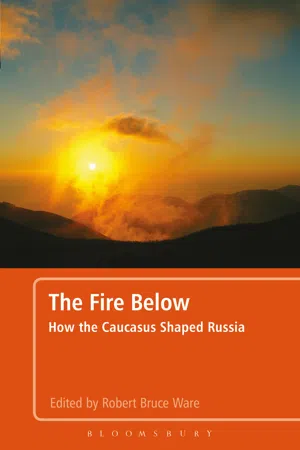
This groundbreaking work examines the complex dynamics of Russia's relations with the Caucasus, revealing the profound effects that Caucasian forces have had upon Russia's development.
Essays show how Georgian sparks ignited conflagrations in South Ossetia (1991-1992) and Abkhazia (1992-1993), spreading northward to conflicts in Ossetia and Ingushetia (1992) and Chechnya (1994-1996). Combined with jihadist influences that entered from the South and East by way of Dagestan, these events culminated in the second Russo-Chechen war (1999-2009).
Chechnya transformed both the Russian military and the presidency of Vladimir Putin. Beginning in 2000, Putin's Chechenization strategy had unforeseen and controversial results for the entire Russian Federation.
These ironies are elucidated in case studies of the Stavropol region, the Sochi Olympics, the Pussy Riot conviction, and Russia's efforts to reintegrate religion with politics against the backdrop of an emerging Islamic "inner abroad."
Neither Russia nor the Caucasus can be understood without an appreciation of their uneasy interconnection and its explosive consequences.
- 360 pages
- English
- ePUB (mobile friendly)
- Available on iOS & Android
eBook - ePub
About this book
Information
CHAPTER ONE
Introduction: How Has the Caucasus Shaped Russia?
Robert Bruce Ware
How has the Caucasus shaped Russia? Once I had asked it of myself that question seemed so natural and inevitable that I wondered whether I could hope to understand either Russia or the Caucasus without answering it. Yet an answer was not easy to find.
My initial search turned up a single study that seemed to address the question directly.1 Whereas many publications have examined the effects that the Russian Federation has had upon events in the Caucasus, there has been much less attention to ways in which the causal relationship has also been reversed. Most of the articles, essays, and studies that I found seemed to presuppose the converse of my question: how has Russia shaped the Caucasus?2 They thereby seemed to presuppose that Russians are naturally agents, that Caucasians are generally patients, and that somehow contrary to Newtonian physics the former affects the latter without the inconvenience of causal reciprocity.
Even at first glance, that seemed unlikely. For if the first Chechen conflict was the culmination of Boris Yeltsin’s decentralizing strategies, the second conflict set the parameters for Vladimir Putin’s recentralization of the Russian state, and for North Caucasian instabilities that have shaped the development of the Federation ever since:
•Putin became Russia’s Prime Minister in August 1999, just one week after Chechnya-based militants invaded Dagestan, and his administrative style was cast in the opening months of the war.
•In May 2000, almost immediately after he was elected president, Putin announced the reorganization of the Russian Federation on the model of Russia’s seven military districts.
•On September 13, 2004—barely one week after the Beslan hostage crisis, and in explicit response to “terrorist” threats—Putin announced the centralized appointment of Russia’s regional governors, and an overhaul of the Russian electoral system that assured additional strength for the party in power.
•In January 2010, President Dmitri Medvedev announced the formation of the North Caucasus Federal District with a focus upon the relentless problems of the region.
•New pressures arrived as early as 2007 with preparations for the 2014 Winter Olympics in the North Caucasian city of Sochi.
•Meanwhile, the republics of this region—especially Dagestan, Chechnya, and Ingushetia—continued to deviate sharply from, and exercise disproportionate influence upon, the rest of the Russian Federation.
Yes, Russia has done much to shape the Caucasus, but as its most volatile region, the North Caucasus also has exerted a disproportionately strong influence upon the evolution of Russia’s federal relations, as well as upon Russia’s social, political, and religious cultures. These complex dynamics seemed to deserve attention.
So I wrote a paper on the topic, and presented it at a conference on Russian regional politics at the University of Dundee. The conference was organized by Cameron Ross, who kindly helped me to publish my paper in Europe-Asia Studies.3 On the same panel at that conference were Domitilla Sagramoso and Richard Sakwa. The three of us met again on a panel that summer in Moscow, where we had a chance to discuss our views with several of our North Caucasian colleagues. Two years later, I organized a panel on the topic of Caucasian influence upon the evolution of Russia’s federal politics at an annual meeting of the Political Studies Association. Richard Sakwa and Anna Matveeva presented papers on that panel.4 Shortly after the panel, I met Marie-Claire Antonine of Bloomsbury Press, who expressed her interest in an edited volume on the topic.
In Bloomsbury’s gracious offer, I recognized an opportunity to engage a group of experts in a conversation about a research question that seemed to be natural and yet surprisingly understudied. So I sent invitations to a number of experts on the Caucasus and Russia, scholars who represented a diversity of viewpoints. The essays in this volume are those of the colleagues who kindly accepted my invitation.
In the first part of this book, Caucasian Causation, the contributors consider how events in the Caucasus have fundamentally altered the development of Russia’s society, religion, politics, and military from the earliest years of the Russian Federation.
Patrick Armstrong opens with the argument that Westerners have understood relations between Georgia and Russia within the context of “memes,” or preconceptions that have structured the journalistic, scholarly, and policy debates about this region. Going back to the 1980s, Armstrong argues that regional problems stemmed from instabilities in Georgia that were partially due to Georgian chauvinism. These tensions led to conflict in South Ossetia (1991–2) and Abkhazia (1992–3). Armstrong further contends that these South Caucasian conflicts contributed to North Caucasian conflicts in North Ossetia and Ingushetia (1992) and in Chechnya (1994–6). In this way, Armstrong traces a chain of contributing causes that extends northward from Tbilisi. He argues that throughout the 1990s, Russia was reacting to problems that were partially Georgian in their origin.
In the next chapter, Domitilla Sagramoso and Akhmet Yarlykapov examine other influences that entered the Caucasus from the South as well as from the East. The authors survey the rise of Islamic influence in the Russian North Caucasus from 1990 to 2012, and go on to show how this predominantly Muslim region has affected developments further northward throughout Russia. Then, by analyzing the flow of causal influence southward from Moscow, they consider the impact of the Kremlin’s religious and regional security policies on the North Caucasus. The authors argue that Moscow’s repressive approach to “nontraditional” Islamic groups and violent jihadist fighters have contributed to the cycle of violence. Finally, they consider how the increasing Islamization of the North Caucasus has contributed to the region’s growing alienation from the rest of Russia, as well as to anti-Caucasian sentiments in the heartland.
In the fourth chapter, Robert Schaefer and Andrei Doohovskoy comprehensively survey the many ways that the Russian military was fundamentally transformed by the wars in Chechnya. According to the authors, these wars entirely reconfigured Russian methods of “organizing, commanding, manning, equipping, and training their military formations.” Russia’s military overhaul was harshly mandated by its dramatic failure in the first Chechen war, was severely tested by the challenges of the second Chechen war, and was proven in Russia’s brief war with Georgia in August 2008. The authors anticipate “the enduring influence of the Caucasus on the Russian military structure,” with ramifications “throughout the social and political fabric of the Russian nation.” This is because the military is among the most important socializing influences in Russia. As Schaefer and Doohovskoy point out, “the Russian military literally knocks at every young man’s door.”
In the second part of this volume, Caucasian Consequences, three contributors consider how these Caucasian instabilities have shaped Russia, especially in the years from 2000 to the time of this writing in 2012. This portion of the book looks at how a Russia, fundamentally transformed by the Caucasus, also acts in a reciprocal manner to alter the Caucasus in turn.
Andrew Foxall focuses the fifth chapter of this volume upon Stavropol’skii krai, surveying the out-migration of population from the North Caucasus republics, the widening of terrorism and insurgency, the rise of Russian nationalism and anti-Caucasian sentiments, the restructuring of the Russian federal system, the institutional separation of the North Caucasus from Russia “proper,” and the shifting economic geography of southern Russia. In Foxall’s words, the chapter suggests that “the economic, demographic, political, and social changes that have taken place in Stavropol’skii krai since 1991 reflect broader changes in Russia as a whole. In many respects, owing to its proximity to the North Caucasus republics, Stavropol’skii krai serves as a front-line barometer of Russian reaction to events in the North Caucasus.” Foxall’s analysis is particularly helpful in that it provides a clear and detailed understanding of various ways in which Caucasian instabilities are spreading northward in their influence upon the Federation.
In Chapter Six, Richard Sakwa provides a theoretical framework for the influences documented in the preceding chapters with his cogent argument that Russian politics is readily understood in terms of the Dual-state political Model. Sakwa’s model focuses upon the divergence of arbitrary administrative decisions from constitutionally enshrined ideals. Sakwa contends that Russia really has become two states, one as it formally claims to be, and quite another as it operates in daily practice. He presents considerable evidence to show that the rise of this dualism has been connected with the exceptional autonomy that was extended by Vladimir Putin to Akhmed and Ramzan Kadyrov in Chechnya.
Walter Richmond provides a fascinating case study, in Chapter Seven, that bears on many of Sakwa’s themes. His study focuses upon preparations for the 2014 Sochi Olympic Games, and particularly upon three areas of concern. First, Richmond presents Olympic preparations within a context of constitutional versus arbitrary decision making, much in the manner of Sakwa’s Dual-state Model. Second, Richmond looks at the ecological issues raised by the Sochi development, and at responses from local populations, from Moscow, and from international organizations. Finally, Richmond surveys the pervasive corruption that he finds in Olympic construction projects, arguing that this maleficence is so extensive as to affect the Russian economy as a whole.
The third part of this volume, Caucasian Crosscurrents, looks at the ways that these multiple, influences, moving in complex patterns northward and southward, have begun to recombine and resonate in ways that are at once stunning, optimistic, and ominous.
Nicolai Petro offers a refreshing look at cooperation among Islamic, Orthodox Christian, and government officials in what he describes as the “Russian Model” of politico-religious partnership. Petro argues that the Russian Model incorporates tolerance of all religions, and is compatible with moderate secularism. He describes how Russian Islamic and Orthodox leaders have recognized that their faiths share core values that are challenged by the nihilism and commercialism that have accompanied the advancement of secularism in the modern world. In the aftermath of the Soviet Union, both traditional Islamic and Orthodox believers have found themselves facing new forms of spiritual competition from confessional variants arriving from the East as well as from the West. Thus they have found strong motives for cooperation in the North Caucasus and throughout the Federation.
More controversially, Petro argues for the benefits of cooperation between both of these faiths and the Russian state, an emerging moral partnership that has caught the attention of some critics. While there are important philosophical traditions—both Christian and Islamic—that support church-state partnership, some secularist proponents have been alarmed by the rise of the Russian Model. Critics found their fears to be realized in the case involving three members of a feminist protest band who were arrested and convicted during the months in which the essays of this volume were compiled. In the appendix, Nicolai Petro presents an analysis of this case, suggesting that its coverage may have illustrated some of the simplistic memes that Patrick Armstrong addresses.
Yet clearly there was an important democratic protest movement in the wake of irregularities during the December 2011 legislative elections in Russia, just as there was clear evidence that some of these protests were met with repression. Surely there is cause for legitimate concern about conflicts within Russia’s political culture and emergent cleavages in Russian values. Are these indicative of the sort of problems that Sakwa explores in his Dual-state Model of Russian politics?
Anna Matveeva examines concerns of this nature as they coalesce in Russia’s new “inner abroad,” namely the republics of Ingushetia, Chechnya, and Dagestan. Drawing vividly upon her field work, Matveeva weaves an exotic tapestry of regional viewpoints that challenges conventional conceptions of Russian culture and citizenship. She argues that these republics diverge so sharply in their moral, religious, and legal practices as to seem only nominally Russian. Yet, as Matveeva shows, they still seek Russian leadership and solicit Moscow’s ample subsidies. Ominously, she finds increasing antagonism and incoherence between perspectives looking, on the one hand, northward from this corner of the Caucasus, and on the other hand, looking southward from Moscow and the rest of the Russian Federation. Matveeva asks how far this trend can go, and how long this cultural incoherence will be tolerable either to North Caucasians or to other Russians?
Matveeva’s account initially seems to support Sakwa’s Dual-state Model. Yet Matveeva points out that the divergence between normative and arbitrary administrative styles applies in all three of these republics, and not in Chechnya alone. This is part of the reason that I argue, in the concluding chapter, for a modification of the Dual-state Model, which I describe initially as the “Chechenization Model” of Russian politics.
The Chechenization Model is derived from the argument that the Chechenization program, which Vladimir Putin inaugurated in Chechnya on June 12, 2000, subsequently became the template for the administration of the Russian Federation from September 2004 to July 2012. The template was exported next door to Ingushetia when Murat Zyazikov was installed as president in 2002. Then on September 13, in the immediate aftermath of the Beslan hostage tragedy in nearby North Ossetia—and a series of other terrorist attacks during the preceding summer—Putin announced an effective extension of the Chechenization template to all other subjects of the Federation. According to the Chechenization Model Russia’s newly recentralized bureaucracy was extended outward and downward in a hierarchical manner to its terminal nodes in each of the Federation’s administrative units. In many cases, these terminal nodes occurred at the administrative level of the republics, as in Chechnya, Ingushetia, North Ossetia, and Kabardino-Balkaria. In other cases, such as Dagestan, the terminal nodes extended deeper into the administrative substrata of the republic, to its raions and djamaats. Wherever a terminal node occurred, local administrators applied a more or less standard repertoire of sanctions and incentives in a manner that allowed them to maintain local control and to guarantee fealty to the federal center. After August 2008, this template was extended to allow for the quasi-incorporation of Abkhazia and South Ossetia into the administrative jurisdiction of the Russian Federation.
The Chechenization Model of Russian politics differs from a Dual-state Model primarily in that the Chechenization Model explicitly recognizes that from 2004 to 2012, Russian federal relations were formally modified along the lines of the Chechenization template. From 2004 to 2012 there was not simply a split between a formal–legal ideal and arbitrary local practices. Rather, a bureaucratic administrative structure that fundamentally incorporated arbitrary local practice was formally instituted. In short, the diversity and arbitrariness of local practices was built into the overarching formal–legal system adopted during those years.
This point may be overlooked if one focuses upon a duality between formal ideals and local deviations. A dualistic approach may also miss subtleties in the operation of terminal bureaucratic nodes throughout the Federation, and it may overlook the fact that from 2004 to 2012 the Russian Federation formally switched from a democratic to an essentially bureaucratic administration. The Chechenization Model helps one to appreciate just how seminal C...
Table of contents
- Cover
- Title
- 1 Introduction: How Has the Caucasus Shaped Russia?
- PART ONE Caucasian Causation
- PART TWO Caucasian Consequences
- PART THREE Caucasian Crosscurrents
- Appendix: A Case Study of Western Memes: The Pussy Riot Conviction
- Index
Trusted by 375,005 students
Access to over 1.5 million titles for a fair monthly price.
Study more efficiently using our study tools.
Frequently asked questions
Yes, you can cancel anytime from the Subscription tab in your account settings on the Perlego website. Your subscription will stay active until the end of your current billing period. Learn how to cancel your subscription
No, books cannot be downloaded as external files, such as PDFs, for use outside of Perlego. However, you can download books within the Perlego app for offline reading on mobile or tablet. Learn how to download books offline
Perlego offers two plans: Essential and Complete
- Essential is ideal for learners and professionals who enjoy exploring a wide range of subjects. Access the Essential Library with 800,000+ trusted titles and best-sellers across business, personal growth, and the humanities. Includes unlimited reading time and Standard Read Aloud voice.
- Complete: Perfect for advanced learners and researchers needing full, unrestricted access. Unlock 1.5M+ books across hundreds of subjects, including academic and specialized titles. The Complete Plan also includes advanced features like Premium Read Aloud and Research Assistant.
We are an online textbook subscription service, where you can get access to an entire online library for less than the price of a single book per month. With over 1.5 million books across 990+ topics, we’ve got you covered! Learn about our mission
Look out for the read-aloud symbol on your next book to see if you can listen to it. The read-aloud tool reads text aloud for you, highlighting the text as it is being read. You can pause it, speed it up and slow it down. Learn more about Read Aloud
Yes! You can use the Perlego app on both iOS and Android devices to read anytime, anywhere — even offline. Perfect for commutes or when you’re on the go.
Please note we cannot support devices running on iOS 13 and Android 7 or earlier. Learn more about using the app
Please note we cannot support devices running on iOS 13 and Android 7 or earlier. Learn more about using the app
Yes, you can access The Fire Below by Robert Bruce Ware in PDF and/or ePUB format, as well as other popular books in Politics & International Relations & Comparative Politics. We have over 1.5 million books available in our catalogue for you to explore.