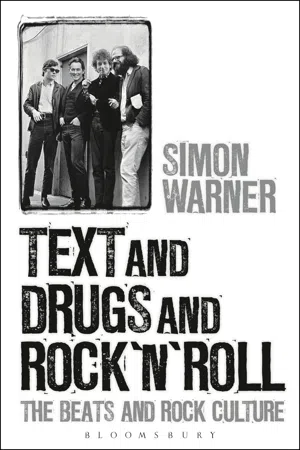
Text and Drugs and Rock'n'Roll explores the interaction between two of the most powerful socio-cultural movements in the post-war years - the literary forces of the Beat Generation and the musical energies of rock and its attendant culture.
Simon Warner examines the interweaving strands, seeded by the poet/novelists Jack Kerouac, Allen Ginsberg, William Burroughs and others in the 1940s and 1950s, and cultivated by most of the major rock figures who emerged after 1960 - Bob Dylan, the Beatles, Bowie, the Clash and Kurt Cobain, to name just a few.
This fascinating cultural history delves into a wide range of issues: Was rock culture the natural heir to the activities of the Beats? Were the hippies the Beats of the 1960s? What attitude did the Beat writers have towards musical forms and particularly rock music? How did literary works shape the consciousness of leading rock music-makers and their followers? Why did Beat literature retain its cultural potency with later rock musicians who rejected hippie values? How did rock musicians use the material of Beat literature in their own work? How did Beat figures become embroiled in the process of rock creativity?
These questions are addressed through a number of approaches - the influence of drugs, the relevance of politics, the effect of religious and spiritual pursuits, the rise of the counter-culture, the issue of sub-cultures and their construction, and so on. The result is a highly readable history of the innumerable links between two of the most revolutionary artistic movements of the last 60 years.
- 544 pages
- English
- ePUB (mobile friendly)
- Available on iOS & Android
eBook - ePub
About this book
Information
1 SIFTING THE SHIFTING SANDS: ‘HOWL’ AND THE AMERICAN LANDSCAPE IN THE 1950s
On 7 October 1955 in the Six Gallery in downtown San Francisco, an emerging but little known poet called Allen Ginsberg stood to deliver a new, long poem he had been working on over the previous months. ‘Howl’, read to a small, if packed, crowd of friends and supporters, would-be novelists and ambitious young poets, was an immediate sensation. The listeners greeted the piece, an impassioned statement touching upon issues as broad as the Cold War, homosexuality, Buddhism and jazz, drugs, the supernatural and suicide, with a huge and enthusiastic ovation. Said Jonah Raskin in his book American Scream: Allen Ginsberg’s ‘Howl’ and the Making of the Beat Generation: ‘[T]he audience was transformed […] indifferent spectators becoming energetic participants […] No one had been to a poetry reading that was so emotional and so cathartic’.1
Several of the writers in attendance would actually go away and write their own first-hand account of what had gone on that evening – Jack Kerouac would fictionalise the occasion in his 1958 novel The Dharma Bums, for example – a suggestion in itself that there was a strong sense a piece of history, a memorable literary moment, had been played out on that autumn night. ‘In all of our memories no one had been so outspoken in poetry before’, wrote another poet Michael McClure after the reading. ‘We had gone beyond a point of no return – and we were ready for it, for a point of no return. None of us wanted to go back to the grey, chill, militaristic silence, to the intellective void – to the land without poetry – to the spiritual drabness. We wanted to make it new and we wanted to invent it and the process of it as we went into it. We wanted voice and we wanted vision.’2 An underground gathering of subterranean scribes and street philosophers, the so-called Beat Generation, had raised its head above the parapet.3
With ‘Howl’, Ginsberg marked his arrival as a writer of profile and status. His previous decade, and more, of uncertain progress – acceptance then expulsion from the Ivy League campus of Columbia in New York, his involvement with the under-classes of Manhattan and his fringe contributions to their criminal activities, a period under the scrutiny of the asylum, his visionary episodes in which he believed he had heard the voice of William Blake, and his time as an employee of the Madison Avenue advertising industry – was behind him; his life as poet had commenced. The day after the Six Gallery reading, Lawrence Ferlinghetti, the proprietor of City Lights bookshop and its emerging publishing operation, would acknowledge Ginsberg’s achievement with scant delay. Ferlinghetti, referencing words that Ralph Waldo Emerson had penned to Walt Whitman in praise of Leaves of Grass in 1855, exactly 100 years before, wrote to Ginsberg: ‘I greet you at the beginning of a great career. When do I get the manuscript?’4
While this new era would not be without its accompanying difficulties – the acclaimed piece would indeed be published by City Lights the following year, as Howl and Other Poems, only to face obscenity charges and a high profile court case within months – the breakthrough that ‘Howl’ represented was enormous, not only for the writer of the poem but also those in Ginsberg’s circle. His friends Kerouac and William Burroughs would gain immensely from the poet’s national, then international, recognition. Ginsberg had been and remained a tireless promoter of his fellow writers’ novels. He had helped Burroughs to publish his debut book, Junkie, in 1953, and would continue to push his much more difficult, experimental works like The Naked Lunch as the 1950s turned into the 1960s. For Kerouac, ‘Howl’ was like the fanfare before the curtain rose and the stage illuminated, for Ginsberg made mention of his friend’s numerous unpublished novels in the preface to the poem and included him among several dedicatees. In 1957, On the Road, the major novel of this tight-knit gathering of writers, would appear and cause a sensation. The Beats, a community known essentially to its core members only before the mid-1950s, would swiftly become a literary grouping familiar to hundreds and thousands of readers around the globe in the months and years that would follow.
Yet, if writers and poets of a fresh vein were beginning to make their mark at this moment, there were other significant forces at play on a shifting American landscape. By the time Ginsberg premiered his soon-to-be published poem, a significant record was coming to the end of a six-month stay in the Top 40, the American Billboard chart which had become the standard weekly sales listing for pop songs from 1940. Bill Haley and His Comets’ single ‘(We’re Gonna) Rock Around the Clock’ – also widely described in its shortened version of ‘Rock Around the Clock’ – had entered the chart on 15 April 1955 and would remain in that list for the next 24 weeks.5 During its stay it would also enjoy eight weeks in the number one position, a significant indicator that this record had entered and remained part of the national psyche for some considerable time.
Why was this of importance? This was not Haley’s first chart entry: Palmer credits his 1953 release ‘Crazy Man Crazy’ as ‘the first white rock and roll hit’6 and, at the end of 1954, Ward states that ‘Shake, Rattle and Roll’, a bowdlerised version of a Big Joe Turner hit, ‘shot up the Top Ten – not only in the United States but also in England, where teenagers were apparently awaiting this blast of new music just as avidly as Americans were’.7 But ‘(We’re Gonna) Rock Around the Clock’ left a deeper imprint because, not only was it heard on record players and radios, but had also been featured in an acclaimed and widely-seen movie of 1955, The Blackboard Jungle, a school-based drama starring Glenn Ford which had utilised music – jazz versus rock ’n’ roll – as a metaphor for the generation gap. The film, based on a novel by Evan Hunter concerned ‘a new teacher at a high school in a “bad” section of town [who] is taunted and abused by a group of his students (including a black one played by Sidney Poitier)’.8 A fellow teacher also endures the ignominy of having his jazz records smashed by members of his class.9
Why though should we attempt to elide these two works, ‘Howl’ and ‘Rock Around the Clock’, a piece of poetry and a song? Why should a connection be made between an un-minted poem, known to but a dedicated few, and a hugely successful pop record, familiar to millions across the States? This chapter will argue that both of these expressions were symptomatic of an America that was undergoing a period of dramatic transition. While Ginsberg’s verse and Haley’s song were coming from different intellectual places, and appealing to different sections of society, they were symbols of that metamorphosis. These two distinct tributaries in America’s cultural stream gushed freely, and largely independently, during the latter 1950s and early 1960s yet, by the middle of the 1960s, appeared to find confluence. By then, the jump and jive innocence of rock ’n’ roll had matured into the earnest exhorting of a new rock, no longer merely concerned with the boy-meets-girl obsessions of adolescent-oriented pop, but now spreading its creative net to embrace sex and psychosis, politics and pot, as the Beatles and Bob Dylan replaced the early heroes of rock’s pantheon. And, with that transformation, some of the key Beats would take the view that rock was something they could feed into and bounce off; the musicians and the poets could and would discover common ground. But that coming-together is a tale for another place in this volume. Here we will examine the US context in which Beat literature, with ‘Howl’ as its unravelling and uncompromising standard, and original rock ’n’ roll, both symptom of, and cure for, post-war teen neurosis perhaps, were initially recognised.
Let us consider the national setting that applied in the middle of the 1950s and the kind of America that felt the psychological tremors that Ginsberg’s vociferous assault sent scurrying across the nation, first among the literati, then the media, then the courts and, with remarkable speed, among ordinary men and women in the street. What had been happening socially and politically prior this to thought-quake; what had been unfolding in the worlds of literature and popular music, art and art music? The decade after the end of the Second World War, concluded first in Europe then devastatingly under atomic clouds in the Far East, was a time of extraordinary contrast for the US. On the one hand, the economic troubles, that had so scarred the 1930s, troubles that had only been exorcised by a combination of Roosevelt’s Keynesian plans to rebuild America and the arrival of the war which had galvanised industry and seen off the last remnants of Depression, evaporated and by the early 1950s economic boom was bringing prosperity to large portions of the nation: the white middle classes, particularly, saw standards of living rise and the home become a haven for an abundance of newly available consumer goods – fridges and other kitchen appliances, radios and televisions. There was a sense, certainly among the advantaged sections of American society that the cruelty of war had at least been followed by the balm of material comfort, the cooling breeze of financial security. As Bradbury writes: ‘[R]eal incomes doubled, the rewards of a mass consumer society spread even further and America became a land of unprecedented affluence, an example to others.’ But, he counsels, ‘the age of affluence was also an age of materialism and conformity’.10
However, we should be cautious of these broad brush-strokes; the picture was far from rosy in all aspects. The Civil War, that traumatic scarification of the American soul, was not yet a hundred years past and the promises the bloody conflict had intended to deliver – emancipation of the American Negro from the yoke of brutalised slavery, in particular – had only been partially fulfilled. If the barbarisms of plantation enslavement had legally ended with the war’s conclusion, even by the 1950s the lot of most black men and women was only marginally improved. Mass Negro emigration to the northern states from the 1930s and into the 1940s had seen cities like Chicago and Detroit, cradles of the US industrial recovery, employ large numbers of black workers on their production lines. In this ...
Table of contents
- FC
- Title
- Copyright
- Contents
- Acknowledgements
- Credits
- Preface
- INTRODUCTION
- 1 SIFTING THE SHIFTING SANDS: ALLEN GINSBERG, ‘HOWL’ AND THE AMERICAN LANDSCAPE IN THE 1950s
- 2 CHAINS OF FLASHING MEMORIES: BOB DYLAN AND THE BEATS, 1959–1975
- 3 MUSE, MOLL, MAID, MISTRESS? BEAT WOMEN AND THEIR ROCK ‘N’ ROLL LEGACY
- 4 RAISING THE CONSCIOUSNESS? RE-VISITING ALLEN GINSBERG’S 1965 TRIP TO LIVERPOOL
- 5 THE BRITISH BEAT: ROCK, LITERATURE AND THE UK COUNTERCULTURE IN THE 1960s
- 6 THE SOUND OF THE SUMMER OF LOVE? THE BEATLES AND SGT. PEPPER, THE HIPPIES AND HAIGHT-ASHBURY
- 7 THE MELTZER CHRONICLES: POET, NOVELIST, MUSICIAN AND HISTORIAN OF BEAT AMERICA
- 8 VERSIONS OF CODY: JACK KEROUAC, TOM WAITS AND THE SONG ‘ON THE ROAD’
- 9 FEELING THE BOHEMIAN PULSE: LOCATING PATTI SMITH WITHIN A POST-BEAT TRADITION
- 10 JIM CARROLL: POETRY PRODIGY, POST-BEAT AND ROCKER
- 11 ALL CUT UP? WILLIAM BURROUGHS AND GENESIS P-ORRIDGE’S BEATNIK PAST
- 12 STEVEN TAYLOR: A BEAT ENGLISHMAN IN NEW YORK
- 13 RETURN TO LOWELL: A VISIT TO THE COMMEMORATIVE AND KEROUAC’S GRAVE
- Appendix – Kerouac and Cassady on record
- Bibliography, discography, filmography, broadcasts, personal communication and interviews
- Index
Trusted by 375,005 students
Access to over 1.5 million titles for a fair monthly price.
Study more efficiently using our study tools.
Frequently asked questions
Yes, you can cancel anytime from the Subscription tab in your account settings on the Perlego website. Your subscription will stay active until the end of your current billing period. Learn how to cancel your subscription
No, books cannot be downloaded as external files, such as PDFs, for use outside of Perlego. However, you can download books within the Perlego app for offline reading on mobile or tablet. Learn how to download books offline
Perlego offers two plans: Essential and Complete
- Essential is ideal for learners and professionals who enjoy exploring a wide range of subjects. Access the Essential Library with 800,000+ trusted titles and best-sellers across business, personal growth, and the humanities. Includes unlimited reading time and Standard Read Aloud voice.
- Complete: Perfect for advanced learners and researchers needing full, unrestricted access. Unlock 1.5M+ books across hundreds of subjects, including academic and specialized titles. The Complete Plan also includes advanced features like Premium Read Aloud and Research Assistant.
We are an online textbook subscription service, where you can get access to an entire online library for less than the price of a single book per month. With over 1.5 million books across 990+ topics, we’ve got you covered! Learn about our mission
Look out for the read-aloud symbol on your next book to see if you can listen to it. The read-aloud tool reads text aloud for you, highlighting the text as it is being read. You can pause it, speed it up and slow it down. Learn more about Read Aloud
Yes! You can use the Perlego app on both iOS and Android devices to read anytime, anywhere — even offline. Perfect for commutes or when you’re on the go.
Please note we cannot support devices running on iOS 13 and Android 7 or earlier. Learn more about using the app
Please note we cannot support devices running on iOS 13 and Android 7 or earlier. Learn more about using the app
Yes, you can access Text and Drugs and Rock 'n' Roll by Simon Warner in PDF and/or ePUB format, as well as other popular books in Media & Performing Arts & Literary Criticism. We have over 1.5 million books available in our catalogue for you to explore.