Adaptations have occurred regularly since the beginning of cinema, but little recognition has been given to avant-garde adaptations of literary or other texts. This compelling study corrects such omissions by detailing the theory and practice of alternative adaptation practices from major avant-garde directors.
Avant-Garde films are often relegated to the margins because they challenge our traditional notions of what film form and style can accomplish. Directors who choose to adapt previous material run the risk of severe critical dismay; making films that are highly subjective interpretations or representations of existing texts takes courage and foresight. An avant-garde adaptation provokes spectators by making them re-think what they know about film itself, just as much as the previous source material.
Adaptation and the Avant-Garde examines films by Peter Greenaway, Jean-Luc Godard, Guy Maddin, Jan Svankmajer and many others, offering illuminating insights and making us reconsider the nature of adaptation, appropriation, borrowing, and the re-imagining of previous sources.
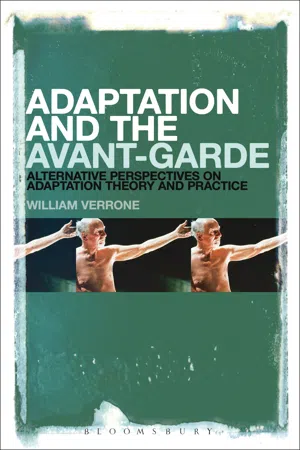
eBook - ePub
Adaptation and the Avant-Garde
Alternative Perspectives on Adaptation Theory and Practice
- 288 pages
- English
- ePUB (mobile friendly)
- Available on iOS & Android
eBook - ePub
Adaptation and the Avant-Garde
Alternative Perspectives on Adaptation Theory and Practice
About this book
Information
Part I
Historical and Theoretical Background
Chapter 1
Defining the Avant-Garde Film
Avant-garde films are not always easy to define in an all-inclusive manner, but they are typically recognized by cineastes and even average spectators because of their very nature of being “different.” Experimental and avant-garde films do not necessarily comprise a large, coherent genre of their own (even though the avant-garde can be called a genre), because they are so diverse; rather, they tend to rework genres in new ways, playing with tropes and subverting or undermining traits, characteristics, or expectations. Additionally, avant-garde films disrupt narrative continuity by often presenting a nonlinear plot. Characterization may or may not be important to the particular film, but almost all avant-garde films have to do with perception, or how one sees things, and so they establish new parameters for defining and emphasizing the representation of vision and subjectivity. Avant-garde films also explore the possibilities of film language, seeking to break from traditional methods of using miseen-scène, cinematography, editing, or sound. In this way, avant-garde film tends to challenge, destabilize, or distort prevailing discourses on cinema, cinema theory, and cinema history. Tracing the history of the avant-garde film, for example, leads one on both tangential and radically alternative paths that sometimes cross with the mainstream but more often than not create their own culturally and socially significant avenues of exploration, as oppositions to the norm/mainstream. Still, as Dudley Andrew asserts, “In laboring to thwart the normal ‘way of the cinema,’ the radically avant-garde film draws attention to the strength and ubiquity of that ‘way.’ ” 1 In other words, typical audiences find themselves seeking normalcy when confronted with the avant-garde.
Defining an avant-garde film is not impossible, but some of the characteristics mentioned imply that there is a clear-cut way to label, classify, or catalog them depending on their specific attributes or characteristics. For instance, there are film poems, “trance” films, structural films, and abstract or graphic films. Most of these descriptions come from P. Adams Sitney’s monumental and irreplaceable Visionary Film , but Sitney, too, is weary of the label avant-garde. In the preface to the first edition of the book, he writes, “‘Avant-garde’ in itself is unfortunate [as a label.] On the one hand it implies a privileged relationship to a norm which I do not wish to affirm, and on the other hand it has been used to describe thousands of films which fall outside the scope of this book …” 2 This is still very true today. However, it seems that using avant-garde as a descriptive category of film-making can be advantageous because it suggests an alternative form of communicating meaning, as opposed to the more customary form found in multiplexes. Rightfully so, though, there are far too many avant-garde films produced to ever fully be accounted for, and many are bad. Also, Sitney’s categories of avant-garde film allow for like-minded filmmakers to be aligned into one group, for example, “visionary.” Another well-known critic and scholar of avant-garde film, Fred Camper, delineates six “qualities” to “naming and defining avant-garde or experimental film.” Camper suggests not all six need to be present in any one given film. They include, and I paraphrase: (1) a film made by one person or occasionally a small group of like-minded people using his or her or their own money; (2) the films avoid assembly-line production, like most mainstream films; (3) they typically do not offer linear stories; (4) they focus very clearly on film form, the “materials of cinema”; (5) they are in opposition to mass media and mainstream culture; and (6) they offer various messages, not a clear “univalent” (or singular) one. Camper concludes by saying, “I don’t propose any mechanical method whereby meeting, say, five of the six automatically qualifies a film, but rather suggest that considering these characteristics might be useful in thinking about this body of work” 3 Camper’s six qualities (and he also calls them a “six-part test”) offer many ways to discuss or “test” the inherent traits of avant-garde film. All things considered, discovering a quick, easy, all-encompassing definition for avant-garde films is nonexistent. But they are recognizable, as are avant-garde adaptations.
Nearly all avant-garde films offer ways to comprehend reality in unconventional yet meaningful ways. The avant-garde is artistically ambitious; filmmakers working in this realm pay little attention to convention and instead maintain a rigorous devotion to their own aesthetic, political, or critical vision. Avant-garde denotes a historical moment of specific activities and practices not necessarily associated with any particular artistic style or strategy. The avant-garde advances new techniques, forms of expression, and subject matter, existing outside the “culture industry” and showcasing a heightened awareness of the trappings of commercial art. The avant-garde, which encompasses most artistic forms (painting, music, and literature, for instance) or at least is aware of other artistic forms, either challenges the understandings of contemporary art or uses the other arts in the filmmaking process, seeking equivalents in signs, codes, or language. The avant-garde is a “personalized, noncommercial, non-narrative, and reductive use of the medium that, in most cases, is related to other art forms, such as painting, music, or poetry.” 4 This relationship immediately sets the avant-garde apart from the mainstream, simply because the avant-garde filmmaker is far more interested in attaining a highly individual vision akin to a poet, painter, or composer, working in opposition to classical narrative cinema and “privileging the personal over the pecuniary.” 5
The avant-garde has routinely been defined as either a collective group of like-minded filmmakers or as lone artists working in remote corners of the film industry (but shunning the industry). Sometimes, avant-garde directors bring more attention to social problems that hamper human endeavor, but their rationale for making films is not typically overtly political. The avant-garde also has been described as a forward-looking practice and art—one that clearly see the future of the medium. The avant-garde started as a more politically minded creative output, seeking to disrupt the bourgeois idea of art. Matei Calinescu, in his still useful book, Five Faces of Modernity , does a fine job tracing the history of the avant-garde, from its origins as a politically oppositional term in the early nineteenth century to its use in the twentieth century as a kind of artistic practice. The avant-garde artist, for example, is similar to the romantic poet, a characteristic that expert avant-garde critic P. Adams Sitney has also outlined, or, as Calinescu says, “The idea that poets are endowed with visionary powers, that they are indeed ‘mirrors of futurity,’ and as such in advance of their time, was shared by many progressive-minded romantics,” which in turn describes the type of art the avant-gardist creates—advanced or ahead of its time. 6 The origin of the term avant-garde is martial. It describes the “advanced guard” that led the troops into battle—they were “in the lead” or “in front of” the rest, hence, the connotative use of avant-garde to imply a futuristic movement and thus perhaps its application to politics. Not every avant-garde filmmaker is interested in politics or ideology, however, and most are not. However, because the term derives from the military, there are specific connotations that cross to the practice of film. As Calinescu points out,
The obvious military implications of the concept point quite aptly toward some attitudes and trends for which the avant-garde is directly indebted to the broader consciousness of modernity—a sharp sense of militancy, praise for nonconformism, courageous precursory exploration, and, on a more general plane, confidence in the final victory of time and immanence over traditions that try to appear as eternal, immutable, and transcendentally determined. 7
All of these categories of defiance can describe avant-garde filmmakers, even though Calinescu is talking more broadly about the artistic avant-garde and its relationship to modernity, a term that implies progress, creativity, and inevitable advancement. Avant-garde film and having an avant-garde attitude, especially in terms of other art forms, are not necessarily the same thing. However, many filmmakers adopt an avant-garde attitude or, more appropriately, an avant-garde aesthetic or approach when making decisions. As Andras Balint Kovacs points out, “The important difference between what is commonly called the avant-garde/experimental movements in film and the avant-garde of fine arts is that the former is not a typically political movement.” 8 Furthermore, “Avant-garde/experimental/underground cinema is a specific cinematic practice that may or may not include a political component. It differs from classical cinema as well as from modernist art cinema precisely by virtue of its practice.” 9 The distinction between politically motivated art and artistically driven film is important because it allows us to examine the film itself on its own terms, without seeking a specific ideological agenda to determine its meaning(s) or value as a film or film adaptation. Artists who stand at the forefront of new ideas, ones that are innovative or experimental, help distinguish the avant-garde filmmaker.
The avant-garde film makes cognizant use of the materials of cinema, normally sidestepping linear stories in favor of either abstract or nonlinear stories—if a story is even part of its narrative structure. Many times, the avant-garde filmmaker works as more than just the director: He or she is also the scriptwriter, perhaps the editor or cinematographer, or the producer. The films are often deliberately ambiguous, which in turn suggests they offer connotative, associative meanings for individual spectators. Kovacs also suggests,
As a cinematic practice, avant-garde/underground/experimental film-making is always aimed at private, self-expressive use of the cinema. It is the laboratory of the audio-visual medium, a formal experiment more or less inspired by modern painting and literature, distributed in a noncommercial circuit, for a restricted audience. That is what always aligns the avant-garde with the arts and literature. It rejects cinema as a commercial institution but affirms it as a personal form of artistic expression whereby all kinds of artistic trends and movements can find their way to the cinema. 10
The cinema has the capacity to be an amalgam of all the arts, an argument articulated in the silent era by many practitioners such as Eisenstein, and therefore it can best represent the importance of the individual in creating a new form of representation and “artistic expression,” as Kovacs suggests. Whether or not avant-garde film is “inspired by modern painting and literature” is true—it remains an argument—it can be said that certain avant-garde films interact with modernist forms of art, hence Kovacs’s assertion. This is important to consider when taking into account adaptations, since, as I will outline later, the better kinds of adaptations always acknowledge their interactions and conflicts with the source text or a variety of sources. The avant-garde filmmaker makes films for self-expressive use, and he or she almost always explicitly makes use of film form to showcase themes or has such a unique yet recognizable vision that his or her style becomes a focal point for discussion. These both aid in identifying and distinguishing certain adaptations made by avant-garde filmmakers.
Avant-garde films often juxtapose realist and antirealist aesthetics or forms, challenge the spectator’s subjectivity, address issues concerning the unconscious, and openly concentrate on film form. Editing, cinematography, and sound combine in unique ways to create particular visions of the filmmaker, with the deliberate overturning of genre or the subversion of generic tropes, the employment of dissociative images and narrative constructs, or the thwarting of spectator omniscience. Because of these characteristics, avant-garde film adaptations arguably are more creative than mainstream productions. Avant-garde films can disrupt narrative time and space, creating temporal and spatial disorientation for spectators through a variety of means, such as “shifts from diegetic continuity to discontinuity, fast editing, disruptions of conventional transitional shots, disorienting shots through unmatched shots or a simultaneous representation of a multiplicity of perspectives.” 11 Avant-garde films have to do with perception, and the way filmmakers decide to construct the film both in style and form plays a large role in how the spectator reacts to the film. Andrew has noted, “Avant-garde filmmakers over the years have disrupted the codes of perception by altering the usual focus, framing, and even the speed and direction of visual recording.” 12 The terms that characterize descriptions of the avant-garde, such as disrupted or discontinuous, imply a deliberate attempt to challenge or thwart the more normal codes of mainstream cinema. These types of films offer alternatives to the cinematic status quo. Classical narrative cinema features narrative comprehension and closure, realist styles, linear plots, clear identification of character motivation, and continuity editing. Avant-garde films may often bear some of these traits, but mostly they can be thought of as being created in direct opposition to and confrontation with these characteristics that dominate mainstream narrative film; “[i]t has always been the domain of experimental cinema to seek to disrupt [the] artificially enforced order” of mainstream cinema. 13 Many avant-garde filmmakers view the mainstream as uninteresting or uninventive. Spectators alike see too many clichés and unimaginative elements in conventional cinema. The same can be applied to adaptations: why are there not enough film adaptations that embrace alternativeness? Why can there not be film adaptations that want to create difference? The purpose of my study is to answer these questions by examining the alternative film adaptations of avant-garde directors, which means exploring traditional discussions of adaptations differently—the same way one would discuss avant-garde films as being antithetical to mainstream productions. If “the function of the avant-garde, as the vanguard of autonomous bourgeois art, is to ensure that all cultural products that penetrate the realm of the bourgeoisie are rendered superfluous,” then film adaptations that welcome interpretive creativity serve a similar purpose: to render those forms of mainstream art to the wayside, in order to showcase the significance of avant-garde film and avant-garde art. 14 According to Calinescu, “What the artists of the new avant-garde were interested in doing … was to overthrow all the binding formal traditions of art and to enjoy the exhilarating freedom of creativity.” 15 This “new” avant-garde, which refers to the artists of the twentieth century, “believed that to revolutionize art was the same as to revolutionize life.” 16 Avant-garde film breathes “new life” into the cinematic medium itself, and avant-garde adaptations revolutionize the way we can imagine how to transfer previous sources to the screen.
Avant-garde film has been described as being wholly personal (the American avant-garde of the 1940s–60s), detailing abstract ideas or forms (the German avant-garde of the 1920s–30s), or addressing the formal characteristics of the medium (the French avant-garde of the 1920s–30s). All of these areas constitute specific historical occurrences of the avant-garde and are important in defining a coherent way of speaking about avant-garde film. Avant-garde film can be highly subjective by focusing on the interior life of the director or of a character, and it can highlight its formal features, drawing our attention to its artifice by employing a scratched or painted filmstrip, using trick photography, or using techniques that are self-reflexive. This structuralist–materialist approach is considered more European, while the more “personal” cinema is associated with the American pioneers of the 1940s or the underground artists of the 1960s. In all its forms, the avant-garde forces us to notice the capabilities of the film medium. Within the realm of the avant-garde, anything is possible. The goal of many avant-garde films is to expand one’s vision. One of the fundamental questions that the avant-garde gives rise to is, What is it that you see when you are looking at something? Different ways of viewing reality or the presentation of the interior life dictates how one should approach an avant-garde film. The same applies to an adaptation: The spectator must be willing to suspend disbelief and any fidelity to the original and instead receive the new form of representation that the avant-garde adaptation offers. In describing the experimental cinema of the 1960s, which included underground and avant-garde film, Wheeler Winston Dixon suggests, “What was sought above all other considerations was a new way of apprehending the visual world,” and that “what was at stake was nothing less than the care of the soul.” 17 Perhaps this is a grandiose statement, but the point is that these artists wanted to present new ways of comprehending the “visual world,” which suggests that they wanted to change or alter the way people already see or have been seeing the world. Additionally, it might be said these artists felt the need—a compulsion—to change the way people think about vision and perception. The avant-garde does not only challenge conventional aesthetic tastes, but it forces us to reexamine the fundamental pre...
Table of contents
- Cover
- Halftitle
- Title Page
- Copyright
- Contents
- Acknowledgments
- Introduction
- Part I: Historical and Theoretical Background
- Part II: A Chronology of Avant-Garde Film Adaptation
- Part III: Case Studies
- Conclusion
- Appendix: Some Avant-Garde Adaptations
- Notes
- Bibliography
- Index
Trusted by 375,005 students
Access to over 1.5 million titles for a fair monthly price.
Study more efficiently using our study tools.
Frequently asked questions
Yes, you can cancel anytime from the Subscription tab in your account settings on the Perlego website. Your subscription will stay active until the end of your current billing period. Learn how to cancel your subscription
No, books cannot be downloaded as external files, such as PDFs, for use outside of Perlego. However, you can download books within the Perlego app for offline reading on mobile or tablet. Learn how to download books offline
Perlego offers two plans: Essential and Complete
- Essential is ideal for learners and professionals who enjoy exploring a wide range of subjects. Access the Essential Library with 800,000+ trusted titles and best-sellers across business, personal growth, and the humanities. Includes unlimited reading time and Standard Read Aloud voice.
- Complete: Perfect for advanced learners and researchers needing full, unrestricted access. Unlock 1.5M+ books across hundreds of subjects, including academic and specialized titles. The Complete Plan also includes advanced features like Premium Read Aloud and Research Assistant.
We are an online textbook subscription service, where you can get access to an entire online library for less than the price of a single book per month. With over 1.5 million books across 990+ topics, we’ve got you covered! Learn about our mission
Look out for the read-aloud symbol on your next book to see if you can listen to it. The read-aloud tool reads text aloud for you, highlighting the text as it is being read. You can pause it, speed it up and slow it down. Learn more about Read Aloud
Yes! You can use the Perlego app on both iOS and Android devices to read anytime, anywhere — even offline. Perfect for commutes or when you’re on the go.
Please note we cannot support devices running on iOS 13 and Android 7 or earlier. Learn more about using the app
Please note we cannot support devices running on iOS 13 and Android 7 or earlier. Learn more about using the app
Yes, you can access Adaptation and the Avant-Garde by William Verrone in PDF and/or ePUB format, as well as other popular books in Media & Performing Arts & Film & Video. We have over 1.5 million books available in our catalogue for you to explore.