The words 'me,' 'mine,' 'you,' 'yours,' can mislead us into feeling separate from other people. This book is an exhilarating contribution to the spirituality of non-duality or non-separation. Meister Eckhart, Mother Julian of Norwich and Thomas Traherne are interpreted as 'theopoets' of the body/soul who share a moderate non-dualism. Their work is brought within the ambit of non-dual Hinduism. Specifically, their passion for unitive spiritual experience is linked to construals of both 'the Self' and 'Awakening', as enunciated by Advaita Vedanta.
Charlton draws on poetry, theology and philosophy to perceive fresh connections. A commonality of interest is proposed between the three Europeans and Ramana Maharshi. The concept of non-duality is basic to much of Asian religion. On the other hand, Christianity has usually ignored its own non-dual roots. This text contributes to a recovery, in the West, of the vital, unifying power of non-dual awareness and connectedness.
eBook - ePub
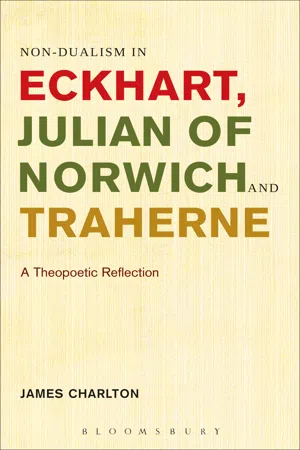
Non-dualism in Eckhart, Julian of Norwich and Traherne
A Theopoetic Reflection
- 192 pages
- English
- ePUB (mobile friendly)
- Available on iOS & Android
eBook - ePub
About this book
Information
1
Thomas Traherne
Traherne’s vision is uncommonly expansive. He resists labels and categories. He elevates the senses and sensuality; he praises embodiment. The joy-filled condition of ‘felicity’ (his theme-word) can be found through an active embrace of the temporal ‘within’ the divine and the divine ‘within’ the temporal. Forgetting the conventional distance between the human and the divine, Traherne loses himself in a personal blend of matter and spirit. A second theme-word will suggest itself: ‘interpenetration’.
As with his predecessors Eckhart and Julian, this quirky poet-theologian sees more with the eye of the heart than with the mind of doctrine. But I hasten to add: Together with his predecessors, Traherne knows that without a doctrine, spiritual life can be reduced to the appreciation of art. Traherne venerates the given, natural world, as do the multitude of his godchildren (such as Thoreau, et al.). But he employs a deeper theopoem than many of his descendants would care for. This deeper strand might be called Christ-centredness. To Traherne, the divine is relational and therefore accessible in mutual reciprocity. Paradox of course will always attend a non-dualism which is coupled with some version of theistic transcendence.
As appears to have been the case with Eckhart and Julian, Traherne was born into a top-heavy world. That is to say, top-heavy with beliefs about divine transcendence. He seems to rediscover a joyful awareness of inherent value. Accordingly, it might clumsily be said that he finds Earth-centredness within his cosmically configured Christ-centredness. I have already implied that the tone of Traherne anticipates that of later writers, whereby the randomness of the contingent world is appreciated on its own terms. My own poem, below, owes its sensibility to Traherne, via aspects of Romanticism.
Yellow-tailed Black Cockatoos
Random as rags whooshed off a truck,
they indolently amble on the air. This caterwaul:
wee-la. Yes, there,
husky, high. It seems an idle sortie,
a lope of meander-flight, a frittering in the eye
of foul weather.
Gale winds begin to split and peel
a suburb of weather-board husks, but the flock
keeps following its memory-grid
to grubs in weakened trees. (Birds like these
saw dinosaurs plod through dust.)
They prise, rip,
rasher the acacia bark, and change trees,
wheeling and veering like black Venetian blinds
collapsed at one end.
Then they dip, curious,
to an English willow;
shimmy down bare verticals on hinge-claws;
whir out
on a glissade of whoops:
concertina-tailed, splay-winged, wailing.
Although Thomas Traherne is a spontaneous, vigorous poet, his work carries a consistent, theopoetic argument: all things in the universe are interconnected and inherently valuable. Ahead of his time, Traherne writes of a universal partnership. He asks his readers: ‘Can you see the way things are? Do you not experience things as inseparable?’ References to the natural world are frequent in Traherne, yet attenuated. His readers can provide their own contexts. Today, theopoets who lose themselves in a blend of matter and spirit will usually add more detail. In the poem above, I attempt a Trahernian openness that is both exultant and meditative.
As already hinted, Traherne does not treat the words ‘God’ and ‘world’ as denoting two completely extrinsic realities. The divine is transcendent, but not in the sense of ‘floating entirely free’ of this world. It is within our immanent and significant world that divine and human transcendence work together.1 Traherne has a vision of the reciprocity of ‘all Things’. It is here that we are able, or unable, to transcend that which defeats us. Ordinary, potentially ‘Joyfull’ life is where transcendence is manifested. A mushroom, an ant, a stone has inherent value. This value resides within the entities themselves; it is not merely ‘endorsed’ by an extrinsic God.
For most of humanity’s literate history, poetry’s purpose has been to contemplate the divine. In Traherne’s England, this purpose included the consideration of all life as linked to the divine. Within such a view, each finite thing can reveal infinitude. In modernist terms, a poet might speak of ‘Reality’ as a stand-in for the divine and describe it as a web of singularities, none of which is completely separate, and all of which seem to be ‘in process’ in different ways. But Traherne (together with Eckhart and Julian)2 uses patristic language. This includes a vision of infinite goodness; it also takes account of humanity’s desire to ‘find itself’ within that goodness. The God of Traherne and predecessors is One, and yet triadic in manifestation. In my understanding, this means that God is held, simultaneously, to be the giver of goodness, the gift of goodness itself and the ‘process of goodness-giving’. The Infinite One is ‘all-ways relating’.
A devout humanist
Traherne trusts his own sensations. But this trust is not separate from trust in the divine. All five senses are part of God’s way of manifestation. In the poem My Spirit, he regards his spirit as inseparable from the senses that pertain to that spirit. He acknowledges no ultimate separation between spirit and intellect. Both are parts of the whole; they inform each other continually. My Spirit appeals to me as Traherne’s most overtly non-dual piece of writing. I will progressively quote most of it and venture some brief comments. Below is the opening verse and part of the closing:
My Naked Simple Life was I.
That Act so Strongly Shind
Upon the Earth, the Sea, the Skie,
It was the Substance of my Mind.
The Sence of self was I.
I felt no Dross nor Matter in my Soul,
No Brims nor Borders, such as in a Bowl
We see, My Essence was Capacitie.
That felt all Things,
The Thought that Springs
Therfrom’s it self. It hath no other Wings
To Spread abroad, nor Eys to see,
Nor Hands Distinct to feel,
Nor Knees to Kneel:
But being Simple like the Deitie
In its own Centre is a Sphere
Not shut up here, but evry Where.
O Wondrous Self! O Sphere of Light,
O Sphere of Joy most fair;
O Act, O Power infinit;
O Subtile, and unbounded Air!
O Living Orb of Sight!
Thou which within me art, yet Me! Thou Ey,
And Temple of his Whole Infinitie!
O what a World art Thou! A World within!3
The opening line ‘My Naked Simple Life was I’ appears to equate Traherne’s self with Life itself. The non-dual confidence of the first verse is overt. Antony Bellette4 states that the poet identifies the phenomenal with the spiritual. That is to say, the subject matter of the poem, that which concerns ‘my spirit’, is inseparable from the senses of that spirit. Bellette continues: ‘. . . the poem establishes in its opening lines the almost godlike indivisibility of the person’.5 To me, this is part of Traherne’s attractiveness; he cannot separate his participation in a spiritual life from his enjoyment of the world of phenomena.
In the first verse of My Spirit the poet risks identifying himself with ‘. . . a Sphere / Not shut up here, but evry Where’. The second verse (below) speaks of the necessary action which is the outward manifestation of the ‘Sphere’. The ‘Centre’ of the ‘Sphere’ now manifests as the principal ‘Act’.
Whatever it doth do,
It doth not by another Engine work,
But by it self; which in the Act doth lurk.
Its Essence is Transformed into a true
And perfect Act.
And so Exact
Hath God appeared in this Mysterious Fact,
That tis all Ey, all Act, all Sight, . . . .6
The third verse maintains the focus on a non-dual interaction between mind and matter. Does the reality of the world reside within the poet’s mind or within the matter of the world? The question does not concern Traherne. The natural world ‘. . . Was all at once within me’. All natural things ‘. . . Were my Immediat and Internal Pleasures’. These are phrases which occur in the third verse of My Spirit:
Her Store
Was all at once within me; all her Treasures
Were my Immediat and Internal Pleasures,
Substantial Joys, which did inform my Mind.
With all she wrought,
My Soul was fraught,
And evry Object in my Soul a Thought
Begot, or was; I could not tell,
Whether the Things did there
Themselvs appear,
Which in my Spirit truly seemd to dwell;
Or whether my conforming Mind
Were not even all that therin shind.7
The non-dual purport is well-perceived by Bellette8 when he says: ‘In the third stanza the act of perceiving objects in the world is virtually equated with the realization of them in the mind (or soul, or spirit, the words seem interchangeable), with the result that material reality and mental act are no longer separable’. My Spirit exults in the reality of the material world; the poet is grateful for his ‘Capacitie’ to feel ‘all Things’ (verse one); he understands them all as originating with God’s inner rationality.9
A few lines further on, Traherne blatantly declares that his soul is ‘. . . Simple like the Deitie’. Here again is a remarkable non-duality. Distinctions are blurred, as between the feeling subject and the felt object. Traherne is a participant with the divine; he shares...
Table of contents
- Cover
- Half-Title
- Introduction
- 1 Thomas Traherne
- 2 Meister Eckhart
- 3 Mother Julian of Norwich
- 4 Losing and Finding the Self
- 5 Non-dual ‘Awakening’
- A Way Forward
- Glossary
- Notes
- Bibliography
- Index
Trusted by 375,005 students
Access to over 1.5 million titles for a fair monthly price.
Study more efficiently using our study tools.
Frequently asked questions
Yes, you can cancel anytime from the Subscription tab in your account settings on the Perlego website. Your subscription will stay active until the end of your current billing period. Learn how to cancel your subscription
No, books cannot be downloaded as external files, such as PDFs, for use outside of Perlego. However, you can download books within the Perlego app for offline reading on mobile or tablet. Learn how to download books offline
Perlego offers two plans: Essential and Complete
- Essential is ideal for learners and professionals who enjoy exploring a wide range of subjects. Access the Essential Library with 800,000+ trusted titles and best-sellers across business, personal growth, and the humanities. Includes unlimited reading time and Standard Read Aloud voice.
- Complete: Perfect for advanced learners and researchers needing full, unrestricted access. Unlock 1.5M+ books across hundreds of subjects, including academic and specialized titles. The Complete Plan also includes advanced features like Premium Read Aloud and Research Assistant.
We are an online textbook subscription service, where you can get access to an entire online library for less than the price of a single book per month. With over 1.5 million books across 990+ topics, we’ve got you covered! Learn about our mission
Look out for the read-aloud symbol on your next book to see if you can listen to it. The read-aloud tool reads text aloud for you, highlighting the text as it is being read. You can pause it, speed it up and slow it down. Learn more about Read Aloud
Yes! You can use the Perlego app on both iOS and Android devices to read anytime, anywhere — even offline. Perfect for commutes or when you’re on the go.
Please note we cannot support devices running on iOS 13 and Android 7 or earlier. Learn more about using the app
Please note we cannot support devices running on iOS 13 and Android 7 or earlier. Learn more about using the app
Yes, you can access Non-dualism in Eckhart, Julian of Norwich and Traherne by James Charlton in PDF and/or ePUB format, as well as other popular books in Theology & Religion & Philosophy of Religion. We have over 1.5 million books available in our catalogue for you to explore.