On the Intrinsic Value of Everything is an illuminating introduction to fundamental questions in ethics.
How-and to what-we assign value, whether it is to events or experiences or objects or people, is central to ethics. Something is intrinsically valuable only if it would be valued for its own sake by all fully informed, properly functioning persons. Davison defends the controversial view that everything that exists is intrinsically valuable to some degree.
If only some things are intrinsically valuable, what about other things? Where and how do we draw the cutoff point? If only living creatures are intrinsically valuable, what does this imply for how we value the environment? If everything has intrinsic value, what practical implications does this have for how we live our lives? How does this view fit with the traditional theistic idea that God is the source of goodness and truth?
Both critics and proponents of the concept of intrinsic value will find something of interest in this careful investigation of the basic value structure of the world.
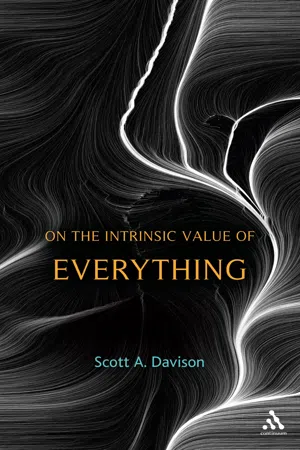
- 160 pages
- English
- ePUB (mobile friendly)
- Available on iOS & Android
eBook - ePub
On the Intrinsic Value of Everything
About this book
Information
1 Preliminary Matters
The concept of intrinsic value has a long and distinguished history, and like most philosophically interesting concepts, it has generated its share of controversy. I have little to add to the detailed debates about the proper elucidation of this concept. Instead, my focus is to argue that the concept has much wider application than most people have previously thought. But before I can argue for this conclusion, I should like to discuss briefly what would count as a successful account of the concept of intrinsic value, and then explain my own approach.
In Rediscovering Colors, Michael Watkins observes that a successful metaphysical account of colors must be semantically serious, ontologically serious, and epistemologically serious.1 Similarly, we should require that a successful account of intrinsic value be all of these things, plus one more. By way of clarification, a semantically serious account of intrinsic value should respect the linguistic conventions governing the use of the phrase intrinsic value. An ontologically serious account should be compatible with what we seem to know about the world.2 And an epistemologically serious account should explain how we might know (or at least justifiably believe) truths about intrinsic value. In addition, unlike a successful account of colors, a successful account of intrinsic value should be ethically serious in the minimal sense that its truth would have some clear bearing on how we should live our lives.
I shall address the requirement of semantic seriousness first, in Sections 1 through 3 of this chapter, before touching on epistemological concerns briefly in Section 4. Then I shall defend the ontological seriousness of my account of intrinsic value in Chapters 2 through 5, arguing that it is more plausible than any alternative view. Of course, in the final analysis, judgments about ontological seriousness are difficult holistic judgments, so people are bound to disagree about them; such is the nature of philosophy. In Chapter 6, I shall defend the ethical seriousness of my Main Conclusion.
1. The Concept of Intrinsic Value
It is safe to say that there is a lot of disagreement concerning the nature of intrinsic value in the philosophical literature.3 I shall not attempt to settle most of these disputes, let alone argue that my way of understanding the concept of intrinsic value is the best one. Instead, I shall introduce some helpful distinctions that others have drawn in order to explain my approach as clearly as possible. Providing an adequate survey and classification of the many ways in which philosophers have used the phrase intrinsic value would require writing another book, so I shall mention here only those distinctions that I find helpful in explaining my own approach.
Christine Korsgaard argues that there are two distinctions in goodness which are often conflated.4 First there is the distinction between intrinsic and extrinsic goodness: something is intrinsically good if and only if it is good in itself, whereas something is extrinsically good if and only if it receives goodness from another source. By contrast, there is the distinction between things which are sought for their own sakes (ends or final goods) and things which are sought for the sake of something else (instrumental goods). She notes that people often define one half of one of these distinctions in terms of one half of the other distinction. For example, people often define the intrinsically good as that which is sought for its own sake. Korsgaard is right to point out that this is a conflation of the two distinctions, and it should be avoided. Since this book is about intrinsic value, I am interested in intrinsic goodness (as opposed to extrinsic goodness), not in whether things are actually sought for their own sakes (as opposed to actually sought as a means to further ends).
Another helpful distinction is drawn by Gary Watson. There is a difference between valuing something and desiring it, since a person can desire something without valuing it (or without valuing it to the same degree that it is desired). This happens in cases of impulsive desire, like the case of the fleeting desire of the humiliated loser in a sporting event to kill the gloating opponent, and in cases of estranged desire, like the case of the man who wishes for religious reasons that he had no sexual desire (but experiences it nonetheless).5 Watson’s distinction undercuts any straightforward attempt to define intrinsic value in terms of desire.
The distinctions introduced by Korsgaard and Watson imply that many of the standard descriptions of intrinsic value are inadequate.6 For example, we cannot say that for something to be intrinsically valuable is for it to be desired for its own sake. We cannot even say that for something to be intrinsically valuable is for it to be valued for its own sake, and this for two reasons: first, not everything that is valued for its own sake need be intrinsically valuable. Second, not everything intrinsically valuable need be valued for its own sake. It is possible to have false negative experiences and false positive experiences of intrinsic value.
So something is intrinsically valuable if and only if it is good in itself, independent of its relations to other things. Clearly, I am not using the word good here in the sense of “useful for attaining some further end,” since that would involve an appeal to instrumental value, not intrinsic value. I am not using the word good here in the sense of “good member of a kind,” as in the sentence This is a good axe, which attributes to some specific axe the distinctive virtues of being an axe (those that correspond to its conventional function, such as being sharp, well-balanced, and so forth).7 So what do I mean by good when I say that something is “good in itself”?
Perhaps there can be no plausible, noncircular analysis of this sense of good.8 Fortunately, it is not necessary to have such an analysis in order to understand what a word means.9 Although I have no analysis to offer, I can exhibit an interesting logical connection between intrinsically valuable, as I use this phrase, and the valuing activities of fully informed, properly functioning valuers. Here it is: something is intrinsically valuable (or good in itself) if and only if it would be valued for its own sake by fully informed, properly functioning valuers. 10 So the claim that human beings are intrinsically valuable, for example, implies that human beings would be valued for their own sake by all fully informed, properly functioning valuers, whether they be human, divine, angelic, alien, or whatever. 11.
The concept of a fully informed, properly functioning valuer clearly has a number of interesting implications. It includes both epistemic and normative components. On the epistemic front, a fully informed valuer would know all the relevant facts concerning a thing and possess a clear understanding of the different kinds of value (economic, instrumental, sentimental, intrinsic, etc.). On the normative front, a properly functioning valuer would have had proper training in the activity of valuing (if necessary12), a history of proper reflection on the objects of value, a properly disinterested stance that is focused on the object in question, and so forth.
Of course, if we were to take this claim about the relationship between intrinsic value and a fully informed, properly functioning valuer to be an analysis of the meaning of good in itself or intrinsically valuable, then it might involve some degree of circularity, since the normative aspect of good would reappear under the guise of “proper” function. (If we did not know what good meant to begin with, would we know what properly functioning meant?) As Rabinowicz and Rønnow-Rasmussen say, concerning a related suggestion, this kind of approach to analysis “will never leave the realm of value.”13
But this is neither surprising nor damaging. Not only does the same problem arise for any plausible attempt to define other legitimate normative notions (such as the notions of duty, obligation, permission, right, etc.), but we encounter this kind of explanatory circle in other places too. For example, the physically possible is that which does not conflict with the laws of nature; the laws of nature tell us what is physically necessary; the physically necessary is that whose denial is not physically possible.14 At some point, we must take certain notions as basic; perhaps the primitive, undefinable sense of good is an acceptable starting point for this inquiry.
Different starting points have been suggested, of course. For example, G. E. Moore suggests defining the intrinsically good in terms of our duty to choose something,15 C. D. Broad employs the notion of a fitting object of desire,16 and both Roderick Chisholm and Michael J. Zimmerman appeal to what would be required in contemplation.17 Other examples could be cited here, but the ones I have mentioned above are sufficient to make my point, which is that rather than eliminating the normative component, these approaches simply relocate it...
Table of contents
- Cover
- Half-Title
- Introduction
- 1 Preliminary Matters
- 2 The Possibilities
- 3 The Bearers
- 4 The Cutoff Question
- 5 Degrees
- 6 Ethics
- 7 Theism and Intrinsic Value
- Bibliography
- Index
Trusted by 375,005 students
Access to over 1.5 million titles for a fair monthly price.
Study more efficiently using our study tools.
Frequently asked questions
Yes, you can cancel anytime from the Subscription tab in your account settings on the Perlego website. Your subscription will stay active until the end of your current billing period. Learn how to cancel your subscription
No, books cannot be downloaded as external files, such as PDFs, for use outside of Perlego. However, you can download books within the Perlego app for offline reading on mobile or tablet. Learn how to download books offline
Perlego offers two plans: Essential and Complete
- Essential is ideal for learners and professionals who enjoy exploring a wide range of subjects. Access the Essential Library with 800,000+ trusted titles and best-sellers across business, personal growth, and the humanities. Includes unlimited reading time and Standard Read Aloud voice.
- Complete: Perfect for advanced learners and researchers needing full, unrestricted access. Unlock 1.5M+ books across hundreds of subjects, including academic and specialized titles. The Complete Plan also includes advanced features like Premium Read Aloud and Research Assistant.
We are an online textbook subscription service, where you can get access to an entire online library for less than the price of a single book per month. With over 1.5 million books across 990+ topics, we’ve got you covered! Learn about our mission
Look out for the read-aloud symbol on your next book to see if you can listen to it. The read-aloud tool reads text aloud for you, highlighting the text as it is being read. You can pause it, speed it up and slow it down. Learn more about Read Aloud
Yes! You can use the Perlego app on both iOS and Android devices to read anytime, anywhere — even offline. Perfect for commutes or when you’re on the go.
Please note we cannot support devices running on iOS 13 and Android 7 or earlier. Learn more about using the app
Please note we cannot support devices running on iOS 13 and Android 7 or earlier. Learn more about using the app
Yes, you can access On the Intrinsic Value of Everything by Scott A. Davison in PDF and/or ePUB format, as well as other popular books in Philosophy & Ethics & Moral Philosophy. We have over 1.5 million books available in our catalogue for you to explore.