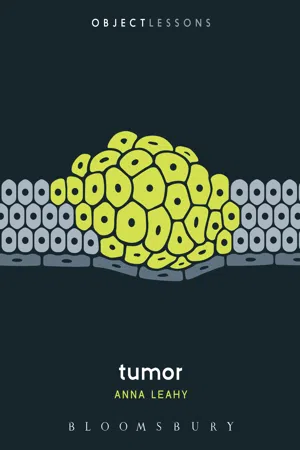
Object Lessons is a series of short, beautifully designed books about the hidden lives of ordinary things.
One in two men and one in three women will develop invasive cancer. Tumors have the power to redefine identities and change how people live with one another.
Tumor takes readers on an intellectual adventure around the attitudes that shape how humans do scientific research, treat cancer, and talk about disease, treatment, and death. With poetic verve and acuity, Anna Leahy explores why and how tumors happen, how we think and talk about them, and how we try to rid ourselves of them.
Object Lessons is published in partnership with an essay series in The Atlantic.
eBook - ePub
Tumor
About this book
Information
1 TUMOR IN THE FAMILY
Mother
Early in 2012, my mother ended up in a hospital emergency room with symptoms indicative of a gallbladder attack. She had no history of gallbladder attacks but had been suffering sporadic nausea, fullness, and general fatigue for several months. The physician who read the x-ray of her abdomen confirmed a possible problem with her gallbladder but told her that it did not require immediate surgery. He told her to see a specialist right away. He was adamant about this referral in a way that got my mother’s attention. In hindsight, we know that he had seen a shadow on her pancreas, an organ tucked near the intestines that produces a juice filled with digestive enzymes and several hormones (such as insulin). The word pancreas comes from the Greek meaning entirely flesh.1 That shadow on the pancreas—on my mother’s internal flesh—turned out to be a tumor, entirely her own tissue but somehow out of character, out of control.
Based on that initial x-ray, the specialist discussed the probability of cancer. After additional imaging, he inserted a lighted tube down my mother’s throat, passed a needle through the tube, and removed cells from the tumor for testing. My mother was officially diagnosed with pancreatic cancer on March 1, when the results of the biopsy of the tumor on her pancreas revealed malignant cells. She was already sure of that diagnosis before then. She had talked with my sister and me about the online research she’d done. She gathered as much information as she could about what the tumor might be, and then she went over all her accounts, assets, and will.
According to the Pancreatic Cancer Action Network, a resource on which my mother, my sister, and I relied in gathering information early on in her illness, the chances of a patient surviving five years after the diagnosis of pancreatic cancer is just 8 percent. That’s actually a recent uptick in survival, but “it is still the lowest survival rate of any major cancer.”2 The chance of surviving a full year from diagnosis is a pitiful 29 percent.3 (It’s even worse in the United Kingdom.4) When my mother read such numbers, she resigned herself to the likelihood that she would be dead within a year, at the age of seventy-two.
The future of pancreatic cancer looks even bleaker than the current state of this disease. Demographic populations change; the population in the United States is getting older, and age is the greatest risk factor for cancer. Treatment options evolve, usually in hopes of decreasing mortality rates, though the advances in treatment for pancreatic cancer seem meager. Incidence rates of this type of cancer are creeping upward, though no one is exactly sure why. And this cancer is often caught too late for existing treatment options to lower the death rate substantially. A study in the journal Cancer Research predicts that deaths from pancreatic cancer will increase “dramatically” and that pancreatic cancer will become the second leading cause of cancer death before 2030, supplanting breast cancer.5
Breast cancer is the most commonly diagnosed cancer in women, accounting for 29 percent of all cancer diagnoses. Women in the United States have a one-in-eight chance of such a diagnosis.6 My mother had been treated for that cancer more than ten years before her pancreatic cancer diagnosis. The tumor in her breast was relatively small and was removed surgically. After recovering quickly from that lumpectomy, she underwent treatment with radiation and then took a daily dose of the oral medication anastrozole to lower her chance of recurrence of breast cancer, since recurrence would have been more threatening than the initial tumor that had been removed and treatment more drastic.
Some cancers are more prevalent in the general population than are others. The incidence rate of breast cancer is much higher than that of pancreatic cancer. The National Cancer Institute estimates a woman’s lifetime risk of developing breast cancer at 12.3 percent,7 whereas a person’s lifetime risk of developing pancreatic cancer is 1.5 percent.8 Many more women will face a breast cancer diagnosis than a diagnosis of pancreatic cancer. The mortality rate—the clinical term for death rate, a reminder of what being mortal means—of breast cancer, however, is much lower because breast cancer is more likely to be detected early, before the cancer has spread, and because treatment for this type of cancer is more effective. So, as cancers go, breast cancer is among the most common, and most people with breast cancer—89 percent—survive at least five years. Overall, 78 percent of breast cancer patients survive fifteen years or more. For someone in my mother’s circumstances when she discovered the small lump, the five-year survival rate is 99 percent.9 While many people—about 41,000 annually in the United States—die of breast cancer,10 those odds are pretty good when it comes to cancer.
A friend who walked in a Race for the Cure event to raise money for breast cancer research a few years ago said that there were too many women to fit in the traditional photograph of survivors. The high incidence rate combined with the increasingly successful treatment of breast cancer has grown to the point that it could no longer be framed. It’s easy to look at the numbers and think that having a small tumor removed from one’s breast is like not having had cancer at all. But one woman in every hundred doesn’t survive her tumor. Women with advanced disease or women with recurrences after the battle had supposedly been won can’t strap on their sneakers and run past the disease.
One type of tumor is not just like another; each cancer has its own madness to its method. The number of deaths for pancreatic cancer is roughly the same as for breast cancer—almost 42,000 annually in the United States—but far fewer people will ever hear that they have pancreatic cancer. The vast majority people who do get that diagnosis do not live long, no matter what treatment they undergo. In a reverse perversity of statistics, 78 percent of breast cancer patients survive fifteen years from diagnosis, but about 80 percent of pancreatic cancer patients are dead in a year. In his Pulitzer Prize-winning book, The Emperor of All Maladies, physician Siddhartha Mukherjee admits how daunting this particular cancer can be for both physician and patient. “Even in oncology, a dismal discipline to begin with, this—unresected pancreatic cancer—was considered the epitome of the dismal.”11Dismal, from the Latin meaning unlucky days, or the days when evil lashes out in your direction. Pancreatic cancer leads to bad days for everyone involved.
Jazz pianist Count Basie, composer Henry Mancini, opera singer Luciano Pavarotti, Pink Floyd’s Syd Barrett, comedian Jack Benny, and actors Ann Francis, Rex Harrison, Pernell Roberts, Ben Gazzara, and Fred Gwynne all died of pancreatic cancer. After a couple of months of abdominal pain in 1991, actor Michael Landon of Bonanza (co-star Pernell Roberts was diagnosed much later) and Little House on the Prairie fame—staples of my childhood television viewing—was diagnosed with pancreatic cancer at the age of fifty-four; he lived less than three months. Bonnie Franklin, star of yet another favorite television show of my childhood, One Day at a Time, died of pancreatic cancer in March 2013, less than six months after the announcement that she was being treated. Actor Patrick Swayze of Dirty Dancing fame was diagnosed in January 2008 and died in September 2009 at age fifty-seven. Julius Carry, a Chicago native who played Bruce Campbell’s best-buddy bounty hunter on The Adventures of Brisco County, Jr. and Sho’nuff in the film The Last Dragon, died of pancreatic cancer in 2008 at the age of fifty-six.
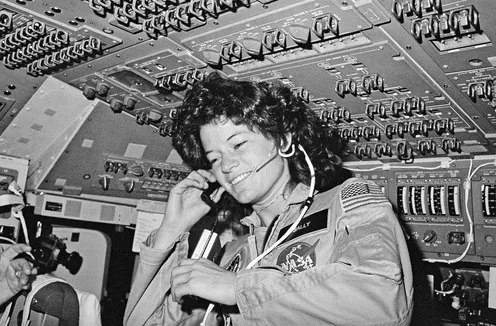
FIGURE 1.1 Mission Specialist Sally Ride on forward deck of space shuttleChallenger on June 21, 1983.
Source: NASA.
Source: NASA.
Sally Ride, the first American woman in space, died the summer my mother was undergoing chemotherapy; Ride had been diagnosed seventeen months earlier. As I wrote this, another space shuttle astronaut, climate scientist Piers Sellers, was diagnosed and decided to spend as much time as he could on his work and with those he loves; he was diagnosed in October 2015 and, the following January, said his prognosis was twelve to eighteen months.12 He died on December 23, 2016, as prognosed.
Carnegie Mellon professor Randy Pausch was diagnosed in 2006 and underwent the Whipple procedure. A year later, he gave his “Last Lecture”—part of a series of previously hypothetical final talks by Carnegie Mellon professors—entitled “Really Achieving Your Childhood Dreams.”13 Pausch’s talk has been watched by more than eighteen million people. In the wake of this sudden popularity, he testified before Congress about funding for cancer research, appeared on The Oprah Winfrey Show and in the film Star Trek, was a “Person of the Week” on ABC’s news, and co-wrote a bestselling book that expanded the lecture. Pausch died at the age of forty-seven, less than two years after his diagnosis.
Apple computer whiz Steve Jobs announced in 2004, when he was forty-nine years old, that he had the lesser of the two evil forms of pancreatic cancer. He kept details of his health as private as possible and had a liver transplant in 2009. He lived until 2011. Supreme Court Justice Ruth Bader Ginsburg had a small pancreatic cancer tumor removed—resected through surgery—in 2009 and was treated for colorectal cancer ten years before that. As of this writing, Ginsburg is still deciding cases at age eighty-three.
As with breast cancer, the best chance of long-term survival of pancreatic cancer is surgical removal of the tumor. The surgery is one of two types. The simpler distal pancreatectomy and splenectomy can be done laparoscopically if the tumor is located at the body or tail of the pancreas. The Whipple procedure is done for tumors located at the head, neck, or uncinate (hooked) process. With the pancreas nestled next to the beginning of the small intestine that leaves the stomach, this operation takes several hours, during which organs and parts of organs are removed, and then what’s left is reconnected in hopes of a semblance of normal life and a slightly higher chance of living longer. However, only 20 percent of those diagnosed with pancreatic cancer are eligible for surgery. Often, a person finds out she has pancreatic cancer only after it has metastasized, or spread elsewhere in the body, when surgical removal of the initial tumor won’t help curb the progression of the disease nor halt the demise of the patient. Even with surgery, the majority of people who have pancreatic cancer do not survive five years. Mukherjee’s patient Beatrice Sorenson, willing to try anything, had undergone surgery, radiation, and chemotherapy to treat the cancer of her pancreas. “But strong or not, there was nothing left to try.”14
My mother’s tumor, to her surprise, appeared to be operable, based on the CT scans, the more nuanced, cross-sectional x-ray imaging via computed tomography. She opted to undergo the drastic Whipple surgery in hopes of living a few years instead of a few months. Statistics, after all, are an extrapolation about the whole population and don’t indicate whether a particular individual in question will live or die within a certain time frame. If the odds can be made better than dismal, why not give it a go?
After the surgeon had opened the abdomen, however, he discovered that the tumor, which was about the length across his closed fist and not as big as the pancreas itself, was attached to a large artery. Though the tumor had not broken through the artery, he could not pry the cancerous mass from that vital blood vessel. He told us that, had it been attached to a vein instead, he would have been able to sever the tumor from its perch and repair the vein. Even though the artery was at risk from tumor invasion, the body often adjusts to the tumor as it grows so that blood is rerouted. But he could not reroute the blood vessel with scalpel and suture. To sever an artery probably would have left the patient—my mother—dead on the table. So, he removed the problematic gallbladder, in case that would ease some symptoms, and closed her belly with the cancer still inside her.
Astronaut Sally Ride’s surgeon must have faced similar dilemmas and disappointments when he performed surgery in October 2011, after several months of chemotherapy and radiation were used to shrink the tumor. Lynn Sherr, in her biography of Ride, notes that the cancer involved more blood vessels than the surgeon expected and that not all the disease could be removed. With pancreatic cancer still inside the body despite the Whipple procedure, the odds remained dismal. Ride’s recovery from surgery was “grueling,” and, within a couple of months, she had lost a lot of weight and wasn’t eating much. After the cancer spread to her bones, Ride underwent additional chemotherapy treatment as well and then radiation, too. By July, “Sally was failing fast.”15Cancer progression involves a process in which the body—the person—fails to thrive.
My mother was failing fast too at that time, though it’s often difficult to track accurately someone’s demise from up close as it’s happening. It’s also difficult to know whether the inability to eat, the nausea, and the diarrhea worsen more from the progression of the disease or from the side effects of the treatment.
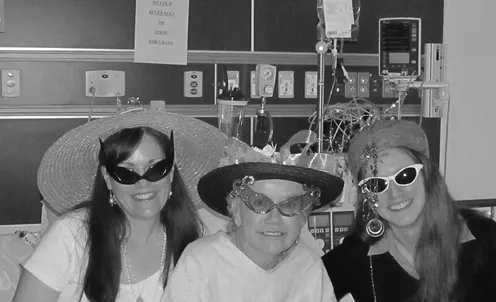
FIGURE 1.2 Brigid (author’s sister), Mary Lee (author’s mother), and Anna Leahy (author) in hospital room. Hats worn for the Kentucky Derby. Note the sign indicating the patient should have no cold beverage or food for five days because of side effects of chemotherapy.
Because my mother’s tumor was likely to irritate nerves nearby as it grew larger and because she had known someone else who’d suffered severe pain as pancreatic cancer progressed, my mother opted to undergo six chemotherapy treatments in an attempt to keep the tumor as small as possible for as long as possible and to put off the use of opioids to which she was allergic. She had no illusions that this treatment would cure her and would not have opted for it solely to extend her life. Chemo—anti-cancer drugs—was administered intravenously and left my mother with a host of side effects, some of which, in hindsight or if we’d been able to see the forest for the trees, might (perhaps should) have led her to stop chemo before the last treatment or two. She chose this option in hopes it would decrease the length and severity of pain at the end of her life, which it likely did. This stopgap undoubtedly also gave her a few extra months of life.
Even so, my mother died on December 12, 2012, slightly longer than nine months after she was diagnosed.
Father
In October 1981, my father felt ill during our family trip to Ireland and, upon arriving back in the Unites States,...
Table of contents
- Cover
- Series
- Title
- Dedication
- Contents
- 1 TUMOR IN THE FAMILY
- 2 TERMS AND CONDITIONS
- 3 SELF/OTHER(S)
- 4 PART AND PARCEL
- 5 INSIDE/OUTSIDE
- Acknowledgments
- Notes
- Index
- Copyright
Trusted by 375,005 students
Access to over 1.5 million titles for a fair monthly price.
Study more efficiently using our study tools.
Frequently asked questions
Yes, you can cancel anytime from the Subscription tab in your account settings on the Perlego website. Your subscription will stay active until the end of your current billing period. Learn how to cancel your subscription
No, books cannot be downloaded as external files, such as PDFs, for use outside of Perlego. However, you can download books within the Perlego app for offline reading on mobile or tablet. Learn how to download books offline
Perlego offers two plans: Essential and Complete
- Essential is ideal for learners and professionals who enjoy exploring a wide range of subjects. Access the Essential Library with 800,000+ trusted titles and best-sellers across business, personal growth, and the humanities. Includes unlimited reading time and Standard Read Aloud voice.
- Complete: Perfect for advanced learners and researchers needing full, unrestricted access. Unlock 1.5M+ books across hundreds of subjects, including academic and specialized titles. The Complete Plan also includes advanced features like Premium Read Aloud and Research Assistant.
We are an online textbook subscription service, where you can get access to an entire online library for less than the price of a single book per month. With over 1.5 million books across 990+ topics, we’ve got you covered! Learn about our mission
Look out for the read-aloud symbol on your next book to see if you can listen to it. The read-aloud tool reads text aloud for you, highlighting the text as it is being read. You can pause it, speed it up and slow it down. Learn more about Read Aloud
Yes! You can use the Perlego app on both iOS and Android devices to read anytime, anywhere — even offline. Perfect for commutes or when you’re on the go.
Please note we cannot support devices running on iOS 13 and Android 7 or earlier. Learn more about using the app
Please note we cannot support devices running on iOS 13 and Android 7 or earlier. Learn more about using the app
Yes, you can access Tumor by Anna Leahy in PDF and/or ePUB format, as well as other popular books in Philosophy & Aesthetics in Philosophy. We have over 1.5 million books available in our catalogue for you to explore.