Henri Bergson is frequently cited amongst the holy trinity of major influences on Modernism-literary and otherwise-alongside Sigmund Freud and William James. Gilles Deleuze's Bergsonism has re-popularized Bergson for the 21st century, so much so that, perhaps, our Bergson is Deleuze's Bergson.
Despite renewed interest in Bergson, his influence remains understudied and consequently undervalued. While books examining the impact of Freud and James on Modernism abound, Bergson's impact, though widely acknowledged, has been closely examined much more rarely. Understanding Bergson, Understanding Modernism remedies this deficiency in three ways. First, it offers close readings and critiques of six pivotal texts. Second, it reassesses Bergson's impact on Modernism while also tracing his continuing importance to literature, media, and philosophy throughout the twentieth and into the 21st century. In its final section it provides an extended glossary of Bergsonian terms, complete with extensive examples and citations of their use across his texts. The glossary also maps the influence of Bergson's work by including entries on related writers, all of whom Bergson either corresponded with or critiqued.
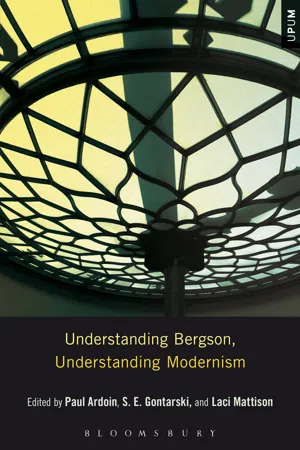
eBook - ePub
Understanding Bergson, Understanding Modernism
- 208 pages
- English
- ePUB (mobile friendly)
- Available on iOS & Android
eBook - ePub
Understanding Bergson, Understanding Modernism
About this book
Information
Part One
Conceptualizing Bergson
1
(Re)Reading Time and Free Will: (Re)Discovering Bergson for the Twenty-First Century
Mary Ann Gillies
In Time and Free Will (TFW),1 Henri Bergson sets the foundation for a philosophy that will help frame fundamental shifts in thought in not one, but two new centuries. In it, he launches a convincing attack on Kantian notions of free will, arguing that “[t]he problem of freedom has thus been sprung from a misunderstanding” of the very concepts which have been used to define the problem in the first place.2 His examination of consciousness challenges how inner states were defined and understood.3 Yet, the book is probably best known for its redefinition of the relations between time and space, particularly for the concept of durée which upends the privileged position that had been accorded to space in both philosophical and scientific renderings of reality.4 TFW launched Bergson into the public eye, durée entered the vernacular of the day, and at the height of his popularity, some would say notoriety, his lectures were standing room only and his advice was sought by statesmen as well as scholars.5 Concepts which were first articulated in TFW continue to resonate with readers well over 100 years after the text’s initial publication, finding a place today in debates about issues as diverse as chaos theory or new media.6
How Bergson approached the problems he addressed and how he created his own nuanced arguments are as central to his body of thought as are the ideas with which he opted to engage. Indeed, as Frédéric Worms writes, “After having dealt with the problem of thought in order to solve other problems (freedom, matter, life, religion), Bergson faces thought itself in order to solve it, so to speak; ‘method’ is thus not a preliminary, but a final step, the highest point.”7 At its core, TFW is a both a challenge that takes aim at the heart of Western intellectual tradition and a model of how we might reshape that tradition. It is, in fact, an exercise in thinking in a new way, one which “neither depends on a point of view nor relies on any symbol,”8 because it requires the reader to exercise a “kind of intellectual sympathy by which one places oneself within an object in order to coincide with what is unique in it and consequently inexpressible” (IM, 6). Thinking is an extended act of intuition, in other words. The method and the concepts are thus inseparable; they are one and the same.
Intuition
Bergson does not define intuition in TFW, although it is the method he introduces and uses throughout. But we can get a sense of what intuition is and how it works from An Introduction to Metaphysics. He begins by identifying “two profoundly different ways of knowing a thing.” The first is “the relative” which “implies that we move round the object” and which “depends on the point of view at which we are placed and on the symbols by which we express ourselves,” and the second is “the absolute” which requires that “we enter into” the object and “neither depends on a point of view nor relies on any symbol” (IM, 1). He goes on to say that the absolute “could only be given in an intuition,” a more effective approach than analysis, which he says “is the operation which reduces the object to elements already known, that is, to elements common to both it and other objects.” “All analysis,” according to Bergson, “is thus a translation, a development into symbols, a representation taken from successive points of view from which we note as many resemblances as possible between the new object which we are studying and others which we believe we know already” (IM, 6–7). To analyze, therefore, is to express a thing as a function of something other than itself. Intuition is the only method able to provide us with absolute knowledge of a thing, and as such it is the approach Bergson employed not only in TFW but throughout his writings.
Intuition was, and still is, seen as a mystifying concept, lacking in logic and relying not on scientific rigor but on some vague form of feeling or empathy. Bertrand Russell was particularly scornful, saying “Instinct at its best is called intuition” and “the division between intellect and instinct is fundamental in his philosophy, much of which is a kind of Sandford and Merton, with instinct as the good boy and intellect as the bad boy.”9 Russell’s ad hominem attack aside, the chief accusation levied against Bergson’s concept of intuition is that it did not satisfactorily account for how intuition could work apart from intellect. On the face of it, this charge may have some validity, given the language Bergson uses in his own definition. However, if we drill down into the actual workings of intuition we can identify two specific components that illustrate how it achieves the necessary rigor and precision: difference and multiplicity.
Elizabeth Grosz remarks in “Bergson, Deleuze, and the Becoming of Unbecoming” that Bergson’s notion of difference proposes a way out of the usual approach to the term as a binary that “has tended to see it as a struggle of two terms, pairs; a struggle to equalize two terms in the one case, and a struggle to render the two terms reciprocal and interchangeable in the other.”10 As she illustrates, Bergsonian difference is not concerned solely with external comparisons between two objects, nor is it occupied with establishing the different components or parts within an object.11 Rather, it is a generative process in which understanding or experience is created moment by moment as each difference unfolds into yet another difference which necessarily shifts our understanding of the object or experience. This becoming/unbecoming is not quite sufficient on its own for Bergson’s purposes, since it does not fully account for the role played by the observer.
John Mullarkey provides us with an explanation of the necessary refinement in what he refers to as Bergson’s “method of multiplicity.”12 Mullarkey, quoting from Bergson’s later work The Creative Mind says, “This, finally, is the method of multiplicity in two short lines: ‘an empiricism worthy of the name . . . sees itself obliged to make an absolutely new effort for each new object it studies. It cuts for the object a concept appropriate to the object alone’ ” (CM, 251). The “method of multiplicity” thus requires that as we track the differences in their unfolding over time, we need to remain flexible and open—allowing the shifts and changes of the unfolding to be reflected in both our approach to each and in our understanding of the object itself. If we combine difference with multiplicity, what we get is Bergson’s intuition: a precise and rigorous method.
Intensity, duration, and freedom
In the “Author’s Preface” to TFW, Bergson concedes that “we necessarily express ourselves by means of words and we usually think in terms of space” and that “this assimilation of thought to things is useful in practical life and necessary in most of the sciences.” He nonetheless asks, “whether, by merely getting rid of the clumsy symbols round which we are fighting, we might not bring the fight to an end” (TFW, xxiii). However, he is not interested in “merely” clearing up symbolic or terminological confusion; rather, he is keenly interested in what lies beneath, and beyond, such confusion. He sees his task as a full-out challenge to the prevailing intellectual paradigm which has resulted in “an illegitimate translation of the unextended into the extended, of quality into quantity” (TFW, xxiii). In each of the book’s three chapters, Bergson takes a central subject and carefully demonstrates the ways in which an “illegitimate translation” occurs which hinders our understanding of it. Consistent with the methods of intuition, Bergson approaches each subject from multiple perspectives, tracing the differences that unfold and adopting multiple vantage points from which to view each difference. The chapters function as an interlocking unit—building on each other and then circling back, requiring us to re-read earlier passages and chapters in light of subsequent material in order to capture the full weight of Bergson’s arguments.
Intensity
In Chapter 1, Bergson starts from the premise that inner states are manifestly different than things that exist in the external world. He argues that the reason we do not distinguish correctly between feelings and objects, for example, is that our conventional way of thinking causes us to “transfer the cause to the effect” and to “replace our immediate impressions by what we learn from experience and science” (TFW, 54). To illustrate the manifest differences between the inner and outer worlds, Bergson introduces three central concepts, which not only support this premise, but which also work together to re-orient our thinking. First, he argues that the main source of confusion arises from our customary practice of thinking about and representing inner states as we would external objects: we use quantity as our frame of reference when we ought to use quality. Second, he distinguishes between differences of degree and differences of kind; the former he associates with quantity, and the latter with quality. Finally, he articulates the crucial concept of qualitative multiplicity, which he employs to describe the nuances of constantly mobile inner states. By the end of the chapter, he not only has established a convincing case for his initial premise—the very real differences between inner states and outer objects—but he has also demonstrated the truth in his contention that we must let go of our habits of conventional thinking if we are to grasp the full reality of our experiences in the moment.
Bergson begins by acknowledging that it is possible to measure objects in the external world, saying that when “we assert that one number is greater than another number or one body greater than another body, we know very well what we mean. For in both cases we allude to unequal spaces . . . and we call that space the greater which contains the other” (2). He is describing the concept of quantity, which can tell us how much we have of something—how big, how many, what weight and so on. What we fail to grasp, Bergson asserts, is that inner states such as sensation or feeling cannot be measured in the same way as objects. We can distinguish between the qualities of sensations, for example—how they feel to us—but we cannot measure those sensations objectively in the way that we can with things external to us.
The slippage in language and thinking results in imposing quantity on inner states and often occurs without our awareness. The example of light and brightness is helpful here. Light is an object in the external world and as such it can be measured by a variety of methods. A 100-watt bulb should give off the same illumination independent of which lamp it is placed in, for example. Brightness, on the other hand, is an individual’s sensory experience of light and can vary depending on a number of factors. The same 100-watt bulb might provide comfortable illumination for reading right now, but feel blindingly bright an hour from now when we are suffering from a headache. The intensity of the bulb has not changed, but the intensity of the experience of it has. What we do that causes confusion is to impose a quantitative magnitude on the different qualitative experiences of light, saying that the light is brighter in the second experience of it—implying that it has increased in magnitude when what has changed is our experience of the light, our sensation of brightness.
Bergson begins the second strand of his argument by suggesting, “Perhaps the difficulty of the problem lies chiefly in the fact that we call by the same name, and picture to ourselves in the same way, intensities which are very different in nature; for example, the intensity of a feeling and that of a sensation or an effort” (TFW, 7). He thus moves his focus to feelings—specifically to the feeling of joy—in order to explore this difference in nature. After exploring the ways one might experience joy, he draws this interesting conclusion: “We thus set up points of division in the interval which separates two successive forms of joy, and this gradual transition from one to the other makes them appear in their turn as different intensities of one and the same feeling, which is thus supposed to change in magnitude.” What, in fact, happens as we experience deep joy is not an increase in magnitude, but “progressive stepping in of new elements, which can be detected in the fundamental emotion and which seem to increase its magnitude, although in reality they do nothing more than alter its nature” (TFW, 11). When we fall in love, for instance, we experience joy; when this joy grows in intensity over time, we might be tempted to ascribe to it a magnitude. However, it is not a singular experience to which magnitude may be added, but rather a number of experiences which interact with each other that create in us a sensation of increasing joy.
He elaborates more fully on this point in his discussion of aesthetic feeling, specifically dance, noting that “the increasing intensities of aesthetic feeling are here resolved into as many different feelings, each one of which, already heralded by its predecessor, becomes perceptible in it and then completely eclipses it” (TFW, 13). When we watch a dancer leap effortlessly across the stage, we are filled with a sense of the gracefulness in the movement. We are drawn into the experience, anticipating each movement as if we knew exactly what path it would take, as if we had choreographed it. Finally, we almost merge with the dancer, for as Bergson suggests, “the regularity of the rhythm establishes a kind of communication between him and us, and the periodic returns of the measure are like so many invisible threads by means of which we set in motion this imaginary puppet” (12). Yet, if we pay close attention to how we feel when we are immersed in watching a brilliant dancer, we see how the intensity comes not from an increase in magnitude, but rather from the accumulation and interpenetration of the sensations and feelings occurring in each moment of the experience. In other words, the increase in intensity occurs not because of a difference in degree—a measurable alteration in one sensation—but because of a difference in kind—we experience “many feelings” in succession which flow together so seamlessly that they appear to be a single feeling.
The third strand in Bergson’s argument emerges from his discussion of affective sensations. After presenting a number of examples—a pin pricking our hand, sound vibrations produced by our vocal chords, the sensations of heat, cold, or pressure on our body, for instance—he concludes, “it will be perceived that the magnitude of a representative sensation depends on the cause having been put into the effect” (47). He extends this observation, providing an alternate way of looking at brightness in his example of the illumination of a sheet of white paper. It is worthwhile quoting his comments at length:
Look closely at a sheet of paper lighted, for example, by four candles, and put out in succession one, two, three of them. You...
Table of contents
- Cover-Page
- Half-Title
- Title
- Copyright
- Contents
- Foreword
- Abbreviations
- Contributors
- Introduction
- Part 1 Conceptualizing Bergson
- Part 2 Bergson and Aesthetics
- Part 3 Glossary
- Index
Trusted by 375,005 students
Access to over 1.5 million titles for a fair monthly price.
Study more efficiently using our study tools.
Frequently asked questions
Yes, you can cancel anytime from the Subscription tab in your account settings on the Perlego website. Your subscription will stay active until the end of your current billing period. Learn how to cancel your subscription
No, books cannot be downloaded as external files, such as PDFs, for use outside of Perlego. However, you can download books within the Perlego app for offline reading on mobile or tablet. Learn how to download books offline
Perlego offers two plans: Essential and Complete
- Essential is ideal for learners and professionals who enjoy exploring a wide range of subjects. Access the Essential Library with 800,000+ trusted titles and best-sellers across business, personal growth, and the humanities. Includes unlimited reading time and Standard Read Aloud voice.
- Complete: Perfect for advanced learners and researchers needing full, unrestricted access. Unlock 1.5M+ books across hundreds of subjects, including academic and specialized titles. The Complete Plan also includes advanced features like Premium Read Aloud and Research Assistant.
We are an online textbook subscription service, where you can get access to an entire online library for less than the price of a single book per month. With over 1.5 million books across 990+ topics, we’ve got you covered! Learn about our mission
Look out for the read-aloud symbol on your next book to see if you can listen to it. The read-aloud tool reads text aloud for you, highlighting the text as it is being read. You can pause it, speed it up and slow it down. Learn more about Read Aloud
Yes! You can use the Perlego app on both iOS and Android devices to read anytime, anywhere — even offline. Perfect for commutes or when you’re on the go.
Please note we cannot support devices running on iOS 13 and Android 7 or earlier. Learn more about using the app
Please note we cannot support devices running on iOS 13 and Android 7 or earlier. Learn more about using the app
Yes, you can access Understanding Bergson, Understanding Modernism by Paul Ardoin, S. E. Gontarski, Laci Mattison, Paul Ardoin,S. E. Gontarski,Laci Mattison in PDF and/or ePUB format, as well as other popular books in Literatur & Französische Literaturkritik. We have over 1.5 million books available in our catalogue for you to explore.